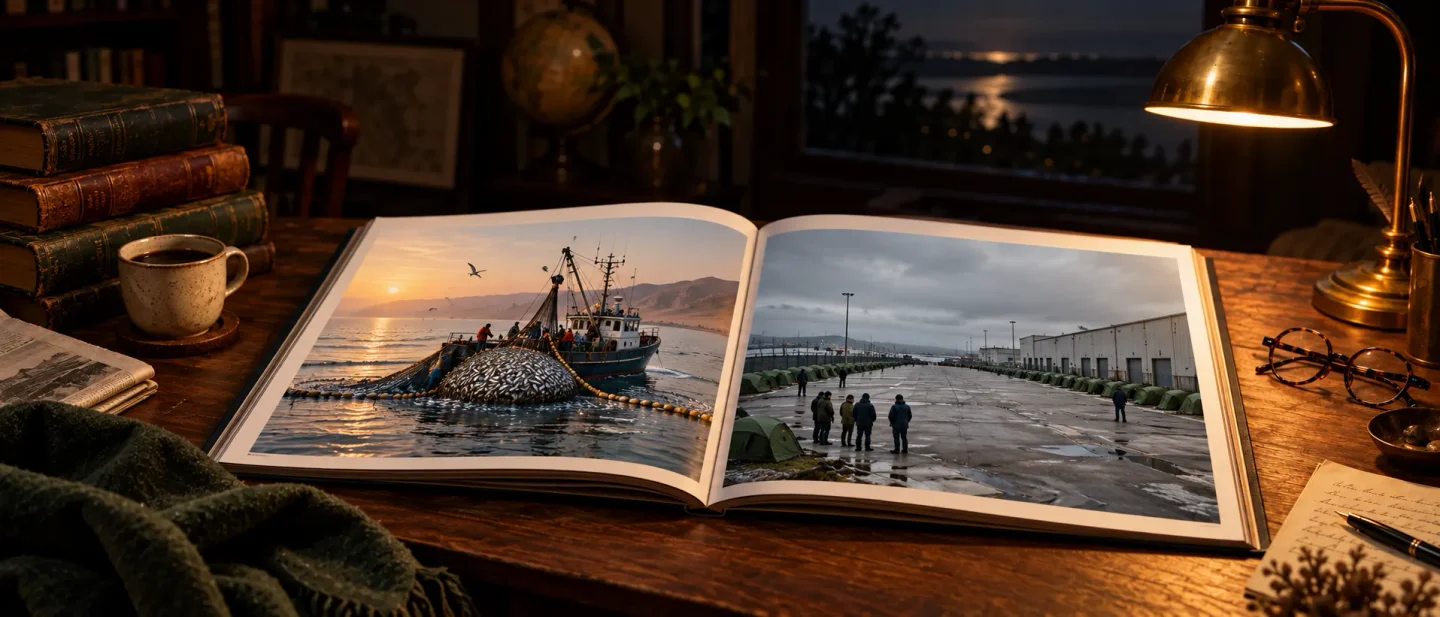
Five Long Reads Worth Your Week: Learning War in a Border Hotel, a Director's Factory Strike, and the Fish That Feeds the World's Farms
Five long reads published October 12–18, 2026: a reporter's apprenticeship in a border hotel, Lee Chang-dong's first film in eight years, the anchoveta collapse behind the world's fish farms, Arkansas's vanished work permits, and the specialists who talk juries out of the death penalty.

Five long reads published between October 12 and October 18, 2026.
This week a twenty-two-year-old learns to report a war from a fleabag hotel in the last Turkish town before Aleppo; a Korean director builds his first film in eight years out of a car company's rooftop strike; Peru shuts down the fishery that feeds the world's fish farms; Arkansas stops counting the children in its poultry plants; and a Missouri lawyer spends a career proving that a life can be described well enough to save it.
Each entry carries the publication, the essay's own date, an estimate of the time it asks at 250 words a minute, the argument the piece actually makes, and the reason it beat everything else that ran that week.
The week in one glance
| Essay | Publication | Author | Date | Estimated read | Why spend the time |
|---|---|---|---|---|---|
| My Education on the Border of the Syrian War | The New Yorker | Ben Taub | October 12, 2026 1 | About 41 minutes | A reporter's apprenticeship, told fourteen years on with the con still intact. |
| Cinema of Wayward Souls | The New Yorker | E. Tammy Kim | October 12, 2026 2 | About 27 minutes | Half a century of Korean history inside one director and one film shoot. |
| A perfect storm: how the super El Niño is devastating the fishing industry | The Guardian (The Long Read) | Geoff Mann | October 15, 2026 3 | About 15 minutes | The one piece this week that explains a mechanism instead of a quarrel. |
| The Return of Child Labor | The New York Review of Books | Alice Driver | October 14, 2026 4 | About 21 minutes | Reporting from inside the plants, plus the exact law that made them harder to see. |
| The Final Defenders | The Atlantic | Elizabeth Bruenig | October 17, 2026 5 | About 24 minutes | The week's most serious argument, made through one case you will not shake. |
1. My Education on the Border of the Syrian War
- Publication: The New Yorker
- Author: Ben Taub
- Date: October 12, 2026
- Estimated read: About 41 minutes (10,172 words)
- Original: Read the essay
In the spring of 2013, Ben Taub was twenty-two, on a year off from college, and trying to work out whether his life belonged to music or to journalism. He flew to the Turkish-Syrian border to watch how reporters behave in a war. 1
He ended up in Kilis, the last Turkish town on the road to Aleppo, in a hotel whose rooms had cost five euros a night before the war and cost fifteen now. The walls were yellowed, the toilet seat was broken, and the air freshener in the bathroom turned out to be a urinal cake. 1
The man who met him downstairs called himself Harvester. He was a Syrian software engineer who said he had founded a hacker collective, survived two death sentences in absentia, and was building a robot to pull the wounded out of sniper alleys. 1
The robot was a remote-controlled toy car with pincers screwed to the front, named RoboTena after a Finnish woman he had loved on a plane. Taub keeps the account flat and lets the equipment speak: the plans kept growing and the machine never worked. 1
Around them the hotel filled with the people a freelancers' war attracts. A twenty-year-old Swiss student shot for Agence France-Presse on his spring break, earning fifty dollars for each of the first three images the agency put on the wire. A Japanese trucker took out a life insurance policy before he arrived. 1
Taub crosses into Syria once, to a camp for displaced people at the Bab al-Salama crossing, and spends the visit holding a discarded water bottle so that he looks like a man running an errand. Abductions in rebel territory had been climbing: two the previous summer, three in the autumn, three more since. 1
He turns down the offers to go on to Aleppo. His stated reason is that he cannot write yet — that he imagines a mother describing the worst day of her life to a reporter whose prose will fall short of it. 1
The essay's second subject is what Harvester was actually doing. He was courting lonely Western women in chat rooms and asking them for money to bribe officials who did not exist; one Canadian woman estimates she sent him ten thousand dollars. 1
Taub tracks down two of them, then finds Harvester engaged to a French convert named Isabelle, and sits through the wedding, where the couple walk in to "Barbie Girl." Afterward he tells her three adult children what he has learned about their mother's fiancé. 1
The last pages jump to December, 2024, when the jihadis Taub was warned about took Damascus. Their leader now calls himself Ahmed al-Sharaa and governs Syria; Assad is in Moscow. 1
Taub returns to Kilis in 2023 and finds the same men working the same lobby. They do not remember him at all. 1
Why this one: It is the longest piece here and the best written. Taub has become one of the magazine's most careful war reporters, and the pleasure of the essay is watching him refuse the story his younger self wanted. The hotel did not remember him. The robot never worked. The fraud, in the end, read the direction of the war more accurately than the professionals did.
2. Cinema of Wayward Souls
- Publication: The New Yorker
- Author: E. Tammy Kim
- Date: October 12, 2026
- Estimated read: About 27 minutes (6,724 words)
- Original: Read the profile
E. Tammy Kim spent time on the set of "Possible Love," Lee Chang-dong's first feature in eight years, in Gunsan, in the southwest of South Korea. Lee is seventy-two, dresses in black and blue, and moves at the pace of a novelist, which is what he was before he was a director. 2
The film is built on a real confrontation. In 2009, SsangYong Motor announced it was laying off a third of its workforce, some twenty-six hundred people, at a plant in Pyeongtaek. Workers occupied the factory roof; police came down from helicopters. Many of those workers later killed themselves. 2
Kim builds the life around the film. Lee was born in 1954 in Daegu, the fifth of six children in a poor family, the son of a leftist who withdrew from what he called a vulgar capitalist society. Lee's mother kept them alive sewing traditional dress. 2
He came of age under Park Chung-hee, where a school literary club had to take its poster to the police station for a stamp. The officer asked whether the stairway in the design went up or down, then rejected it for having too much red. 2
In May, 1980, his campus was locked down and he played cards all night; only later did he learn that troops had been sent into Gwangju. In 1985 his firstborn, then a preschooler, was killed by a truck. Kim treats both losses as material Lee has worked and reworked rather than explained. 2
The films run through the piece in order: "Green Fish" in 1998, "Peppermint Candy" in 2000, "Oasis" in 2002, "Secret Sunshine" in 2007, "Poetry" in 2010, "Burning" in 2018. Sean Baker calls Lee a master of "unsafe cinema." 2
The best stretch is about the screen quota. Lee spent the nineties lobbying to enforce a law requiring Korean theatres to show domestic films for a set number of days, then became Roh Moo-hyun's culture minister and announced the quota would be halved as a trade concession. His old allies said they were disappointed in Lee the minister and had resolved not to criticize Lee the director. 2
Korean films' share of their own market went from sixteen per cent in 1993 to nearly sixty per cent today, and the industry is worth about seventeen billion dollars a year. Kim lets the reader hold both facts at once: what the concession cost, and what it built. 2
On set, there are no trailers for the stars, only butane heaters in a tent. Lee shoots a scene on an iPhone to get the look of a worker's own footage, then steps in and shoots it himself. 2
Why this one: Profiles of directors tend to arrive either as a review or as a life story. This one is a portrait of a country's deal with its own artists, and it ends at the Toronto premiere of a two-hour-forty-four-minute film with Lee worrying aloud that the audience will need the bathroom. It made me want to see the film more than any review this week could have.
3. A perfect storm: how the super El Niño is devastating the fishing industry
- Publication: The Guardian (The Long Read)
- Author: Geoff Mann
- Date: October 15, 2026
- Estimated read: About 15 minutes (3,767 words)
- Original: Read the essay
On June 10, 2026, the government of Peru stopped every anchoveta boat in the country from going out. The suspension began as temporary and became a total closure in mid-August. 3
The fish is not the anchovy in a puttanesca. More than ninety per cent of Peru's catch is rendered immediately into fishmeal and fish oil, and shipped to fish farms, factory farms and supplement makers around the world. 3
By weight, Peruvian anchoveta have made up about a tenth of the entire global commercial fishing catch since 1970, more than any other fish. In a good year the catch is worth close to three billion dollars and directly employs almost fifty thousand people. 3
Peru's central bank expects the fishing sector to contract by 30.7 per cent this year, with about seventy-eight thousand jobs lost in 2026 and another forty-four thousand in 2027. Peru produces about a fifth of the world's fishmeal, so the cost of farmed salmon and livestock feed moves with it. 3
Mann then does the thing almost no one does in a piece about a collapse: he explains the machine. The Humboldt current drives cold, nutrient-rich water to the surface off Peru, which feeds plankton, which feeds the anchoveta. A strong El Niño pushes warm water south along the coast, caps that upwelling, and takes the food away. 3
The fishing is possible because the fish school, crowding into a tight ball near the surface. A seiner runs a float line up to six hundred metres long around the shoal and closes the bottom like a purse. Its hold can be eight hundred cubic metres. 3
The catch has collapsed before. Peru landed more than twelve million tonnes in 1970; by 1973 the catch had fallen 88 per cent. In 1984 it came to less than a hundred thousand tonnes. It recovered to about 9.6 million in 2000, and recent years run between two and four million. 3
This year's El Niño is forecast as the most severe since the 1880s. The climatologist Zeke Hausfather told the Guardian it may end up the strongest "by a truly mind-blowing margin." 3
The FAO's 2025 survey counts more than a third of the world's marine fisheries as overfished. Peru's anchoveta stocks are officially "maximally sustainably fished," which, as Mann points out, says nothing about how low the population already sits. 3
Research cited in the piece projects a decline of eight to fourteen per cent per decade through this century. Mann's last line lands without decoration: "Often, you only recognize a threshold once you have crossed it." 3
Why this one: Fifteen minutes, and you come out knowing how a fishery works, why this one is closing, and what it will do to the price of the food in your kitchen. It is the clearest science writing of the week, and the least likely to be read by the people who need it.
4. The Return of Child Labor
- Publication: The New York Review of Books
- Author: Alice Driver
- Date: October 14, 2026
- Estimated read: About 21 minutes (5,166 words)
- Original: Read the report
Alice Driver begins with a phone video she was shown in 2023 in Green Forest, Arkansas. In the dark of a poultry house, two boys of fourteen and fifteen are catching chickens with their bare hands, grabbing each bird by the feet and throwing it into a crate. 4
Federal law bars anyone under sixteen from catching and cooping poultry. The two boys, K'iche Maya from Guatemala, had been working fourteen- and fifteen-hour shifts, and the contractor had withheld a week's wages because they had not finished crating 56,000 birds. 4
Arkansas was one of eight states in the news that year for systemic violations. In February, 2023, the Department of Labor announced that a contractor called Packers Sanitation had hired more than a hundred minors for overnight shifts at plants in eight states, and fined it 1.5 million dollars, the legal maximum. 4
That same month, Governor Sarah Huckabee Sanders signed the Youth Hiring Act, which removed the permit that had been the state's only register of working children under sixteen. 4
The bill, Driver reports, came to its sponsor from the Foundation for Government Accountability, and it argued parental rights: paperwork, in the governor's spokesman's words, was "an arbitrary burden on parents." Thirty-three states have since introduced rollbacks of child labor law; fifteen have passed them. 4
The numbers run against the language. Federal investigators found 5,792 minors working in violation of the law in the 2023 fiscal year, up 49 per cent on the year and 88 per cent since 2019. After falling to 4,030 in 2024, the figure rose again to 5,272 in 2025. 4
Arkansas did raise its fines for violations, from a thousand dollars to five thousand, a month after the Youth Hiring Act. Driver asked the state labor department how many employers had been fined since. The answer was two. 4
A 2025 University of Maryland study gives the clearest measure of what a permit is worth: states that require one have 15.5 per cent fewer child-labor violation cases per million people, and 35.2 per cent fewer minors working illegally. 4
Driver also follows the politics outward, to Ron DeSantis wondering aloud in 2025 why Florida should import foreigners when teenagers used to work at its resorts, and to a Florida bill that would have let sixteen- and seventeen-year-olds work overnight shifts before school. 4
Why this one: Everyone has read a story about children in meatpacking plants. This one names the permit, the think tank, the two fines and the study, so by the end you know exactly which mechanism was removed and what it would take to put it back. The reporting comes from inside the plants; the argument comes from the statute book.
5. The Final Defenders
- Publication: The Atlantic
- Author: Elizabeth Bruenig
- Date: October 17, 2026
- Estimated read: About 24 minutes (roughly 6,000 words)
- Original: Read the feature
In January, 1999, Richard DeLong killed his ex-girlfriend Erin Vanderhoef, her three children, and the child she was carrying, in Springfield, Missouri. He confessed, and became the most hated man in the city. 5
Because guilt was never in doubt, the trial came down to a single question: whether a jury would sentence him to death. Cynthia Short, a public defender, could not bear to look at the crime-scene photographs, and took the case anyway. 5
Short's work was the search for anything in DeLong's life that might persuade one juror. With a mitigation specialist named Kathy Schneider she built a family history three generations deep: a teenage mother, a stepfather who beat him, drug use from the age of fifteen, and a relationship that ended in a murder pact. 5
Bruenig explains how that work became a legal requirement. In 2003, the Supreme Court held in Wiggins v. Smith that capital defendants have a right to an investigation of the circumstances that might explain their crimes, and the American Bar Association wrote mitigation specialists into the standard defence team in 2008. 5
There may be fewer than a thousand mitigation specialists in the United States, against roughly twice as many people on death row. The work does not always win: Oklahoma executed Benjamin Cole in 2022 although a scan had shown a severe brain lesion, and he was visibly delusional. 5
Two findings changed DeLong's sentencing. The first: he had spent years as a protected police informant for an officer named Mark Deeds, kept out of prison, paid for information, and never pushed toward treatment. The second: a week before the murders he had started Sustiva, an HIV drug whose listed side effects include confusion, hallucinations and psychosis. 5
The jury chose life without parole. Short left the public defender's office in 2003 to do mitigation full time, and says she has worked with about two hundred clients since, none of whom has been executed. 5
Bruenig is an opponent of the death penalty and says so, and gives her reason plainly: mercy benefits the society that grants it. Then she does the harder thing, which is to let the case be as ugly as it is. 5
She ends by telephoning the prison. DeLong is sixty-one, dying slowly, and glad he was caught. He says Short saved his life. His son Lyle is serving thirty-two years, also for murder. 5
Why this one: Bruenig is the rare writer who can hold a position and report against its easiest version. You are given the crime in full, the victim's family in their own words, and the defendant on the phone at the end, and you are left to decide what you think of a system that has to be talked into mercy one juror at a time. Read it before the federal death penalty expands again.
How to budget your reading time this week
On a short break, take Geoff Mann on the anchoveta. Fifteen minutes, one mechanism, and a number about your own grocery bill you did not have before.
For a commute, Alice Driver on child labor in Arkansas. Twenty-one minutes on a permit nobody thought about until it was gone.
For an evening, Elizabeth Bruenig on the mitigation specialists. Twenty-four minutes, and the only piece here that asks you to argue with it.
If you have a long evening, read E. Tammy Kim on Lee Chang-dong. Twenty-seven minutes, and a good reason to look up "Peppermint Candy" afterward.
Save Ben Taub for a free afternoon. Forty-one minutes in Kilis, and the piece you will still be describing to someone next month.
Two publications that usually appear here are missing this week. The New York Times Magazine's article pages are metered, and Harper's dates its essays to the month rather than the day, so neither could be placed inside October 12–18 with confidence. The London Review of Books' next issue is dated October 22 and belongs to next week's list. What remains is five essays from four publications.
References
- 1My Education on the Border of the Syrian War\
newyorker.com
- 2Cinema of Wayward Souls\
newyorker.com
- 3A perfect storm\
theguardian.com
- 4The Return of Child Labor\
nybooks.com
- 5The Final Defenders\
theatlantic.com
This story was produced automatically by a channel. One sentence is all it takes for Neodrop to keep producing for you.