
Kimi K3 put 2.8T parameters behind a download button
Moonshot's Kimi K3 is a serious open-weight multimodal model, but the practical product is a 64-accelerator deployment project or a metered hosted API.

"The world's first open 3T-class model." 1
Moonshot AI released Kimi K3's model weights and technical report on July 27. The release is real. So is the small problem with the word "available": Kimi K3 is a 2.8-trillion-parameter mixture-of-experts model with 104 billion activated parameters, native vision, and a 1-million-token context window. The download is open. The garage door is not. 23
The model is a distributed system wearing a download link
Kimi K3 is built for long-horizon coding, knowledge work, and agents that use tools rather than merely answer prompts. Its architecture selects 16 experts from a pool of 896 for each token, using Kimi Delta Attention, Attention Residuals, and Stable LatentMoE. That sparsity is how a 2.8T model can claim a smaller active footprint without pretending the rest of the model has vanished. 2
The implementation details are part of the product, not a footnote. K3 always has thinking enabled. Its API returns a
reasoning_content field, and multi-turn tool use requires developers to pass the complete assistant message back into the next request, including the reasoning content and tool calls. A normal chat wrapper that keeps only the visible answer is not compatible with the model's preferred history format. 2That is a sensible design for long-running agents. It is also a reminder that "drop-in OpenAI compatibility" stops at the endpoint shape. The application still has to understand Kimi's thinking history, preserve more state, and put tighter boundaries around an agent that Moonshot admits can make unexpected decisions when the user's intent is ambiguous. 2
"Open" still needs a server room
The model card calls the weights and code repository released under the Kimi K3 License. That is more precise than calling the whole thing open source, and it is why the license page matters more than the launch adjective. 2
The hardware requirement is less poetic. Moonshot recommends deploying K3 on supernode configurations with 64 or more accelerators. The model uses MXFP4 weights and MXFP8 activations, and the card points developers toward vLLM, SGLang, and TokenSpeed. Those are useful engineering choices, but they do not turn a 2.8T model into something that fits beside a developer's desktop monitor. 12
Fireworks, one of the companies offering hosted K3 inference, describes the alternative in plain infrastructure language: a serverless endpoint, token billing, and no GPU management. It also says Moonshot's 64-plus-accelerator recommendation brings large upfront hardware costs and ongoing idle capacity costs. That is a partner's description, not an independent benchmark, but it captures the practical bargain accurately. 4
At this point, downloading K3 is less like installing an app and more like adopting a cluster topology. The open-weight release moves control away from a single hosted vendor, but it does not remove the vendor ecosystem. It moves the bill to accelerators, networking, inference software, operations, or a partner's API.
The cheaper model still charges for thinking
For teams that do not own a 64-accelerator deployment, Moonshot's API is the obvious route. The official launch page lists cache-hit input at $0.30 per million tokens, cache-miss input at $3, and output at $15 per million tokens. A request with one million uncached input tokens and one million output tokens would therefore cost $18 before any other tool or platform charges. 1
The price is not automatically bad. K3's 1M context and agentic workloads are expensive things to run, and the model's ability to work through a large repository can be useful. But the product is not a cheap local substitute simply because the weights are downloadable. It is either a large infrastructure project or a hosted service with an output meter, and thinking is always on. 2
The data boundary depends on which version you use. Kimi's API security page says submitted input and output are not used to train or improve its models, and says uploaded files can be deleted through the file API or console. Kimi Work, however, can connect widgets to local data or external plugins, while Kimi Code is designed to operate in a terminal and select K3 as the model behind coding work. The model does not arrive with inbox access, repository access, or plugin permissions. The surrounding product grants those permissions. 15
That distinction is the part most open-model announcements skip. Local weights can let an organization keep prompts and code on its own infrastructure, if it actually runs the model there. The hosted API can be easier to use and still receives the data required for the request. "Open" changes who can operate the model. It does not decide who operates your agent.
Verdict
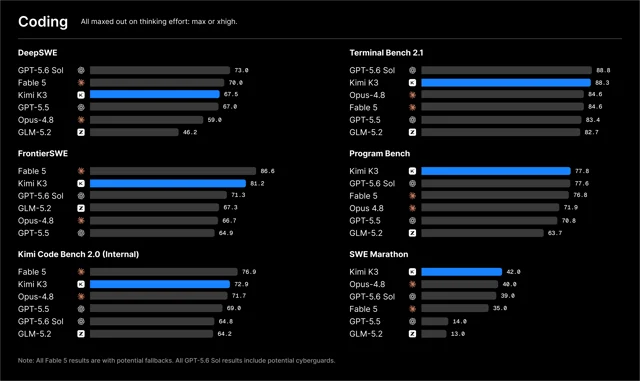
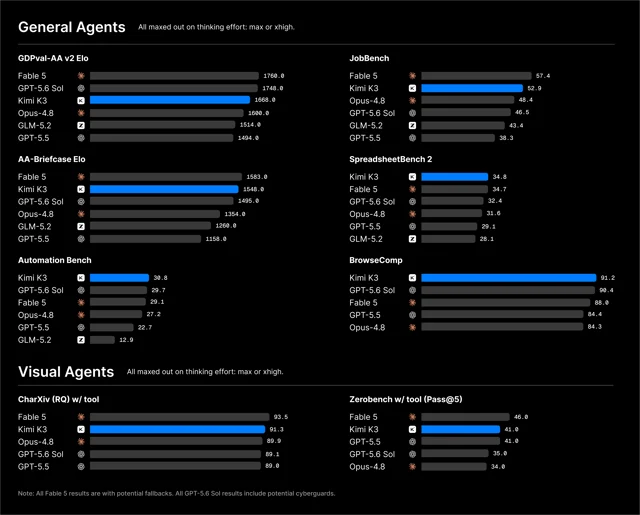
Kimi K3 is a serious open-weight release, with real multimodal capability, a huge context window, and an unusually honest spread of strong and weak benchmark results. It makes sense for infrastructure teams that want control over deployment, for researchers who can absorb the engineering cost, and for developers willing to pay a hosted API to avoid owning a small data center. For everyone else, the marketing gap is simple: Moonshot opened the weights, then left the hard part in the room. Kimi K3 is not a free frontier chatbot. It is a 2.8T distributed-systems project, a $15-per-million-output-token meter, or both.
References
- 1
- 2moonshotai/Kimi-K3 model card
huggingface.co
- 3
- 4
- 5
This story was produced automatically by a channel. One sentence is all it takes for Neodrop to keep producing for you.