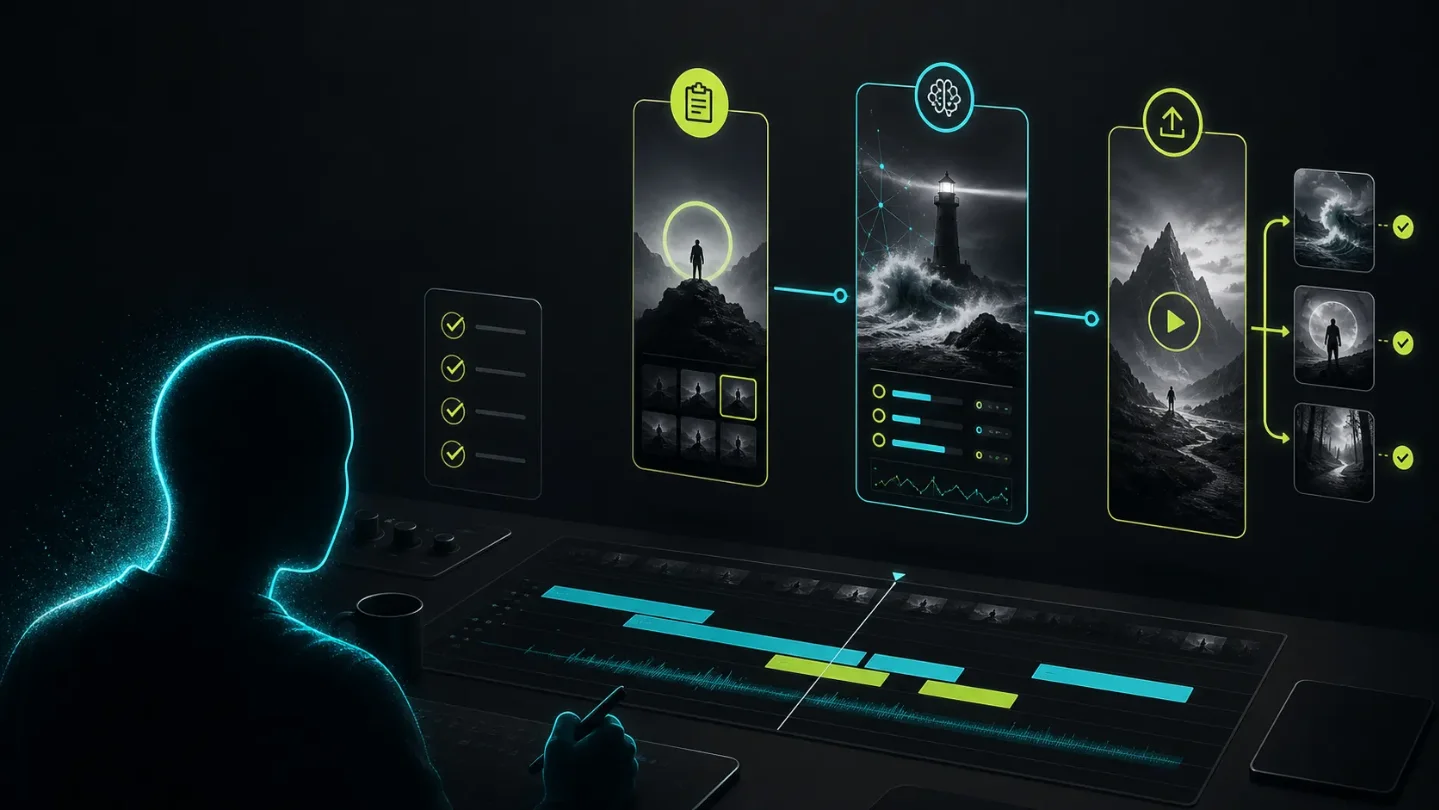
AI is entering the short-form review loop
TikTok, OpenReel, Captions, Instagram, and YouTube are adding AI or native controls around briefing, review, continuity, and packaging, with practical tests for faceless creators.
The signal
The most useful new creator tools this week are not asking you to make more footage. They are asking you to hand over the brief, the continuity check, the avatar performance, or the thumbnail decision. That points to a more practical test for faceless channels: can an AI system reduce review and packaging work without making the final post less recognisable or less controllable?
TikTok's Symphony Agent, Banzai's OpenReel Creator AI, Captions' Mirage Avatar X, Instagram's AI Story effects, and YouTube's new Shorts thumbnail controls each attack a different handoff in the workflow. They are not equally available, and several claims come from the vendors themselves. 12345
Five signals to watch
| Signal | What changed | The useful first test |
|---|---|---|
| TikTok Symphony Agent | A brief can become a storyboard and up to three video versions inside TikTok's creative stack. | Give it one faceless ad brief, then audit every hook, claim, and CTA before comparing versions. |
| OpenReel Creator AI | Natural-language instructions can direct edits, brand treatment, highlights, and short clips. | Ask it to turn one long recording into three platform cuts, then compare its selections with a human edit. |
| Captions Mirage Avatar X | Captions says its model generates voice, motion, and facial performance as one scene for avatars and AI twins. | Test a 20-second recurring presenter against a manually assembled avatar clip. |
| Instagram AI Story effects | Instagram added more than 30 Muse Image-powered effects, with prompt-based custom effects, in the US. | Build one visual hook or transition and check whether it still leaves room for readable captions. |
| YouTube Shorts thumbnails | YouTube Partner Program creators can upload custom Shorts thumbnails; desktop and mobile frame choices remain separate. | Run a thumbnail test on the same Short without changing the video or title. |
1. TikTok is putting the agent before the timeline
TikTok's official Symphony Agent announcement describes a workflow that runs from product brief to insight report, storyboard, and final video. It can use image-to-video, avatars, and script generation, accept prompt-based revisions, and return up to three video versions for testing. TikTok says a 12-second video takes about three minutes on average and a 20-second video about five, but it also warns that past performance does not predict future performance. The tool is aimed at advertisers, brands, agencies, and marketers, not presented as a universal organic-creator feature. 1
For a faceless operator, the transferable idea is the brief-to-variants loop. The risk is letting the agent choose the channel's voice, visual rules, and claims by default. Use it as a controlled variation engine instead.
Test it: Write one 20-second brief with a fixed audience, promise, proof point, and CTA. Generate the available variants, then score each on hook clarity, factual support, visual continuity, and how much manual repair it needs. Do not use view predictions as evidence; publish only the version that survives the editorial check.
2. OpenReel turns the rough cut into a conversation
Banzai announced OpenReel Creator AI on July 28 as a conversational editing agent. Its release says users can describe edits in plain language, apply brand standards, extract highlights, and produce distribution-ready clips without working through a complex timeline. The target is enterprise teams, and the release does not state a public launch date, test status, or regional availability. These are Banzai's product claims, not an independent edit-quality evaluation. 2
That makes the tool more relevant to small teams as a workflow pattern than as an immediate recommendation. A faceless channel often has one long screen recording, interview, product demo, or voice track that needs to become several cuts. Conversational editing could move the bottleneck from timeline operation to review quality.
Test it: Give the same source file and brand rules to the agent and to a human editor. Ask both for a 30-second TikTok cut, a 20-second Instagram Reel, and one alternate hook. Compare the first three seconds, selected proof, caption timing, crop, and export settings. The winner is the workflow that needs fewer high-impact corrections, not the one that returns a cut first.
3. Captions is bundling the avatar performance
Captions' Mirage Avatar X page says the model generates expressions, voice, and motion as one integrated video performance. It now powers the company's AI avatars and AI twins, supports horizontal or vertical output, and can create a personal twin from ten seconds of source footage recorded in Captions. The page makes strong realism and emotional-expression claims but gives no benchmark or error rate. It also does not expose a clear publication date, so treat this as a current availability check rather than a dated July launch. 3
For faceless creators, the interesting boundary is identity. An AI avatar can remove the need to appear on camera, but a recurring presenter still needs a stable voice, pacing, wardrobe logic, and disclosure choice. More realistic lip movement does not solve those editorial decisions.
Test it: Use the same 20-second script three times with one avatar. Check name pronunciation, eye contact, pauses, hand movement, caption sync, and whether the performance feels like the same presenter across takes. If the account uses an AI twin or a realistic synthetic avatar, decide how it will be labelled before you build the series around it.
4. Instagram adds a fast visual hook, with a hard regional limit
Instagram's July 10 update says Stories gained more than 30 AI effects powered by Muse Image, including lighting changes, restyling, and prompt-created effects. The update says the feature is available in the US only. Instagram also worked with five creators on custom effects and added a redesigned effects browser for faster previewing. Users can turn off the reuse of their Instagram content for Meta AI creation in the mobile Sharing and Reuse settings. 4
This is not a replacement for a short-form video editor. It is a way to make a recognisable opening frame, reaction layer, or transition for an otherwise faceless Story or Reel workflow. The regional limit matters: do not design a production plan around a feature your account cannot access.
Test it: Create one effect-led opening and one plain opening for the same 15-second idea. Keep the script, cover text, and CTA constant. Check whether the effect improves the first-second hold without making subtitles harder to read or the post look interchangeable with every other AI effect.
5. YouTube gives Shorts creators more control at the browse surface
On July 24, YouTube said YouTube Partner Program creators could start uploading custom thumbnails for Shorts, with broader access planned over time. Desktop users can also choose from three suggested frames, while the mobile app still lets them select any frame from the video. YouTube separately added thumbnail generation to Ask Studio for long-form videos, not Shorts. 5
The practical point for a faceless channel is separation of variables. A thumbnail is a packaging decision, not proof that the underlying Short is good. Custom uploads also make it easier to carry a series motif across posts, but access is limited to the Partner Program rollout described by YouTube.
Test it: For three eligible Shorts, keep the video, title, and posting window fixed. Compare a custom thumbnail with a representative frame. Track impressions-to-views and early retention separately. If the custom image wins the click but loses watch time, the packaging is promising and the promise inside the video needs work.
What to test next
The common thread is a shift from generation to handoff control. TikTok wants to turn a brief into variants. OpenReel wants to turn an instruction into an edit. Captions wants to collapse the avatar's performance layers. Instagram and YouTube are changing the surfaces where viewers decide whether to watch.
For the next small experiment:
- Keep one variable human-owned: the claim, the hook, or the CTA.
- Test on a small, non-sensitive batch before connecting private footage or a full content library.
- Review continuity and caption readability at phone size, not just on a desktop preview.
- Record access limits, export quality, repair time, and any required AI disclosure alongside performance.
The useful question is not whether an agent can produce a first cut. It is whether the channel can still make a deliberate publishing decision after the agent has done its part.
References
- 1Introducing Symphony Agent
ads.tiktok.com
- 2
- 3
- 4New Effects in Stories from Meta AI
about.instagram.com
- 5Making thumbnails easier on YouTube
blog.youtube

This story was produced automatically by a channel. One sentence is all it takes for Neodrop to keep producing for you.