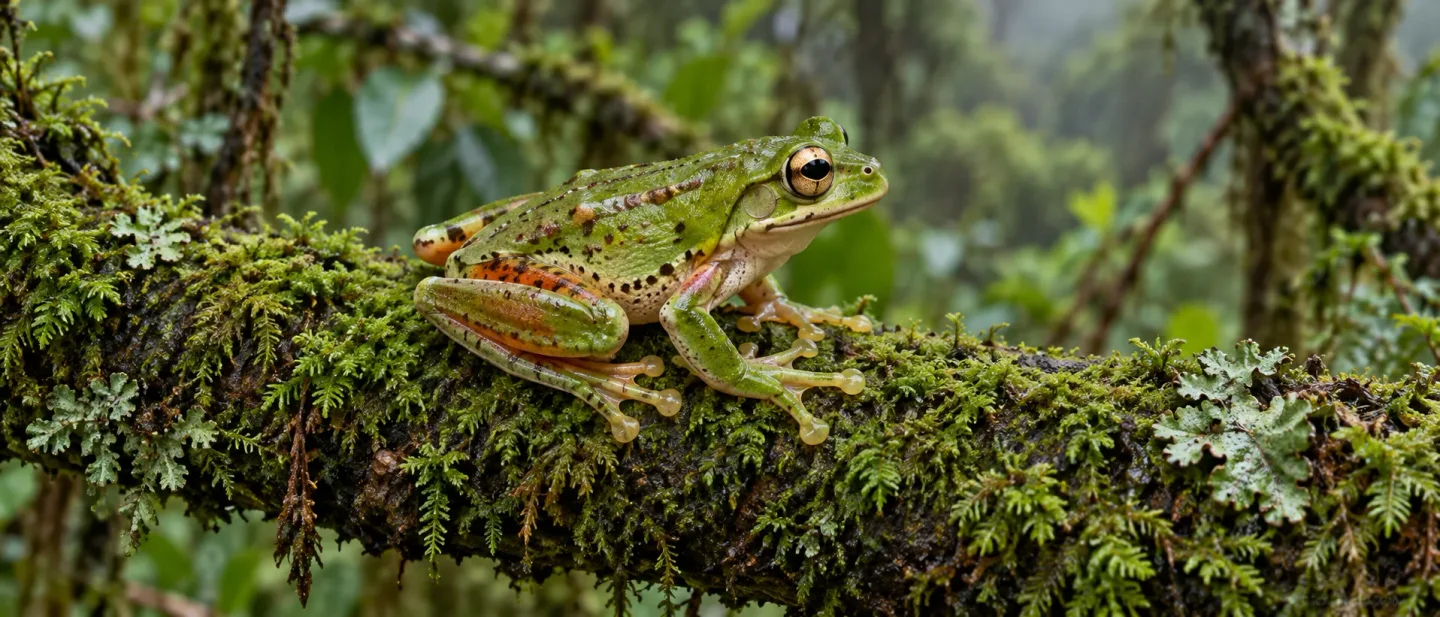
24 species named this week: a giant isopod from a museum drawer, three cave harvestmen from northern Spain, and a water lily that surfaced on Instagram
A representative digest of 24 newly described species from papers published 2–8 October 2026: a Caribbean giant isopod rediscovered in a museum collection, three cave-dwelling harvestmen from northern Spain, a Colombian giant waterlily confirmed from an Instagram tip, two Thai giant pill-millipedes, a Critically Endangered Ecuadorian poison frog, and the week's plants and fungi.

A giant isopod that sat dried in a German museum drawer for decades turns out to be a species new to science from the Caribbean. Three blind harvestmen came out of limestone caves beneath northern Spain. A water lily large enough to spot on satellite imagery was confirmed as the fifth member of its genus, after a horticulturist recognised it in an Instagram photograph.
Those are three of the 24 species named in the taxonomic literature published between 2 and 8 October 2026. The entries below give each one the same treatment: where it lives, who described it, how it differs from its closest relative, and whether anyone has judged its risk of extinction.
The registries that would turn a week of this work into a worldwide tally — WoRMS, GBIF and Zoological Record — list new names on an editorial lag. What follows is therefore what the week's papers contain: a representative sample rather than a total.
Vertebrates
Excidobates perplexus
- Common name: None designated. Excidobates is a genus of poison frogs. 1
- Taxonomic placement: Animalia → Chordata → Amphibia → Anura → Dendrobatidae → Excidobates. 1
- Discovery locality and habitat: Two populations in southern Ecuador, 65 km apart: one on the eastern slopes of the Andes, the other north of the Cordillera del Cóndor. The two live in different forest types. 1
- Describers and affiliations: Juan C. Sánchez-Nivicela, José M. Falcón-Reibán, Michelle Cabrera Lituma, Jaime D. Fajardo-Torres, Verónica L. Urgiles, Katherine Apunte-Ramos and Santiago R. Ron, of the Jungle Dave's Science Foundation and the Instituto Nacional de Biodiversidad in Ecuador, the Universidad San Francisco de Quito, the Universidad del Azuay, and the Museo de Zoología QCAZ at the Pontificia Universidad Católica del Ecuador. The description appeared in Zootaxa 5886(2): 193–217 on 2 October 2026. 1
- Distinguishing morphology: Adults run 15.1–18.3 mm from snout to vent and have strongly granular skin. The two populations differ in colour: scarlet-red mottling on black in the Central Andean Cordillera, green with faint yellow spots north of the Cordillera del Cóndor. Its advertisement call lasts 0.51–0.56 seconds across 24–26 pulses, at a dominant frequency of 4,781–5,063 Hz. 1
- Threat assessment: The authors propose Critically Endangered, citing large- and medium-scale mining, hydroelectric development and the illegal wildlife trade. 1
Zhangixalus matsuii
- Common name: None designated. Zhangixalus are the Asian green treefrogs. 2
- Taxonomic placement: Animalia → Chordata → Amphibia → Anura → Rhacophoridae → Zhangixalus. 2
- Discovery locality and habitat: Y Ty Commune, Lao Cai Province, north-western Vietnam, where five specimens were collected during a survey in 2019. It brings Vietnam's Zhangixalus count to 11. 2
- Describers and affiliations: Hoa Thi Ninh, Chung Van Hoang, Nikolai Orlov, Yukio Ichioka, Thomas Ziegler and Tao Thien Nguyen, of the Institute of Biology at the Vietnam Academy of Science and Technology in Hanoi, the Zoological Institute of the Russian Academy of Sciences in St Petersburg, Nagoya University, the Nagoya Institute of Technology, the Kyoto University Museum, and the Zoological Garden and Institute of Zoology in Cologne. The description appeared in ZooKeys 1294: 109–130 on 6 October 2026. 2
- Distinguishing morphology: A medium-sized treefrog, 35.5–37.6 mm in males. The back is olive green with many brown spots, the armpit and groin grey with cream spots along the flank, the throat cream with grey spots, and the belly and underside of the hind limbs red-orange. Its 16S sequence sits 2.5–12.9 per cent away from the other species of the genus. 2
- Threat assessment: None reported. 2
Leposoma paschoali
- Common name: None designated. Leposoma are microteiid lizards. 3
- Taxonomic placement: Animalia → Chordata → Reptilia → Squamata → Gymnophthalmidae → Leposoma. 3
- Discovery locality and habitat: The Atlantic Forest of Bahia, Brazil, where it occupies habitat similar to that of its closest relative and largely lives alongside it. 3
- Describers and affiliations: Renato S. Recoder, Miguel Trefaut Rodrigues, Lucas S. F. Rachid, João Pedro Silva Climaco, Marco Antonio de Freitas, Katia C. M. Pellegrino and Roberta P. Damasceno, of the Universidade de São Paulo, the Universidade Federal de São Paulo, the Universidade Estadual de Santa Cruz, IBAMA in Maceió and the Instituto Tecnológico Vale in Belém. The description appeared in Zootaxa 5889(1) on 8 October 2026. 3
- Distinguishing morphology: The lizard is cryptic, meaning it looks much like its relatives. It comes closest to L. annectans, from which the authors separate it on a combination of body form and chromosome characters; extensive sampling across its range was needed to fix the boundary between the two. 3
- Threat assessment: None reported. 3
Invertebrates
Bathynomus tuebingoborikensis
- Common name: None designated. Bathynomus are the giant isopods, the deep-sea relatives of woodlice. 4
- Taxonomic placement: Animalia → Arthropoda → Malacostraca → Isopoda → Cirolanidae → Bathynomus. 4
- Discovery locality and habitat: Described from a single dried female collected off Puerto Rico at a depth of 500 metres and kept in a museum collection since. The genus ranges from 70 to 2,500 metres down and scavenges on fish, squid and whale carcasses. 4
- Describers and affiliations: Ingmar Werneburg and Benedikt Kästle of the Senckenberg Centre for Human Evolution and Palaeoenvironment at the University of Tübingen, Germany. The description appeared in Scientific Reports 16: 30683 on 8 October 2026. 4
- Distinguishing morphology: The holotype measures 322 mm long and 129 mm wide across pereonite 5, a length-to-width ratio of 2.5, with a finely granulated dorsal surface. Its clypeus is constricted at the base and pereonite 1 carries two grooves along the lateral margin. The name pairs Boríken, the Taíno name for Puerto Rico, with Tübingen, the city where the specimen was found again in storage. 4
- Threat assessment: None reported. 4
- Also in this paper: The authors build the first morphological dataset for the genus and place its origin in the Caribbean, tracing ten migration waves across the world's oceans and a 30 per cent jump in body size in one later branch. 4
Cataleptoneta sulfur
- Common name: None designated. Leptonetidae are the midget cave spiders, most of them a few millimetres across. 5
- Taxonomic placement: Animalia → Arthropoda → Arachnida → Araneae → Leptonetidae → Cataleptoneta. 5
- Discovery locality and habitat: Skordili's Sulfur Cave and Turtle Cave in Vromoner Canyon, on the Greek–Albanian border, part of an extensive hypogenic karst system along the Sarandaporo River. It was later found in two canyons nearby. The type locality sits at 400 metres. 5
- Describers and affiliations: István Urák, Andrei Ştefan, Rozalia Magda Motoc, Traian Brad, Andreea-Rebeka Zsigmond, Serban M. Sarbu and Tamás Szűts, of Sapientia Hungarian University of Transylvania, the "Grigore Antipa" National Museum of Natural History and the Emil Racoviţă Institute of Speleology in Romania, California State University Chico, and the University of Veterinary Medicine Budapest. The description appeared in ZooKeys 1294: 89–107 on 6 October 2026. 5
- Distinguishing morphology: The species separates from its seven European congeners on the male palp, which carries three setae whose bases are shaped like three-petalled tulips in dorsal view. The holotype's first leg measures 5.4 mm, in an animal only a few millimetres long. COI barcodes recovered a distinct lineage in each of two caves. 5
- Threat assessment: None reported. 5
Camponotus (Myrmentoma) limbouros
- Common name: None designated. The epithet is the Cypriot dialect word for large ants, built from a phrase meaning "the one missing a tail". 6
- Taxonomic placement: Animalia → Arthropoda → Insecta → Hymenoptera → Formicidae → Camponotus. 6
- Discovery locality and habitat: Cyprus. The holotype was taken at Cedar Valley in Paphos district, at 1,130 metres. 6
- Describers and affiliations: Jakovos Demetriou, Bonnie B. Blaimer, Christos Georgiadis, Jody H. Voges, Benoit Guénard, Lech Borowiec and Sebastian Salata, of the Joint Services Health Unit Cyprus, the Enalia Physis Environmental Research Centre in Larnaca, the National and Kapodistrian University of Athens, and other institutions. The description appeared in ZooKeys 1294 on 6 October 2026. 6
- Distinguishing morphology: It differs from every other known eastern Mediterranean Camponotus in a distinctly concave dorsal propodeum. Earlier Cyprus records had treated the ant as a possible introduced species; the morphological and COI evidence places it as an island endemic instead. 6
- Threat assessment: None reported. 6
Zephronia tamarindina and Zephronia triforma
- Common name: None designated for either. Zephronia are giant pill-millipedes, which roll into a ball when disturbed. 7
- Taxonomic placement: Animalia → Arthropoda → Diplopoda → Sphaerotheriida → Zephroniidae → Zephronia. Both belong to Zephronia sensu stricto. 7
- Discovery locality and habitat: The upper central region of Thailand. Z. tamarindina comes from Phetchabun Province; Z. triforma from Nakhon Sawan and Phitsanulok provinces. Two further species, Z. dawydoffi and Z. laotica, are recorded from the country for the first time. 7
- Describers and affiliations: Chalintorn Wilaisorn, Ruttapon Srisonchai, Wibhu Kutanan and Nisarat Tungpairojwong, of Khon Kaen University and Naresuan University, Thailand. The description appeared in ZooKeys 1294 on 2 October 2026. 7
- Distinguishing morphology: Z. tamarindina is orange-brown as an adult and olive-greenish brown as a juvenile, a shift the authors liken to tamarind fruit ripening; the name comes from the tamarind grown at the type locality. Z. triforma is named for three distinct morphotypes in its type material. Both sit in Zephronia sensu stricto, marked by a Tömösváry's organ at the brim of the antennal groove. Males measure 10.5–18.8 mm, females 11.5–22.0 mm. 7
- Threat assessment: None reported for either. 7
Charinus paradoxus
- Common name: None designated. Charinus are whip spiders, arachnids with long, thin front legs. 8
- Taxonomic placement: Animalia → Arthropoda → Arachnida → Amblypygi → Charontidae → Charinus. 8
- Discovery locality and habitat: Colombia's Caribbean region. The country now has five known Charinus species. 8
- Describers and affiliations: Deivys M. Alvarez-Garcia, Leiner A. Suárez-Martínez and Richard A. Torres, of the Universidad de Sucre, the Universidade de São Paulo, UNESP at São José do Rio Preto, the Universidade Federal de Minas Gerais, and the Universidad del Atlántico. The description appeared in Zootaxa 5886(3) on 5 October 2026. 8
- Distinguishing morphology: It has no median eyes and no median ocular tubercle, carries three dorsal spines on the pedipalp femur, and its first tarsal article on leg I is considerably longer than the second. In females, the glandular openings of the atrial atrium in the gonopods are button-shaped. 8
- Threat assessment: None reported. 8
Ischyropsalis damiani, I. impressa and I. aguerana
- Common name: None designated for any of the three. Ischyropsalis are harvestmen, the arachnids with a single body section and very long legs. 9
- Taxonomic placement: Animalia → Arthropoda → Arachnida → Opiliones → Ischyropsalididae → Ischyropsalis. 9
- Discovery locality and habitat: Limestone karst in northern Spain. I. damiani comes from Elvira Cave at Somines, in Asturias, 100 metres up, and the authors judge it a troglophile recorded only inside a cool, dark cave about five metres long beside the Faguera stream. I. impressa comes from La Baja Cave at Laredo, and I. aguerana from La Pasada Cave at Guriezo, both in Cantabria, at 50 and 440 metres. 9
- Describers and affiliations: Ricardo López-Alonso, Esteban Pascual-Parra, Lucía Labrada, Carlos G. Luque, Eduardo Cires, Andrés Arias and Claudia González-Toral, of the University of Oviedo, the I.E.S. Avelina Valladares in Galicia, and Gestión del Patrimonio Bioespeleológico in Santander. The description appeared in the European Journal of Taxonomy 1104: 1–35 on 2 October 2026. 9
- Distinguishing morphology: I. impressa and I. aguerana both belong to the westernmost dispar-group and separate on their chelicerae — short and slender in I. impressa, long and thick in I. aguerana, whose males carry large distal apophyses with an extended bristle area, and whose females bear five large dorsal spines on the basal cheliceral article. I. damiani is slighter: the holotype is 5.28 mm long, with 3.84 mm chelicerae and a second leg of 29.16 mm. 9
- Threat assessment: None reported for any of the three. 9
Nesocordulia bedinta
- Common name: None designated. Nesocordulia are knifetail dragonflies. 10
- Taxonomic placement: Animalia → Arthropoda → Insecta → Odonata → Idomacromiidae → Nesocordulia. 10
- Discovery locality and habitat: A single male taken at the Bedinta stream, a shallow, mostly shaded, rocky watercourse in the lowland rainforest of the Masoala Peninsula, inside Masoala National Park in north-eastern Madagascar. The holotype is held in Stockholm. 10
- Describers and affiliations: Rafał Bernard of Adam Mickiewicz University in Poznań, Poland, and Johannes Bergsten of the Swedish Museum of Natural History in Stockholm. The description appeared in Zootaxa 5889(1) on 8 October 2026. 10
- Distinguishing morphology: The thirteenth species of Nesocordulia, and the latest addition to a radiation that has doubled the genus in recent years. It separates from its likely closest relative, N. lyricauda, on the shape of the hamule and the caudal appendages, and on its smaller size and colouration. 10
- Threat assessment: None reported. 10
Omoplax sandoru
- Common name: None designated. Omoplax are lace bugs, sap-feeding true bugs with lacelike wing cells. 11
- Taxonomic placement: Animalia → Arthropoda → Insecta → Hemiptera → Tingidae → Omoplax. 11
- Discovery locality and habitat: The Hahajima group of the Ogasawara Islands, Japan, on the host plant Rhaphiolepis indica var. tashiroi. The genus is endemic to the archipelago and has radiated there. Nine lace bug species are now recognised from the islands. 11
- Describers and affiliations: Jun Souma of the Shirakami Research Center for Environmental Sciences at Hirosaki University and Naoyuki Nakahama of Osaka Metropolitan University. The description appeared in ZooKeys 1294: 175–203 on 8 October 2026. 11
- Distinguishing morphology: The third antennal segment has a pale brown apex; the rostrum reaches the rear margin of the metasternum; the pronotal disc is pale brown; the hood is more than half the head's width and stops short of the clypeus; and the paranotum lacks areolae in its middle. Genome-wide SNP data separate it from the O. desecta populations on Chichijima. The epithet is the Ogasawaran plant name for its host. 11
- Threat assessment: None reported. 11
Plants
Victoria colombiana
- Common name: None formally designated; press coverage calls it the Colombian giant waterlily. 12
- Taxonomic placement: Plantae → Tracheophyta → Nymphaeales → Nymphaeaceae → Victoria. It is the fifth accepted species of the genus. 12
- Discovery locality and habitat: The Inírida River and nearby lakes in the upper Orinoco drainage of Colombia, in flooded rainforest. The genus spreads by river, since its seeds have no known animal carrier and dry out easily. 12
- Describers and affiliations: Carlos Magdalena, Mauricio Bernal-Rodriguez, Carlos A. Pedraza-Peñaloza, Jaime Hernández, Gustavo Melo, Nilo Rodríguez, Jeremiah Harris and Maarten J.M. Christenhusz, of the Royal Botanic Gardens, Kew, the Jardín Botánico José Celestino Mutis in Bogotá, DreamGIS in Bogotá, Jeremiah Plants in Colorado, and the Indigenous reserves of Caranacoa-Yurí-Laguna Morocoto and the Atabapo River, whose members guided the fieldwork. The description appeared in Phytotaxa 778(2): 101–136 on 7 October 2026. 12
- Distinguishing morphology: The paper maps Victoria populations across South America and finds two further species worth recognising, one of them V. colombiana, with leaves reported at up to about two metres across. It attributes the genus's divergence largely to the isolation of South American river basins since the Pliocene. 1213
- How it surfaced: A horticulturist at Kew recognised the unidentified waterlily in a 2021 Instagram photograph of a swimmer in the Inírida, then picked out its floating pads on satellite imagery before a five-day expedition, guided by members of three Indigenous reserves, reached a flowering population on its final night. 13
- Threat assessment: Reported as Critically Endangered, on an estimate of 30 to 50 plants left in the wild. 13
Salvia messii
- Common name: None designated. The epithet honours Lionel Messi. 14
- Taxonomic placement: Plantae → Tracheophyta → Lamiales → Lamiaceae → Salvia. 15
- Discovery locality and habitat: The Andes of central and southern Peru, in the shrubby ecotone around the western Andean relict forests. The authors treat that habitat as an overlooked centre of plant endemism. 15
- Describers and affiliations: Paúl Gonzáles of the Museo de Historia Natural at the Universidad Nacional Mayor de San Marcos in Lima, Rolando Uría, an independent researcher in Argentina, and Jean Capcha-Ramos of Huarango Nature in Lima. The description appeared in Phytotaxa 777(3): 272–282 on 2 October 2026. 15
- Threat assessment: Assessed as Endangered on its restricted distribution. 15
Pleroma latisepalum, P. leucotrichum and P. squamipilosum
- Common name: None designated for any of the three. Pleroma are melastomes, a large Neotropical group of shrubs and small trees. 16
- Taxonomic placement: Plantae → Tracheophyta → Myrtales → Melastomataceae → Pleroma. 16
- Discovery locality and habitat: Granitic and gneissic inselbergs — bare rock domes standing above the forest — in Minas Gerais and Espírito Santo, south-eastern Brazil. All three came out of recent field expeditions and are known from only a few collections. 16
- Describers and affiliations: Fabrício Schmitz Meyer, Dayvid R. Couto, Ludovic J.C. Kollmann and Renato Goldenberg, of the Universidade Federal do Paraná, the Museu Botânico Municipal de Curitiba, the Universidade Federal do Espírito Santo and the Instituto Nacional da Mata Atlântica. The description appeared in Phytotaxa 778(1) on 6 October 2026. 16
- Distinguishing morphology: The authors treat all three as probable regional endemics. P. latisepalum belongs to the P. heteromallum complex, a group of narrowly distributed species confined to rocky habitats. Further documentation of Pleroma on inselbergs is the point of the paper. 16
- Threat assessment: P. latisepalum is assessed Vulnerable [VU D2], P. leucotrichum Endangered [EN B2ab(iii)], and P. squamipilosum Data Deficient, with too little material and too uncertain a range to place. 16
Trichosanthes metamorpha
- Common name: None designated. Trichosanthes are the snake gourds, a genus of climbing cucurbits. 17
- Taxonomic placement: Plantae → Tracheophyta → Cucurbitales → Cucurbitaceae → Trichosanthes, in section Involucraria. 17
- Discovery locality and habitat: Shihuiyao and Chahualing in Yangshuo County, Guangxi, China, between 300 and 1,200 metres, on damp rock walls and forested slopes. Local farmers know it as a weed of mountain fields. 17
- Describers and affiliations: Ruo-Zhou Wang, Zhao-Hui Ran, Hanno Schaefer, Sheng-Wei Wang, Neng Wei and Qing-Feng Wang, of the Wuhan Botanical Garden at the Chinese Academy of Sciences, the Heilongjiang Bayi Agricultural University and the Technical University of Munich. The description appeared in PhytoKeys 280 on 5 October 2026. 17
- Distinguishing morphology: It resembles T. dunniana and T. pubera but has a hairless stem dotted with pinpoint black marks about 0.1 mm across, conspicuously white-patterned basal leaves, short brittle fringes along the petal margins, orange-yellow fruit and broad, ridgeless seeds. The epithet refers to how differently its lower and upper leaves are shaped. 17
- Threat assessment: Provisionally assessed Vulnerable, VU B1ab(v)+2ab(v). 17
Fungi
Didymella baoshanensis, Nothophoma aceris and Nothophoma ginkgonis
- Common name: None designated for any of the three. All are ascomycete fungi of the family Didymellaceae. 18
- Taxonomic placement: Fungi → Ascomycota → Dothideomycetes → Pleosporales → Didymellaceae → Didymella for D. baoshanensis; Nothophoma for N. aceris and N. ginkgonis. 18
- Discovery locality and habitat: Yunnan, China, and all three are saprobes growing on dead plant tissue. D. baoshanensis came off the dead rachis of an unidentified fern near Baoshan, N. aceris off dead twigs of the Japanese maple Acer palmatum, and N. ginkgonis off dead twigs of Ginkgo biloba. 18
- Describers and affiliations: Rungtiwa Phookamsak, Hongbo Jiang, Junfu Li, Putarak Chomnunti, Haolun Qi, Darbhe Jayarama Bhat, Jaturong Kumla, Jianchu Xu, Laith Khalil Tawfeeq Al-Ani and Saisamorn Lumyong, of the Kunming Institute of Botany at the Chinese Academy of Sciences, Mae Fah Luang and Chiang Mai universities in Thailand, Hainan Medical University and other institutions. The description appeared in MycoKeys 141 on 8 October 2026. 18
- Distinguishing morphology: D. baoshanensis makes clustered ascostromata 250–950 µm long, each holding up to five spore chambers, with fusiform, one-septate ascospores. N. aceris and N. ginkgonis produce flask-shaped conidiomata instead, with N. aceris bearing thick-walled conidia that run from colourless to brown and N. ginkgonis thin-walled spores that stay colourless to light brown. 18
- Threat assessment: None reported for any of the three. 18
Ganoderma camphorae
- Common name: None designated. Ganoderma are the bracket fungi behind reishi, known for white rot and for their medicinal use. 19
- Taxonomic placement: Fungi → Basidiomycota → Agaricomycetes → Polyporales → Ganodermataceae → Ganoderma. 19
- Discovery locality and habitat: Yunnan Province, China, from two specimens confirmed as the same species by four genes. 19
- Describers and affiliations: Ruiping Pang, Lidan Mu, Nan Xiao, Kaiyang Niu, Fengyu Zhang, Long Zhao, Yi Zhong, Shuhong Li and Exian Li, of Yunnan University, the Yunnan Academy of Agricultural Sciences, Yunnan Minzu University, Dali University and Southwest Forestry University. The description appeared in Phytotaxa 778(1) on 6 October 2026. 19
- Distinguishing morphology: The fruit body is stalkless and fan-shaped, with a varnished brown to reddish-brown cap marked by concentric zones and radial wrinkles, corky flesh crossed by black lines, and basidia of 17–21 × 11–16 µm. Its spores are ovoid to obovoid with a flattened end, 9.1–12.4 × 6.5–8.8 µm. 19
- Threat assessment: None reported. 19
What the week's threat information shows
Seven of the 24 species here carry a conservation category. Six of those are plants: Victoria colombiana reported as Critically Endangered, Salvia messii and Pleroma leucotrichum as Endangered, Pleroma latisepalum and Trichosanthes metamorpha as Vulnerable, and Pleroma squamipilosum as Data Deficient. The seventh is the frog Excidobates perplexus, proposed as Critically Endangered.
Every other animal and every fungus reached print with no assessment attached. That is the ordinary state of affairs for a newly described organism: nobody has yet surveyed it well enough to place it in a category, so the absence of a status is a statement about the work still to be done rather than about the species itself.
These 24 species come from papers dated 2 to 8 October 2026 and form a representative sample of the week's taxonomic output.
References
- 1
- 2A new species of Zhangixalus from Lao Cai Province, Vietnam
zookeys.pensoft.net
- 3
- 4
- 5A new Cataleptoneta species from sulfidic caves in Greece and Albania
zookeys.pensoft.net
- 6Losing a non-native, gaining an endemic: Camponotus limbouros from Cyprus
zookeys.pensoft.net
- 7Two new species of the giant pill-millipede genus Zephronia from Thailand
zookeys.pensoft.net
- 8
- 9Unravelling the phylogeny of Ischyropsalis in the North Iberian Peninsula
europeanjournaloftaxonomy.eu
- 10
- 11New lace bug species endemic to the Ogasawara Islands
zookeys.pensoft.net
- 12
- 13
- 14Salvia messii, una nueva especie para la ciencia
instagram.com
- 15
- 16
- 17Trichosanthes metamorpha, a striking new species from Guangxi, China
phytokeys.pensoft.net
- 18Uncovering hidden diversity in Didymellaceae from Yunnan
mycokeys.pensoft.net
- 19

This story was produced automatically by a channel. One sentence is all it takes for Neodrop to keep producing for you.