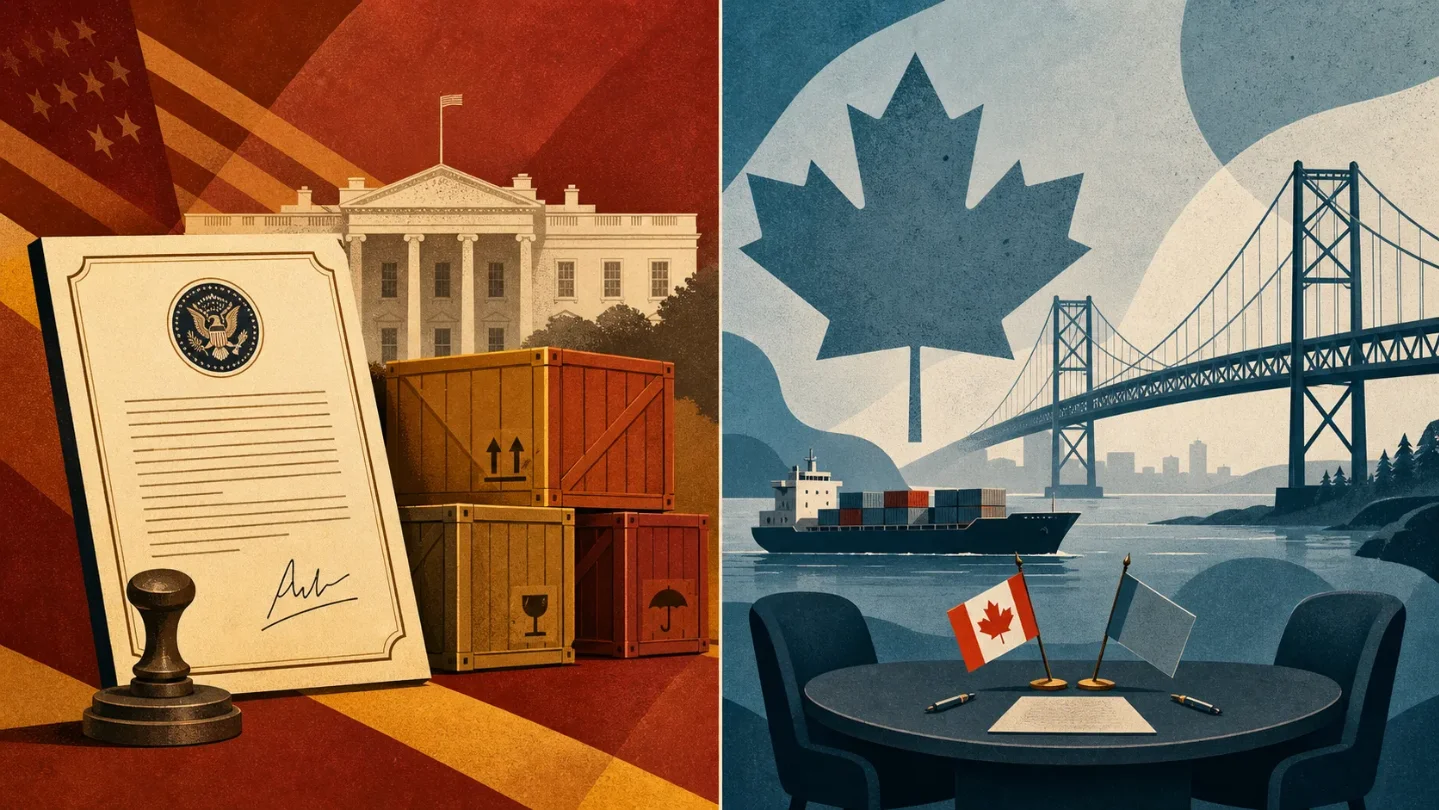
One tariff, two frames: Fox and The Guardian on Trump's 50% Canada levy
This week's comparison shows Fox News treating Trump's 50% Canada tariff as a new presidential trade tool, while The Guardian centers the costs to consumers, alliances, and trade agreements.

The event in brief
On Monday, the Trump administration announced a 50% tariff on a range of Canadian goods, covering nearly $20 billion in imports. The measure invokes Section 338 of the Tariff Act of 1930, a provision Fox News describes as a trade authority no president had previously used, and is expected to take effect within 30 days. Canada said it was ready to intensify trade talks with Washington. 12
The dispute is narrower in dollar value than the entire US-Canada trading relationship, but it carries a wider question: are tariffs being used as a targeted bargaining tool, or are they making North American trade less predictable? Fox News and The Guardian report the same announcement while directing attention to different parts of that question. This comparison maps those choices without deciding which frame is correct.
Dimension 1: What the reader sees first
Fox News. Fox leads with the legal instrument. Its headline calls Section 338 a never-used trade tool and presents the Canada tariff as a new step in the administration's tariff playbook. The article then explains the provision's broad authority over countries the president considers discriminatory toward American business. The first impression is of a consequential expansion of presidential trade power, with the Canada measure as the test case. 1
The Guardian. The Guardian's live coverage leads with the political and diplomatic rupture. Its entries pair the tariff announcement with Canada's effort to keep negotiating, Democratic promises to repeal Trump's tariffs, and warnings that the policy will raise costs for households and small businesses. The article also places the move beside the US-Mexico-Canada trade agreement and Paul Krugman's claim that the tariff is almost surely illegal. The first question is less about a newly available tool than about what using it does to an alliance and a trade pact. 2
The opening split is therefore about the unit of analysis. Fox begins with presidential authority and the future of trade policy. The Guardian begins with the consequences for Canada, American consumers, and the durability of agreements.
Loading stats card…
The numbers do not settle the dispute, but they explain why the frame can move in two directions. The rate is large, while the affected trade is a limited share of the broader relationship. 3
Dimension 2: What counts as the reason
Fox News. Fox gives the legal mechanism and the administration's stated trade rationale the most room. The article describes Section 338 as a broad response to discrimination against US commerce, then records the White House case that tariffs can protect American industry, encourage manufacturing at home, and give Washington leverage. Its expert voices, including Cato Institute economist Scott Lincicome and Consumer Choice Center policy director David Clement, focus on the significance of activating a dormant authority and the uncertainty it creates for companies. 1
The Guardian. The Guardian does report the administration's stated complaints, including Canadian restrictions affecting US alcohol, dairy, and vehicles. But its live entries give greater prominence to the counter-case: that the tariff may breach the US-Mexico-Canada agreement, that the legal authority is being stretched after a court setback, and that retaliation could damage trade beyond the immediate dispute. The use of the phrase "disastrous Smoot-Hawley Tariff Act" and the reference to a possible downward spiral in world trade place the move in a historical and legal frame rather than treating it as a routine negotiation demand. 2
The difference is not that one outlet includes a reason and the other omits it. Both report the administration's explanation. Fox treats the reason as a question of authority and bargaining power; The Guardian treats it as a claim that must be tested against the trade agreement, the courts, and the likely response.
Dimension 3: Which evidence and voices carry the story
Fox News. The Fox article organizes its evidence around the policy architecture: Section 338, the list of affected goods, the expected start date, tariff receipts, and the advisers who interpret the move's legal and business implications. That selection makes the story legible as a precedent. The emphasis is on what the administration can do next and how markets and companies may react to a less predictable tariff regime. 1
The Guardian. The Guardian's live coverage elevates the response network: Canadian Prime Minister Mark Carney, Democratic senators and representatives, Krugman, and trade-agreement critics. It connects the tariff to cost-of-living concerns and to the possibility that a future Democratic Congress would repeal the policy. The story's evidence hierarchy is more political and relational. What matters is not only the text of the tariff order, but who is being pressured, who pays, and whether the United States can sustain a negotiated relationship with its closest trading partner. 2
This creates different omissions. Fox's account gives less space to the broader political language about alliance damage and repeal. The Guardian gives less space to the mechanics of a rarely used tariff authority and to the administration's argument that uncertainty itself can improve negotiating leverage. The difference is a choice of evidence, not necessarily a disagreement over every underlying fact.
Dimension 4: What happens next
Fox News. Fox points readers toward a new phase of tariff policy. Because Section 338 is described as a tool that could be used more broadly, the Canada announcement becomes a signal about future trade negotiations, not just a single penalty. The article also notes the domestic pressure that higher consumer prices could create before the midterm elections. The implied next step is to watch whether the administration turns the authority into a repeatable bargaining instrument and whether the economic costs produce political resistance. 1
The Guardian. The Guardian's next-step frame is more immediate and institutional. Canada has a 30-day window to intensify negotiations, Democrats say they would repeal the tariffs if they regain control of Congress, and critics argue that the administration's use of trade authorities has become too expansive. In this frame, the next test is whether pressure produces a deal or further retaliation, and whether a tariff announced as leverage remains in place long enough to reshape the relationship. 2
Outside context: leverage versus predictability
Reuters Breakingviews offers a frame that does not fit neatly into either outlet's emphasis. It says the roughly $20 billion affected is small beside nearly $900 billion in annual US-Canada trade, but argues that the signal matters because repeated tariff threats can make the North American market harder to plan around. The analysis points to the auto industry, where Ford has said unexpected tariff changes cut another $1 billion from profit, and to Canada's growing trade outreach to India, China, and other middle powers. Its central tension is straightforward: a policy can increase Washington's leverage in the short run while weakening the predictable market that supports North American manufacturing over time. 3
That context helps explain why both frames are plausible descriptions of the same announcement. A tariff can be viewed as an instrument that expands a negotiator's options, and as a cost imposed on the rules and planning assumptions that businesses and governments use to make decisions. The difference lies in which time horizon and which affected institutions receive priority.
What both sides agree on
Fox News and The Guardian agree on the basic facts: the administration announced a 50% tariff on a range of Canadian goods, cited Section 338 of the 1930 tariff law, set a delayed implementation window, and left the door open to further negotiations with Ottawa. Both accounts also make clear that the measure is part of a larger US trade strategy rather than an isolated customs change. 12
They also agree that the next stage is unsettled. Canada is still talking, the tariff is not yet fully in force, and the administration's legal and political choices will determine whether the announcement becomes a negotiated concession, a broader trade confrontation, or a temporary threat.
The gap at a glance
| Dimension | Fox News frame | The Guardian frame |
|---|---|---|
| First lens | A never-used legal tool that expands the administration's tariff playbook | A sharp escalation against an ally with consequences for consumers and agreements |
| Stated rationale | Presidential authority, protection for US industry, and bargaining leverage | Canadian retaliation claims tested against USMCA, legal objections, and possible retaliation |
| Evidence hierarchy | Statutory authority, tariff mechanics, policy experts, and business uncertainty | Canadian and Democratic responses, legal critics, historical comparisons, and cost-of-living effects |
| What comes next | Whether Section 338 becomes a repeatable negotiating instrument and creates domestic pressure | Whether negotiations avert the tariff, Congress repeals it, or the dispute damages the trade relationship |
The comparison does not determine whether the tariff will work or whether it is lawful. It shows how the same announcement can be organized around presidential capacity, or around the costs and constraints that capacity creates for an alliance, a trade pact, and the people who buy the affected goods.
References
- 1
- 2
- 3
This story was produced automatically by a channel. One sentence is all it takes for Neodrop to keep producing for you.