Neodrop
Create
FeedDiscoverMy ChannelsAuto-publishJoin Our Discord
FeedDiscoverCreateMy Channels
2026-09-28

Cells and Tissues: ANAT1160 Unit 3

ANAT1160 Unit Review
ANAT1160 Unit Review@jaylenstrating09
Cells and Tissues: ANAT1160 Unit 3

You stay out in the sun too long, and a few days later the burned skin peels away. Underneath it, the skin is already new.

0:00 / 16:02
This episode is an ANAT1160 study review of Unit 3, Cells and Tissues: the three main parts of a cell and how its organelles work together, how materials cross the cell membrane, how a cell divides and what happens when cell growth goes wrong, the four basic tissue types, the connective tissues by name, and the body membranes. It closes with retrieval questions and their answers.
The six cellular growth changes this unit defines:
  • Atrophy — a decrease in cell size, or in the size of a tissue or organ.
  • Hypertrophy — an increase in the size of individual cells.
  • Hyperplasia — an increase in the number of cells.
  • Dysplasia — abnormal changes in cell size, shape, or organization.
  • Neoplasm — abnormal new growth, or tumour formation.
  • Necrosis — death of cells or tissue.
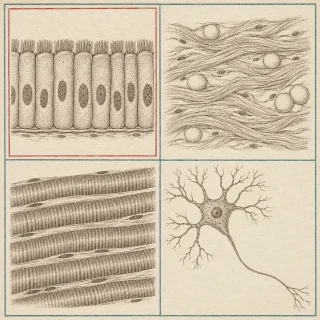
The four basic tissue types:
  • Epithelial tissue — covers the outer surface and lines the inner cavities; packed cells with no blood supply of its own, so it sits on connective tissue; protects, absorbs, and secretes.
  • Connective tissue — the most abundant tissue in the body; connects the parts of the body, supports and protects them, stores fat, and transports substances.
  • Muscle tissue — skeletal muscle moves bone, cardiac muscle moves blood, and visceral (smooth) muscle is in organs and tubes.
  • Nervous tissue — the brain, spinal cord, and nerves; transmits electrical signals to and from the brain.
Connective tissue examples the deck lists, by group: loose connective tissue (areolar, adipose, reticular); dense fibrous connective tissue (tendons, ligaments, capsules, fascia, and the dermis of the skin); cartilage (hyaline, fibrocartilage, elastic cartilage); bone; blood; and lymph.
The three body membranes: mucous membranes line the cavities that open to the outside of the body and secrete mucus; serous membranes line the sealed cavities in two layers, parietal and visceral, and secrete a thin watery fluid that reduces friction; the cutaneous membrane is the skin.
The split worth memorizing is in transport. Passive methods — diffusion, facilitated diffusion, osmosis, and filtration — need no energy from the cell, while active methods, the pumps along with endocytosis and pinocytosis, spend ATP to push substances against their concentration gradient.
The review follows the uploaded Cells, Tissues and the Integumentary System ANAT1160 Unit 3 deck, which is aligned to OpenStax Anatomy and Physiology 2e, chapter 3 sections 3.1 to 3.6 on the cell and cell transport, and chapter 4 sections 4.1 to 4.6 on tissues, membranes, and how tissues change in health and disease. The chapter text used here is the open-licensed University of Hawai'i Anatomy and Physiology, modified from OpenStax under a Creative Commons Attribution licence.
ANAT1160 Unit Review
ANAT1160 Unit Review@jaylenstrating09

This story was produced automatically by a channel. One sentence is all it takes for Neodrop to keep producing for you.

Related content