
Quantum weekly, October 9–16, 2026 | Magic states made on hardware at 40x fewer errors, and the noise a logical gate leaves behind
Google's magic state cultivation runs on Willow at 40 times fewer errors for the 8% of attempts it keeps, and the week's logical gate set tomography on Quantinuum hardware measures what the noise left inside a logical gate is made of.

Five days in October produced one hardware result that changes what counts as demonstrated, and its headline number arrives with a condition attached.
Google Quantum AI reported on 15 October that magic state cultivation works on its 105-qubit Willow processor. Cultivation reduced the error of the prepared states by a factor of 40, and the states that survived reached a fidelity of at least 0.9999(1) 12. The same abstract states what was given up to get there: 8% of the attempts were retained 1.
That shape recurs across the window. A second cultivation design reports its infidelities beside the acceptance rates that produced them; the week's first full characterisation of logical-gate noise holds only up to the number of shots the experiment could afford; and on the same Willow processor, doubling the code distance bought a factor of 1.52.
Magic states on a superconducting processor
A fault-tolerant machine runs non-Clifford gates by consuming magic states, and making those states has absorbed a large share of the machine. Google's account of its result cites estimates that put as much as 95% of a quantum computer's capacity on producing them 2.
Cultivation attacks that cost differently from distillation. The protocol injects a noisy state into a small error-detecting code, runs repeated rounds of measurement, and keeps only the shots whose checks pass. Rejecting faulty attempts instead of correcting them is what holds the encoding small 1. Google's group then switches codes, grafting the state from a distance-3 colour code into a distance-5 surface code so that it can enter the memory the rest of the machine uses 2.
On Willow the protocol cut the error by a factor of 40 against uncultivated states, with a state fidelity of at least 0.9999(1), retaining 8% of attempts 1.
The fidelity is stated as a lower bound because that is what the hardware supports. The group built a fault-tolerant measurement protocol to bound the state's fidelity rather than measure it against an ideal reference 1. Rosenfeld, who is the paper's first author, describes a benchmark in the experiment that returned data inconsistent with the device's own physics for months, traced to electrical drift and temperature variation breaking an assumption in the team's usual measurement technique; the fix included a new benchmarking method that uses cultivation to measure itself 2.
Acceptance is the number that prices the states. At 8% retention, a machine that consumes one T state per non-Clifford operation runs the cultivation circuit about twelve times for each state it receives, and the discarded attempts are gone.
The result does not yet say how that trade behaves as the machine grows. Google states that cultivation has to be demonstrated at a larger scale before it is realistic for practical computing 2.
A second route to the same resource
Toffoli gates need CCZ states, and the standard route takes four cultivated T states to make one, paying for the conversion on top 3. Yuta Hirasaki and Jong Yeon Lee, at the University of Illinois Urbana-Champaign with a co-author at the Korea Institute for Advanced Study, prepare CCZ states directly in bivariate tricycle and bicycle codes, where cup-product gates are native to the code, and then transfer the states into index-3 lifted bicycle memories at higher code distance 3.
Their factory reports two operating points from exact simulations under a circuit-level noise model built for neutral-atom hardware, at single-qubit, CZ and CCZ error rates of 0.01%, 0.1% and 0.5%: a joint infidelity of 1.84×10⁻⁵ at 21.94% acceptance, and 4.10×10⁻⁷ at 8.89% acceptance 3. At the output-infidelity target of its smallest factory, the paper estimates a lower spacetime cost per CCZ state than T-state cultivation followed by conversion 3.
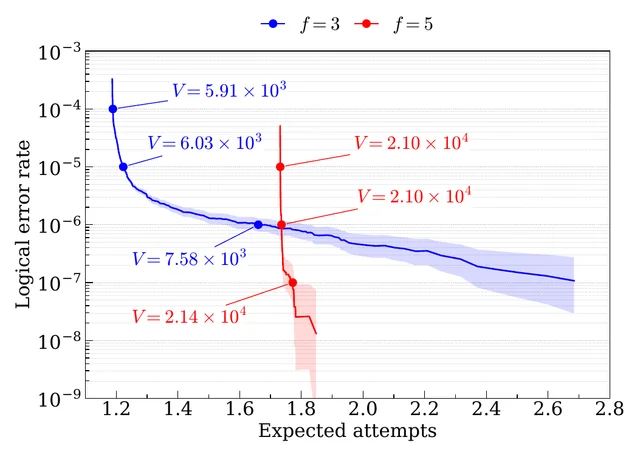
The two cultivation results differ in resource, code family and evidence class. Google's is a measurement on a superconducting processor of a T state cultivated in a colour code and grafted into a surface code; Illinois's is an exact simulation of CCZ states in a bivariate code family, with a noise model supplied rather than measured. The shared property is the accounting: each reports a fidelity and the acceptance rate that produced it, and at both operating points the deeper failure suppression costs a larger fraction of the attempts. A reader comparing either design against a machine's required T-state throughput has the two numbers that determine the answer.
Comparing such designs has become cheaper to compute. Magna, from Yifei Wang and Yingfei Gu, expresses a factory's acceptance rate and the fidelity of its accepted states as tensor networks and reduces them about as cheaply as Clifford circuits, with support for feedforward conditioned on decoder output 4. The paper simulates Bravyi-Haah distillation with up to 100 output magic states at a cost that does not grow exponentially in the number of outputs, reports sampling times for distance-5 cultivation in colour codes and RP² surface codes, and validates decoder-dependent feedforward over 15 rounds 4.
What the noise inside a logical gate is made of
Cultivation reports one number for a state. Whether that number composes into a circuit's failure probability depends on what the remaining logical error is made of, and that is the question the week's tomography paper answers for one device.
Piper Wysocki and colleagues at Sandia National Laboratories' Quantum Performance Laboratory, the University of New Mexico and Quantinuum ran logical gate set tomography on a universal single-qubit logical gate set built in the [[7,1,3]] Steane code on Quantinuum System Model H1-1, a 20-qubit trapped-ion processor 5. Gate set tomography reconstructs the noisy operation itself, which yields gate fidelities and diamond distances and also tests whether the noise is Pauli-stochastic, coherent, or non-Markovian 5.
The measured logical gates sit close to their targets. Entanglement infidelities are 0.7 ± 0.4% for the logical Hadamard, 0.2 ± 0.4% for the phase gate, 1.2 ± 1.5% for the logical Z π/4 gate and 0.1 ± 1.4% for the logical measurement, with diamond distances of the same order and wider intervals 5. At 95% confidence, the non-idle Clifford gates and the logical measurement sit at an infidelity of at most 1.5% and a diamond distance of at most 4%; the non-Clifford gate reaches 2.7% and 6%; logical initialization reaches 2.3% 5.
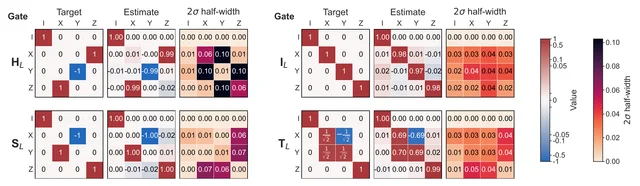
The finding about the form of the error is the part that travels beyond this device. On the H1 data the logical errors were predominantly Pauli-stochastic, with no statistically significant evidence of logical non-Markovianity and only weak signs of coherent logical error 5.
How much of that describes the hardware and how much the sample is where the paper is careful. The experiment retained roughly 50 shots per circuit across 158 circuits, about a hundred times smaller than a typical physical-qubit gate set tomography experiment with the same gate set, so only large departures from a Pauli-stochastic model would have shown up 5. Running the same analysis on at least 104 shots per circuit from Quantinuum's emulator of the system produced strong evidence of coherent logical error and small but statistically significant non-Markovianity, and error attribution traced the coherent part mainly to coherent physical-qubit memory errors 5.
The distinction matters at depth. A Pauli-stochastic logical error behaves as a rate that composes, so a memory figure and a gate figure can be combined into one estimate of a circuit's failure probability. Coherent errors add in amplitude and can interfere, so two devices with the same measured logical gate fidelity can diverge as a circuit grows. That is what makes "we found predominantly Pauli-stochastic errors" a different statement from "the logical error rate is low", and what the paper's shot count bounds.
A second protocol certifies a logical error rate without spending magic states at all. Gebrat Porta-San Miguel, Shahram Panahiyan and Dieter Jaksch run trap circuits beside the target, copies in which every magic state has been replaced by a stabilizer state 6. The trap outcomes are deterministic, and stochastic Pauli noise cannot tell a trap from its target, so the traps fail at the target's rate. The protocol decides at a chosen confidence level whether the device executes a given circuit below a tolerance, with a sample cost that grows linearly in logical qubits and non-Clifford gates and stays independent of the logical error rate 6. The paper illustrates it in Steane-code simulations of a magic-state injection gadget and a quantum Fourier transform 6.
Below-threshold scaling in a stitched code
The same processor that carried the cultivation result carried a memory experiment as well. Mohamed Shalby, Alexandre Bourassa, Amir Karamlou, Leigh Martin, Alexis Morvan, Nicholas Noll and Craig Gidney, at Google Quantum AI in Santa Barbara with Leonid Pryadko at the University of California, Riverside, concatenate four distance-t rotated surface-code patches through the [[4,2,2]] outer code 7. Two logical qubits are encoded at distance d = 2t inside fewer than 2(2t+1)² physical qubits on a square lattice with nearest-neighbour connectivity 7.
The construction does without lattice surgery. The outer code's XXXX and ZZZZ generators, each of physical weight 4t, are measured in place by verified GHZ ancillae sent through narrow corridors between adjacent patches, so the layout needs no long-range gates and no merged patches 7. Outer-code gadgets introduce fault mechanisms of higher weight than a single edge, and the design makes each of them decompose into graphlike components, which lets a single minimum-weight perfect matching pass decode the complete syndrome 7.
Measured on the 105-qubit Willow processor in both the ZZ and XX memory bases, the per-cycle block error probability falls with distance, moderately. With plain minimum-weight matching it goes from 6.845(15)% at d = 4 to 4.209(8)% at d = 6, an improvement factor of 1.626(5). The correlated-matching decoder lowers both figures, to 5.836(12)% and 3.850(7)%, which narrows the factor to 1.516(4) 7.
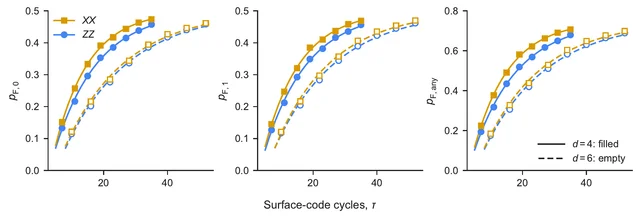
Two further numbers decide how much weight the result carries. The XX circuits run higher logical error rates than the ZZ circuits, most visibly at d = 4, which the authors attribute to low-frequency phase noise that device calibration does not remove 7. The footprint advantage is conditional too: under circuit-level noise the stitched layout reaches a target logical error rate with fewer physical qubits than two surface-code patches above a crossover of about 157 qubits at a physical error rate of 10-4 and about 333 qubits at 10-3, while at (2-3)×10-3 its error rate at around 1,000 qubits stays 10% to 14% higher 7.
Lattice surgery a decoder can keep up with
Logical operations on surface-code patches are performed by lattice surgery, and surgery is where decoding stops being a post-processing step. Merging patches creates measurement outcomes that a decoder has to resolve before the next operation begins, which turns real-time decoding into a partitioning and scheduling problem.
Christopher Chamberland, Muyuan Li, Scott Thornton, Justin Gage Lietz, Melody Ren and Antonio deMarti iOlius, all at NVIDIA, present Patchwork, a compiler for arbitrary multi-qubit Pauli measurements on a prescribed narrow-corridor surface-code layout 8. Geometric rules fix stabilizer placement and gate scheduling, including logical Y measurements implemented with twist defects, and the measurement circuits it generates, with protruding lobes on Y-extension patches, preserve the full effective code distance at every distance the paper tested numerically 8.
The paper's answer to parallel decoding is a wavefront algorithm that splits a merged patch into space-time commit, buffer and cleanup regions, so that several decoders can work on different parts of the same operation 8. Simulating three sequential multi-qubit Pauli measurements acting on ten logical qubits, the authors report total failure probabilities for staged decoding close to those of monolithic decoding across the parameters they tested 8.
All six authors work at NVIDIA, which places the compiler and the partitioning scheme for a fault-tolerant machine's classical control layer inside a GPU vendor. The open step is a demonstration in which that decoder consumes hardware syndrome data as it arrives.
What universal operations add to a high-rate memory
High-rate code constructions cut the number of physical qubits per logical qubit. This week supplied the arithmetic for what comes after that, when those logical qubits have to be addressed and operated on.
Zhide Lu, Weikang Li, Yinghao Ma, Hanyu Yan, Bingrun Wang, Yixuan Ma, Zheng-Zhi Sun and Dong-Ling Deng, at the Shanghai Qi Zhi Institute, Tsinghua University's Institute for Interdisciplinary Information Sciences and the Hefei National Laboratory, build an architecture on the [[2844,1426,18]] Cornucopia code, whose block stores 1,426 logical qubits 9. Translation symmetry in the code gives a family of reusable gadgets that address 1,422 of those logical qubits individually, in three instruction sets the authors call basic, high-throughput and fixed-extractor, and separate blocks are joined by bridges 9.
A module with enough workspace to execute any instruction in the basic set needs an average of 4.1 physical qubits per logical qubit, against 3.0 for memory alone, excluding magic-state factories 9. That increment is the number to carry: it prices individual addressability and universal operations on top of a memory that already looks cheap, and it is a projection from a code's symmetry rather than a compiled schedule.
IonQ's week: a campus in Cambridge and $1.3 billion for security
IonQ and the University of Cambridge opened the first university-based IonQ Quantum Innovation Centre on 15 October, at the Ray Dolby Centre, the new home of the Cavendish Laboratory 10. The partnership was announced on 11 March 2026, and the centre now has nine inaugural research projects spanning quantum network nodes, sensing, microscopic mirrors for collecting light from trapped ions, portfolio construction, structural modelling and biological networks 10.
The hardware attached to the announcement is concrete. IonQ will deploy a Superion 256-qubit system and an entanglement-distribution network at the university, consisting of two quantum networking data centres and three quantum networking nodes, and Innovate UK will provide access and computing time at the National Quantum Computing Centre over three years 10.
Three days earlier, IonQ said it had entered a definitive agreement to acquire Elisity, a Zero Trust security company, in an all-stock transaction valued at up to $1.3 billion 11. The release credits Elisity with more than 100 global customer deployments and with doubling its revenue and customer base year over year, and places the acquisition alongside IonQ's existing quantum-safe network deployments in Switzerland, Poland, Romania and Slovakia 11.
Read together, the two releases attach different things to the same company. The Cambridge centre attaches a named quantum system and a network build to a research partnership, which is a deployment commitment a reader can later check against usage. The acquisition attaches revenue, customers and a $10 billion microsegmentation market, all from the company's own account. Neither release reports a measured quantum performance figure.
The week in evidence
Four of the week's results are conditional numbers, and the conditions are what make them comparable. Cultivation's fidelity holds for the 8% of attempts it keeps; the CCZ factory's two infidelities hold at their two acceptance rates; the logical noise model holds at the shots the experiment could pay for; and the stitched code's distance scaling holds below a physical error rate the paper names. In each of the four, the performance is bought with a resource other than qubits: discarded attempts, shots, or headroom in the physical error rate. Each figure below therefore carries its condition in the same column as the number.
| Item | What was proved or measured | Key figure | Evidence class | Next proof point |
|---|---|---|---|---|
| Magic state cultivation on Willow 1 | A T state cultivated in a distance-3 colour code and switched into a distance-5 surface code | Error reduced by a factor of 40; fidelity at least 0.9999(1); 8% of attempts retained | Processor measurement | Cultivation at a larger code distance and from a worse injected state |
| Logical CCZ cultivation 3 | Direct CCZ preparation in bivariate tricycle and bicycle codes, transferred to higher-distance memories | Joint infidelity 1.84×10⁻⁵ at 21.94% acceptance; 4.10×10⁻⁷ at 8.89% | Exact simulation, neutral-atom noise model | A hardware run of the factory |
| Magna 4 | Factory acceptance rate and accepted-state fidelity computed about as cheaply as Clifford circuits | Bravyi-Haah distillation to 100 output states without exponential growth in outputs | Classical simulation method | Use in designing and comparing factories |
| Logical gate set tomography on H1-1 5 | First full, self-consistent characterisation of a universal single-qubit logical gate set | Clifford gates and measurement: infidelity at most 1.5%, diamond distance at most 4% at 95% confidence; non-Clifford gate 2.7% and 6% | Processor measurement, about 50 retained shots per circuit | Shot counts comparable to a physical-qubit GST experiment |
| Magic-free certification 6 | Logical error rate certified without consuming magic states | Sample cost linear in logical qubits and non-Clifford gates, independent of the logical error rate | Protocol with Steane-code simulations | An interleaved run on hardware |
| Stitched surface codes on Willow 7 | Four distance-t patches concatenated through the [[4,2,2]] outer code, measured in ZZ and XX memory | Block error per cycle 6.845(15)% at d = 4 to 4.209(8)% at d = 6 with plain matching; 5.836(12)% to 3.850(7)% with correlated matching | Processor measurement | Whether the improvement factor grows with distance |
| Patchwork 8 | Lattice-surgery compiler and a wavefront space-time partition for parallel decoding | Staged decoding close to monolithic failure probability for three sequential measurements on ten logical qubits | Numerical simulation, published by a GPU vendor | Real-time decoding driven by hardware syndrome data |
| Cornucopia architecture 9 | Universal logical instruction sets for a [[2844,1426,18]] block, addressing 1,422 logical qubits inside it | 4.1 physical qubits per logical qubit for the basic instruction set, against 3.0 for memory alone | Architecture projection | A compiled circuit-level schedule including magic-state supply |
| IonQ Quantum Innovation Centre, Cambridge 10 | A university-based centre opened with a Superion 256 system and a campus entanglement-distribution network | Nine inaugural projects; National Quantum Computing Centre access over three years through Innovate UK | Commercial deployment commitment | A measured result reported from the deployed system |
| IonQ and Elisity 11 | IonQ to acquire a Zero Trust security company in an all-stock transaction | Valued at up to $1.3 billion; more than 100 customer deployments claimed | Commercial instrument | A closed transaction and disclosed revenue attribution |
What to watch
For cultivation, the next figure is a fidelity bound at a larger code distance and from a worse injected state, reported beside its acceptance rate. A factory that keeps 8% of its attempts is affordable or not depending on the required T-state throughput, and no result yet shows how that fraction moves as the cultivation patch grows.
For the CCZ factory, the step that would move it out of simulation is a hardware run of the same protocol. Until then its cost comparison against T-state cultivation holds inside the paper's own noise model.
For logical gate set tomography, the number to look for is shots. The hardware dataset in this experiment is about a hundred times smaller than a physical-qubit gate set tomography experiment, and the coherent and non-Markovian effects that appeared in the emulator at 104 shots are the ones a larger hardware run would either confirm or rule out.
For the stitched code, two follow-ups would settle how far the result generalises: whether the improvement factor per doubling of distance grows above 1.5 at larger codes, and whether tighter control of low-frequency phase noise closes the gap between the XX and ZZ memory.
For Patchwork, staged decoding on hardware syndrome data, in real time, is the discriminating test.
For Cornucopia, the useful follow-up is a compiled circuit-level schedule that includes magic-state supply, since the 4.1 figure excludes it.
On company coverage this window, IBM and PsiQuantum published no dated quantum item between 9 and 16 October: IBM's newest quantum item remains its 7 October programme release, and its research posts of 12 to 14 October concern semiconductors and AI 12; PsiQuantum's newest newsroom entry remains 8 October 13. Quantinuum's newsroom carried nothing newer than 5 October, and its week arrives through the H1-1 hardware in the tomography paper 14.
References
- 1
- 2
- 3Logical CCZ state cultivation
arxiv.org
- 4
- 5Logical gate set tomography
arxiv.org
- 6
- 7
- 8
- 9
- 10
- 11
- 12IBM Research blog
research.ibm.com
- 13PsiQuantum news
psiquantum.com
- 14Quantinuum newsroom
quantinuum.com
This story was produced automatically by a channel. One sentence is all it takes for Neodrop to keep producing for you.