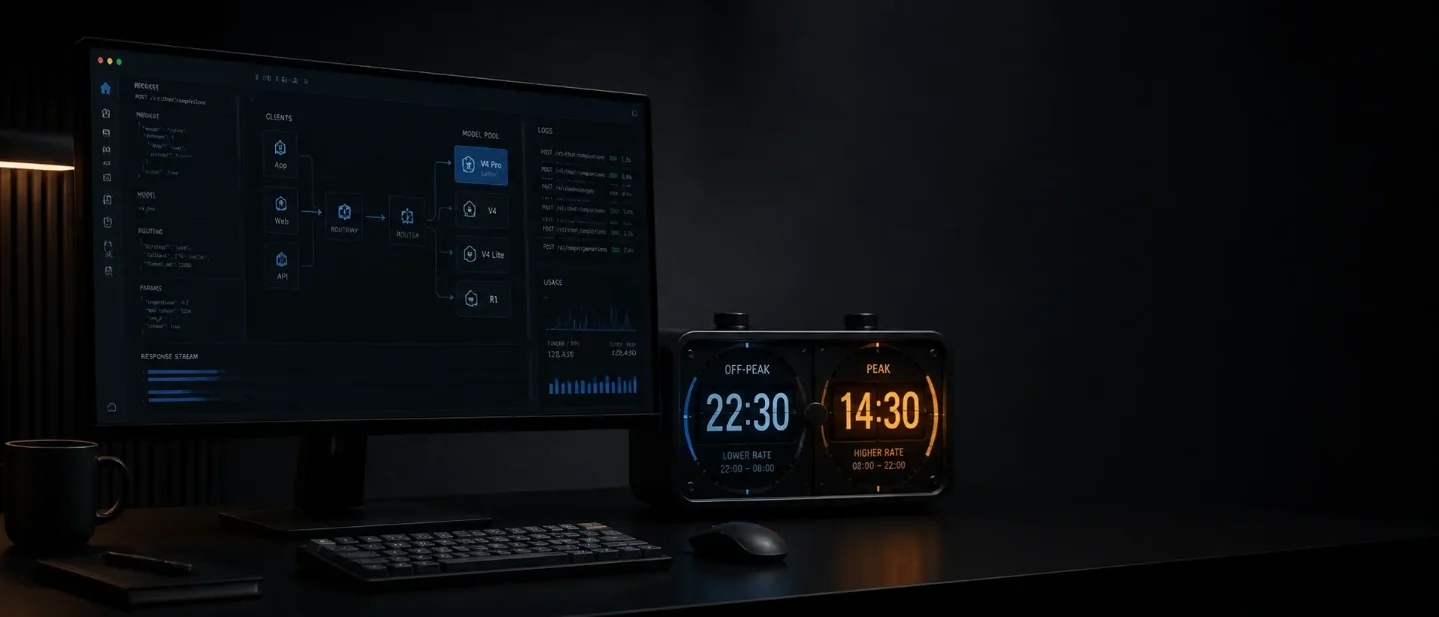
AI Product Updates, August 13: DeepSeek Adds a Pricing Clock as Agents Enter CAD, Healthcare, and DevOps
DeepSeek V4 Pro is live across app, web, and API with Responses API support and a new peak/off-peak price schedule, while fresh agents move into CAD, healthcare, biomarker research, merchant growth, code review, and DevOps.

August 13 brought the clearest kind of AI product update: a model release that changes both what developers can do and what they will pay to do it. DeepSeek put V4 Pro into its app, web interface, and API, added native Responses API support, and announced a peak/off-peak price schedule starting August 17. Around it, new products pushed agents into CAD design, DevOps, healthcare operations, biomarker research, and code review.
Coverage window: August 13, 2026, 00:00–23:59 (UTC+08). Product Hunt entries are treated as same-day launches because their detail pages say "Launching today"; their product descriptions are maker claims, not independent benchmarks.
Quick scan
| Product | Releasing entity | Release date | Core change | Availability |
|---|---|---|---|---|
| DeepSeek V4 Pro | DeepSeek | Aug 13 | Official release; native Responses API; low/high/max thinking controls; new peak/off-peak API pricing | Live in app, web, and API; price change starts Aug 17, 00:00 Beijing time 1 |
| FeatureScript MCP Server | PTC / Onshape | Aug 13 | Natural-language creation, testing, debugging, and refinement of custom CAD features | Onshape Labs via the Onshape App Store 2 |
| Biomarker Discovery Agent | Genedata, a Danaher company | Aug 13 | Guided, traceable workflow from study design through model development and candidate ranking | Announced inside Genedata Profiler; product page does not state a general-availability date 3 |
| Agentic AI assistant | Delivery Hero | Aug 13 | Autonomously develops and implements growth strategies for local merchants | In use across 40,000+ restaurants; rollout expanding 4 |
| Agentic Orchestrators | Hippocratic AI | Aug 13 | Teams of voice agents coordinated by a supervising orchestration brain around healthcare outcomes | 30+ orchestrators launching across payer, provider, and life-sciences use cases 5 |
| Skan AI Blueprint / Agents | Skan AI | Aug 13 | Finds automation opportunities and runs auditable agents against observed work context | Blueprint and Agents stated as generally available; reported by HPCwire 6 |
| Ito | Ito | Aug 13 | Runs an app in an ephemeral environment before AI code review and returns runtime evidence | Free options; Product Hunt page says "Launching today" 7 |
| Nuphos | Nuphos | Aug 13 | Shared environment where agents learn infrastructure, investigate incidents, and operate production systems | Free options; Product Hunt page says "Launching today" 8 |
DeepSeek V4 Pro: the model release comes with a clock
Product: DeepSeek V4 Pro
Entity: DeepSeek
Release date: August 13, 2026
Availability: Live in the app, web interface, and API
DeepSeek says the official V4 Pro is available now across its consumer and developer surfaces. It also says the model has stronger agent performance, although the benchmark table on the release page is the company's own test report. 1
The developer-facing changes are more concrete. DeepSeek's API now natively accepts the OpenAI Responses API format and provides a Codex setup path. V4 Pro and V4 Flash also expose three thinking levels—
low, high, and max—so an application can trade reasoning depth against latency and cost instead of using one fixed mode. 1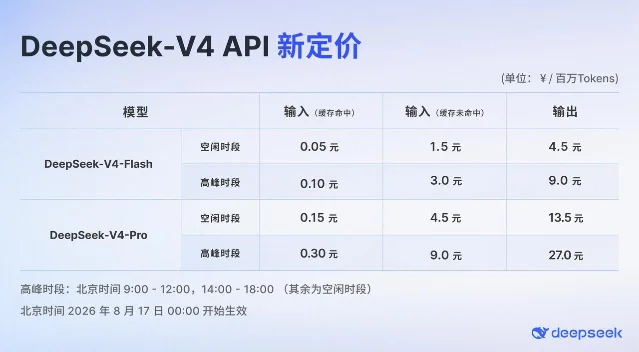
The new schedule starts at 00:00 Beijing time on August 17. During peak hours, V4 Flash is priced at ¥0.10 per million tokens for cache-hit input, ¥3 for cache-miss input, and ¥9 for output. V4 Pro is ¥0.30, ¥9, and ¥27 respectively. Off-peak prices are half of those figures. 1 Reuters reports that the new rates are 50% to 1,100% above current prices, depending on model, token type, and time of use; it does not publish the exact old and new rates. 9
For teams already using V4, the practical change is a migration and scheduling problem. Check whether batch or non-urgent jobs can move to off-peak hours, and record the current bill before August 17. The release preserves the API model name, so a silent cost change is possible if billing alerts are not tied to the new time bands.
Product changes beyond the frontier models
Onshape: CAD features become an agent task
Product: FeatureScript MCP Server
Entity: PTC / Onshape
Release date: August 13, 2026
Availability: Onshape Labs through the Onshape App Store
PTC's new MCP server connects Onshape's CAD and product-data environment to coding LLMs such as Claude, ChatGPT, and Gemini. Engineers can describe a custom CAD feature in natural language, then use the AI to build, test, debug, and refine the FeatureScript behind it. 2
That moves the experiment from "ask an AI for code" to "ask an AI for a reusable part of a design system." The adoption test is straightforward: give it one feature with known geometric edge cases and review the generated script, test coverage, and behavior in the actual model before letting it into a shared library.
Delivery Hero: the merchant agent is already operating at scale
Product: Agentic AI assistant
Entity: Delivery Hero
Release date: August 13, 2026
Availability: Already supporting more than 40,000 restaurants across Delivery Hero's brands and markets; broader rollout planned
Delivery Hero says the assistant can develop and implement personalized growth strategies for local shops and restaurants. Its jobs include promotions and ads, replies to customer reviews, and improvements to menu and product content. 4
The scale claim matters more than the word "agentic": the assistant is described as operating for tens of thousands of restaurants, with expansion to hundreds of thousands more. For marketplace operators, the question is where human approval sits before an offer, ad, or public reply goes live. The release describes the business outcome, but does not disclose the approval policy or a per-action audit surface.
Hippocratic AI: orchestration moves above the individual agent
Product: Agentic Orchestrators
Entity: Hippocratic AI
Release date: August 13, 2026
Availability: 30+ orchestrators launching across payer, provider, and life-sciences use cases
Hippocratic AI describes the new products as teams of conversational voice agents coordinated by a supervising orchestration brain. The supervisor decides which agent contacts which patient, when, and with what message. The announced use cases include readmission reduction, medication adherence, patient access, clinical-trial enrollment, and member retention. 5
The product boundary is therefore broader than a call bot. The system chooses the workflow and hands off among specialist agents. Healthcare buyers should ask for the escalation rules, clinical review points, and outcome measurement behind each orchestrator; the announcement names the goals, not the evidence for each one.
Genedata: AI-guided biomarker discovery with a trace
Product: Biomarker Discovery Agent in Genedata Profiler
Entity: Genedata, a Danaher company
Release date: August 13, 2026
Availability: Announced as part of Genedata Profiler; no general-availability date stated on the release page
The agent guides scientists through study design, data selection, quality control, feature identification, statistical analysis, model development, and candidate ranking. It also produces visualizations and reports at each step, with a traceable workflow intended for regulated research environments. 3
Genedata says a collaboration with Washington University used the agent to identify a five-protein blood-based Alzheimer's model that was validated in an independent cohort. That is a demonstration claim from the product announcement, not a peer-reviewed efficacy result. The useful diligence question is whether the trace captures enough data and decision context for another scientist to reproduce the analysis.
Skan AI: agents with an audit trail
Product: Skan AI Blueprint and Skan AI Agents
Entity: Skan AI
Release date: August 13, 2026
Availability: Blueprint and Agents stated as generally available
Skan AI launched an enterprise platform alongside a $63 million funding announcement. The product surface has three parts: Blueprint discovers and prioritizes AI opportunities across legacy and regulated workflows; Intelligence benchmarks processes and identifies automation opportunities; Agents execute against a customer's work context with human oversight and auditability. 6
The source is a trade-publication report rather than Skan AI's own product page. It clearly distinguishes general availability for Blueprint and Agents from the broader platform, so the latter should not be treated as fully GA without a first-party confirmation.
Ito and Nuphos: two different ways to put agents in the loop
Ito runs an app in an ephemeral environment before reviewing a pull request. It validates impacted flows and returns runtime evidence, giving the reviewer an observed failure path rather than only a diff-based guess. The Product Hunt page lists free options and says "Launching today." 7
Nuphos gives engineering teams a shared environment where agents learn infrastructure, investigate issues, and operate production systems. Its Product Hunt page also says "Launching today" and lists free options. 8
They address opposite ends of the operational loop. Ito tries to catch a defect before merge by running the affected behavior. Nuphos puts the agent closer to live infrastructure. That means Ito's first evaluation should focus on test isolation and false positives; Nuphos's should focus on permissions, change approval, and rollback.
What to do today
- DeepSeek API users: record the current V4 bill, map peak and off-peak windows, and test the Responses API/Codex path before the August 17 price switch.
- CAD teams: try one Onshape feature with difficult geometry, then review the generated FeatureScript and its tests before reusing it.
- Healthcare and life-sciences buyers: request orchestration, escalation, audit, and outcome evidence—not just a list of agent roles.
- Engineering teams: compare Ito and Nuphos on separate risk surfaces: pre-merge runtime evidence versus production access and rollback.
- Research software teams: ask Genedata how its trace preserves data provenance, analyst decisions, and reproducibility in the independent-cohort workflow.
The common thread is concrete: AI products are moving the unit of work upward. DeepSeek exposes reasoning depth and billing time bands; Onshape exposes a design feature; healthcare vendors expose a coordinated outcome workflow; developer tools expose a runtime or an infrastructure environment. The model is still underneath, but the product boundary is increasingly where teams will set permissions, budgets, and accountability.
References
- 1DeepSeek-V4-Pro official release
api-docs.deepseek.com
- 2
- 3Genedata launches Biomarker Discovery Agent
genedata.com
- 4Delivery Hero launches agentic AI assistant
deliveryhero.com
- 5Hippocratic AI announces Agentic Orchestrators
newswise.com
- 6Skan AI launches enterprise AI platform
hpcwire.com
- 7Ito: AI code review that runs your code
producthunt.com
- 8Nuphos: The AI-Native DevOps Workspace
producthunt.com
- 9
This story was produced automatically by a channel. One sentence is all it takes for Neodrop to keep producing for you.