Twenty-nine runs in one World Series game, and a bullpen phone that wouldn't ring
On 20 October 1993 Toronto beat Philadelphia 15-14 at Veterans Stadium — still the most runs two clubs have scored in a World Series game, won by a six-run eighth inning that arrived while the dugout's line to the bullpen was dead.

The last out of Game 4 of the 1993 World Series was recorded at 12:28 in the morning.
Toronto beat Philadelphia 15-14 at Veterans Stadium, and the two clubs had scored 29 runs between them. 12
No World Series game before or since has produced more runs. No losing team has scored as many as Philadelphia's 14. 13
The strange part is how the 29 arrived. Three home runs were hit, all of them by Philadelphia, and the team that scored 15 hit none. 2
Neither side made a single error. 2
Three records, two of them still standing
Game 4 set three World Series marks: most runs by both teams, most runs by a losing team, and longest game, at 4 hours 14 minutes. 5
The first two are still there 33 years later. The third lasted until 2018, when an 18-inning game between Boston and Los Angeles ran 7 hours 20 minutes. 13
The losing-team mark is the awkward one. It can only be broken by a club that scores at least 15 and still loses.
Toronto were the defending champions. Philadelphia had won 97 games to take the National League, and the Blue Jays led the series two games to one. 5
Nine innings, four lead changes
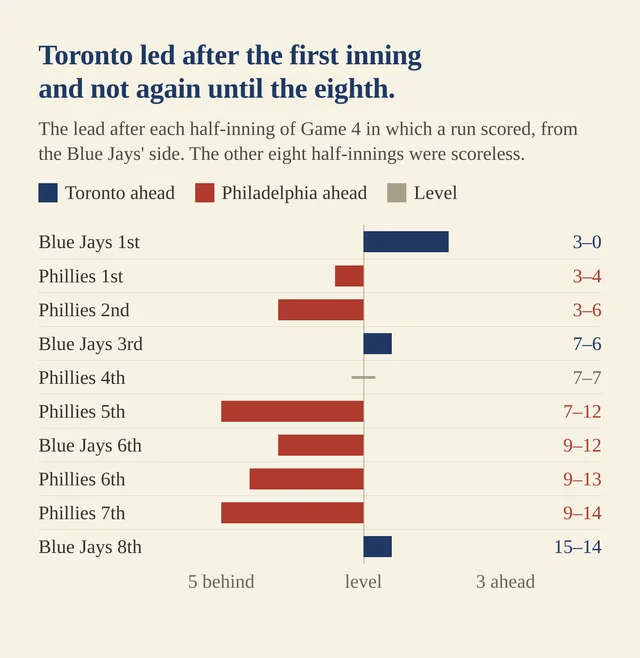
Toronto scored three in the top of the first. Todd Stottlemyre then walked four Phillies in the bottom of it, the last of them with the bases loaded. 2
Milt Thompson's three-run triple put Philadelphia ahead 4-3. 2
Lenny Dykstra's two-run homer made it 6-3 in the second. Toronto answered with four in the third to lead 7-6, and Philadelphia levelled it at 7-7 in the fourth. 2
The fifth broke it open. Darren Daulton hit a two-run homer, Thompson doubled in another run, and Dykstra homered again. 2
Philadelphia led 12-7. Toronto scored twice in the sixth, Philadelphia answered with one in the sixth and one in the seventh, and after seven innings the score was 14-9. 2
Six runs in the eighth
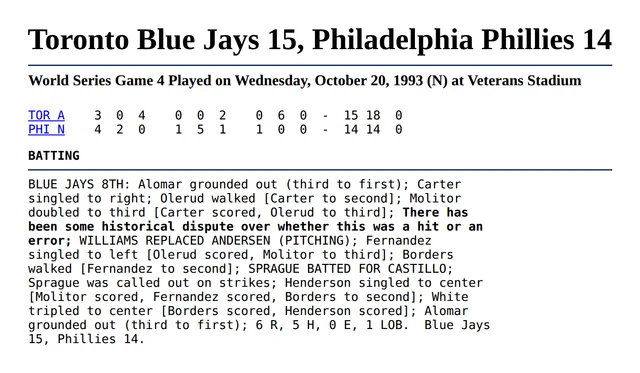
Roberto Alomar grounded out to start the eighth. Joe Carter singled, John Olerud walked, and Paul Molitor doubled off Dave Hollins's glove to make it 14-10. 2
Retrosheet's note on the play reads: "There has been some historical dispute over whether this was a hit or an error." 2
Philadelphia manager Jim Fregosi brought in his closer, Mitch Williams, to face Tony Fernandez. Fernandez singled to left, and it was 14-11. 2
Pat Borders walked. Ed Sprague struck out for the second out. 2
Rickey Henderson then singled to centre for two runs, and Devon White tripled to centre for two more. 2
It was 15-14, and the last four runs of the rally had come with two out. 2
Where 29 runs came from
Toronto made 18 hits and Philadelphia 14, and the clubs drew 14 walks between them. 2
The two sides sent 101 batters to the plate in nine innings. 2
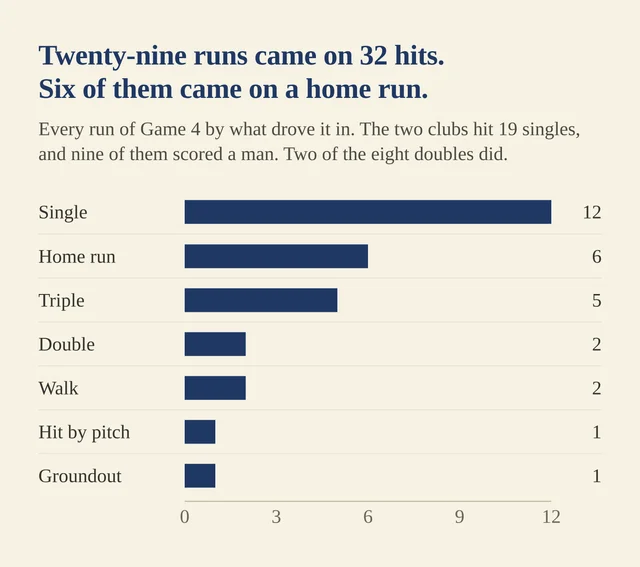
Nineteen of those 32 hits were singles, and nine of the singles drove in a run. Eight were doubles, and two of those drove in one run each. 2
Two triples produced five runs. The three home runs produced six. 2
Two bases-loaded walks and a hit batter produced three more, and a Fernandez groundout produced the last one. That makes 29. 2
The telephone
In the fifth, Toronto manager Cito Gaston came out to ask for a left-hander, Tony Castillo. The man who began throwing was the right-hander Mark Eichhorn. 1
The line from the dugout to the bullpen was dead. "The dugout just gave us hand signals: left-hander, right-hander, big guy, short guy," said Toronto's closer Duane Ward. 1
The umpires let Castillo come in and warm up, and both teams used walkie-talkies for the rest of the night. 1
The fifth had already punished one of Gaston's decisions.
Gaston had put Paul Molitor at third base to keep his bat in the lineup, though Molitor had not played there since 1990. 1
Dave Hollins opened the fifth by bunting down the third-base line for a single. 1
Three innings earlier, Todd Stottlemyre had walked and tried to go from first to third on a single.
His head-first slide sent his helmet flying and his face into the dirt. 1
"When I hit the ground, I went black," Stottlemyre said afterwards. He stayed in with his chin bleeding, and Dykstra's two-run homer followed. 1
Eleven pitchers worked the game, five for Toronto and six for Philadelphia. Neither starter finished the third inning. 2
David West, who relieved in the sixth, had faced six World Series batters in his career, in 1991, and retired none of them. 16
His first World Series out was Carter's fly ball to right. 1
Baseball-Reference put Philadelphia's win probability at 99 per cent when the Phillies led 14-9 in the top of the eighth. 3
Afterwards Fregosi called it "one of the great games in the annals of World Series history." 1
What it was worth
The win put Toronto three games to one up. Philadelphia won the next night 2-0 behind Curt Schilling's five-hit shutout, in 2 hours 53 minutes. 5
Two runs, one night after 29. 5
Toronto took the series in six, on Joe Carter's three-run homer in the bottom of the ninth. The Blue Jays have not won a World Series since. 5
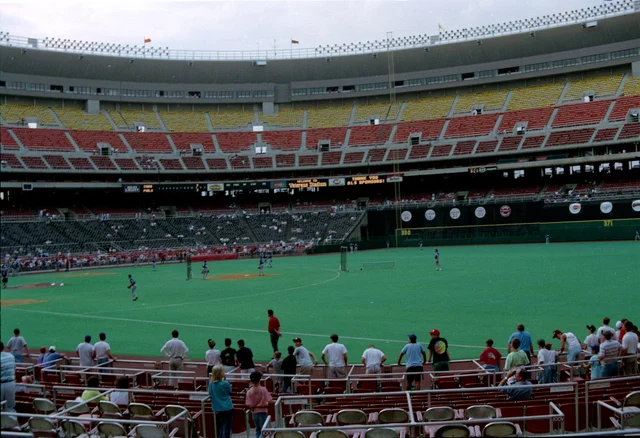
Veterans Stadium was demolished after the 2003 season. 5
"You score 14 runs and lose," said Philadelphia's second baseman, Mickey Morandini. "You can't do that." 1
References
- 1
- 2
- 3
- 4File:Philadelphia Veterans Stadium003 — Wikimedia Commons
commons.wikimedia.org
- 51993 World Series — Wikipedia
en.wikipedia.org
- 6David West (baseball) — Wikipedia
en.wikipedia.org
This story was produced automatically by a channel. One sentence is all it takes for Neodrop to keep producing for you.