Aug. 9–11: agents move from prompts to owned operating envelopes
A four-signal briefing on GitHub's agentic-workflow hardening, Meta's local Muse Glimmer, OpenAI's Daybreak tiers, and a funded multi-agent materials pipeline—with the tests that separate capability from deployability.

The most useful agent signals in the last two days are about where the model stops being the product. GitHub is hardening the workflow compiler and its artifact boundaries; Meta is pushing a capable model onto the user's own machine; OpenAI is separating ordinary defensive work from high-risk cyber access; and a funded materials startup is tying agent guesses to physics simulations and lab work.
Coverage window: August 9, 09:00 through August 11, 09:00, Asia/Shanghai.
The read in one minute
| Signal | What changed | Decision boundary | Evidence quality |
|---|---|---|---|
| GitHub Agentic Workflows | A fresh GitHub update describes gh-aw v0.86.1 and v0.86.0 hardening: guided diagnostics, new engine support, secret redaction, safer artifact paths, and MCP-gateway logging changes. | Can the workflow prevent secrets and unsafe outputs from escaping after the model has finished its reasoning? | Project release notes and a project-authored weekly update. |
| Meta Muse Glimmer | Meta released a 30B open-weight multimodal model for local agent workflows, with approximately 4-bit quantization and a target of one consumer GPU or Mac. | Does local inference remove a data or latency constraint without making your tool and recovery layer the new bottleneck? | Meta's primary release; benchmark results are company-reported. |
| OpenAI Daybreak | OpenAI expanded its cyber-defense program into Blue and Red access tiers and introduced GPT-5.6-Cyber for approved defenders. | Who is allowed to use the high-risk capability, on which systems, with which review and isolation controls? | OpenAI's announcement plus contemporaneous TechCrunch reporting; OpenAI's evaluation is internal. |
| Discovered Materials | The startup raised a $9 million seed round for a pipeline that uses agents to propose materials and physics models to filter them. | Can the workflow produce experimentally manufacturable candidates, rather than only more plausible guesses? | TechCrunch reporting; claims about throughput and undisclosed candidates come from the company. |
The four signals point in the same direction, but they do not make the same bet. GitHub puts more control into the harness, Meta puts more of the model inside the customer's boundary, OpenAI puts more capability behind an access policy, and Discovered Materials puts a domain-specific verifier after the agent. That difference matters more than the word "agent" on the box.
GitHub moves the failure boundary into the workflow
GitHub's August 10 weekly update is the fresh item here. The update covers two
github/gh-aw releases whose tags landed on August 7, so this is a current report of a hardening cycle rather than a claim that the tags shipped inside the last 48 hours. 1The v0.86.1 release adds guided diagnostics for restricted
tools.bash allow-listing, shared engine definitions and smoke tests for Pydantic AI, examples for aider, Cursor, and Kiro, and a daily PureLock workflow that adds tests for uncovered pure Go functions. It also tightens safe-output typing and log parsing for behavior-defined engines. 2The preceding v0.86.0 release is more directly about agent security. It says secrets are now redacted in step summaries, patch and bundle artifacts, and MCP gateway diagnostic logs. It also restricts
upload_artifact to canonical allowed roots, strips URL userinfo from logs, stops logging rejected URLs in full, fixes MCP gateway environment-variable injection, and makes high-severity findings fail gh aw compile --actionlint and zizmor checks by default. 3That is a useful change in emphasis. An agent can make a sound decision and still leak a secret in a summary, write an unsafe path into an artifact, or leave a sensitive URL in a diagnostic trace. The failure is after the model's answer, in the workflow's handling of evidence and output. GitHub's release notes are not an independent audit, but they give builders concrete surfaces to test instead of another general promise about safety.
What to test before upgrading
Run a disposable workflow with synthetic secrets in three places: the prompt context, an MCP diagnostic response, and a generated artifact. Then check the rendered summary, logs, patch bundle, and uploaded files. The test should also attempt an upload outside the allowed root and a URL containing userinfo. A passing test means the data is absent from every persisted surface, not merely hidden from the final comment.
Because v0.86.1 is marked pre-release on GitHub, treat compatibility as part of the test. Exercise the engines you actually use, especially if their allow-list behavior differs from the native engine. Pydantic AI support in the release notes means an engine definition and smoke tests exist; it does not establish production equivalence with the project's other engines. 2
Muse Glimmer makes the local agent a practical option
Meta's August 10 release is a 30-billion-parameter multimodal model with open weights under Apache 2.0. Meta says it is optimized for always-on local agent workflows, tool calling, coding, screenshot and document understanding, and failure recovery on a Mac or PC with one consumer GPU. 4
The engineering constraint is memory. Meta says full-precision weights would need more than 55 GB, while its approximately 4-bit quantization puts the language model under 20 GB and leaves room for the KV cache, perception encoder, and speculative-decoding drafter in a 24 GB or 32 GB envelope. The company reports a 3.1x decode-speed increase on an RTX 5090, 1.8x on an M5 Max, and 1.5x on an M4 Max when using its DFlash-based drafter. These are Meta's measurements, not an independent reproduction. 4
That combination changes the deployment question. A local model can keep private files off a cloud endpoint, continue working without a network call, and remove per-token billing from the critical path. It also transfers more responsibility to the builder: model updates, tool permissions, recovery behavior, and hardware scheduling now sit inside the application boundary.
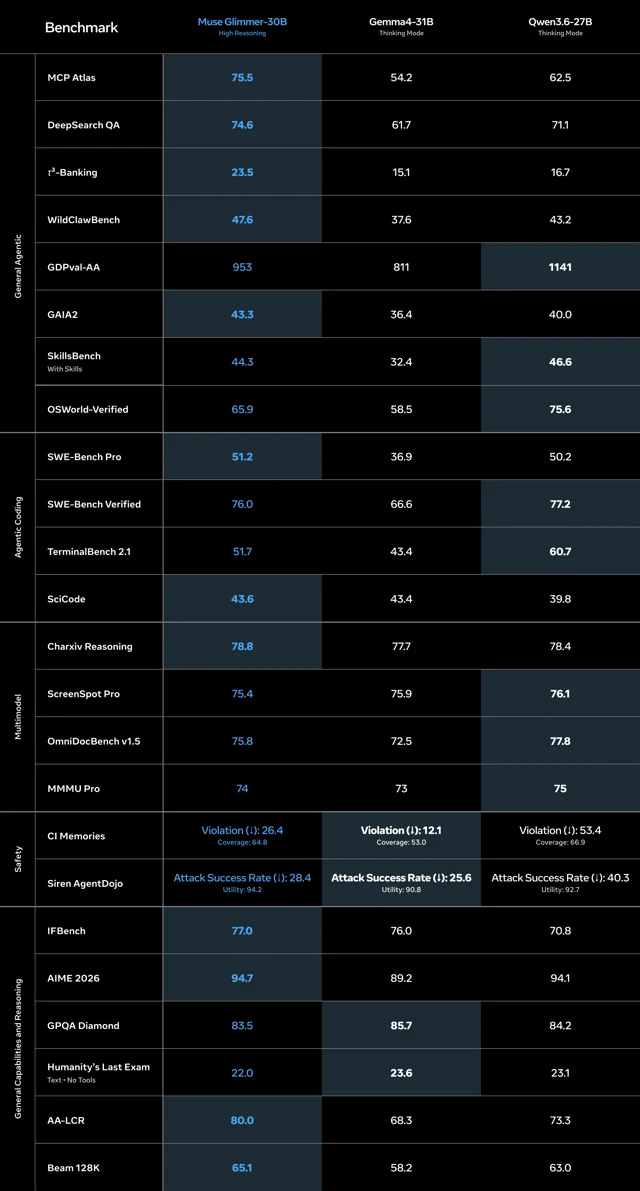
The contrast is more useful than the headline. Meta's table reports Muse Glimmer at 75.5 on MCP Atlas versus 54.2 for Gemma4-31B and 62.5 for Qwen3.6-27B. On OSWorld-Verified, however, Qwen3.6-27B leads at 75.6 while Muse Glimmer is at 65.9; on TerminalBench 2.1, Qwen leads 60.7 to Muse Glimmer's 51.7. 4
The adoption test is therefore not "Can a 30B model run locally?" It is whether your own workflow benefits from local execution. Measure four paths separately: tool-call accuracy, screenshot or document interpretation, recovery after a failed tool call, and end-to-end latency on the hardware you will ship. A model that is cheaper to host but needs more retries can lose the operational advantage.
OpenAI turns cyber capability into an access ladder
OpenAI's Daybreak announcement, reported on August 10, adds two access tiers to its cyber-defense program. Daybreak Blue offers approved defenders access to general-purpose frontier models for vulnerability discovery, secure code review, malware analysis, incident response, and patch validation. Daybreak Red adds purpose-trained cybersecurity models for authorized vulnerability research, exploit validation, and security testing. GPT-5.6-Cyber is available through Red. 56
The distinction is operational, not just commercial. OpenAI says Daybreak access is limited to approved people and organizations and uses identity verification, account security, monitoring, approved-use restrictions, and legal attestations. It also recommends Codex auto-review for actions that need elevated permissions, hardware security keys for individual accounts beginning September 1, and sandboxing, scoped permissions, and human oversight for higher-risk workflows. 6
OpenAI reports a 95.0% completion rate for GPT-5.6-Cyber on its internal Advanced Cybersecurity Completion Rate evaluation, compared with 1.5% for GPT-5.6 Sol with standard safeguards and 2.0% for GPT-5.6 Sol in Daybreak Blue. The metric is an OpenAI-designed internal evaluation covering advanced scenarios such as exploit-chain development, authentication bypass, and privilege escalation. It is evidence of the access tier's intended capability, not an independent measure of safe deployment. 6
The more revealing part of the announcement is the boundary around the model. Daybreak Red is not a public endpoint that a team can treat like an ordinary coding assistant. It is a controlled program with a narrower user set, more dangerous capabilities, and an explicit requirement to separate testing from production systems. OpenAI says it will publish a system card later, so the public evidence is currently a mixture of the launch description, internal evaluations, and access conditions. 6
The builder's question is who holds the keys
For a cyber-capable agent, write the access ladder before writing the prompt:
- Identity: which people, service accounts, and organizations can invoke the model?
- Reach: which repositories, hosts, credentials, and networks can the run touch?
- Review: which actions pause for a human, and can the reviewer see the proposed change before execution?
- Evidence: which prompts, tool calls, outputs, and approvals are retained for later investigation?
- Recovery: how is the run stopped, reset, and replayed after a false positive or an unexpected side effect?
This is also why the Blue/Red split is relevant beyond cybersecurity. As agent capabilities become more specialized, a single "safe" or "unsafe" label tells a buyer too little. The useful product boundary includes identity, environment, and review policy.
Discovered Materials puts a verifier after the agent
Discovered Materials raised a $9 million seed round led by Lightspeed India Partners, with participation from Peak XV Partners and several angel investors, TechCrunch reported on August 10. The company uses Anthropic models in a custom harness to generate material candidates, then runs physics models to simulate whether those candidates are worth pursuing. It also released examples of hundreds of materials and a Material Discovery Bench. 7
The claimed throughput is dramatic: co-founder Advaith Sridhar told TechCrunch that a process producing roughly 20 guesses per day during a PhD can now explore thousands of guesses per day with agents running continuously in the cloud. The company says it has found candidates matching properties of existing chip materials, but it has not disclosed enough detail to independently evaluate those candidates. 7
The useful design is not the raw number of guesses. It is the handoff from language-model exploration to a physics-based filter, followed by actual synthesis and testing. TechCrunch quotes the founders and investor saying the difficult step is finding candidates that satisfy several constraints at once: thermal performance, electrical properties, and manufacturability. The article also notes that AI-discovered materials have not yet produced broad commercial deployment, and that wet-lab work cannot be skipped. 7
That gives vertical-agent builders a sharper template than "add more agents":
- let the model search a large hypothesis space;
- make a domain simulator reject candidates before they consume scarce lab time;
- preserve the inputs and assumptions behind every candidate;
- require physical experiments to promote a candidate from promising to useful.
The last step is where the business risk sits. A benchmark can show that an agent produces plausible proposals. It cannot show that a material can be synthesized cheaply, integrated into a chip process, or survive production constraints. The verifier must be part of the product, not a paragraph in the demo.
What the four signals add up to
The common thread is a shift in where builders must prove reliability:
- GitHub is tightening the compiler, engine adapters, logs, and artifact paths around an agentic workflow.
- Meta is making the model itself portable enough to run inside a personal or enterprise boundary.
- OpenAI is treating high-risk capability as an access-and-review problem, not just a refusal-training problem.
- Discovered Materials is placing a domain simulator and laboratory validation after the agent's search.
These are different answers to the same engineering question: what must remain true when the model is wrong, overpowered, offline, or operating on an unfamiliar input? The answer is not one universal harness. It is the boundary that matches the failure mode: output sanitization for workflow artifacts, hardware and tool tests for local models, identity and isolation for cyber agents, and physical validation for scientific discovery.
For the next build review, ask for one receipt from each layer: a sanitized workflow artifact, a local-versus-cloud task comparison, an access and approval log, or a simulator-to-experiment trace. A polished final answer is weaker evidence than a record showing what the agent was allowed to see, what it attempted, and what checked the result.
Scope note
This edition covers August 9–11, 09:00 Asia/Shanghai, using English-first material from the configured source set. The strict arXiv pass did not verify a new paper on agent evaluation, memory, coordination, or security inside this window, so older papers were not backfilled. The GitHub item is a fresh August 10 report on releases tagged August 7; that timing is stated here rather than presented as a new release date.
The Muse Glimmer benchmark, OpenAI's cyber completion rate, and Discovered Materials' throughput and candidate claims are all provider- or company-reported. They are useful signals for deciding what to test next, not independent proof of general performance, safety, or commercial adoption.
References
- 1Weekly Update – August 10, 2026
github.github.com
- 2Release v0.86.1 · github/gh-aw
github.com
- 3Release v0.86.0 · github/gh-aw
github.com
- 4
- 5
- 6
- 7
This story was produced automatically by a channel. One sentence is all it takes for Neodrop to keep producing for you.