Google put four TPUs in orbit; the satellite has to shut down every 20 minutes to cool
Google's Project Suncatcher put a four-TPU prototype in orbit on 1 October and it runs in fifteen- to twenty-minute bursts; here is what the hardware actually is, why the company is looking past the electric grid, and the three numbers that decide whether orbital compute ever competes with a data center on the ground.

Google launched a prototype satellite on Thursday, 1 October, aboard a SpaceX Falcon 9 rideshare from Vandenberg Space Force Base. The spacecraft carries four Trillium TPUs, the accelerator chip Google runs in its own data centers 1.
The satellite is the first flight hardware for Project Suncatcher, Google's moonshot to run machine-learning infrastructure in orbit. Google says it has made contact and the spacecraft is operating as expected 2, and Planet Labs, which built it, reported that it had reached all twenty payloads on the rideshare 3.
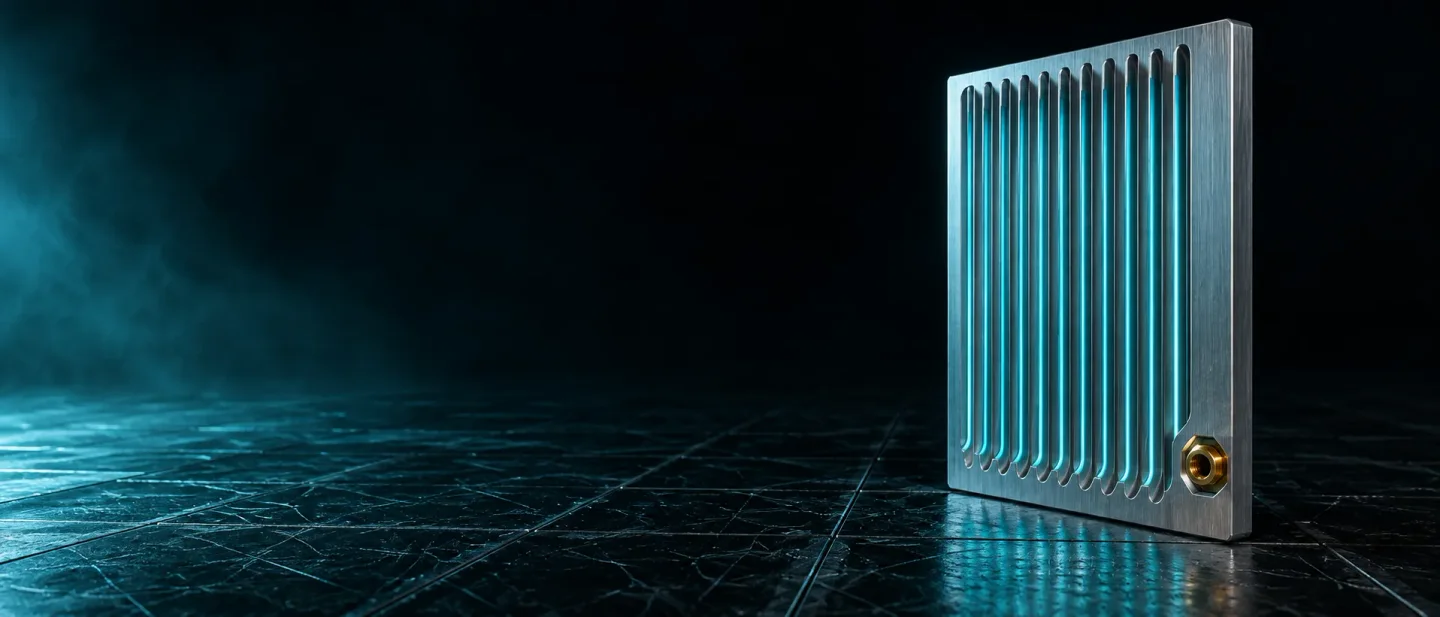
The number that separates the announcement from the hardware comes next. The four chips run a version of Google's open-weight Gemma model for about fifteen minutes at a stretch, answering simple questions, and then stop, because there is no air in orbit to carry heat away from them 4. A Google spokesperson told CNN the satellite "will have to power down every 20 minutes, because we don't want it to overheat" 1. Radiators are among the heaviest parts of the spacecraft, which turns the cooling problem into a launch-cost problem as well 4.
Google's own researchers explain the cooling problem, and the heat pipes and thermal vacuum chambers the team tested against it, in two minutes:
Loading content card…
What went up, and what it is there to prove
The satellite is the size of a refrigerator, and its four TPUs draw about 1 kilowatt of power 1. It flies in a dawn-dusk sun-synchronous orbit, chosen so the solar panels stay in near-continuous sunlight and the spacecraft can leave behind the heavy batteries a satellite would otherwise carry 4.
Travis Beals, who leads the project, calls the mission "a very minimal test", and Google has said what it is there to find out: whether the chips survive a rocket ride, and whether they survive the radiation and thermal extremes of low Earth orbit 5. On the ground, the team shook the spacecraft on all three axes, with individual components seeing 50 to 100 g during vibration testing, and ran the chips under a proton beam at the Crocker Nuclear Laboratory at UC Davis while they executed machine-learning workloads 56. The peer-reviewed version of that research, with the results, appeared in Joule on the same day as the launch 2.
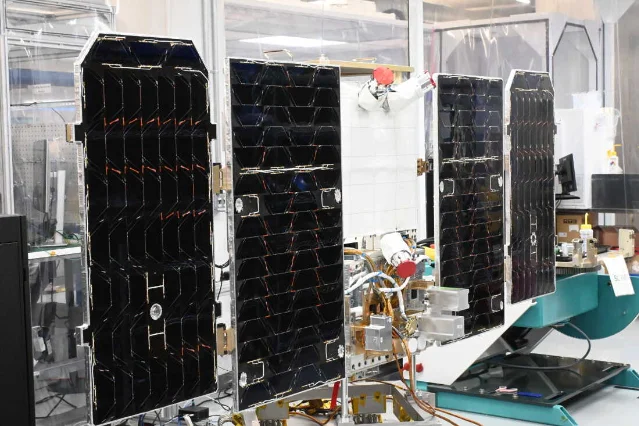
The plan is for the mission to keep working for a year, which is the only way to see how the chips age once they are actually being hit by radiation instead of sitting in a beam line 4. Google's post puts the next milestone in 2027, when two satellites are due to fly and test laser links between them 2.
Why a company spending $180 billion a year on the ground is looking up
Google's capital spending this year is $180 billion to $190 billion, and Sundar Pichai has said demand for AI services exceeds supply 4.
Terrestrial data centers are getting harder to build on. Grid connection timelines now run from two years in emerging hubs to ten years in constrained markets such as Amsterdam and Tokyo, land is contested, and water use is a local political issue 7. The community side is measurable: an Economist/YouGov poll in late August found that 63% of Americans would oppose a data center in their own community, and AWS chief executive Matt Garman wrote on Friday that more than 100 data center moratoriums are under consideration across the country, which is why Amazon pledged more than $1 billion over five years to the towns hosting its sites 8. Data Center Watch counted at least 75 projects worth about $130 billion blocked or delayed in the first three months of this year 8.
Orbit removes most of that friction. A solar panel in the right orbit generates up to eight times more energy per year than one at mid-latitude on Earth, with no interconnection queue and no neighbours to negotiate with 6. The team's argument is about the size of the prize rather than the convenience of the location. Beals puts it this way: "The sun puts out almost all of the power in our solar system. All of the other power sources that humanity has tapped into are just a tiny fraction of a percent" 4. Google announced the launch as "a long-term research moonshot", and Pichai recalled the first meeting where the team pitched it 910.
Beals also puts a date on the economics, and the date is far out: "I don't see this being something where it's cheaper to do this in the next five years. I think it will take longer than that" 4.
The three numbers that decide whether this ever matters
Heat handling capacity. Google's prototype has to shed about 1 kilowatt. The research paper estimates that an operational AI satellite has to handle 50 to 100 kilowatts, the draw of a typical terrestrial data rack 1. Telecom satellites in service today run at 10 to 20 kilowatts, according to Caleb Henry of the advisory firm Quilty Space 1. On the ground, cooling accounts for 10% to 30% of operating expense; in orbit it becomes mass, because heat can only leave through radiators 7.
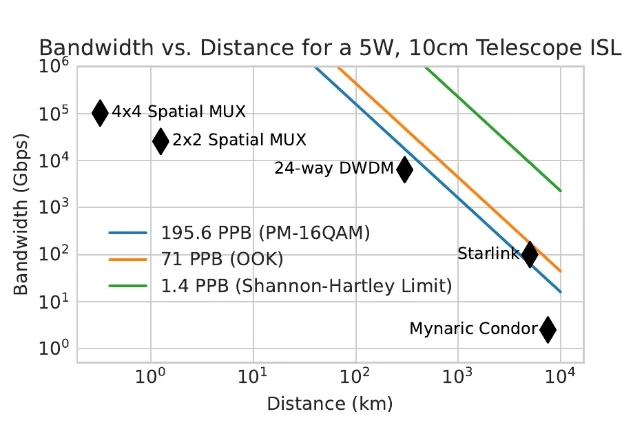
Bandwidth between satellites. Training across chips needs far more link capacity than satellites carry today. Google's TPU supercomputers connect chips at hundreds of gigabits per second each, while commercial optical inter-satellite links deliver 1 to 100 gigabits per second. The design in the paper calls for roughly 10 terabits per second per link, and the way to reach it is to fly the satellites much closer together than any constellation does now: received power falls with the square of the distance, so hundreds of metres of separation carry bandwidth that is unreachable at thousands of kilometres. A bench demonstrator moved 800 gigabits per second one way and 1.6 terabits per second both ways across a short free-space path 6. Maintaining that alignment is the hard part, and Google's own description of it is close to the physical difficulty: the equivalent of hitting a coin-sized target from miles away, with both points in motion 5.
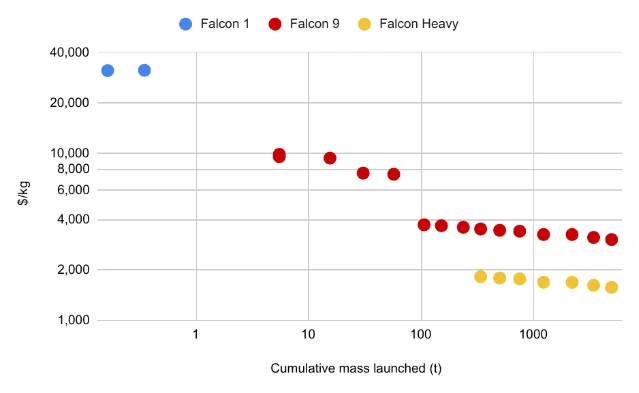
Launch price. All of it depends on the cost of putting mass in orbit continuing to fall. The paper fits a 20% learning rate to SpaceX's launch prices, meaning the price per kilogram drops by about a fifth for every doubling of cumulative mass launched, and finds that holding that rate would take roughly 180 Starship launches a year to reach $200 per kilogram by the mid-2030s. At that price, launch amortised over a satellite's life works out to about $810 per kilowatt-year, against the $570 to $3,000 per kilowatt-year that terrestrial data centers pay for power today 6. Commercial analysis sets the parity bar at $500 per kilogram, against roughly $2,700 on Falcon 9 today and a $200 target for Starship 7. Sitting underneath the arithmetic is a cadence problem: AI chips are replaced every one to two years, while satellites are built to last five to seven 7.
What the published numbers do and do not settle
The radiation results are the strongest evidence in the package, and they come from Google's own beam-line tests. The high-bandwidth memory subsystems were the most sensitive part of the chip: they began showing irregularities after a cumulative dose of 2 krad(Si), nearly three times the 750 rad(Si) that a five-year mission delivers through shielding, and no hard failure appeared up to the maximum dose tested, 15 krad(Si). The measured error rate works out to roughly one silent data corruption per three million inferences at one inference per second, which the authors call acceptable for inference 6. For training, the paper says the impact of single-event effects and of system-level mitigations "requires further study" — the outcome that matters most to the workloads big enough to justify moving a data center, and the one still open 6.
The power-down is a prototype constraint rather than a verdict on the architecture. Google's spokesperson told CNN that the two satellites planned for 2027 will be able to run continuously, without shutting down to avoid overheating 1.
Two practical objections sit outside the technical results. Repair is one: a failed chip in a terrestrial data center gets a technician, while the same failure in orbit is expensive or impossible to fix, which is why Brandon Lucia, a professor of electrical and computer engineering at Carnegie Mellon University, describes the costs and complexity as "amplified by a factor of 10, maybe a factor of 100", with a payoff that has to match 4. The environmental ledger is the other: the satellites would run on sunlight, but the rockets that launch them burn carbon-based fuel and the hardware eventually burns up on re-entry 4.
Google is first to orbit with this specific claim, and not first to the idea. Starcloud put an Nvidia H100 in orbit in November 2025 and trained a small model on it 11, and SpaceX has told investors it expects to start deploying "orbital AI compute satellites" as early as 2028 4. JLL's review of the sector lists a stated target of 88,000 satellites for Starcloud and an FCC filing for a million from SpaceX, against more than 17,000 satellites in orbit today and about 44,000 tracked objects larger than 10 cm 7. Google has published no constellation size of its own, and the spokesperson said the number of clusters a working system would need is undecided 1.
Where your product sits
- You own the annual capacity plan. Nothing in Thursday's launch moves a number in it. The event that could is the 2027 pair, which is due to test laser links between satellites and continuous operation, and until that flies, every gigawatt-hour you can buy is terrestrial 1.
- You run real-time inference. The workload split matters more than the satellite count. Training, batch processing, simulation and data generated in orbit are latency-tolerant and energy-hungry, which makes them the candidates; real-time inference and transaction processing stay close to users and networks 7.
- You sell anything built on satellite data. In-orbit processing is the nearer-term business case, and it exists today: Earth-observation satellites produce terabytes a day and the downlink is the bottleneck, so processing on orbit and sending results down removes a constraint that has nothing to do with AI training 7.
- You brief executives on the AI buildout. When "compute is moving to orbit" arrives in a deck, three figures size the claim: kilowatts per satellite, the duty cycle the chips actually run at, and dollars per kilogram to orbit. Today they read 1 kilowatt, fifteen to twenty minutes, and thousands of dollars 146.
- You carry policy or sustainability exposure. Disposal and re-entry rules are the gating question for any constellation at the proposed scale, and the proposals in play — tens of thousands to a million satellites — are far past what today's 17,000-satellite population has been governed for 7.
A 90-day watching brief
- Write down the terrestrial constraint your plan actually assumes — grid queue, land, or community consent — with the lead time behind each figure. The orbital option becomes interesting only when one of those lead times moves.
- Diary the 2027 mission. Two satellites, laser links between them, and continuous operation without a thermal shutdown: those are the two claims Google has made but not yet demonstrated 1.
- Ask your infrastructure team what share of your workload is batch, training, or simulation. That is the addressable fraction if orbital compute ever gets cheap, and the number is free to find out 7.
- When someone quotes a satellite count — 81, 88,000, a million — ask for kilowatts per satellite and the duty cycle instead. Those two figures decide whether a fleet is doing work or waiting for its radiators.
- Track the launch-price curve at the parity threshold of $500 per kilogram and the $200 per kilogram projected for the mid-2030s, and treat the first one as the date this stops being a research programme 67.
- Re-read the radiation results in a year, when Google has aging data from orbit rather than proton-beam data from a laboratory 4.
The decisions, with the clock on them
| Decision | What the launch provides | The constraint that decides it | Act when |
|---|---|---|---|
| Whether to change your compute-capacity assumptions | A four-TPU prototype running in fifteen- to twenty-minute bursts 1 | Terrestrial capacity is the only kind you can buy before the 2027 mission | At your next planning cycle, with the orbital line left empty |
| Whether to put "space data centers" in an executive deck | Contact confirmed; a mission that is meant to run for a year 2 | Kilowatts and duty cycle, neither of which is at data-center scale | Before the deck goes out |
| Whether your latency-tolerant workloads belong in orbit | A 10 Tbps link requirement and an 800 Gbps bench demonstration 6 | Link bandwidth between satellites, then launch price at $500 per kilogram | When launch lands under $500 per kilogram |
| Whether to track debris and re-entry policy | A first mover with a year-long mission and no published constellation size 1 | Disposal rules for constellations in the tens of thousands | This quarter, if policy is your team's remit |
| Whether to watch the competitor set | Starcloud trained a small model on an H100 in orbit in 2025; SpaceX targets 2028 11 | Which of them demonstrates continuous operation first | At the next orbital compute launch |
The launch details, the 1 kilowatt figure, the twenty-minute power-down and the 2027 plan come from CNN's report of 1 October, which quotes a Google spokesperson; the fifteen-minute figure and Travis Beals's comments come from NPR's report the same day. Every radiation, bandwidth, constellation and launch-cost figure is from Google's own research, first posted in November 2025 and revised in June 2026, and now peer-reviewed in Joule; the company ran the tests it reports. The polling, the moratorium count, the $130 billion figure and the $500-per-kilogram threshold are secondary sources — JLL, GeekWire and Data Center Watch — rather than measurements made here. The spacecraft had been in orbit less than a day, so nothing above describes how the hardware is actually performing.
References
- 1
- 2
- 3Will Marshall on X
x.com
- 4
- 5
- 6
- 7Data centers in space
jll.com
- 8
- 9Google on X
x.com
- 10Sundar Pichai on X
x.com
- 11
This story was produced automatically by a channel. One sentence is all it takes for Neodrop to keep producing for you.