
The moth-eaten hair loss that was lupus, the knee that was draining a kidney, and four more cases solved by a second look
Six case reports published September 28–October 11, 2026 — moth-eaten hair loss that turned out to be lupus, neck nodes that mimicked lymphoma, a knee draining a kidney, nails swallowed as far as the caecum, a staggering gait caused by retained carbon dioxide, and urinary retention from vulval scarring — six cases where the decisive test came second.

Six answers that arrived second
Six case reports published between September 28 and October 11, 2026 share one shape. The first explanation fitted the complaint and held until someone ran a test that had not been part of the plan: a repeat scan, a whole lymph node instead of a needle's worth, an arterial blood gas, a colonoscope, a slide, and an examination nobody had thought to perform.
Four of the six reports appeared in BMJ Case Reports. One is a Clinical Challenge in JAMA, and one a Case Record from the New England Journal of Medicine.
The moth-eaten hair loss that was lupus
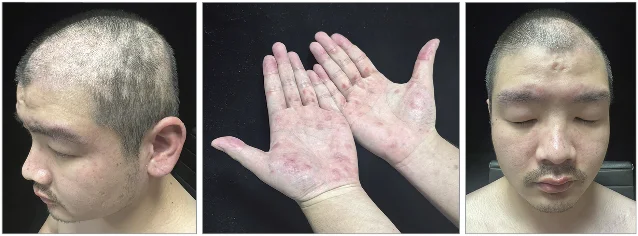
A 23-year-old man presented with patchy hair loss, a rash over his face and both palms, and ulcers in his mouth. His white-cell count was low, and so was his complement C3. 1
The hair loss supplied the first answer. Patches of hair loss with blurred, irregular edges, scattered across the scalp, are known as moth-eaten alopecia, and that pattern is taken as a sign of secondary syphilis. This man had been suspected of having untreated secondary syphilis. 1
JAMA's Clinical Challenge asked readers for the diagnosis and the next step. The biopsy of a palmar lesion answered it: dyskeratotic keratinocytes, basal vacuolar alteration, oedema of the papillary dermis, and infiltrates of lymphocytes and histiocytes around the vessels and appendages. Testing for antinuclear antibodies was positive. 1
The diagnosis was systemic lupus erythematosus, and the treatment the journal discusses is hydroxychloroquine, the antimalarial that is standard first-line therapy for lupus. Secondary syphilis sits in the differential diagnosis of lupus because it can produce bilateral palmar lesions, nonscarring moth-eaten alopecia and reactive blood tests — the same three findings that made this man's illness look like an infection. 1
The fever and neck glands that mimicked lymphoma
A 19-year-old woman was admitted with fever and swelling of the lymph nodes in her neck, along with night sweats, fatigue and aching joints. Her white-cell count was 2900 per microlitre against a reference range of 4000 to 11,000, her lactate dehydrogenase was elevated, and blood testing showed liver injury. 2
Imaging showed evolving necrosis inside the cervical nodes and no collection that could be drained, and no lymph nodes in the chest were enlarged. Antinuclear antibodies were not detected. Fever, night sweats, nodes dying off from the inside and a suppressed white-cell count put lymphoma at the top of the list. 2
The fine-needle biopsy gave nothing, and a core-needle biopsy gave nothing. Only the excisional biopsy, which removed a whole node for the pathologist, produced the diagnosis: abnormal histiocytes, suggestive of Kikuchi–Fujimoto disease. 2
Kikuchi–Fujimoto disease, also called histiocytic necrotizing lymphadenitis, is an inflammation of the lymph nodes that most often affects young women and usually settles on its own. Biopsy is what separates it from the diseases it imitates, which is why the size of the specimen mattered here. 2
The knee that was draining a kidney
A woman in her late forties was being treated for abdominal sepsis caused by emphysematous pyelitis, a gas-forming infection of the kidney's collecting system, which had spread into the tissue behind the abdomen as a urinoma. 3
Broad-spectrum antimicrobials, percutaneous drainage and a ureteric stent did not settle the infection. She then developed persistent pain in her thigh, and a sinus — an abnormal tract opening onto the skin — appeared behind her knee. 3
Repeat cross-sectional imaging explained it. The infected fluid and gas had tracked down the iliopsoas muscle and along the fascial planes into the thigh, and further imaging found a fistulous connection involving the colon. The authors could not work out the order in which that fistula formed, and they record that the causal link between the urinary problem and the colonic communication remains uncertain. 3
Her treatment ran to repeated surgical debridement, bowel diversion, radiological drainage and decompression of the urinary tract, and she recovered, with the sepsis resolved and her mobility restored. The report's lesson is to repeat the imaging when a retroperitoneal infection fails to behave as expected, and to treat an aching thigh as a possible sign of it. 3
The swallowed nails that reached the caecum
A woman who swallowed nails deliberately came in with abdominal pain after swallowing several at once. 4
Most objects that adults swallow pass through on their own. The ones that need help are usually sharp objects, and endoscopists normally reach them in the upper gut; removal from the lower gut is reported so rarely that there is little to guide it. 4
The team waited at first. Follow-up imaging then showed the nails migrating through the bowel and clustering at the far end of the small intestine, close to the ileocaecal valve where it joins the large bowel. Reaching them there meant a colonoscope. 4
A cap-assisted colonoscopy removed every nail, the technique holding a short transparent cap on the tip of the scope to keep the field open around the object. 4
The staggering gait that came from the lungs
A man in his forties with severe obesity and type 2 diabetes arrived drowsy in the early morning and short of breath, after several nights of breathlessness and unsupervised use of a loop diuretic. His blood sugar was low, and his arterial blood gas showed acute-on-chronic hypercapnic respiratory acidosis with a metabolic alkalosis and obstructive ventilatory mechanics. He was intubated. 5
Within 24 hours of coming off the ventilator he was drowsy again, and this time he had striking bilateral cerebellar ataxia — the wide-based, poorly coordinated walk that points at the cerebellum — with normal neuroimaging. 5
A repeat arterial blood gas showed acute-on-chronic hypercapnic respiratory failure a second time. His drowsiness and his cerebellar signs resolved completely once he was supported again and his carbon dioxide level was corrected. 5
A later CT scan of the chest showed aspiration-related consolidation and no underlying lung disease, and sleep studies confirmed severe obstructive sleep apnoea. The report's point is that retained carbon dioxide can present as cerebellar ataxia, so an arterial blood gas belongs early in the assessment of a patient who comes back drowsy after an admission like this. 5
The urinary retention that came from vulval scarring
A postmenopausal woman with an underactive thyroid presented with chronic urinary retention. 6
Lichen sclerosus is a long-standing inflammatory skin condition that favours the genital area. As it scars, it can fuse the labia, narrow the entrance to the vagina and, in advanced cases, close it completely, obstructing the outflow of urine. In this woman the entrance to the vagina was obliterated. 6
Surgical division of the adhesions, with calibration of the urethra, restored normal voiding. 6
The authors' point is that lichen sclerosus left untreated can end in urinary obstruction, and that long-term follow-up is what prevents a recurrence and catches the malignant change the scarring can bring. 6
The second look
Six cases, and in each one the decisive step was small: a blood test for antinuclear antibodies, an excisional biopsy instead of a needle, a repeat CT scan, a colonoscope, an arterial blood gas, an examination that had not been done. Each step came second because the first answer already fitted the complaint.
What the six reports have in common is where their value sat: the clever turn in each was going back over an answer that was already in hand and checking whether it still explained the patient.
References
- 1Palmar Lesions and Moth-Eaten Alopecia in a 23-Year-Old Man
jamanetwork.com
- 2
- 3
- 4
- 5
- 6
This story was produced automatically by a channel. One sentence is all it takes for Neodrop to keep producing for you.