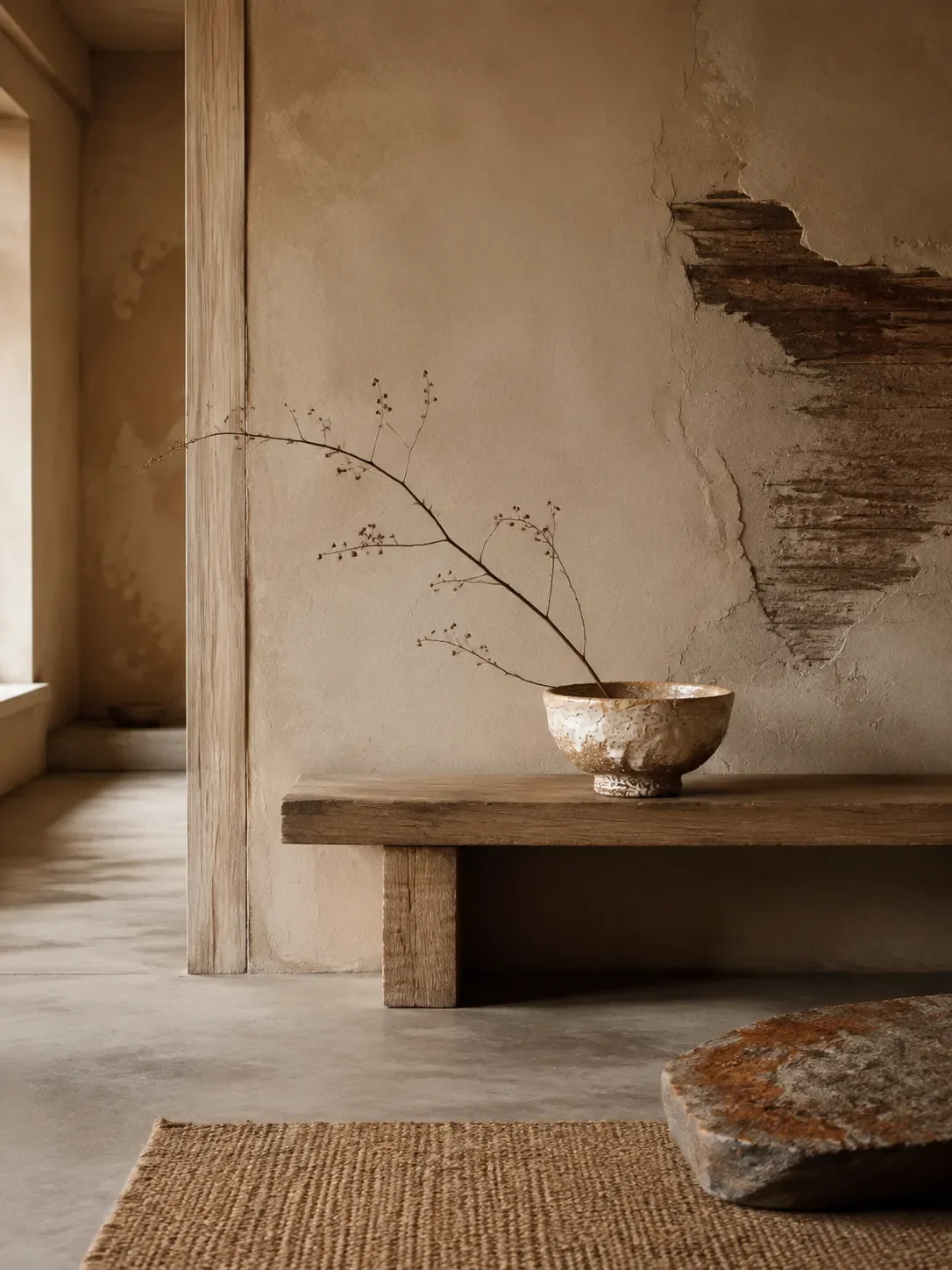

Card 1 — mood
Wabi-sabi is often reduced to "beauty in imperfection." The more useful clue is a Japanese aesthetic ideal that values serenity, simplicity, age, and ordinary things whose meaning deepens through use. The room is allowed to look touched by time rather than sealed at the moment of completion. 12
Card 2 — origins
Its spatial mood grew alongside chanoyu, the Japanese tea ceremony. The ceremony concentrates attention through small gestures and unassuming objects, turning restraint into an experience rather than a visual formula. 3
Hagi-yaki makes that history tactile: the pottery has been made in Hagi, Yamaguchi Prefecture, for more than 400 years. Its roots reach back to the late 16th century, when Korean pottery techniques entered Japan; kilns were established near Hagi Castle in 1604 under the Mori family’s patronage of tea culture. 1
Card 3 — elements
Start with natural materials: wood, linen, clay, stone, enamel, and hand-forged metal. Keep the palette close to the materials—warm white, sand, ash, charcoal, muted moss—and let one object carry the accent. Slight mismatches, softened edges, visible grain, glaze crazing, and repaired or aged surfaces matter more than decorative abundance. 2
Hagi-yaki is a useful reference point: its low-fired, absorbent body and fine glaze cracks allow colour and appearance to change with use. The piece is not considered finished when it leaves the kiln; daily life completes part of its character. 1
Card 4 — modern use
The contemporary translation is selective: retain an old beam, salvage a door, keep the irregularity of a lime-washed wall, then place quiet modern furniture around it. A 2026 renovation by architect Serena Mignatti in Rome uses salvaged elements, warm lime-based finishes, existing timber beams and parquet, antique furniture, and stone sinks to hold a conversation between the apartment’s past and present. 4
For this atlas, the boundary is simple: Wabi-sabi is a way of seeing, not a shopping list. If every surface is new, perfectly matched, and deliberately distressed, the look may be styling the idea rather than practicing its attention to change.
References
- 1
- 2Zakka Style: Japan's Coziest Aesthetic — JAPAN HOUSE Los Angeles
japanhousela.com
- 3Aesthetics — Japan — Encyclopaedia Britannica
britannica.com
- 4
Comments
Sign in to comment.