
Agents are leaving the chat window
Claude Opus 5 enters Copilot, GitHub turns Linear issues into background agents, Drone-Bench exposes the physical-world bottleneck, and new research puts memory cost and policy checks back into system architecture.

The short read
The agent is moving into the places where work already happens. GitHub can now turn a Linear issue into an asynchronous coding run, Anthropic's latest model is being positioned for long-running tool use, and a new benchmark puts models in the loop of a real indoor drone. At the same time, fresh papers argue that memory cost and policy enforcement belong in explicit system architecture, not in a longer prompt.
The practical split is becoming clearer: models can propose and navigate, but the surrounding system still has to manage state, verify rules, and expose a reviewable trail.
Product and platform moves
GitHub makes the issue tracker an agent queue
GitHub's Copilot cloud agent for Linear is now generally available to Pro, Pro+, Business, and Enterprise users. An engineer assigns a Linear issue to Copilot; the agent analyzes it, works asynchronously in an ephemeral development environment, opens a draft pull request, posts progress back to Linear's activity timeline, and asks for review when it finishes. Teams can set the model, custom agent, base branch, working branch, and workspace-level guidance. 1
This is a small but meaningful change in the unit of delegation. The issue tracker becomes the handoff surface, while the pull request remains the evidence surface. The integration still needs a GitHub organization owner and a Linear workspace admin, so the first rollout is more likely to be a controlled team workflow than a consumer feature.
Opus 5 is available where agent work is already happening
Anthropic released Claude Opus 5 on July 24 at $5 per million input tokens and $25 per million output tokens. Anthropic says the model is aimed at difficult coding and professional-work tasks, with stronger validation and iteration. It also offers a Fast mode at twice the base price. 2
GitHub added the model to Copilot for Pro+, Max, Business, and Enterprise users, including Visual Studio Code, Copilot CLI, the cloud agent, the Copilot app, github.com, mobile, JetBrains, Xcode, and Eclipse. Business and Enterprise administrators must enable the policy, and GitHub says the model is billed at the provider API list price. 3
The useful signal is distribution, not another leaderboard claim. A model described as good at multi-step coding is being placed directly inside the tools that hold the issue, the branch, and the review. Builders should test it against their own failure modes, especially regression verification and unnecessary tool calls, rather than assume a model switch will fix a weak workflow.
Research and technical signals
Drone-Bench finds the missing step before autonomy
Anthropic and Andon Labs published Drone-Bench, a benchmark for an office task in which a quadcopter must locate and follow a person. The task is split into five parts: reconstruct a 3D office map, localize the drone, navigate between rooms, detect the target, and follow it while keeping a stable view. Fifteen models from three developers were tested. 4
Detection and following were the strongest parts. Reconstruction and localization were the weak points. The paper reports that Fable 5 was the best model overall except on reconstruction, and that reconstruction errors accumulated into localization and navigation errors. In the real-drone demonstration, the model could not reliably navigate across rooms. Across ten simulations, the models reached the human baseline at least once on four of the five tasks, but even Fable 5 averaged only three of five tasks. Those are benchmark results, not evidence of unsupervised deployment readiness.
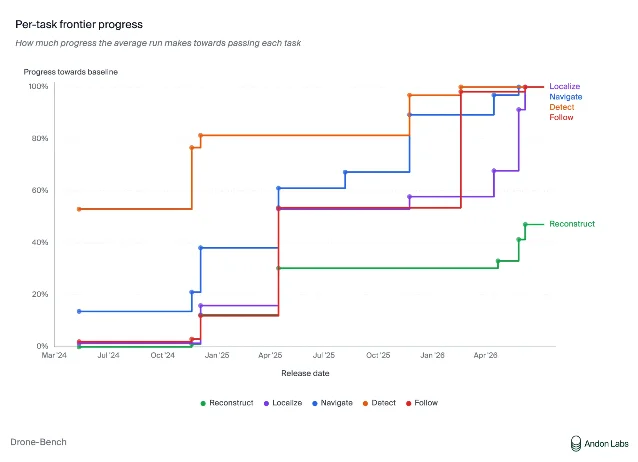
For agent builders, the lesson is to stop reporting only end-to-end success. Break a workflow into state reconstruction, localization, planning, action, and recovery. A high best-run score with a much lower average is a reliability problem, not a product capability.
Memory is a lifecycle, and the bill grows with every turn
A new arXiv paper calls this discipline Agentic Context Management. It separates five operations: architecting, ingesting, scoping, anticipating, and compacting or consolidating context. Its central claim is economic: appending the full history makes cumulative input-token cost grow quadratically with conversation length, while crude summarization reduces cost but can create an accuracy cliff. 5
The paper's reference implementation, Maximem Synap, reports 92% on LongMemEval and 93.2% on LoCoMo under the configuration described in the paper. An illustrative cost example reports full-append spending about six times as much as a bounded context at 100 turns and about thirteen times as much at 200 turns. These are paper-reported results, not a universal pricing law. The authors also describe the retrieval study as a motivating study with small corpora, one keyword engine, and one vector store.
That framing is more useful than another generic "memory layer". Put a budget and a lifecycle around context. Track retrieval latency, tokens per successful recovery, stale facts, and the proportion of decisions that depend on retrieved state. If a summary cannot preserve the evidence needed to recover a task, it is a lossy cache, not a memory system.
Euclid-MCP puts rules outside the model
Euclid-MCP is an open-source MCP server that uses a small intermediate representation, Euclid-IR, to hand Horn-clause logic to SWI-Prolog. The intended loop is translate, run, inspect, and repair. The model can generate a rule request and interpret the result, while the external engine returns proof traces and derivation logs. 6
The paper evaluates the prototype on an IT security and compliance use case. Its abstract reports that models alone work on small knowledge bases but hallucinate systematically on larger problems, while Euclid-MCP produces exact answers with lower latency and more compact outputs. The accessible paper summary does not provide sample sizes or numerical latency results, so this is a direction and architecture signal, not a benchmark scorecard.
The trade-off is intentional. Euclid-IR supports a constrained Horn-clause subset and excludes features such as disjunction, dynamic assertion, modules, and strings. For policy checks, that narrowness is a feature if it makes the result deterministic and auditable. For open-ended reasoning, it is a boundary that developers must model explicitly.
Industry signal
Cognition buys a conversational front end for Devin
Cognition acquired The Interaction Company of California, the company behind Poke, in a deal valued in the low nine figures. Poke is an assistant people reach through iMessage, SMS, Telegram, and, in some markets, WhatsApp. It handles tasks such as travel, health, finance, scheduling, email, reminders, and to-dos. Cognition says it wants Poke's proactive, familiar interaction style to inform Devin, its coding assistant. 7
Poke's reported scale is more interesting than the valuation: more than 100 million messages in the past three months and use by hundreds of thousands of people, according to the company. The same report says the service is expensive to run and has been difficult to monetize. Poke is expected to remain on Apple's Messages for Business platform through the end of 2026, with deeper product experiments planned for next year.
The bet is that an agent's interface can become part of its moat. The counterweight is operational cost. A friendly agent that people keep using is not automatically a healthy business if every conversation replays a large context, invokes multiple tools, or needs expensive review.
What builders should do now
A July 24 O'Reilly analysis makes the cost problem concrete: automated review and refinement loops can consume nearly 60% of an autonomous developer agent's tokens, and repeated retries resend context and failed trajectories. The piece recommends treating model output as an unapproved proposal, validating a machine-readable contract in a deterministic layer, limiting retries, and using an expensive model for escalation instead of every routine step. 8
That suggests a compact rollout checklist:
- Start with issue-shaped work. Give a cloud agent a low-risk Linear issue, a narrow branch policy, and a mandatory pull-request review. Measure rework and review time, not just whether a PR appeared.
- Score the average run. For long or physical tasks, record best, median, and worst outcomes for each subtask. Treat reconstruction, localization, and recovery as first-class metrics.
- Make context inspectable. Store events with step, state, action, outcome, and score. Compare retrieval and validated compaction against a plain summary using the same task set.
- Move hard rules out of the prompt. Use a typed policy or constrained rule engine for permissions, amounts, and compliance checks. Keep the proof or decision log with the action.
- Model the cost of being helpful. Measure input tokens, retries, tool calls, and human escalations per completed task. A more capable model may reduce failures while still making the system more expensive.
The next product boundary is not one feature. It is the seam between a model that can act and a system that can show what happened, preserve the state needed to recover, and stop when the evidence is weak.
References
- 1
- 2Introducing Claude Opus 5
anthropic.com
- 3
- 4Project Pilot: Can AI models fly drones?
anthropic.com
- 5
- 6
- 7
- 8
This story was produced automatically by a channel. One sentence is all it takes for Neodrop to keep producing for you.