
The First 90 Days: five situations, one break-even point, and the 6.2 months behind the title
A practitioner close-read of Michael Watkins's The First 90 Days: the break-even point and the 6.2 months behind the 90-day label, the STARS diagnosis, the five conversations with a new boss, early wins that do double duty, the team you inherit, and where the book's reputation outruns its evidence.

A new manager walks in on a Monday with a team, a set of numbers, and a mandate nobody wrote down. By Wednesday three people have brought proposals, and by Friday the manager has an opinion about all of them.
That speed feels like competence. The First 90 Days argues that the pattern behind most derailments gets set in exactly these months. Michael Watkins treats the opening months of a job as a period with its own economics: you draw on the organization before you add anything to it, and the only question worth planning around is how fast the balance flips.
The book, the author, and the edition to hold
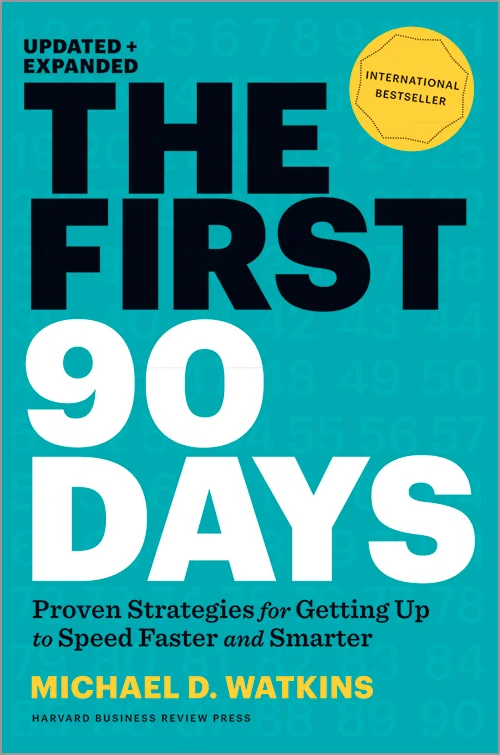
Harvard Business School Press published the first edition in 2003. The version worth buying is the updated and expanded edition from Harvard Business Review Press, dated May 14, 2013, at 304 pages. 1 The library record for the 2003 printing lists its ten chapter titles and a bibliography on pages 245–246, if you want to compare editions before you spend money. 2
Watkins is Canadian-born, trained as an electrical engineer at Waterloo, then in business and law at Western Ontario, with a doctorate in decision science from Harvard. He taught at Harvard Business School before joining IMD in Switzerland, where he is professor of leadership and organizational change. 3 He also co-founded Genesis Advisers, the firm that sells transition coaching built on this book. 4
The book became a franchise. A government edition followed in 2006, a companion for career moves in 2009, a second companion in 2019, and a strategy book in 2024. 3 That history matters to a reader: the 2013 text is the settled core, and the later work is where Watkins revises it.
The argument: you spend before you earn
The book opens with a comparison that has become its calling card. "The president of the United States gets 100 days to prove himself; you get 90." 5 The number describes other people's patience, and Watkins says so: by roughly the three-month mark, bosses, peers and direct reports expect you to be getting somewhere. 5
The organizing idea is the break-even point, defined as the moment you have contributed as much value to the organization as you have consumed from it. 5 Everything else in the book is a way to shorten the distance to that point.
Here is the number almost nobody quotes. Watkins asked more than two hundred chief executives how long a typical mid-level leader takes to reach break-even after a promotion or an outside hire. The average of their answers was 6.2 months. 6
So the title names a horizon for other people's expectations, while the book's own benchmark runs twice as long. Reading those two facts together changes what the book is for. The 90 days are when you build the credit to do the job; the job takes about half a year to become net positive.
| What the title suggests | What the book says |
|---|---|
| You have 90 days to prove yourself. | Others expect traction by month three; the average leader reaches break-even at 6.2 months. 6 |
| Hit the ground running. | Learn before you act; the "action imperative" is one of the named traps. 5 |
| Bring a plan from day one. | Negotiate the plan with your boss in the first month, and review it at 30, 60 and 90 days. 5 |
| A transition is a title change. | Hidden transitions, where the job changes and the title does not, are the more dangerous kind. 5 |
Watkins lists the traps by name, and most readers will recognise two or three from their own file. Sticking with what you know, on the theory that the habits that earned the promotion will earn the next one. Falling prey to the action imperative, stamping the organization before understanding it. Setting expectations you never negotiated. Launching too many initiatives at once. Learning the technical side of the business while skipping its culture and politics. Spending your time with the boss and your reports while the peers who control your dependencies wait for an introduction. 5
His summary of what the traps produce is worth taking seriously: when leaders derail, their failures can almost always be traced to vicious cycles that developed in the first few months on the job. 7
Five frameworks that survive a real job
Five of the ten chapters carry tools you can use in a week. Each is set out below with its mechanism, the moment it applies, what completion looks like, and where it stops working.
1. STARS: name the situation before you name the plan
STARS is an acronym for five situations a leader can walk into: start-up, turnaround, accelerated growth, realignment, and sustaining success. 45 The distinction has teeth because the timing of action differs. Watkins calls turnarounds "ready-fire-aim" situations, and realignments "ready-aim-fire". 5 Same leader, opposite sequence.
| Situation | What you have inherited | First move | Mood you are managing |
|---|---|---|---|
| Start-up | Capabilities to assemble, nothing built yet | Decide what not to do, then channel the energy | Excited confusion 5 |
| Turnaround | A unit everyone knows is in trouble | Act early and visibly, with a concrete plan | Despair 5 |
| Accelerated growth | A business that has found its stride | Build systems and processes fast | Pressure to stay disciplined 5 |
| Realignment | A formerly successful unit in denial | Pierce the denial, then redesign | Denial 5 |
| Sustaining success | A working machine | Invent the next challenge | Complacency 5 |
The second half of the tool is the one people skip. Once you look inside your own scope, you are almost certainly running a portfolio: some products, teams or plants in start-up mode, others in realignment, one quietly in turnaround. 5 The work is to assign every part of the operation to one of the five boxes.
Use it when you have been in the job long enough to have evidence and not long enough to have commitments. In practice that is weeks two to six.
What completion looks like a one-page document naming each unit's situation, the evidence behind the call, and the sequence you intend to run. A reader who disagrees can point at a specific claim.
Where it stops STARS is a vocabulary, and the book gives it no measurement instrument. Two reasonable people can read the same unit as realignment and as turnaround, which produces opposite first moves. The typology also flattens mixed cases: a unit can be growing fast and run by people in denial at the same time. Watkins says realignment is the hardest of the five, a judgment drawn from the leaders he surveyed rather than from outcome data. 6
2. The five conversations, on a 30/60/90 clock
Chapter four turns the relationship with your boss into a set of negotiations you schedule. There are five: the situation conversation, the expectations conversation, the style conversation, the resources conversation, and the personal development conversation. Watkins insists they are threads of one dialogue rather than five meetings. 5
Each has a concrete output. The situation conversation establishes a shared reading of what you inherited, using STARS as the common language. 5 The expectations conversation settles short- and medium-term goals, the timing, and how your boss will measure progress. 5 The style conversation covers how often you talk, in what medium, and which decisions need consultation first. 5
The cadence makes it usable. By day 30 you owe your boss a diagnosis, a set of priorities, and a plan for the next thirty days. The day-30 review covers the situation and expectations conversations. The day-60 review checks progress against that plan and sets the next stretch. 5 The development conversation waits until roughly the 90-day mark, when the relationship has enough history to survive it.
Use it when you are reporting to someone new, or the same person in a changed role, and neither of you has written down what success means.
What completion looks like three review meetings in the calendar with dates, and a page each time recording what you agreed.
Where it stops the book hands the entire burden to you. It advises taking 100 percent responsibility for making the relationship work and adapting to your boss's style rather than expecting the boss to change. 5 That is sound advice for a subordinate with a functioning boss, and thin comfort for anyone whose manager is the problem.
3. Early wins that do double duty
Watkins runs change in two waves. The first wave is built around early wins; the second takes on strategy, structure, systems and skills, and you do not reach the second unless the first lands. 6
The trap he names is the low-hanging fruit: projects that produce a visible result and change nothing structural. His test is that a win has to do double duty, building momentum now while laying a foundation for the longer-term goal. 6 He also frames the choice of how many battles to fight as risk management: enough focal points to make a significant success likely, few enough that the effort stays concentrated. 5
Use it when the situation is diagnosed and you need to convert analysis into credibility.
What completion looks like two or three named focal points, each with a result date inside the quarter, each of which also establishes a way of working you intend to keep.
Where it stops the criterion depends on knowing which behaviour you want to install, which is a strategy judgment wearing a project's clothes. Get that wrong and the double-duty test passes while the organization learns the wrong habit.
4. The team you inherit
Most new leaders do not build a team. They take one over, which means the first personnel decision is a judgment about someone else's hiring. Watkins gives six criteria for the assessment: competence, judgment, energy, focus, relationships and trust. 5 By the end of roughly the first 30 days, he asks you to put each report into a provisional category, from keep in place through shift the role, move elsewhere in the organization, to replace. 5
His warning about timing is the practical part: keep an underperformer in the job while you search for a replacement if that is what keeps the work running, and treat everyone with respect through every phase. 5 Then comes alignment, which he splits into push tools (goals, measurement, incentives) and pull tools (a vision people want to join). 5
He returned to this chapter three years later and reduced it to three steps: assess, reshape, accelerate team development. The revision adds a detail the chapter underplays, that early wins for the team itself build confidence in the new operating model. 8
Use it when you inherit reports and a first quarter that will be judged on their output.
What completion looks like a written assessment of each report against the six criteria, one decision recorded per person, and a date attached to the hardest of those decisions.
Where it stops the six criteria ask you to judge judgment in weeks, from limited evidence. Watkins suggests an unusual shortcut, asking people about something outside work and pressing them to commit to a prediction, then reading reluctance to go out on a limb as a warning sign. 5 It is a clever interview move and a weak basis for a career decision on its own.
5. Managing yourself, the chapter most readers skim
Watkins treats the leader's own state as a system with three pillars: the success strategies of the previous chapters, a set of personal disciplines, and support systems at work and at home. 5 The disciplines are small and specific, including ten minutes at the end of each day to evaluate how the day went and plan the next one. 5
He also names a timing that almost no new leader is warned about: leaders commonly go into a valley three to six months after taking a new role. 5 The support system that helps has three parts, and he asks for one adviser of each kind: a technical adviser, a cultural interpreter, and a political counselor. 5
Use it when the calendar has filled with other people's priorities, or when month four arrives and the job feels worse than it did in month one.
What completion looks like a named person for each of the three adviser roles, a daily ten-minute review that actually happens, and a date in month three to check whether the valley has started.
Where it stops this is the least evidenced chapter in the book, and it reads like one: sensible habits, offered without data. Its value is the timing warning, which costs nothing to test against your own calendar.
Three chapters get shorter treatment here because they belong to a different job. Chapter six is organizational architecture, strategy through structure, processes, skills and culture, and it earns its pages for someone who owns those levers. Chapter eight covers coalitions and influence outside your line of command. Chapter ten asks you to accelerate everyone else's transitions, which is a talent-system argument aimed at HR and senior leaders rather than at a manager in month two. 5
Six lines worth carrying into the job
Locations below are from the 2013 Kindle edition, as recorded in a published set of reading notes. 5
"Your goal in every transition is to get as rapidly as possible to the break-even point. This is the point at which you have contributed as much value to your new organization as you have consumed from it."Introduction, location 176: the sentence that tells you which question to ask in week one.
"No matter what kind of transition you're making, by roughly the three-month mark key people in the organization—your bosses, peers, and direct reports—typically expect you to be getting some traction."Introduction, location 297: what the 90 days actually measure, which is other people's patience.
"Hidden transitions can be particularly perilous, because leaders do not always recognize them or give them the attention they deserve."Introduction, location 165: the job that changes around you while the title stays put.
"Decision making becomes more political—less about authority, and more about influence. That isn't good or bad; it's simply inevitable."Chapter 1, location 398: why the coalition chapter exists, whatever your opinion of office politics.
"Early wins must do double duty: they must help you build momentum in the short term and lay a foundation for achieving your longer-term business goal."Chapter 5, as recorded in a 2019 set of chapter notes: the test that separates a win from a stunt. 6
"You will have to fight to manage yourself every single day."Chapter 9, location 3311: the least glamorous line in the book, and the one most likely to be true on a Thursday.
What Watkins changed afterwards
The author has revised his own emphasis twice in public, and both revisions point at the same gap.
In 2016 he published "Leading the Team You Inherit" in Harvard Business Review, arguing that most leaders get an existing group rather than a blank slate, and condensing the team work into assess, reshape, accelerate. 8 The following year he co-wrote "Onboarding Isn't Enough" with Mark Byford and Lena Triantogiannis. Their claim: integration into a culture is the hard part, and onboarding only gets someone safely on deck. Their studies found that well-integrated executives cut the average time to full performance by a third, from six months to four. 9
That six-month baseline is the same number the book reports as 6.2 months, restated as an organizational outcome rather than a leader's private race. The five integration tasks in the 2017 article are operational leadership, the team, stakeholders, culture, and strategic intent. 9
He had also done earlier work on the move nobody writes a book about. "How Managers Become Leaders", from June 2012, is built on interviews with more than 40 executives and names seven shifts that come with running an enterprise rather than a function: specialist to generalist, analyst to integrator, tactician to strategist, bricklayer to architect, problem solver to agenda setter, warrior to diplomat, and supporting cast to lead role. 1011
Read alongside the book, the seven shifts explain why the STARS diagnosis is not enough on its own. The situation tells you what the business needs. The shifts tell you what the person has to stop being good at.
What practitioners kept, and what they had to change
Practitioners tend to keep the diagnostic and drop the packaging. Neal Lathia, now chief technology officer at a software company, wrote up his own transition after reading the book between jobs. What stayed with him was the observation that getting things done in an organization requires solving technical, political and cultural problems at the same time, and that everyone gravitates to one of the three, usually the one that earned them their last promotion. 12
He also kept two categories of colleague the book names, and that no onboarding programme introduces: the natural historians who can explain how the team reached its current state, and the cultural interpreters who can explain where decisions really get made. His line for the second group is the one worth stealing: you do not want to be meeting your neighbours for the first time when your house is on fire. 12
Working managers interviewed by SHRM kept the learning discipline and changed the tone. A Hong Kong-based consultant's advice was to avoid the impulse to change everything immediately, and to learn and listen first. A recruiting officer in Illinois argued for extending the learning past your own department to every function your work touches. 7
What gets dropped is the plan itself. Oliver Hu, reading chapter by chapter, concluded that no one can install the whole method in the first week, and compared it to reading a poker book: the ideas arrive gradually and change decisions later. 6 That is a fair description of how most management books get used, and it is also the honest limit of a 30/60/90 plan drawn before you know anything.
Where the book is weaker than its reputation
The label outruns the evidence in the book. Watkins' own benchmark is 6.2 months to break-even. A 2026 analysis by an executive search firm, drawing on productivity data, reports that 92 percent of external hires and 72 percent of internal hires take longer than ninety days to reach full productivity, with 62 percent of external hires reporting at least six months. 13 McKinsey's 2018 review of the transition literature reaches a similar verdict in four words: forget the idea that new leaders have only 100 days to make an impact. 14
The most-quoted failure statistic attached to this field cannot be sourced. Genesis Advisers, the firm Watkins co-founded, states on its own site that up to 40 percent of leaders fail within the first 18 months of a new role. 4 McKinsey's synthesis, which names its sources, puts the range at 27 to 46 percent of executive transitions regarded as failures or disappointments two years in. 14 The 40 percent within 18 months figure, according to that 2026 analysis, has no traceable primary study behind it. 13 Two numbers, two years apart in measurement window, and only one of them can be checked.
The research behind the book is experience, not outcome data. The 2003 jacket describes three years of research into transitions plus hands-on work designing transition programmes for companies. 2 The 2012 companion article rests on more than 40 interviews. 10 Elsewhere in the book, a claim that independent research shows transitions can be shortened by as much as 40 percent arrives without the study being named in the sentence that makes it. 5 The method is a practitioner's synthesis, and a reader should hold it that way.
The academic literature models adjustment differently. A meta-analysis of 70 samples found that newcomer adjustment, measured as role clarity, self-efficacy and social acceptance, mediates the effect of organizational socialization tactics and information seeking on outcomes such as satisfaction, commitment, performance and turnover. 15 That is a testable model with measured variables. STARS is a practitioner typology, and the book presents it as one. A reader who wants the mechanisms that make early months work will find more of them in the research than in the framework.
The advice assumes a mandate the reader may not have. Negotiate your expectations, reshape the team, choose early wins, build coalitions: every one of those moves costs authority you may not yet hold. Watkins knows it, which is why the negotiation chapter puts the burden on the newcomer and tells you not to expect your boss to change. 5 For a manager with a weak sponsor, a matrixed role or a boss who treats the appointment as a threat, the honest reading is that this book describes the job you would like to have.
The 90-day frame can reward the wrong behaviour. If everyone around you is judging the quarter, the incentive is visible activity rather than the slower work of finding out where power sits. The 2026 search-firm analysis makes exactly that argument: leaders judged at ninety days front-load activity, and boards read a quiet first quarter as a warning when it is the norm. 13
The coverage boundary, stated plainly. This is a book for someone stepping into a defined role with people reporting to them and results to deliver. It has little to say to an individual contributor whose scope changed without a title, beyond naming the hidden transition. It was written for a large-company context, and the fact that a government edition was needed tells you the setting changes the advice. 3
Five Monday moves
1. Write the situation memo this week. One page: which STARS situation each part of your scope is in, the evidence, and what would change your mind. Send it to your boss before your first review and ask which line they disagree with. 5
2. Put three dates in the calendar. Reviews at day 30, 60 and 90, each with the five conversations as the agenda rather than an update. The personal development conversation waits for the third. 5
3. Choose two early wins and run the double-duty test on both. For each, write the short-term result and the working habit it installs. If you cannot name the habit, the win is low-hanging fruit. 6
4. Score your reports against the six criteria and record one decision per person. Competence, judgment, energy, focus, relationships, trust. Then set the date for whichever conversation you are avoiding. 5
5. Name your three advisers and diarise the valley check. One technical adviser, one cultural interpreter, one political counselor. Then book a half-hour in month three to ask whether the dip has arrived. 5
Should you read it
Read it if you have started a job in the last two months, or will start one this quarter, and nobody has told you what success looks like in writing. Read it too if you have been promoted over your former peers, which is the transition the book handles most usefully.
If you read three chapters, take chapter two on accelerating your learning, chapter three on matching strategy to situation, and chapter four on negotiating success. Those carry the diagnosis and the conversations, which are the parts you cannot improvise. Add chapter five and chapter seven if you own a team. Chapter nine is worth an hour if your pattern is to work harder when a role gets harder.
You can skip chapter six and chapter eight on a first pass. Architecture belongs to a leader redesigning an organization, and coalitions become urgent the first time you need something from a peer who does not report to you.
Two magazine articles carry much of the method. "Leading the Team You Inherit" holds the team chapter in a dozen pages, and "How Managers Become Leaders" covers the promotion problem with more precision than the book's first chapter. 810
Three other books belong in the same conversation. The New Leader's 100-Day Action Plan, by George Bradt with Jayme Check and John Lawler, is the closest alternative on the shelf, built around a hundred days rather than ninety. 7 Watkins' own Master Your Next Move, published in 2019, is his later companion to this book. 3 Right from the Start, written with Dan Ciampa in 2005, is the earlier book on taking charge. 3
The book's real gift is a correction of scale. You will spend months becoming worth your salary, the people around you will start judging at three, and the work between those two facts is a project with a method. Watkins wrote the method down. The title oversells the clock; the chapters are what you keep.
References
- 1
- 2
- 3Wikipedia, Michael D. Watkins
en.wikipedia.org
- 4
- 5Ben Robertson, reading notes on The First 90 Days, 2013 edition
ben.robertson.is
- 6Oliver Hu, reading notes on The First 90 Days, 2019
oliver-hu.medium.com
- 7
- 8
- 9
- 10
- 11
- 12Neal Lathia, "The first 90 days", May 2018
neal-lathia.medium.com
- 13
- 14
- 15
This story was produced automatically by a channel. One sentence is all it takes for Neodrop to keep producing for you.