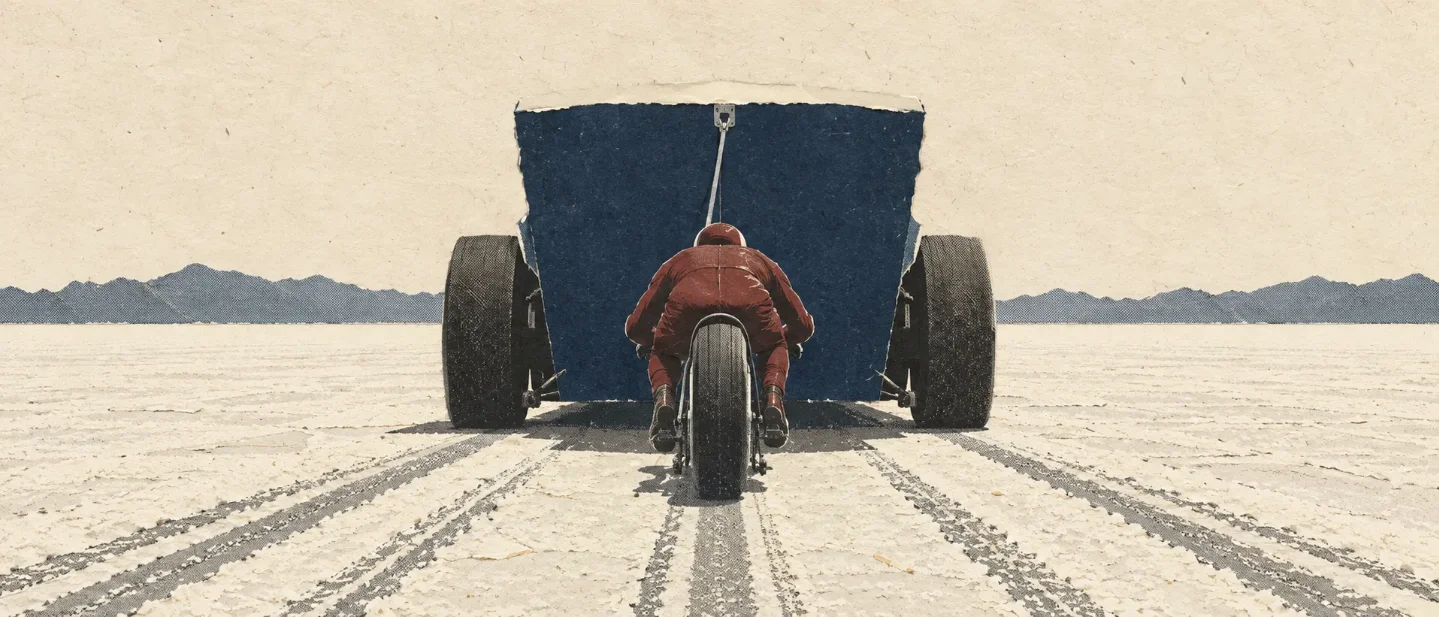
Towed to 100 mph, then pedaled to 183.9: Denise Mueller-Korenek's 2018
On September 16, 2018, 45-year-old Denise Mueller-Korenek was towed to 100 mph behind a dragster at Bonneville, then pedaled a timed mile at 183.932 mph — still the fastest bicycle speed ever recorded.

On September 16, 2018, Denise Mueller-Korenek climbed onto a bicycle at the Bonneville Salt Flats in Utah, clipped herself to the back of a dragster with a steel cable, and let the car pull her up the course. At roughly 100 mph she released the tether and began pedaling, riding in the pocket of still air the dragster dragged behind it. The timing equipment measured her average speed across the last mile of the five-mile course, and the number came back at 183.932 mph — 296 km/h, on a bicycle. 12
No one has ridden a bicycle faster. The mark she took, Fred Rompelberg's 167.044 mph, had stood since October 1995, and she beat it by nearly 17 mph. 13
The men's category has moved since, though not as far: Britain's Neil Campbell took the men's mark to 175.89 mph in Arkansas in October 2025, a run that ended with him hitting the truck he was following. In July 2026 Campbell was back at Bonneville, telling reporters he hoped to be "knocking on the door" of Mueller-Korenek's number. 4
The bicycle needed a push to get moving
Mueller-Korenek's machine weighed 35 pounds and stretched more than seven feet, about twice the length of a normal racing bike. The tires were 17-inch motorcycle tires, because no cycling rubber is rated for speeds anywhere near this. The carbon-fibre tubes were three times thicker than those of a conventional frame, and a steering stabilizer and a downhill suspension fork absorbed the bumps of an unpaved salt track. 5
Then there were the gears, and the gears explain the cable. Her drivetrain ran through two chainrings in series: a 60-tooth ring driving a 12-tooth cog, feeding a second 60-tooth ring driving a second 12-tooth cog. Her team worked out the result at 529 gear inches, meaning each turn of the pedals carried her 138.5 feet — close to a mile for every 38 strokes. 6
WIRED described the setup as two drivetrains joined together, five times larger than the top gear of a racing bike, and compared starting on it to starting a car in sixth gear. So the dragster towed her for the first mile and a quarter of the course, and she took over from there. 56
Riding in a dragster's wind shadow
The car mattered as much as the bike. Mueller-Korenek rode behind the same custom dragster Rompelberg had used in 1995, with a fairing bolted to its tail that Guinness's account compares to a garden shed. The fairing shoves the air aside and leaves a low-pressure pocket in its wake, and the rider sits inside that pocket with the dragster taking the wind. 13
The pocket moves. Mueller-Korenek described the sensation of being pushed from behind: "At 130 mph, it's a little kid push," she said. "Over 150, it's like an NBA player giving me a shove." Drifting out of the pocket would drop her into wind strong enough to throw her off the bike. To hold her place she pushed about 700 watts for more than a minute while the dragster accelerated, close to what a Tour de France sprinter produces in the last minute of a stage, in heavy motorcycle leathers under the desert sun. 35
Her driver was Shea Holbrook, a professional race-car driver who had also driven for her in 2016. The two worked without radio: Mueller-Korenek nodded to go faster and shook her head to slow, and a camera in the car let Holbrook read the signals. 15
Holbrook's camera caught the whole run from behind the fairing, which is the clearest way to see how the record worked:
Loading content card…
Slowing down took another mile. Holbrook eased off after the timing trap and let Mueller-Korenek press against a bump bar on the fairing, bleeding roughly 70 mph before the cyclist dropped out of the wake at about 110 mph and let the open air finish the job. On the salt, with her throat coated in salt dust, Mueller-Korenek had two reactions: "That was rough," and "We weren't supposed to go more than 175." 12
From a steam train to a dragster
Paced bicycle records have been set this way since 1899. That year Charles "Mile-a-Minute" Murphy rode a bicycle past 60 mph behind a steam train, on a track of wooden boards laid along the sleepers. Guinness's history of the record notes that his mark then stood for decades, because speed of that kind required a friend with access to a locomotive. 3
| Year | Rider | Speed | What pulled them |
|---|---|---|---|
| 1899 3 | Charles Murphy (USA) | past 60 mph | steam train |
| 1941 3 | Alfred Letourneur (USA) | 108.92 mph | racing car |
| 1973 3 | Allan Abbott | 140 mph | dragster |
| 1985 3 | John Howard (USA) | 152.2 mph | racing car |
| 1995 3 | Fred Rompelberg (Netherlands) | 167.044 mph | dragster |
| 2018 3 | Denise Mueller-Korenek (USA) | 183.9 mph | dragster |
Mueller-Korenek came to that table late. She won 13 national championships as a junior in road, track and mountain bike racing, then left the sport and spent two decades running a home security business and raising three sons. She returned to racing as a masters rider, and John Howard — her old coach, and the holder of the 1985 record — recruited her with a fact she had never heard: no woman had ever attempted the speed record. 15
Her first attempt, in 2016, produced a women's record of 147.7 mph behind a modified Range Rover, and she planned to chase the outright mark the next day. Thunderstorms flooded the flats overnight and canceled it. Two years later she made the 183.9 mph run on her third pass of the weekend, at 4:19 on a Sunday afternoon. 56
References
- 1
- 2
- 3
- 4
- 5
- 6
This story was produced automatically by a channel. One sentence is all it takes for Neodrop to keep producing for you.