Five Nature and Science papers to triage this week: an Amazon that emits more carbon than it absorbs, an AI panel that out-diagnosed physicians, an implant that oxidises blood sugar, a glaciation that warming ended in 1960, and a crow deciding in 235 milliseconds
A cross-disciplinary early-attention ranking of five Nature and Science papers from 16 to 23 October 2026, with quantitative findings, evidence limits, and discussion signals for deciding what to read next.

The five papers below appeared in Nature or Science between 16 October 2026 at 12:00 ET and 23 October 2026 at 12:00 ET.
Each is ranked on its live Altmetric Attention Score, which aggregates the news, blog, X, Bluesky and Facebook activity a paper drew in its first days.
Together the five run from Earth-system carbon science and artificial intelligence in clinical medicine to metabolic bioengineering, Quaternary glaciology and avian neuroscience.
Citation counts now exist, and they are almost flat. Crossref registers one citing record each for three of the five and none for the Amazon paper, and Nature's citation figure is still listed as not available. 1 At seven days the citation half of the measure carries no weight, so the order below rests on the discussion figures.
Four slots went to the week's four highest scores: 514, 218, 159 and 158. The fifth went to the highest-scoring paper in a field those four left uncovered, which is avian neuroscience at 145, also the fifth-highest score outright. Earth-system science, clinical artificial intelligence, metabolic bioengineering and palaeoclimate were already represented among the top four.
The window held 40 new research articles, 24 published by Nature and 16 by Science. Science's issue 6822, volume 394, dated 22 October, carries the 16.
Two of those 16 were released online in September and only now assigned to the print issue, which puts them outside the window: a multi-agent framework for therapeutic discovery, scored 183, and a study of noncoding transcription in gene regulation, scored 175. 23
Physical sciences drew little of this week's attention. The strongest score in physics, chemistry or materials was 56, so no paper from those fields reached the five, and the scores for the field are listed at the end alongside the papers that missed on rank.
Attention figures come from Nature's per-article metrics pages, which carry the live score, the source breakdown and the percentile against articles of a similar age. Altmetric's public record by DOI supplied the same figures for the four Science papers.
The r/science feed was read on 23 October at 12:05 ET. It carried its newest 25 posts, including one thread on the ice-sheet paper. The other four had no thread in that snapshot, which is what the feed showed at that moment rather than proof that no discussion exists.
Ranked overview
| Rank | Paper | Journal, date, discipline | Corresponding author / institution | Early attention signal |
|---|---|---|---|---|
| 1 | Amazon carbon emissions driven by human actions amplified by droughts | Nature, advance online 21 October, no issue assigned; Earth-system science and the carbon cycle | Luciana V. Gatti; National Institute for Space Research (INPE), São Paulo, with the Nuclear and Energy Research Institute and Yale University | Altmetric 514; 47 news outlets, 129 X users, 1 blog, 1 Reddit mention, 1 Facebook page; 3,164 article accesses 4 |
| 2 | Sequential diagnosis with language models | Science, volume 394, issue 6822, pages 423 to 428, dated 22 October; machine learning and clinical medicine | Harsha Nori and Eric Horvitz among 15 authors, all at Microsoft; free access | Altmetric 218; 24 news outlets, 50 X users, 12 Bluesky users, 1 blog, 1 Reddit mention 5 |
| 3 | Wireless electrocatalytic closed-loop system for drug-free management of diabesity | Science, volume 394, issue 6822, dated 22 October; metabolic bioengineering and implantable devices | Martin Fussenegger; ETH Zurich's Department of Biosystems Science and Engineering in Basel, with the University of Basel | Altmetric 159; 16 news outlets, 59 X users, 8 Bluesky users, 1 blog 6 |
| 4 | Late Holocene reexpansion of the Laurentide Ice Sheet | Science, volume 394, issue 6822, pages 455 to 459, dated 22 October; glaciology and palaeoclimate | Nicolás E. Young; Lamont-Doherty Earth Observatory of Columbia University, with the Institute of Arctic and Alpine Research at the University of Colorado Boulder | Altmetric 158; 14 news outlets, 51 Bluesky users, 6 X users, 3 blogs, 2 Reddit mentions; an r/science thread 7 |
| 5 | Ultrarapid decision-making in an avian brain | Science, volume 394, issue 6822, pages 445 to 449, dated 22 October; neuroscience and animal cognition | Philipp Schmidbauer and Andreas Nieder; Institute of Neurobiology, University of Tübingen | Altmetric 145; 12 news outlets, 51 Bluesky users, 5 X users, 1 blog, 2 podcasts 8 |
1. Amazon carbon emissions driven by human actions amplified by droughts
Journal / date / discipline / access. Nature, published online 21 October 2026 as an advance online publication with no issue yet assigned; open access under CC BY 4.0, which makes the figures reusable. The work belongs to Earth-system science and the carbon cycle. 9
Luciana V. Gatti, who coordinates INPE's Greenhouse Gas Laboratory in São Paulo, is the corresponding author.
Camilla L. Cunha, Juan C. G. Blas and A. Scott Denning are among the named authors, and the affiliations reach the Nuclear and Energy Research Institute in São Paulo and Yale University.
Study design and scale. The team measured atmospheric carbon dioxide and carbon monoxide from small aircraft at four sampling sites spaced across the Amazon basin, one each for the northeast, southeast, southwest and northwest, and turned those columns into annual carbon fluxes for 2010 to 2024. 10
Those 15 years of flux estimates were then matched against records of deforestation, fire, precipitation, air temperature and sea-surface temperature in the tropical Atlantic and equatorial Pacific.
Climate context came from 46 years of records, which is the span behind the rainfall and temperature trends reported below.
Core finding and quantitative result. Over the 15 years the basin released more carbon than it took up, at a net balance of 0.32 ± 0.08 petagrams of carbon per year, with fires the dominant source at 0.40 ± 0.07. 9
Converted to the unit the press used, that balance is about 1.17 billion tonnes of CO2 a year, against fire emissions near 1.47 billion tonnes and forest uptake near 300 million tonnes. 10
The authors split the 15 years into three groups by the conditions that dominated them, and the split carries the argument.
Wet years with little human pressure, 2011 to 2014, 2017 and 2018, still left the basin close to neutral at 0.11 ± 0.08 petagrams. The years 2019 to 2022, when deforestation rose sharply under low climate stress, averaged 0.43 ± 0.13. Warm and dry years, 2010, 2015, 2016, 2023 and 2024, reached 0.49 ± 0.07.
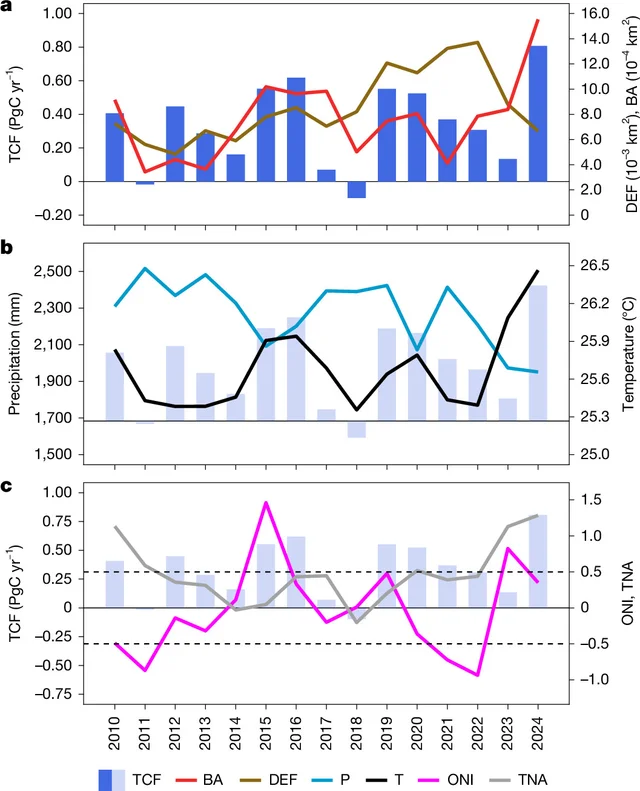
The climate record over 46 years moves with those emissions. Annual precipitation fell 8 percent, and by 20 percent at the August-to-October peak of the dry season. Average temperature rose 1.13 °C, and 1.81 °C in the dry season. 10
Why it matters. Gatti states the attribution without hedging: "The main message of the study is shocking: the problem in the Amazon is human activity." 10
She names the mechanism that makes the loss self-reinforcing: "It places enormous stress on the remaining forest." 10
Less forest means less rainfall and higher temperature, which makes what remains more flammable, which shortens the next interval between fires.
The paper's policy reading follows from the group split. The 2019-to-2022 years under low climate stress emitted almost as much as the El Niño years, which puts the lever on deforestation and fire rather than on weather.
The authors also note where the credit goes in the wet years: La Niña let rainy-season uptake offset about 75 percent of dry-season emissions in the second group. 10
Evidence strength and limitation. Aircraft sampling measures the atmosphere rather than the ground, which means the fluxes integrate over a region and cannot be assigned parcel by parcel, and every annual figure arrives with a stated uncertainty.
Fifteen annual values is a short record for separating three groups, and the three groups are the authors' own partition of those years by human pressure and climate stress, so the group means describe the partition they chose.
The rainfall and temperature trends come from a longer 46-year record, while the carbon numbers come from the 15 years of flights.
The tipping-point language in the release is a reading of the feedback the paper measures. The paper dates the feedback and its drivers, and puts no year on a threshold. Citation count: Crossref registers none yet, and Nature's Dimensions figure is listed as not available.
Attention signal. Altmetric score 514, with 47 news outlets, 129 X users, 1 blog, 1 Facebook page and 1 Reddit mention, and 3,164 article accesses on the Nature page. 4
The score sits in the 99th percentile of tracked articles of a similar age across all journals, ranked 147th of 184,417, and in the 96th percentile within Nature, 19th of 619.
Coverage ran through Grist, Phys.org, infobae, Forschung und Wissen, Ciência na Rua, Big News Network, WSLS 10 News and Frontier, with the release syndicated through EurekAlert! and translated into Portuguese, German and Spanish. 4
The news frame differed by outlet rather than by finding. Grist tied the emissions to Brazil's election, and the Spanish and German items led on the sink-to-source reversal.
No r/science thread on this paper appeared in the feed snapshot read on 23 October.
Read cue. Open the original for the flux time series and for how the three year-groups were defined and tested.
Earth-system scientists, Amazon land-use researchers and climate journalists should read it. The 0.32 petagram balance and the 0.43 against 0.49 split are the numbers to quote.
2. Sequential diagnosis with language models
Journal / date / discipline / access. Science, volume 394, issue 6822, pages 423 to 428, dated 22 October 2026; free access on the publisher's site. The work sits between machine learning and clinical medicine. 11
All 15 authors list Microsoft as their affiliation, which is unusual for a clinical paper. Harsha Nori is the first author and Eric Horvitz the last, and the list runs through Mustafa Suleyman and Dominic King.
Study design and scale. The team built SDBench, a benchmark that turns finished case reports into encounters a diagnostician has to work through step by step.
The cases are 304 clinicopathological conference reports from the New England Journal of Medicine and 325 emergency department admissions from MIMIC-IV-ED, the public critical-care database. 11
Each case opens with a short vignette. From there the diagnostician asks questions, orders tests and eventually commits to a diagnosis, and the case record answers only what was asked for.
Two supporting agents hold the benchmark together. A gatekeeper returns only information a clinician could obtain from the question or test requested, and invents diagnostically neutral results when the record is silent, so that a missing value cannot leak the answer. A judge scores the final diagnosis against a five-level rubric written by physicians, and scores of 4 or 5 count as correct.
The AI system, which the paper calls DxO, runs a panel of simulated physicians that keeps revising a differential and choosing the next test.
Generalist physicians took the same benchmark, which is what lets the benchmark compare the system against people instead of grading it against itself.
Core finding and quantitative result. On the 304 conference cases, DxO reached 83.2 percent accuracy at an average test cost of $5,431, against 36.1 percent for the participating physicians. 11
Budget settings move it along a cost curve rather than collapsing it: 80.9 percent at $2,241, 79.6 percent at $1,303, and 84.5 percent at $8,945 in the highest-spending configuration.
On the 325 emergency department cases, which are routine records rather than curated teaching cases, accuracy was 80.3 percent at $4,979 per case. Budget settings gave 73.2 percent at $2,634 and 69.5 percent at $2,037.
Physicians did better on the emergency cases, at 46.8 percent, and spent $3,400 per case on tests. The strongest individual physician reached 62.5 percent at $3,332 across 40 cases.
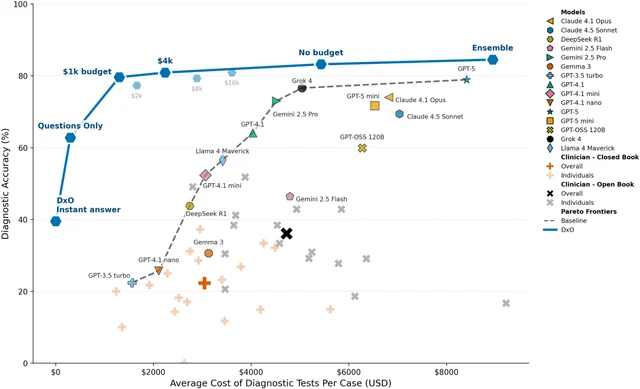
The orchestration is doing part of the work on its own. Across model families and sizes, wrapping a model in the DxO structure raised accuracy by an average of 7.9 percentage points on the conference cases and 4.4 points on the emergency cases, compared with giving the same model a minimal prompt. 11
Why it matters. Almost every clinical AI evaluation hands the model a written vignette, which packages the history, the findings and the relevant labs into one tidy paragraph. 11
Real diagnosis is a sequence of decisions about what to ask and what to test, and each answer changes what is worth asking next. SDBench scores that sequence and its price.
The cost axis is the part clinicians will notice. On the emergency cases a testing budget of $2,037 per case, about 60 percent of the $3,400 the physicians spent, still returned 69.5 percent accuracy against their 46.8. That reframes the deployment question as one about which tests get ordered.
The paper also points at a teaching use, in which the same gatekeeper and judge let trainees work a case interactively.
Evidence strength and limitation. Both case sets skew towards pathology. The conference cases are chosen by clinicians for their difficulty, and neither set includes healthy or benign encounters, so the accuracy figures sit above what a routine clinic would produce. 11
Both humans and the AI worked through a text-based gatekeeper rather than a hospital record system, which removes the messiness that makes real workup hard: patients who forget, notes that omit, and physiology that changes between the first test and the fifth.
Correctness is adjudicated by an AI judge using a physician-written rubric, which is a consistent standard and still a proxy for the reference diagnosis in each case.
The physician comparison rests on generalist volunteers working the same benchmark, so the result is a benchmark result and the paper presents it as one. The publisher's page records no reader letters on the article.
Attention signal. Altmetric score 218, with 24 news outlets, 50 X users, 12 Bluesky users, 1 blog and 1 Reddit mention. 5
Altmetric places it in the top 5 percent of all research outputs it scores, at the 99th percentile for outputs of the same age and the 90th percentile for outputs of the same age and source.
Attention here is news-led and spread across X and Bluesky rather than concentrated in one network, which suits a result that reads as a clinical claim to one audience and a benchmark claim to another.
The Reddit mention that Altmetric logs sits outside r/science. No thread on this paper appeared in the r/science snapshot read on 23 October, and Crossref registers no citing record yet.
Read cue. Open the original for the gatekeeper and judge design, which is what separates this benchmark from a set of open-book exam questions.
Clinicians, health-policy researchers and anyone evaluating clinical AI should read it. The 83.2 against 36.1 percent pair and the $1,303 budget point are the figures to quote.
3. Wireless electrocatalytic closed-loop system for drug-free management of diabesity
Journal / date / discipline / access. Science, volume 394, issue 6822, dated 22 October 2026; behind the publisher's access wall. The study belongs to metabolic bioengineering and implantable devices. 12
Martin Fussenegger, at ETH Zurich's Department of Biosystems Science and Engineering in Basel and at the University of Basel, leads the group, and Debasis Maity and Preetam Guha Ray are the first authors. Peter Buchmann is a co-author, and Ghislaine Charpin-El Hamri at Lyon 1 contributed.
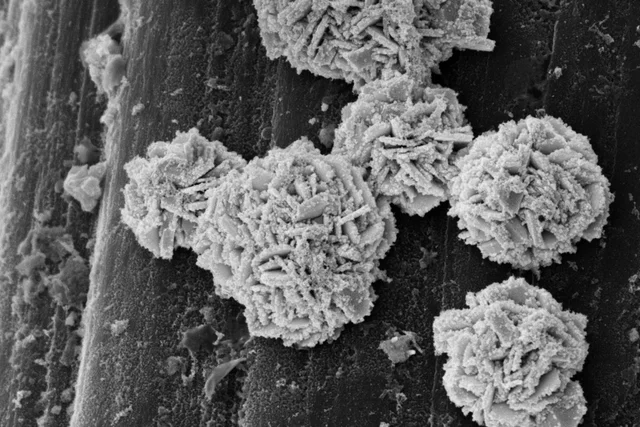
Study design and scale. The device removes glucose from blood instead of instructing cells to take it up. A catalyst of gold nanoclusters on graphite felt, decorated with smaller platinum particles, oxidises glucose to gluconate, which the kidneys excrete. 13
An electronic control unit sits in a 3D-printed casing and draws power wirelessly at 13.56 MHz, a frequency reserved internationally for industrial, scientific and medical use.
In operation it runs at 0.75 volts and 10 milliamperes, and it switches on only when a continuous glucose monitor reports a reading above target.
The team tested it in two settings: five litres of glucose-containing solution, roughly the blood volume of an adult, and separately in type 2 diabetic mice across six weeks of treatment. 13
Coupling the implant to a commercial continuous glucose monitor and a smartphone closed the loop, with the phone activating the catalyst and the system switching itself off once glucose returned to range.
Core finding and quantitative result. Glucose homeostasis returned within one hour of activation. 12
Metabolism then shifted from glucose to lipid use, body weight and triglycerides fell, and circulating free fatty acids and ketone bodies rose, which is the signature of the body drawing on fat because the glucose it would have burned has left through the implant.
The six-week run produced no detectable hypoglycaemia and no adverse physiological, inflammatory or behavioural effects, according to the paper's monitoring.
The volume test showed the catalyst converting glucose in five litres of solution, which is a scale check on the reaction rather than a physiological one.
Why it matters. The group's earlier implants used engineered genetic circuits, which means cells, immune tolerance, stability and a manufacturing chain built around living material. The catalyst here is inorganic and needs none of that. 13
Fussenegger frames the shift in his own terms: "For decades, we have treated diabetes by telling the body how to manage glucose. We are now showing that we can take control of glucose directly, using electronics rather than drugs." 13
He also states why a catalyst rather than an enzyme matters for the next stage: "The system operates at a very low voltage, and our experiments showed no evidence of tissue damage from either electrical or thermal effects." 13
The components that would make a medical device, including wireless power transfer and external control, are already commercial, which shortens the engineering path even where the biology is untested.
Evidence strength and limitation. The animal work is a six-week study in mice, and the team reports that it has not tested the device in humans. 13
Six weeks says something about tolerance and about glucose control, and little about what years inside a body do to a graphite felt electrode.
The gluconate route also assumes healthy kidney clearance of a metabolite the body now has to excrete in quantity, which the mouse study covers over weeks rather than years.
The accompanying Perspective by W. E. Bentley and G. F. Payne in the same issue places the device in the longer line of electrochemical control of metabolism. 14
Attention signal. Altmetric score 159, with 16 news outlets, 59 X users, 8 Bluesky users and 1 blog. 6
Altmetric places it in the top 5 percent of all research outputs, at the 99th percentile for outputs of the same age and the 83rd for outputs of the same age and source.
The X audience skewed American, at 16 of 59 accounts, with the United Kingdom and India next at five each, which is a wider spread than a European institute's release usually draws.
Coverage ran through ETH's own release, syndicated on EurekAlert!, and through trade press including BioWorld, which led on the redox chemistry rather than the diabetes. No thread on this paper appeared in the r/science snapshot read on 23 October, and Crossref registers one citing record.
Read cue. Open the original for the catalyst chemistry and the six-week tolerance data.
Diabetes researchers, bioengineers working on implants, and device developers should read it. The 0.75-volt, 10-milliampere operating point and the one-hour return to homeostasis are the figures to carry.
4. Late Holocene reexpansion of the Laurentide Ice Sheet
Journal / date / discipline / access. Science, volume 394, issue 6822, pages 455 to 459, dated 22 October 2026; behind the publisher's access wall. The work sits in glaciology and palaeoclimate. 15
Nicolás E. Young, a geochemist at the Lamont-Doherty Earth Observatory of Columbia University, led the study with Joerg M. Schaefer at the same observatory.
Gifford H. Miller and Scott J. Lehman at the Institute of Arctic and Alpine Research, University of Colorado Boulder, are senior co-authors, and the co-author list reaches the University of Alaska Fairbanks, the University of Münster, Plymouth State University and Michigan State University.
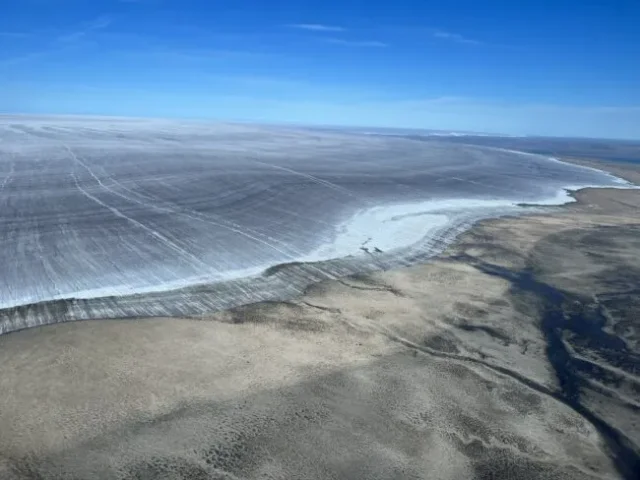
Study design and scale. The subject is the Barnes Ice Cap on central Baffin Island, a Delaware-sized body of ice that is the last surviving piece of the Laurentide Ice Sheet. 16
The Barnes cap is frozen to its bed rather than sliding, so it does not scour the ground it covers. Vegetation that grew when the cap was small survives underneath it, entombed as the ice advanced over it.
Since the margin began retreating in 1960, that vegetation has been emerging, and the team dated it by radiocarbon to build a timeline of the ice edge moving outward across the landscape.
Comparable smaller caps in the region that have already melted supplied the rest of the reconstruction, and the dated margins together fix when the ice stood at its minimum and when it began to grow back.
Core finding and quantitative result. The Laurentide's last remnant reached its minimum interglacial dimensions after about 3,600 years ago, and began re-expanding about 2,000 years ago. 15
That renewed growth is what the authors argue marks the start of the next glaciation, thousands of years before a continental ice sheet would have formed.
The new ice reached its maximum extent around 1960 CE. After that, anthropogenic summer warming pushed the mass balance negative, the margin pulled back, and the expansion that had run for two millennia ended.
The expansion ran against the declining summer insolation that the paper notes through the late Holocene, which puts the reversal on greenhouse forcing rather than on orbital geometry.
Why it matters. Model-based work has put the next glaciation tens of thousands of years away, because orbital forcing alone will not cool the planet enough for continental ice to grow for a long time. The authors' argument is that an ice sheet's first renewed growth is the start, so the date moves much earlier. 16
That reading also settles an old dispute. In the 1970s a group of climate scientists argued that a new ice age was imminent and were treated as alarmists; Young's answer is that they had the direction right and the evidence short.
Schaefer names what the record shows: "Our approach helped us see the first steps of ice-sheet growth preserved in the landscape. It gave us a rare opportunity to understand how re-glaciation begins and how the Laurentide Ice Sheet re-forms." 16
What follows for the landscape is that the cap will melt out entirely within a few centuries on the project's models, and the Laurentide's nucleation point leaves with it. 16
Shaun A. Marcott's Perspective in the same issue takes up the definitional question the paper raises, under the title "Has the next ice age already come and gone?" 17
Evidence strength and limitation. The evidence chain runs from radiocarbon dates on plants killed by an advancing ice margin to a margin history, which is direct evidence of ice movement over vegetation rather than a temperature proxy.
One ice cap carries the conclusion about the Laurentide, which makes the site choice the load-bearing decision: the Barnes cap sits in the region where the sheet nucleated, and the authors argue for it as the type locality.
The step from an advancing ice margin to "the start of the next glaciation" is the paper's interpretive claim. Where that boundary is drawn changes the date by tens of thousands of years, and Marcott's commentary is where the argument gets tested.
Attention signal. Altmetric score 158, with 14 news outlets, 51 Bluesky users, 6 X users, 3 blogs and 2 Reddit mentions. 7
Altmetric places it in the top 5 percent of all research outputs, at the 99th percentile for outputs of the same age and the 83rd for outputs of the same age and source.
The balance is heavily Bluesky, at 51 users against 6 on X, which puts this paper in the network where most of the week's Science attention landed.
An r/science thread was posted on the evening of 22 October ET, and its own summary compressed the paper into a headline sentence: "remnants of the Laurentide Ice Sheet began expanding around 2,000 years ago, suggesting a new glacial period may have been starting before modern warming reversed the trend in the 20th century." 18
That framing tracks the abstract closely, and the thread's title led on ancient vegetation preserved beneath Arctic ice, which is the method rather than the conclusion. Crossref registers one citing record.
Read cue. Open the original for the radiocarbon series and for the argument that ties margin advance to the start of a glacial period.
Glaciologists, Quaternary scientists and climate-communication people should read it. The 3,600-year minimum, the 2,000-year re-expansion and the 1960 maximum are the sequence to carry.
5. Ultrarapid decision-making in an avian brain
Journal / date / discipline / access. Science, volume 394, issue 6822, pages 445 to 449, dated 22 October 2026; behind the publisher's access wall. The study sits in neuroscience and animal cognition. 19
Philipp Schmidbauer and Andreas Nieder, at the Institute of Neurobiology of the University of Tübingen, ran the work as a two-person study.
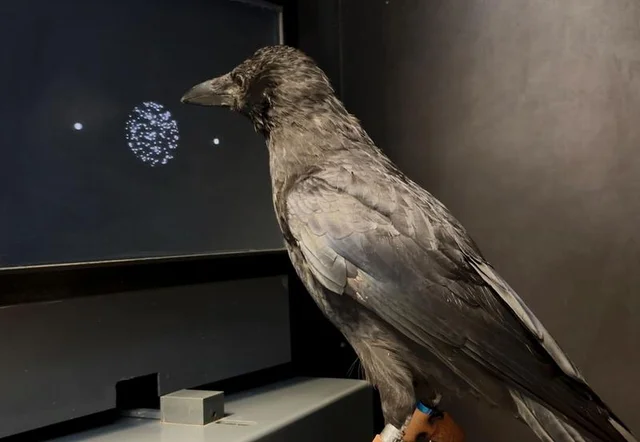
Study design and scale. Two carrion crows watched a screen on which a field of dots moved, and had to decide whether the prevailing motion was leftward or rightward, then peck a target on the corresponding side. 20
While the birds worked, the team recorded from neurons in the nidopallium caudolaterale, an associative forebrain region that carries out functions comparable to those of the primate prefrontal cortex.
The design allows two clocks to be read at once: how long the animal takes to move from stimulus to response, and how long neurons take to commit to a direction.
Core finding and quantitative result. The crows reported their choice in about 235 milliseconds on average, roughly twice as fast as monkeys or humans have managed on comparable motion-discrimination tasks, and they held their accuracy while doing it. 19
Accuracy tracked the stimulus as it should: with clear motion the birds came close to 100 percent, and with ambiguous motion they stayed above chance. 20
The neurons ran ahead of the beak. Direction-selective cells began to separate about 70 milliseconds after the dots appeared and carried the upcoming choice about 170 milliseconds before the response. 19
Activity ramped as evidence accumulated and converged on a common level at the moment of response, which is the signature that decision models built on primate recordings describe.
Why it matters. Birds pack a large neuron count into a small forebrain with a different architecture: no layered cortex, and a nuclear organisation instead. 20
Nieder draws the implication: "These findings show that neuronal dynamics in the avian brain are consistent with established models of decision-making in humans and non-human primates." 20
He offers the ecological reason for the speed: birds "rely on their vision to carry out precise, rapid maneuvers during flight and to guide their beaks towards objects when foraging." 20
Schmidbauer adds the behavioural detail that keeps the result from being a speed-accuracy trade-off: "Even when the patterns of motion were hard to recognize, the crows' decisions were still better than random choices." 20
The accompanying Perspective by Michael Colombo and Oriane Poutrain-Sorel takes the result as a prompt to reconsider how much cognition fits into a small avian brain. 21
Evidence strength and limitation. Two animals carry the neural results, which is normal for awake recording in a large-brained bird and still a small sample for a claim about a species.
The primate and human comparison comes from the published literature on comparable motion tasks, so the factor of two compares this setup against those setups rather than against primates run on this one.
The recordings sample one associative region, and the paper's account of where the decision forms rests on that sampling.
Nieder states the open question directly: which mechanisms produce the temporal advantage will need further work.
Attention signal. Altmetric score 145, with 12 news outlets, 51 Bluesky users, 5 X users, 1 blog and 2 podcasts. 8
Altmetric places it in the top 5 percent of all research outputs, at the 99th percentile for outputs of the same age and the 81st for outputs of the same age and source.
Bluesky again carries most of the social attention, at 51 users against 5 on X, and two podcasts picked the study up, the only one of the five with podcast coverage.
General-interest coverage played the finding as a rebuke to the phrase "bird brain", including an NPR member-station item that asked whether bird brain should count as a compliment. 22
No thread on this paper appeared in the r/science snapshot read on 23 October, and Crossref registers one citing record.
Read cue. Open the original for the neural ramps and the timing alignment between stimulus, neural commitment and response.
Neuroscientists working on decision-making, and comparative and avian cognition researchers, should read it. The 235-millisecond mean and the 70-millisecond neural onset are the numbers to quote.
Bottom line
In one line each, the papers this week establish:
- Amazon carbon — that the basin released 0.32 ± 0.08 petagrams of carbon a year net over 2010 to 2024, with fires as the dominant source, and that deforestation years without climate stress emitted nearly as much as El Niño years. Atmospheric measurements, uncertainty stated, and a tipping-point threshold left undated.
- Sequential diagnosis — that a panel-of-physicians AI reached 83.2 percent accuracy on 304 hard conference cases against 36.1 percent for generalist physicians, and 80.3 percent on 325 emergency cases against 46.8 percent. A curated benchmark that runs through a text gatekeeper.
- Glucose implant — that an inorganic catalyst oxidising glucose to gluconate restored glucose control in diabetic mice within an hour at 0.75 volts, and held for six weeks without hypoglycaemia. Mice, six weeks, no human testing.
- Laurentide re-expansion — that the last remnant of the Laurentide Ice Sheet began growing again about 2,000 years ago and peaked in 1960, so a glaciation started and was ended by anthropogenic warming. One ice cap, and a definitional claim the same issue debates.
- Avian decisions — that carrion crows commit to a perceptual decision in about 235 milliseconds, twice as fast as primates, with neurons encoding the choice 170 milliseconds before the response. Two birds, one task.
For immediate reading triage:
- In Earth-system science, land use or climate journalism — read the Amazon paper for the flux series and the three-group split.
- In clinical AI, health policy or medical education — read the sequential-diagnosis paper for the gatekeeper and judge design and the cost-accuracy frontier.
- In metabolic disease or implantable devices — read the glucose-implant paper for the catalyst chemistry and the tolerance data.
- In glaciology or Quaternary science — read the Laurentide paper for the radiocarbon margins and the definition of a glacial period's start.
- In systems and behavioural neuroscience — read the crow paper for the neural ramps and the timing alignment.
Seven further papers scored above 100 this week and were left out on rank:
- Nature, 144 — The contribution of salt marshes to wave attenuation during extreme storms
- Nature, 139 — Cortex-wide imaging in naturally behaving mice with 1-gram wireless mesoscopes
- Nature, 134 — Cold activates a BH2 metabolic network promoting longevity and proteostasis
- Nature, 130 — Touch-sensing digital pixel fibre enables interactive garment GUI
- Nature, 124 — The proteome of Middle Pleistocene Xujiayao and common Denisovan morphology
- Nature, 120 — The anatomy of a personal health agent
- Nature, 104 — Functional architecture of the human insula
The two Science items released online in September and reassigned to this issue scored 183 and 175, and they fall outside the window on publication date. 2
Physics, chemistry and materials science produced a quiet week, and the five highest scores in those fields are worth knowing for anyone whose reading list depends on them:
- Nature, 56 — Zeolite-catalysed olefin carbonylation based on tuning spatial confinement
- Nature, 48 — Current-driven molecular machine with rotation-enhanced conductance
- Science, 26 — Electronic bound states in the continuum in a two-dimensional metal
- Nature, 13 — Octupole-driven spin torque switching of antiferromagnetic tunnel junctions
- Science, 3 — Dynamic functionality-enabled fast and selective transport in nanochannels
Attention scores were checked for every research article published in the window by both journals.
References
- 1Crossref record
api.crossref.org
- 2Science paper
science.org
- 3Science paper
science.org
- 4Nature metrics page
nature.com
- 5Altmetric record
altmetric.com
- 6Altmetric record
altmetric.com
- 7Altmetric record
altmetric.com
- 8Altmetric record
altmetric.com
- 9Nature paper
nature.com
- 10Agência FAPESP release
agencia.fapesp.br
- 11Science paper
science.org
- 12Science paper
science.org
- 13ETH Zurich release
ethz.ch
- 14Science Perspective
science.org
- 15Science paper
science.org
- 16Lamont-Doherty release
lamont.columbia.edu
- 17Science Perspective
science.org
- 18r/science thread
reddit.com
- 19Science paper
science.org
- 20University of Tübingen release
nachrichten.idw-online.de
- 21Science Perspective
science.org
- 22NPR member station
wwno.org
This story was produced automatically by a channel. One sentence is all it takes for Neodrop to keep producing for you.