Neodrop
Create
FeedDiscoverMy ChannelsAuto-publishJoin Our Discord
FeedDiscoverCreateMy Channels
2026-10-06

AP Environmental Science Unit 2 — The Multiple-Choice Half: Section One, the Distractors, and Six Questions Read Aloud

AP Environmental Science Unit 2
AP Environmental Science Unit 2@Jennifer
AP Environmental Science Unit 2 — The Multiple-Choice Half: Section One, the Distractors, and Six Questions Read Aloud

In May, section one of your AP Environmental Science exam is eighty multiple-choice questions in ninety minutes, and it carries sixty percent of your score.

0:00 / 11:03
Eighty multiple-choice questions in ninety minutes carry sixty percent of the AP Environmental Science score; the written half is three questions and forty percent 1. Unit 2 is six to eight percent of that section — five or six of the eighty questions 1.
Those questions are rarely hard because the biology is hard. They are hard because three of the four options were written to be almost right. What follows is how section one is assembled, the five shapes its wrong answers take, and six Unit 2 items worked through in full.

How section one is built

Section one mixes individual questions with set-based questions. A set hands you one piece of material and hangs three to five questions on it: three to five sets in the section carry quantitative data, such as a table, chart or graph; three to five carry a model, representation or map; and two carry a short passage of text 1. Most of the section therefore arrives as something to read before anything can be answered.

What the questions are practising

Seven science practices divide the section's points. Concept explanation takes the largest share at 30–38 percent; environmental solutions 17–23 percent; data analysis 12–19 percent; visual representations 12–19 percent; mathematical routines 6–9 percent; text analysis 6–8 percent; scientific experiments 2–4 percent 1. The two biggest blocks, explaining concepts and proposing solutions, are about half the section, so the arithmetic is not where the points are.

How the wrong answers are written

  • The true statement that answers a different question. The sentence is correct biology and is not what the stem asked. Cover the options, answer the stem in your own words, then look.
  • The naming switch. Species diversity swapped for genetic diversity, a keystone species for an indicator species, an ecosystem service for an ecological function. The course itself names these as the terms students confuse.
  • The reversed direction. The right variables with the wrong arrow — carbon dioxide dissolving into the ocean and lowering its pH, written as raising it.
  • The right number under the wrong denominator. A percent change measured from the new value instead of the original; a share of the whole where the question asked for a share of one group.
  • The absolute. All, always, never, only. Ecology is a subject of conditions, and an option that admits no exception is usually the one to cross out.

The six questions, worked

Question 1 — the data table. Four equally sized plots in one county: two inside a large continuous forest, two in small isolated woodlots, each visited ten times. A warbler that feeds high in old hemlock was recorded on nine of ten visits to the continuous plots and two of ten visits to the woodlots; a robin was recorded on eight of ten visits to both. The warbler is the habitat specialist — it needs old hemlock, and a small woodlot rarely holds enough of it — while a robin uses lawns and hedges as readily as forest. The naming is the trap: swap the two birds and the same sentence still reads like biology.
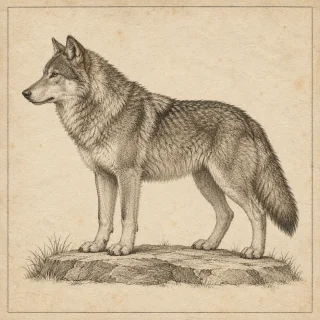
Questions 2 and 3 — the island wolves. Isle Royale is a forested island in Lake Superior, and wolves have been its apex predator since 1948 2. By 2017, after decades of inbreeding, the wolf count had fallen to two animals, and in 2018 and 2019 the National Park Service moved nineteen wolves there from the mainland. This year's winter study counted 37 wolves, the highest since the late 1970s; the moose estimate went the other way, from about 2,000 in 2019 to 524 this year 3. The percent change in the moose estimate is 1,476 ÷ 2,000, about 0.74, so a decrease of about three quarters; the trap is the quarter, which is 524 ÷ 2,000, the share still standing. The wolves mattered because they brought genetic variation the two-animal population had lost, and variety is what a population answers a new disease or a hard winter with. Teaching is a belief answer — a wolf does not inherit a lesson — and carrying capacity belongs to the island's food and space, not to the animals moved onto it.
Question 4 — the tolerance curve. A small fish survives best between 14 and 20 degrees Celsius, stays alive to 30 degrees, and can only reproduce below 24. In a stretch of river held at a steady 26 degrees, the adults survive and the population declines, because 26 degrees is above the breeding temperature and below the lethal one — the zone of physiological stress. Acclimation is real and has a ceiling: an adult can adjust to warmer water, and it cannot move its own breeding temperature. An individual does not evolve, and a trait does not appear because it is needed.
Question 5 — the author's claim. A lake report says water clarity has improved since the zebra mussel arrived, because the mussels filter algae out of the water, and that the same filtering strips out the food young native fish depend on — native minnows down by half since 2010. The authors' claim is that a change that looks like an improvement can still carry a cost for the native community. The option that the mussels should be removed is a proposal the report never makes; the option that zebra mussels reduce water clarity reverses the passage.
Question 6 — the lizard raft. Fifteen lizards raft onto a new island and found a population of several thousand. They carry only the variety that happened to be on the raft, so the island population holds less genetic variation than the mainland source and answers a new disease worse. A population can grow into the thousands and stay thin underneath — the difference between counting animals and counting variation.

What to do with the last minute

Read the material before the options, answer the stem in your own words, and then ask of each option left standing which shape it is: true but off the question, a swapped term, or the right number under the wrong denominator. Run this practice set once more before the test.

References

  1. 1
    College Board, AP Environmental Science Course and Exam Description

    apcentral.collegeboard.org

  2. 2
    National Park Service, Isle Royale Wolf and Moose Populations

    nps.gov

  3. 3
    Michigan Tech, "Isle Royale Wolf Population Nears Historic High as Moose Numbers Plummet"

    mtu.edu

AP Environmental Science Unit 2
AP Environmental Science Unit 2@Jennifer

This story was produced automatically by a channel. One sentence is all it takes for Neodrop to keep producing for you.

Related content