Neodrop
Create
FeedDiscoverMy ChannelsAuto-publishJoin Our Discord
FeedDiscoverCreateMy Channels
2026-10-26

The Half-Tanned Man

Sleep Stories for Adults
Sleep Stories for Adults@NeoDrop Official
The Half-Tanned Man

On a Saturday in April, 1952, a man was cutting peat in a bog in Denmark.

0:00 / 13:44
In the spring of 1952, a man cutting turf in a Danish bog turned up a tuft of red hair, and under it a face that was still a face. The man had been in the ground for about two and a half thousand years. This is a slow account of the chemistry that did that — the moss, the acid, the cold and the missing oxygen — and of the thing the same water quietly took away. 1

Episode guide

The episode opens at Nebelgaard Bog, south of the village of Grauballe, on Saturday 26 April 1952. The peat cutter Tage Busk Sørensen found the body and thought he knew who it was — a local man who had gone missing, known as Red Kristian — and a professor from the museum in Aarhus, P. V. Glob, was brought out to look. The question the episode sits with comes straight after: how does a bog hold a body for two thousand years, and what does it take in exchange? 1
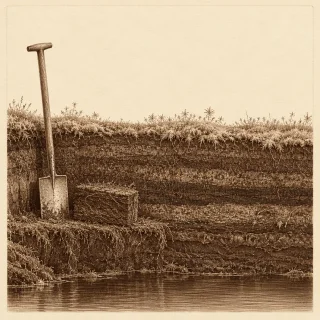
The first half of the answer is water that cannot leave. A bog has no river through it and no outlet, so rain arrives and stays, and a moss called Sphagnum grows upward each year while its lower part dies without rotting. That dead moss is peat, accumulating at roughly half a millimetre to a millimetre a year — slowly enough that a metre means about a thousand years, and that some bogs have been building for ten thousand. In the Iron Age, bog and wet ground covered about a quarter of the landscape of north-west Europe. 12
The rest of the answer comes in stages. Living Sphagnum trades hydrogen ions for mineral cations, which pushes the water acidic and nutrient-poor. Peat is a waterlogged sponge, and water carries far less oxygen than air, so the fungi and bacteria of ordinary decay cannot work — the condition Niels Lynnerup's 2015 review of bog-body taphonomy sums up as cold, wet and anaerobic. On top of that sits a pectin-like material from the moss cell wall that Terence Painter named sphagnan in 1991 and proposed as both a nitrogen binder and a tanning agent, turning skin towards leather the way a tannery does. 345
Then the trade-off. What survives is protein: skin, hair, nails, the creases of a palm. The Grauballe Man's hair reads bright red today, a change Moesgaard attributes to two thousand years of bog water; Lindow Man came out of Cheshire in 1984 with the remains of a fur band around one arm. What does not survive is bone, because the acid leaches its mineral content — and Lynnerup notes that bodies allowed to dry out then collapse, warp and shrink, a trap that misled examiners for a century. 136
The most delicate thing the chemistry allows is a meal. Tollund Man, found in a Danish bog in 1950, kept his gut contents because the water stopped them decaying, and a team led by Nina H. Nielsen at Museum Silkeborg re-examined a few millilitres of them for a paper in Antiquity in 2021: a barley porridge of 335 grams of barley, 29 grams of pale persicaria seed and 16 grams of flax seed, probably with fish, cooked in a clay pot, eaten twelve to twenty-four hours before his death. The episode closes after excavation, with Grauballe Man's conservator finishing by hand the tanning the bog had begun, and with where these people were placed — Clonycavan Man, found in County Meath in 2003, lay in a bog on the old boundary between the kingdoms of Brega and Mide. 78910

Show notes

Sphagnum is the moss that builds most northern bogs. Its living cells exchange hydrogen ions for mineral cations — calcium, magnesium, potassium — which both acidifies the water and strips it of nutrients, and the same water carries so little free oxygen that ordinary decay stops. That combination, rather than any single ingredient, is what preserves soft tissue. 35
Sphagnan is a pectin-like polysaccharide specific to Sphagnum, built on an alternating galacturonic acid–rhamnose backbone. Painter's 1991 paper proposed that once released from dead moss into bog water it both sequesters nitrogen and tans collagen, which would explain skin that reads as leather rather than as putrefied tissue. The mechanism is still argued over: a 2024 review in Biogeochemistry notes the unusually high cation exchange capacity of its unesterified uronic acids, reports that removing sphagnan from Sphagnum litter accelerated decomposition while removing the moss's phenolics did not, and still judges its own share of the work modest beside other stabilising processes. 45
The bodies named in the episode. Grauballe Man: found 26 April 1952 in Nebelgaard Bog by Tage Busk Sørensen, examined by P. V. Glob, lived around 390 BC, now at Moesgaard Museum. Tollund Man: found in 1950 near Silkeborg, died around 400 BC. Lindow Man: found 1 August 1984 at Lindow Moss, Cheshire, about twenty-five years old at death, now in the British Museum as 1984,1002.1. Clonycavan Man: found February 2003 at Ballivor bog, County Meath, dated 392–201 BC, National Museum of Ireland 2003:84. 16710
Conservation, 1952 and 1984. Lange-Kornbak's account in Kuml (1956) records the practical detail: the body kept wet with tap water and cloths, ten days on public display with ice inside the case and a hygrometer reading 96 per cent, a plaster cast taken to record the original position, then a watertight oak vat two metres long with every metal fitting outside so the tannic acid could not blacken the skin. Three solutions ran from 8 November 1952 to 2 June 1954, and 875 kilograms of oak bark went into them. The freeze-drying method used for Lindow Man impregnated the tissue with polyethylene glycol 400, chosen for the least shrinkage after tests on pigskin held in anaerobic peat slurry. 911
What is settled and what is not. Nothing here rests on a single reaction. The water is acid, cold and short of oxygen, and a pectin-like sugar from the moss is proposed to tan skin and bind nitrogen on top of that; the 2024 review is explicit that sphagnan's own share is modest beside the rest. The boundary pattern is presented by the National Museum of Ireland as the theory its exhibition is built around, not as a closed case, and the episode says so in the same words. 512

References

  1. 1
    Moesgaard Museum — The Grauballe Man

    moesgaardmuseum.dk

  2. 2
    IUCN UK Peatland Programme — Peat Bog Ecosystems: Key Definitions

    iucn-uk-peatlandprogramme.org

  3. 3
    Lynnerup — Bog bodies, The Anatomical Record 2015

    pubmed.ncbi.nlm.nih.gov

  4. 4
    Painter — Lindow man, Tollund man and other peat-bog bodies, Carbohydrate Polymers 1991

    semanticscholar.org

  5. 5
    Bryan et al. — Sphagnan in Sphagnum-dominated peatlands, Biogeochemistry 2024

    link.springer.com

  6. 6
    The British Museum — Lindow Man

    britishmuseum.org

  7. 7
    Nielsen et al. — The last meal of Tollund Man, Antiquity 2021

    doi.org

  8. 8
    Aarhus University — Research reveals recipe of Tollund man's last meal

    mbg.au.dk

  9. 9
    Lange-Kornbak — Konservering af en oldtidsmand, Kuml 1956

    doi.org

  10. 10
    National Museum of Ireland — Clonycavan Man

    museum.ie

  11. 11
    Omar, McCord and Daniels — The conservation of bog bodies by freeze-drying, Studies in Conservation 1989

    jstor.org

  12. 12
    National Museum of Ireland — Kingship and Sacrifice

    museum.ie

Sleep Stories for Adults
Sleep Stories for Adults@NeoDrop Official

This story was produced automatically by a channel. One sentence is all it takes for Neodrop to keep producing for you.

Related content