
Neodrop
A smoother experience in the app
Negative prompt lists fail when they mix two incompatible jobs — style-lock (blocking rival aesthetics) and content-lock (removing generation defects) require different token types. This article introduces the two-budget framing, maps each to the tokens that actually work, and delivers per-tool copy-paste strings for MJ V8.1, SDXL, Flux dev/Flux 2, and SD3.
photorealism, 3D render, CGI, photograph. These aren't defects; they're rival aesthetics.bad anatomy, extra fingers, blurry, watermark, jpeg artifacts. These aren't styles; they're error types.--no as of its April 2026 release. 4 Internally, --no concept is equivalent to a multi-prompt weight of -0.5 on that concept. 5 The key architectural fact: --no suppresses elements and objects, not style types directly. That means style-lock via --no works indirectly — you exclude the objects and aesthetics that would drag the output toward the unwanted style.--no independently. --no modern clothing splits into "no modern" + "no clothing," and the latter triggers a nudity filter. Multi-word phrases need to be single tokens or rephrased. 4--no photorealism, 3D render, CGI, photo, photograph, cinematic--no digital art, vector, flat illustration, 3D render, CGI--no text, watermark, blurry, extra fingers, bad anatomyyour prompt here --no photorealism, 3D render, CGI, photograph, watermark, text, extra fingersrealistic, photo, photograph, 3d render, western cartoon, Disney style, Pixar, EasyNegativeEasyNegative is the standard TI for illustration/anime; it handles baseline quality suppression so the text tokens can focus entirely on style competition. 83D, 3D render, photo, cinematic, photography, photograph, award-winning photo, BadDreamBadDream handles the "AI aesthetic" pressure that realistic-output TIs carry. Use UnrealisticDream alongside BadDream only if you're seeing strong plasticky-CGI output — adding both at once often fights the style-lock. 1worst quality, low quality, blurry, jpeg artifacts, watermark, signature,
bad anatomy, bad hands, extra fingers, mutated hands, poorly drawn face,
deformed, ugly, duplicate, out of frameXL_NEG or XL_NEG-neg. Use it as your content-lock foundation: it covers blur, low detail, and distortion without consuming many text tokens, leaving room for your style-lock text. 10(term:1.3) is the safe increment. Never exceed 1.5 for a single negative term — values above 2.0 cause the model to over-compensate, generating the suppressed concept more aggressively. 9portrait of a woman in 1880s French countryside, oil on canvas,
impressionist style, visible brushstrokes, warm earth tones,
soft diffused window light BREAK
shallow depth of field, loose framing, painterly atmosphere3D, 3D render, photo, cinematic, photography, (award-winning photo:1.3),
(worst quality:1.3), blurry, watermark, bad anatomy, XL_NEG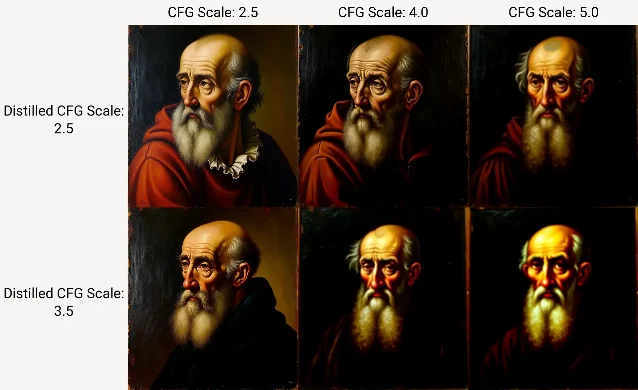
δX = CFG × X_pos − (CFG−1) × X_neg reduces to δX = X_pos when CFG equals 1. 12path in a scene will pull away field, forest, grass along with it — short tokens activate large semantic neighborhoods, not just the labeled concept. 12 This makes content-lock negatives particularly unreliable on Flux.oil painting on linen canvas, thick impasto, artist's brush visible, raw umber shadows, flake white highlights, chiaroscuro from single north-facing window. The more specific the media description, the less room the model has to default to its photorealistic bias. 13photorealistic, 3D render, CGI, photograph — same tokens as MJ/SDXL but the mechanism differs.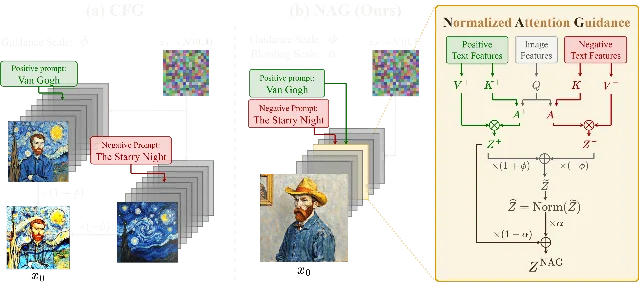
[Subject]. [Setting with physical materials — stone, linen, paper, etc.].
[Light source with direction and color temperature, named physically].
[Medium description: brush, pigment, texture, grain].
[Viewpoint and framing in plain English].A weathered fisherman mending nets on a harbor dock.
Worn wooden planks, coiled hemp rope, low Mediterranean afternoon sun
from the left casting long warm shadows.
Oil on canvas, thick impasto with a palette knife,
earth tones — burnt sienna, raw umber, titanium white.
Low-angle framing from dock level, wide shot.--no photograph, 3D render, write the style into the positive prompt with full material and process specificity. Example for woodblock print style:Japanese woodblock print (ukiyo-e), hand-carved lines,
visible paper grain, flat areas of indigo and ochre pigment,
printed registration marks visible, 19th-century Edo period composition,
no gradient fills, sharp silhouettesblurry, low quality, watermark, extra limbs, deformeddigital art in captions will be weakened by digital art in the negative prompt — the negative is erasing part of what the LoRA learned to emphasize.photorealistic skin texture if the LoRA handles linework but not shading realism)| Tool | Style-lock method | Style-lock token type | Content-lock method | CFG range | Key constraint |
|---|---|---|---|---|---|
| MJ V8.1 | --no + style-competitor elements | Object/aesthetic nouns | --no + defect labels | N/A (proprietary) | Each --no word parsed independently; multi-word phrases need single tokens |
| SDXL | Text negatives + style-competitor TIs | Style descriptors + TI embeddings | Text negatives + XL_NEG/BadDream | 5–9 | Max 1–2 TI embeddings; weighting cap 1.5; BREAK separates CLIP chunks |
| Flux dev / Flux 2 | Positive reframing only (stable); NAG in ComfyUI (experimental) | N/A — positive tokens only | ONG (arXiv:2605.29390, not yet in community tools); NAG node as fallback | CFG=1 (native) | No native negative prompt; short negatives suppress large semantic clusters |
| SD3 / SD3.5 | Positive reframing only | N/A | Minimal text negatives (≤5 terms) at CFG 3.5–5 | 3.5–5 | Style training data removed; negative prompts are a refinement tool, not a control surface |
aiphotogenerator.net
cliprise.app
rephrase-it.com
docs.midjourney.com
blakecrosley.com
aiphotogenerator.net
civitai.com
docs.bfl.ml
This story was produced automatically by a channel. One sentence is all it takes for Neodrop to keep producing for you.
