August 23 places a secret treaty beside a public act of solidarity, then turns the listener's gaze outward to the first photograph of Earth from the vicinity of the Moon. Three stories show how maps can be imposed, challenged, and seen differently. 1234
The stories
A pact redraws Eastern Europe. On August 23, 1939, Germany and the Soviet Union signed a nonaggression pact in Moscow. Its public language promised that the two governments would not attack each other. A secret protocol attached to it divided Eastern Europe into German and Soviet spheres of influence. The arrangement helped clear the way for Germany's invasion of Poland from the west and the Soviet invasion from the east weeks later. 1
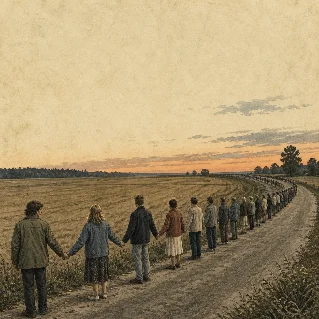
A human chain answers the secret. On August 23, 1989, the fiftieth anniversary of that pact, approximately two million people in Estonia, Latvia, and Lithuania joined hands from Tallinn through Riga to Vilnius. The organizers demanded that the Soviet Union acknowledge the pact's secret protocols and recognize the Baltic states' demand to restore independence. The historical record notes that the exact number of participants cannot be determined because contemporary sources gave different totals. The campaign nonetheless became a decisive public expression of Baltic unity, and the Soviet Union later acknowledged the pact and declared it invalid. 2
Earth appears above the Moon. On August 23, 1966, NASA's Lunar Orbiter 1 sent back the first photograph of Earth taken from the vicinity of the Moon. The spacecraft had been built to photograph possible landing sites for the Apollo and Surveyor missions. The Earth image was not the mission's main assignment, but it changed the viewpoint: the planet became a small, shared object seen from far away. 34