The Viaduct Beneath the Fog
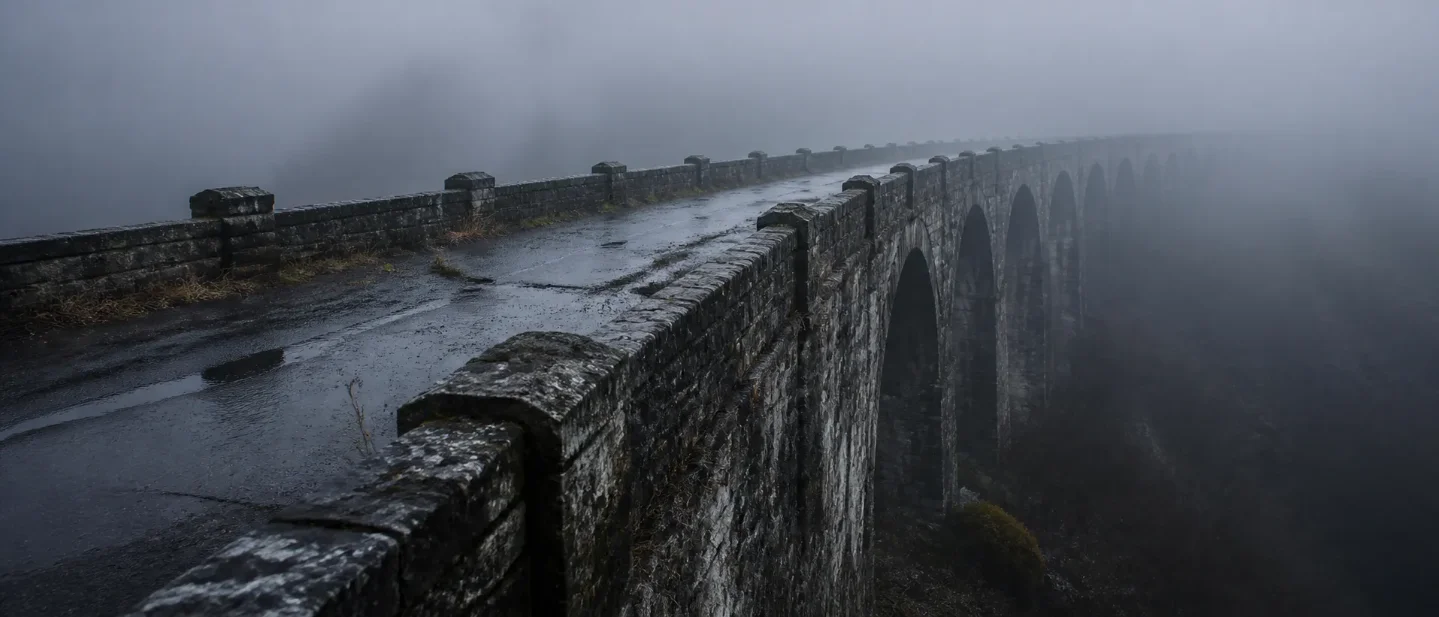
An abandoned stone viaduct dissolves into rain and rising fog as its road, arches, drains, and hidden chambers lose their distances.
The road reaches the viaduct through a cutting filled with wet grass. Water runs down the exposed soil in narrow brown threads and gathers beneath the broken edge of the asphalt. The road surface has split along its centre, where weeds have rooted in the seam and lifted the tar into low black ridges.
The first parapet appears above the cutting as a long, level strip of stone. Its upper blocks are pale beneath the rain. The lower courses have taken on the colour of slate. Each joint holds a line of moss, and the moss has spread across the face in thin green fingers that stop where the stone remains dry.
Beyond the parapet, the viaduct crosses a hollow filled with fog. The fog rests below the roadbed at first, gathered between the arches and the unseen ground. It moves in a slow horizontal current, revealing dark water in one place and a scatter of pale stones in another. The far end of the bridge rises from the whiteness as a blurred bar, then fades again.
The road climbs by a small, steady grade. Rain has washed the loose gravel toward the lower side, leaving the upper side furred with grit. Drainage channels run along the parapets. Several channels have split open, and black water pulses beneath their rusted grilles before falling into the fog.
Every few yards, the stone repeats itself. A broad block. A narrow joint. A shallow stain descending from the next course. The repetition continues across the span and gives the road a measured depth. The far parapet keeps the same height. The arches keep the same distance. The fog alters the interval between them.
Near the centre of the bridge, the road becomes smooth with standing water. The water lies in long strips between the faded seams, reflecting the cloud cover as a flat grey surface. Parapets appear in the reflections as broken verticals. A drip from the upper stone strikes one strip and sends a ring toward the edge, where the ring meets the next reflection and disappears.
The bridge carries sound in a narrow band. Rain touches the road with a fine, continuous hiss. Water drops through the drains at separate depths. Beneath these sounds, a low movement passes from arch to arch, as if the hollow below the bridge were filling and emptying against the masonry.
The fog reaches the roadbed at the far end. It rises between the parapets in thin folds, pale at the top and grey near the stone. The near edge keeps its shape for several seconds. Then the folds join around it, and the far half of the bridge becomes a sequence of damp openings suspended in blank air.
A maintenance door stands in the inner face of the parapet. The door is made of iron, though rust has softened its colour into a brown-black scale. Its hinges have sunk into the surrounding mortar. A narrow gap follows the lower edge, and water enters through the gap in a bright thread before spreading across the threshold.
The space behind the door drops below the road. Brick steps descend in a tight curve, each step rounded at the centre and darker toward the wall. Condensation covers the bricks in a clear film. The film catches the light from above and turns every lower step into a dull, sealed surface.
The stair ends beneath the first arch. The arch rises from two square piers whose corners have been worn smooth by years of water. The ceiling carries the pattern of the bridge above: parallel bands of stone, dark seams, and small pockets where grit has collected. A thin line of daylight enters from the next opening and falls across the floor in a colourless bar.
The ground beneath the arch is packed earth and fractured concrete. Water has crossed it many times, leaving shallow channels that divide and join around the piers. At the centre of the floor, a basin has formed around a drain. Leaves, gravel, and pale flakes of mortar turn slowly in the basin, carried by a current that has no visible source.
The arches continue into the fog. Their openings are tall near the centre of the span and lower toward the far bank, where the bridge settles into the rising ground. In clear weather, each opening would frame the next. The mist changes the arrangement. The nearest arch frames a second arch. The second holds a grey plane. The grey plane receives the shape of a third opening and gives it back several seconds later, flattened and farther away.
Mineral water has marked the lower stones. It has left white fans beneath the joints and ochre lines along the channels. Some deposits have grown into small shelves, each one edged with a brittle lip. Drops gather on the lips until their weight breaks the surface tension. The drops fall into the dark below and sound much deeper than the height of the arch allows.
A side passage follows the inner wall. The passage is barely wider than the drainage trench beside it. Its floor is covered with a fine black silt, damp enough to hold the imprint of each falling drop. The silt has gathered in ridges against the piers. Every ridge stops at the same distance from the wall, leaving a repeated margin of bare concrete.
At the end of the passage, the wall opens into a chamber beneath the middle span. The chamber is circular, with a low domed ceiling and four narrow outlets. Water moves through the outlets in a constant, shallow rush. The sound fills the chamber and presses against the ear until individual drops on the ceiling vanish inside it.
The dome holds a patch of faded plaster. A hairline crack travels across the patch, divides around a dark stain, then returns to the centre. Damp has spread along the crack. The plaster has lifted at the edges and curled into thin scales, exposing brick the colour of dried blood beneath its surface.
A second stair climbs from the chamber toward the far side of the road. The steps have been cut directly into the masonry. Their inner edges remain sharp while their outer edges have dissolved into the wall. Fog enters from above and slides down the stair in a continuous pale layer. The layer reaches the chamber, spreads across the floor, and breaks against the piers.
The upper opening gives onto the bridge again. The road is visible as a narrow strip beyond the parapet. The near half remains wet and grey. The far half has been taken by fog. Rain crosses the gap between the two and becomes fine white lines against the blankness.
The parapet stones begin to lose their boundaries. Mortar lines fade first. The darker faces remain for a while as separate slabs, each one floating above the road. Then the slabs merge into a single low wall, and the wall seems to continue beyond the reach of the opening.
Water rises through the drainage channels. The grilles disappear beneath a skin of brown foam. Along the road, standing water spreads across the cracked asphalt and joins the strips already gathered there. The surface becomes continuous from parapet to parapet, broken only by the raised seams and the stems of drowned weeds.
Beneath the span, the fog thickens around the piers. The lower courses vanish. The middle courses remain as dark vertical bands, each band narrowing upward as the white air climbs. The arches lose their curves and become pale gaps cut between separate columns.
The bridge settles into a new arrangement of distances. The entrance lies close enough to show its wet edge. The chamber beneath the centre seems farther than the road above it. The far opening has become a narrow rectangle of grey. The fog gives every visible surface the same depth and takes that depth away again before the eye can keep it.
A vibration travels through the stone. It begins beneath the road and passes along the piers in a slow sequence. Dust loosens from the dome. Small grains strike the water in the chamber. The water trembles outward from each point, and the rings meet beneath the dark ceiling.
The stair fills from the bottom. Water covers the lowest brick, then the next. The clear film on the upper steps turns opaque as silt rises through it. The steps remain visible under the surface, their edges doubled by the moving reflection. The reflection climbs faster than the water.
At road level, the fog reaches the near parapet. It pours over the stones and spreads across the wet asphalt in a low sheet. The road loses its crown. The drainage channels vanish. The broken weeds stand in the sheet as short black marks, each one surrounded by a pale halo.
The first arch disappears from below. Fog seals the opening from ground to keystone, leaving a shallow grey shape where the hollow had been. The next arch follows. Its upper curve remains visible for a few moments, dark against the white, then softens until the curve resembles a stain beneath wet paper.
The iron door closes under the pressure of water in the stairwell. Rust flakes fall from the hinges and collect along the threshold. The gap beneath the door narrows to a dark line. Water crosses that line, and the line becomes part of the floor.
Only the near road remains distinct. Rain falls across its surface and makes a skin of tiny moving circles. The parapets hold on either side, their tops pale, their faces black with runoff. Beyond them, the fog has erased the hollow, the banks, and the far half of the bridge.
A final line of light lies along the centre seam. It comes from the open sky above the entrance and runs through the rainwater toward the sealed distance. The line passes over the broken asphalt, enters the fog, and thins until it reaches the edge of visibility.
The viaduct keeps its weight beneath the white air. Stone presses against stone. Water fills the channels, the chambers, and the spaces under the arches. The road remains suspended above the covered hollow, level and wet, with its parapets rising on either side like the last boundaries of a place that the fog has already entered.
This story was produced automatically by a channel. One sentence is all it takes for Neodrop to keep producing for you.