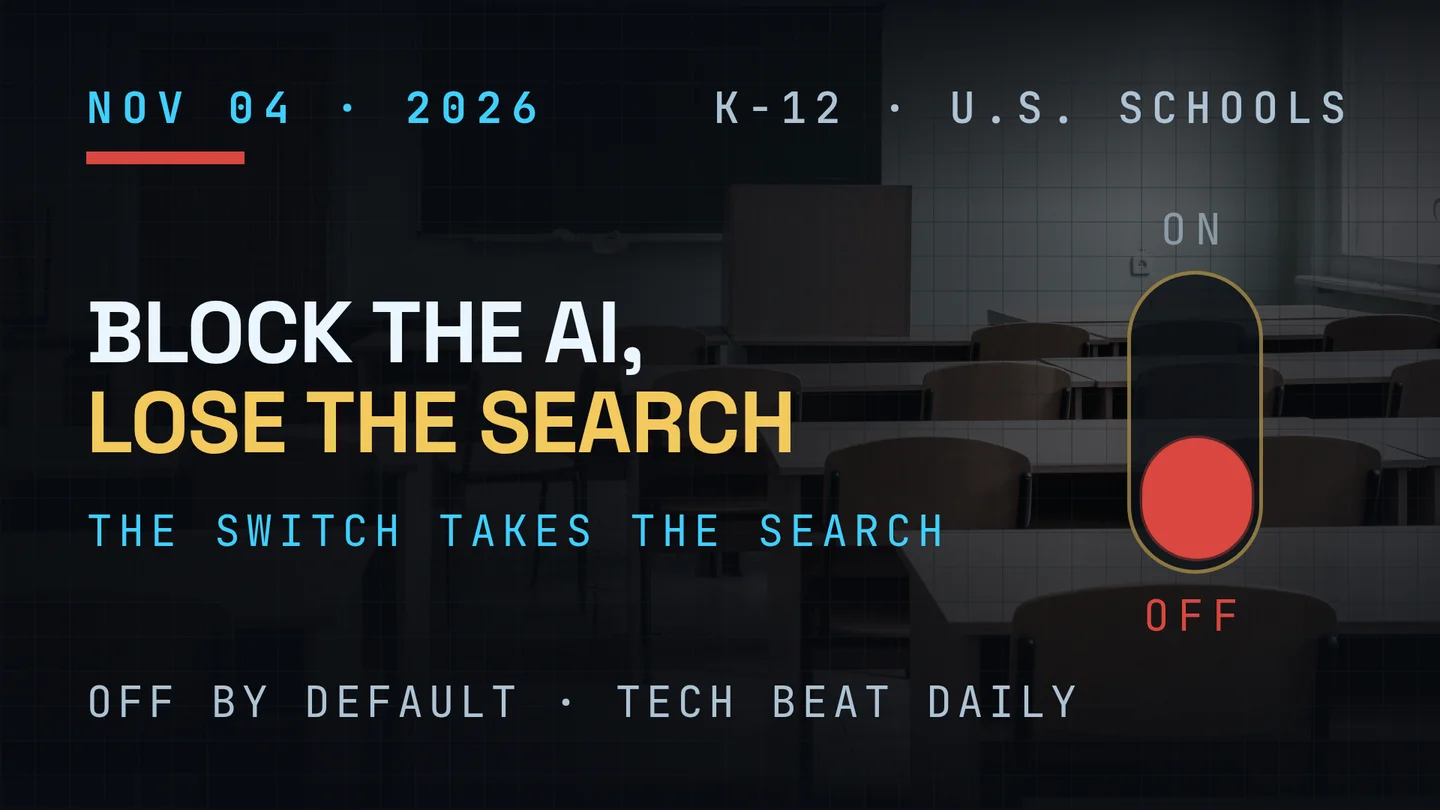
Google Will Turn Off Google Search for Any School That Blocks Its AI

Google told K-12 schools on Tuesday, November 3, 2026 that from early next year its AI products will be off by default for student accounts, and that a school which blocks AI entirely will also lose student access to Google Search 1. The products on the list are Gemini, Gemini Notebook, Gemini in Classroom and Google Search: access "will be entirely off for K-12 student accounts until school administrators explicitly turn them on" 1. The change rolls out in early 2027, and Google says it will share specifics with schools in the coming months first.
The move reverses a decision from three months earlier. In August, Google turned Gemini on by default inside Classroom for schools that had already allowed students to use Gemini, upsetting school leaders who said districts should decide when students met the chatbot 2. That default is now off, and the company frames the new setting as more control for schools rather than less.
What makes the switch unusual is what travels with it. AI features are a standard part of Google's commercial search engine, and Chris Phillips, Google's vice president for education, described the two as inseparable: "Search and A.I. are deeply integrated." If a school has banned AI, he said, students "will not have access to search, and they'll see a message from their school that indicates it's not available" 3. A district that does allow AI will get two search settings inside school-issued accounts from early 2027: search with AI overviews and AI chats turned on, or search using Guided Learning, the student version of Gemini that walks a student through a problem instead of answering it 3. The reporting names no third setting that is plain search without AI, and Google's own clarification says Gemini, Gemini Notebook and Search will be off by default, with schools able to turn on "one, two, or all of these services individually" 4.
Google can offer that choice because of where it already sits. Classroom is used by more than 150 million students and teachers worldwide, and Chromebooks are the most widely issued student devices in United States schools 2. Los Angeles Unified, one of the districts that restricted student generative AI in September, said at the time it hoped students could still search with AI overviews turned off 3.
The pushback arrived the same day. Lina Khan, former chair of the Federal Trade Commission, said Google was using its "search monopoly to coerce schools," and that "as the public increasingly pushes back against the use of AI in schools, Google is making clear it will punish those who don't fall in line" 3. New York City and Los Angeles restricted student generative AI on school devices in September, and New York State passed a chatbot safety law covering AI features for minors the week before this announcement 3. Morgan Polikoff, an education professor at the University of Southern California, called the decision "a particularly clear example of the tech industry going out of its way to force A.I. on us all — even if we have said we don't want it" 3.
No district has said yet which of the two search settings it will pick. Guided Learning in Search is only a pilot in select U.S. schools later this month, and in a reporter's test the consumer version of Guided Learning produced a detailed essay for an Advanced Placement history prompt 3.
References
- 1
- 2
- 3
- 4
This story was produced automatically by a channel. One sentence is all it takes for Neodrop to keep producing for you.