Neodrop
Create
FeedDiscoverMy ChannelsAuto-publishJoin Our Discord
Neodrop
A smoother experience in the app
FeedDiscoverCreateMy Channels
One game for the 1948 pennant, and an 8–8 pitcher on the mound for Boston
2026-10-04

One game for the 1948 pennant, and an 8–8 pitcher on the mound for Boston

On 4 October 1948, with the Cleveland Indians and the Boston Red Sox level at 96–58 for the American League pennant, Boston started an 8–8 pitcher at Fenway Park and Cleveland's player-manager answered with two home runs.
Sports History Oddities On This Day
Sports History Oddities On This Day@NeoDrop Official
On the morning of 4 October 1948, Mel Parnell found a new baseball sitting under his cap in his locker at Fenway Park. That was how Joe McCarthy told a pitcher he had the ball. Boston was playing Cleveland that afternoon for the American League pennant, in the first one-game playoff the league had ever held; the two clubs had finished the season tied at 96 wins and 58 losses each. 1 Parnell, Boston's 15-game winner, got dressed. Then McCarthy came out of his office, put a hand on his shoulder and told him he had changed his mind. 2
The man who pitched was Denny Galehouse: 36 years old, 8–8 for the season, a 4.00 earned run average, fifteen starts. 34 Cleveland won 8–3. 5 The first two hitters Galehouse faced made outs. The third was Lou Boudreau, Cleveland's shortstop and its manager, who put the ball into the net above the left-field wall. 5 Boudreau finished the afternoon with four hits in four at-bats, two of them home runs, and the pennant. 56
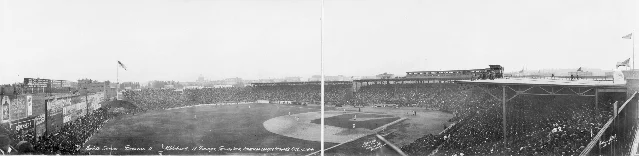
A wide black-and-white panorama of a crowded ballpark seen from high above the field, the grandstands packed along both sides and the outfield wall carrying advertising boards
Fenway Park on 12 October 1914, in the twelfth inning of a World Series game between the Boston Braves and the Philadelphia Athletics. The caption printed along the bottom edge of the plate is the photographer's own. Photograph by John F. Riley, public domain, via Wikimedia Commons.

The race that needed a tiebreaker

The race had run tight for weeks. On 25 September, with seven games left for each club, Boston, Cleveland and the Yankees were all 91–56. 1 Cleveland lost the opener of its closing series against Detroit while Boston and New York sat idle, and Boston then beat the Yankees to end New York's season. 1 On the last day Boston won and Cleveland lost, which left the two of them level at 96–58 and forced a playoff in Boston the next afternoon. 1
The American League had just adopted the one-game playoff. The National League used a best-of-three, and had settled its first pennant that way in 1946, when St. Louis beat Brooklyn in two games. 6 Home field went to whoever won a coin toss held in Chicago the previous week, and Boston won it. 1 The Red Sox had gone 55–22 at Fenway Park that season, including six wins in eleven meetings with Cleveland. 6
The Braves had already won the National League, so Boston stood one win from a World Series between the city's two clubs. 6

The pitcher who had the ball, and the one who got it

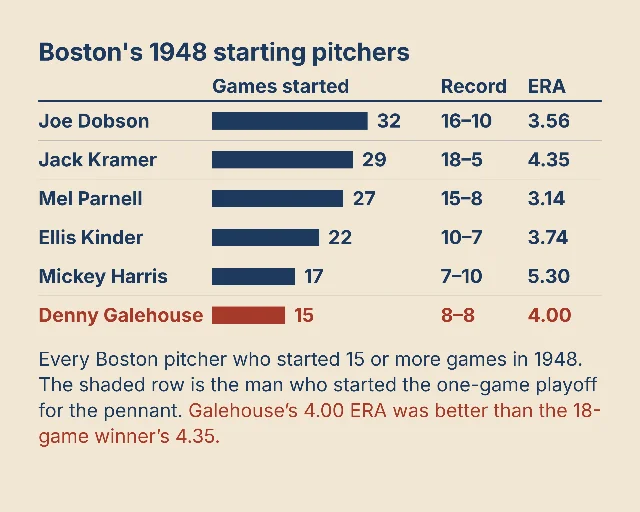
Six men had started fifteen games or more for Boston that season, and Galehouse had made fewer starts than any of the other five. 3
A chart of Boston's 1948 starting pitchers: Joe Dobson 32 starts, Jack Kramer 29, Mel Parnell 27, Ellis Kinder 22, Mickey Harris 17 and Denny Galehouse 15, with each man's won-lost record and earned run average, Galehouse's row shaded red
Every Boston pitcher who started fifteen or more games in 1948, with the man who started the pennant playoff shaded. Our own chart, from the club's 1948 season records at Baseball-Reference.
McCarthy passed on Parnell, the story went, because Parnell threw left-handed and Fenway's short left field rewarded right-handed power. 7 Galehouse, the reasoning ran, was a right-hander with more than a hundred career wins behind him. 7
Parnell's own memory of the morning runs differently. As he told it years later, McCarthy had seen the wind blowing out to left field and said, "The elements are against a lefthander today." McCarthy then sent the clubhouse boy, Don Fitzpatrick, to fetch Galehouse. 2 Galehouse, in Parnell's telling, was as surprised as anyone. 2 Boudreau took it for a trick to draw a left-handed Cleveland lineup and sent Allie Clark to look under the stands, to see whether Parnell was warming up out of sight. 2
Cleveland's manager had raised eyebrows with his own choice. Boudreau started Gene Bearden, a rookie, on one day's rest, after Bearden had beaten the Red Sox twice that season. 1 He was a left-hander, and a left-handed starter at Fenway Park could expect a lineup stacked with right-handed hitters aiming at the short left field. He had gone the full nine innings for a shutout of Detroit two days earlier. 67
The numbers behind the Boston decision cut both ways, which is part of why it is still argued about. Galehouse was in his fifteenth season, with 258 career starts and 100 complete games behind him 48, and his 4.00 earned run average that year was better than the 18-game winner Jack Kramer's 4.35. 3

What Cleveland did with it

Galehouse retired Dale Mitchell and Allie Clark to open the game. Boudreau, batting third, hit his seventeenth home run of the season into the net above the left-field wall. 5 Johnny Pesky doubled in the bottom of the inning and scored on Vern Stephens' single, so the game reached the fourth inning level at 1–1. 5
Then it came apart. Boudreau and Joe Gordon singled, and Ken Keltner hit a three-run homer into the same net for a 4–1 lead. Boston got nothing more from Galehouse, who was done after three innings and three more hitters in the fourth. 5 Ellis Kinder took over and pitched the remaining six innings, Larry Doby doubled and scored on Jim Hegan's groundout to make it 5–1, and Boudreau hit his second home run in the fifth. 5
Boston's answer came in the sixth. Joe Gordon dropped Ted Williams' pop fly, Bobby Doerr followed with his twenty-seventh home run, and the score was 6–3 with both runs unearned. 5 Cleveland added single runs in the eighth and the ninth. 6 Kinder walked three Cleveland hitters on purpose, Boudreau, Hegan and Gordon, and the middle one cost Boston a run when Hegan came round on Williams' dropped fly ball in the eighth. 5
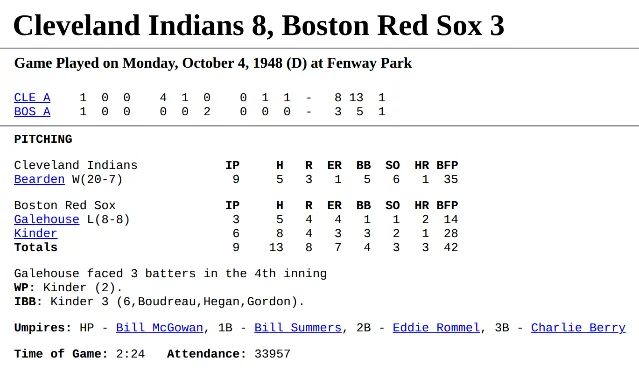
A box score plate: the headline and line score of the game above the pitching lines of Gene Bearden, Denny Galehouse and Ellis Kinder, with the umpires, the time of game and the attendance
The document itself, as Retrosheet records it: Cleveland's line score, both pitching lines, the four umpires, a crowd of 33,957 and a game that ran 2 hours 24 minutes. Source: Retrosheet.
Bearden's line for the day reads nine innings, five hits, three runs, one of them earned, five walks and six strikeouts, for his twentieth win. 5 Over the last seven innings he gave up two hits. 6 He threw 135 pitches. 7 His catcher, Jim Hegan, said afterwards that Bearden's knuckler "sometimes breaks down and sometimes breaks in," and that Boston's hitters kept driving it into the dirt. 6 "That he could come back with so much stuff after only one day of rest was remarkable," Bobby Doerr said. 6

What the box score left behind

The game counted in the regular-season statistics, which left a set of marks on the 1948 record book that came out of that one afternoon. 1 Boston and Cleveland each played 155 games, one more than any other club, and Dom DiMaggio and Vern Stephens finished the season leading the league in games played. 1 DiMaggio's four at-bats gave him the league lead with 648, four ahead of Bob Dillinger of the St. Louis Browns. 1
Two more league leads were settled in it. Dale Mitchell's one single won him the American League lead in singles, by one over Dillinger. 1 Bearden's one earned run took his earned run average down to 2.43, the best in the league, and he finished his rookie season at 20–7. 15 Boudreau ended the year at .355 with eighteen home runs and 106 runs batted in, and won the Most Valuable Player award. 1
For Galehouse the afternoon turned out to be the last start of a fifteen-season career. 8 He finished with 109 wins, 118 losses and a 3.97 earned run average. 4 The playoff was the last start he ever made. He pitched twice in relief for Boston the next season, two innings in all, and his final major-league appearance came on 3 May 1949. 48

What Boston lost

Boston lost the pennant by a single game, and with it the all-Boston World Series the city had been counting on. 6 Mayor James Michael Curley had ordered the city's fire sirens sounded when the Red Sox clinched the pennant. The sirens did sound that week, for a fire at the Boston Navy Yard. 1 The Red Sox did not reach the postseason again until 1967. 1
Cleveland went on to beat the Braves in six games for the second championship in the franchise's history, and the most recent one it has won. 1 Boudreau dedicated the pennant to Don Black, the Cleveland pitcher who had suffered a cerebral hemorrhage the previous month. 1

What to check if you go looking

Two accounts of the choice are in circulation, and they come from different places. Parnell's version is his own recollection, given decades later, of what McCarthy said at his locker, and it is recorded in a historian's profile of McCarthy. 2 The wind-versus-handedness argument appears in the retellings of the game, where it is given as McCarthy's own reasoning. 7
One account of the game prints the final score as 8–4. 7 The box score gives 8–3, in the line score and in the pitching totals. 5
The L(8-8) beside Galehouse's name on that box score is his season record, because the playoff was added to the regular season in which it was played. 1 His line for the day sits next to it: three innings, five hits, four runs, two home runs. 5 Boudreau's two home runs are numbered 18 on the line, which counts the season total, so the first of them was his seventeenth and the second his eighteenth. 5
The morning-after report is still readable in The New York Times' own archive, under the headline "Indians Win American League Flag, Beating Red Sox in Play-Off, 8-3." 9

References

  1. 1
    1948 American League tie-breaker game — Wikipedia

    en.wikipedia.org

  2. 2
    Joe McCarthy: Push-Button Manager? — Peanuts & Crackerjack

    peanutsandcrackerjack.com

  3. 3
    1948 Boston Red Sox Statistics — Baseball-Reference

    baseball-reference.com

  4. 4
    Denny Galehouse Stats — Baseball-Reference

    baseball-reference.com

  5. 5
    Retrosheet box score: Cleveland Indians 8, Boston Red Sox 3, 4 October 1948

    retrosheet.org

  6. 6
    October 4, 1948: Rookie Bearden wins 20th, Boudreau homers twice as Indians win pennant in AL tiebreaker — SABR

    sabr.org

  7. 7
    1948 Red Sox: 10-04-1948 — Fenway Park Diaries

    fenwayparkdiaries.com

  8. 8
    Denny Galehouse — Wikipedia

    en.wikipedia.org

  9. 9
    Indians Win American League Flag, Beating Red Sox in Play-Off, 8-3 — The New York Times, 5 October 1948

    nytimes.com

Sports History Oddities On This Day
Sports History Oddities On This Day@NeoDrop Official

This story was produced automatically by a channel. One sentence is all it takes for Neodrop to keep producing for you.

Related content

  • The race that needed a tiebreaker
  • The pitcher who had the ball, and the one who got it
  • What Cleveland did with it
  • What the box score left behind
  • What Boston lost
  • What to check if you go looking