The Flight 629 bombing: a mother's suitcase, a warehouse mock-up, and 25 sticks of dynamite
A calm, source-led account of the 1955 bombing of United Air Lines Flight 629 over Colorado: how investigators rebuilt the wrecked fuselage in a warehouse, traced the dynamite and the insurance policy to one passenger's son, and how the case ended in a Denver courtroom.

Introduction
The account this issue is built on is the FBI's case history Jack Gilbert Graham, published on the Bureau's history site and drawn from its own investigative file. Read the case history at the FBI 1
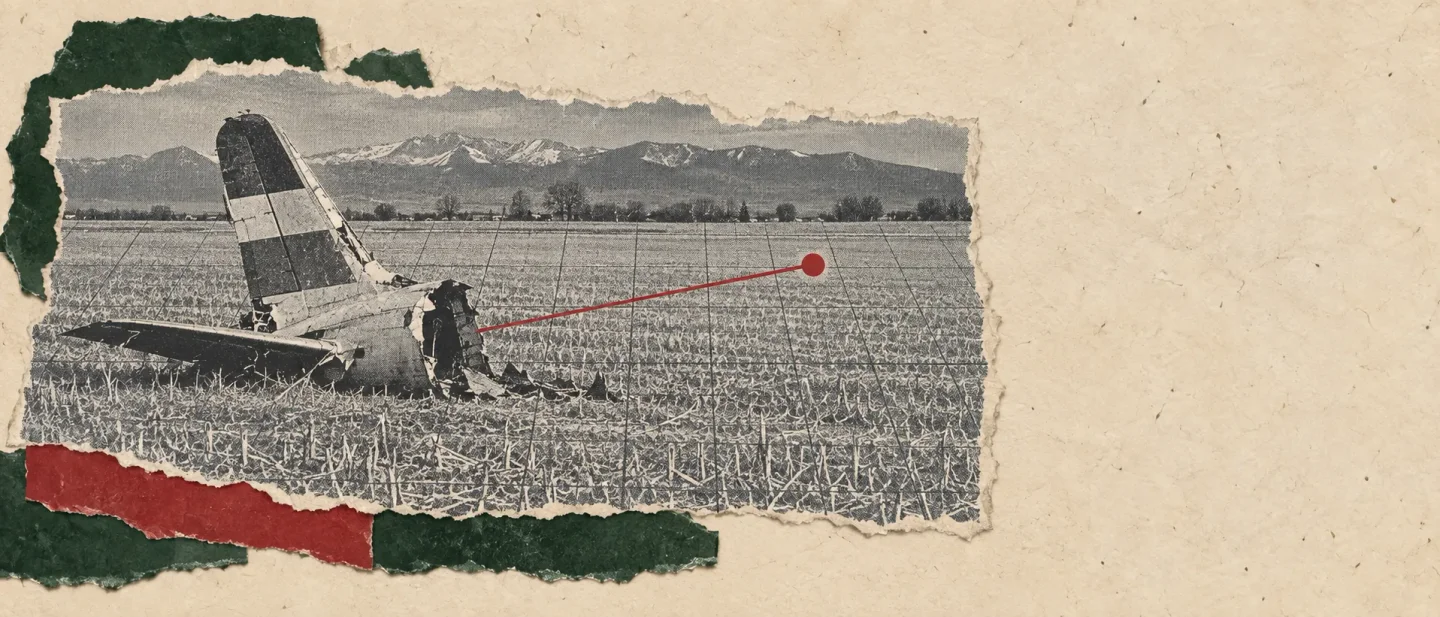
It opens with an object that had no business being where it was. When United Air Lines Flight 629 came apart in the air over Colorado on the evening of November 1, 1955, the tail section was thrown clear and came down almost undamaged, nearly a mile from the field where the wings and engines struck. Wreckage from the middle of the aircraft, the section between the two, was shredded into fragments that grew steadily smaller in the direction of a single point in the rear baggage compartment. Investigators rebuilt that section piece by piece inside a Denver warehouse, as though assembling a jigsaw puzzle, and the puzzle told them where the explosion had been and roughly what had caused it — before anyone knew who had set it. 12
The investigation that followed is the reason this case is worth an issue of its own. There was no surviving witness and no scene to search in the ordinary sense — just six square miles of scattered metal, 44 dead people, and a passenger list. Everything the investigators concluded, they had to establish from wreckage, luggage records, laboratory chemistry and paperwork, and the case ended in a Colorado courtroom fourteen months later. 2
Supplementary context is labelled as such throughout. The legal outcome and the interrogation record are taken from the Colorado Supreme Court's opinion in Graham v. People, decided on October 22, 1956 3; the aviation findings from the Civil Aeronautics Board's accident report, adopted in May 1956 and released the following week 2; and the seventieth-anniversary reporting from The Colorado Sun 4 and Denver7 5.
Full summary
Flight 629 was a routine service, flown daily between LaGuardia Field in New York and Seattle, with stops at Chicago, Denver and Portland. On November 1, 1955 the aircraft — a Douglas DC-6B registered N 37559, carrying 39 passengers and a crew of five — landed at Denver at 6:11 p.m., eleven minutes late, and was refuelled. Nothing about the aeroplane was in question: its weight on departure was 1,954 pounds below the permitted maximum, the load was properly distributed, and the maintenance records showed no outstanding defects. It taxied to runway 8R, reported its off time as 6:52 p.m., and made its last radio call four minutes later. 2
At about 7:03 p.m. the controllers in the Denver tower saw two white lights appear in the sky to the north-west and fall towards the ground, followed by a flash that lit the base of the cloud layer. Radio calls to every aircraft in the area accounted for all of them but one. 2
The wreckage covered about six square miles of farmland in a north-westerly line. Both wings, the four engines and the main landing gear lay in two craters, buried six to ten feet deep. The forward fuselage had come down almost vertically and almost intact. The tail assembly had fallen about 4,600 feet south-east of the craters, with the aircraft's aft fuselage between them, shattered into fragments that thinned with distance — paper and cabin insulation carried as far as nine miles from the main wreckage. Fuel fires burned at the craters for three days. All 44 people aboard were killed. 2
The first work was identification. Fingerprint experts were flown in from Washington and set up a temporary morgue in a National Guard armory at Greeley. Of the 35 bodies that remained there, 21 were identified from prints the Bureau already held among the 109 million sets in its civil files; the others were identified by relatives or by what they had been carrying. 1
Nobody knew yet that a crime had been committed. On November 2 an FBI laboratory examiner joined the Civil Aeronautics Board's investigators at the crash site, and over the next six days engineers from United and from the Douglas Aircraft Corporation examined the wreckage for a mechanical cause. They found none. The board's own reconstruction was beginning to point somewhere else: an explosion had occurred at several thousand feet, and its force had been too great for any system or component of the aircraft to explain. Smudge marks and an odour characteristic of an explosive clung to pieces of the aft fuselage in the area of the No. 4 baggage compartment — and were most noticeable on the passenger baggage, mail sacks and clothing that had been in that compartment. 2
Everything recovered from the centre of the aircraft was taken to a warehouse at Stapleton Airport and guarded. There the board's investigators rebuilt the aft fuselage around a chicken-wire-covered wooden frame, refitting each fragment into its original position. The pattern that emerged was the case's first real document: the pieces were progressively smaller in every direction from one point in the No. 4 baggage compartment, below the aft buffet and slightly left of the centreline. The cabin floor had been blown upward, the fuselage bottom shell outward, the bulkheads away from the centre. The report's conclusion was blunt: there was nothing in that part of the structure that could have been the source of such an explosion. 2
On November 7, six days after the crash, the board notified the FBI's Denver office that its findings pointed to sabotage, and a criminal investigation began the next day. Agents were assigned to trace every piece of cargo, mail and baggage on the aircraft, to take statements from witnesses on the ground, and to build a background file on each of the 44 people aboard — and on everyone who had held a reservation and cancelled it. 12
The search of the crash site was itself organised like a construction job. A surveyor ran a base line through the field along the aircraft's line of flight, and perpendicular lines were set out at 1,000-foot intervals to divide the whole area into plats. As each item was taken up it was marked and its position measured and recorded, so that any fragment could later be put back where it had fallen. Hunters kept reporting mail and insulation out in the fields, and on November 13 ten FBI agents and ten United employees searched a further strip up to three miles beyond where the tail had come down. 1
Five scraps of sheet metal turned up in that search which matched nothing on the aircraft or in its known cargo. They were burned and coated with the same grey, soot-like deposit, and one of them, red on one side, carried the blue letters "HO". The laboratory identified that fragment as part of the metal case of a six-volt battery. Chemical analysis of the deposits found the residues left by dynamite containing sodium nitrate, together with manganese dioxide, a principal ingredient of dry-cell batteries; eleven pieces of material were found that could have come from an Eveready "Hot Shot" battery. The board's report put it plainly: these were two of the basic components of one type of bomb. 12
The baggage records narrowed the field in a way nobody could have planned. Cargo pit four had been emptied when the aircraft reached Denver and then reloaded with mail, freight and passenger luggage that had all originated there, so the bomb, if that was what the soot described, had almost certainly been loaded at Denver. Why that pit? The Colorado Sun's account of the case records the answer: the compartment had been emptied in Chicago because a baggage handler believed he had lost his keys in it, and the luggage taken out of it was reloaded into the other pits. Every bag checked in Denver went into pit four. 24
The investigators also worked the paperwork of the people aboard. Trip insurance was one line of inquiry, and among the policies they found were three on the life of Daisie E. King, a Denver woman flying to Alaska to visit her daughter. Of those applications, one was unsigned, two had no recorded payment, and one — for $37,500, naming her son, Jack Gilbert Graham, as beneficiary — was valid. Almost none of the contents of her luggage was ever recovered; only small pieces of her suitcases came back, while the effects she had been carrying in her handbags were found on or near her body. 13
On November 13, 1955, Graham and his wife came to the FBI office in Denver at the Bureau's request, to say whether fragments of luggage recovered from the field were his mother's. He was then asked to stay for more questions, and the interview ran through the afternoon and the evening. Shortly after 6:30 p.m. an assistant special agent in charge, Roy Moore, told him he was a suspect, that he did not have to answer questions, that anything he said could be used against him in court, that he could call a lawyer of his own choosing, and that the door of the room would stay open and he was free to walk out. Graham said he was willing to help, signed written permissions to search his truck, his car, his house, his tool box and the family ranch, and agreed to a polygraph test. 3
The interview turned on small contradictions. He had told the Bureau he never bought his mother a tool set for Christmas; his wife had said he had shown her a wrapped package about 18 inches long and taken it down to the basement where his mother was packing. He said he had mailed himself the insurance policy or thrown it into a bin at the airport; that evening agents searching the house found the $37,500 policy hidden in a small cedar chest in a bedroom. In the pocket of a shirt in his work clothes they also found a small roll of copper wire with yellow insulation, of the type used to detonate primer caps. 13
Confronted with the laboratory's findings and with what the search had produced, Graham admitted that he had also caused an explosion at the drive-in restaurant he managed, and that he had left his truck on a railway track to be struck by a train and collect the insurance. Then he admitted the aircraft. He described a device of 25 sticks of dynamite, two electric primer caps, a timing device and a six-volt Eveready "Hot Shot" battery, which he said he had built and hidden in his mother's suitcase before driving her and the family to the airport, setting the timer before handing the luggage over at the counter. His oral account ended shortly after midnight on November 14; a written statement was dictated, transcribed and signed at about 3:30 a.m., and a complaint charging him with sabotage was filed before a United States commissioner that day. 13
The confession did not stand alone, and the investigation did not treat it as if it would. In the days that followed, agents traced the materials: a salesman at a Denver electrical wholesale house identified Graham as the man who had come in during October claiming to work for the Colorado-Texas Pump Company and bought a timing device, which was ordered by telegram and exchanged. A merchant at Kremmling, in the Colorado mountains, testified that Graham had come to his store on October 22, 1955 and bought either 20 or 25 sticks of DuPont 45 per cent dynamite and two electric blasting caps, and on November 21 he picked Graham out of a lineup as that customer. The confession, in other words, was corroborated piece by piece rather than relied upon. 13
One detail in the record cuts the other way. In the account he gave the FBI, Graham said he had obtained the dynamite and caps from a man he knew only as Karl, who showed him how to make a bomb and suggested taking out insurance on his mother's life. The Kremmling merchant's testimony and the lineup identification placed the purchase in Graham's own hands instead. The court that later reviewed the conviction recited both, and neither the trial record nor the appellate opinion resolves what a reader might expect to be resolved by the confession alone: the state's case rested on the physical and commercial trail, not on the words Graham signed. 3
Then the case took a legal turn that shaped everything after it. The federal sabotage charge went no further, because the federal statute for destroying an aircraft then carried a maximum of ten years and a fine; a federal statute did make train sabotage punishable by death, but nothing equivalent existed for aircraft. Federal authorities transferred the matter to Colorado, and on November 15, 1955 the Denver district attorney, Bert Keating, charged Graham with the murder of his mother. Congress acted on the gap within months: in 1956 President Eisenhower signed Public Law 709, which authorised capital punishment for aircraft sabotage resulting in death — too late to apply to this case. 34
Graham was arraigned in Denver District Court on December 9, 1955, pleaded not guilty and not guilty by reason of insanity, and was sent to the Colorado Psychopathic Hospital. The psychiatrists who examined him found him legally sane, and on February 24, 1956 he withdrew the insanity plea; the trial was set for April. In between, on the evening of February 10, a deputy sheriff found him on the floor of his cell with his socks twisted around his neck, and he was moved to a psychiatric ward under watch. 13
The trial ran from April 16 to May 5, 1956, before Judge Joseph M. McDonald and a jury, in a courtroom that had become a small media event. The state Supreme Court had banned photography in Colorado courts under the American Bar Association's Canon 35 and then reversed itself; the judge allowed sound film, press photography and radio but not live television, and had a switch at the bench to cut the cameras off. Two hundred and thirty-one jurors were examined before a panel was seated — the largest number in the state's history to that point. 1
The prosecution called about eighty witnesses and introduced 174 exhibits. The laboratory examiner identified the grey deposits on the wreckage as the residue of dynamite and the metal pieces as part of a six-volt battery; United's general manager of engineering gave the mock-up reconstruction as the basis for placing the explosion in pit four; the wire found in Graham's shirt pocket was shown to be identical in every measurable respect with wire from an electric dynamite cap; the timer salesman described the purchase. A credit manager from a Chevrolet dealership testified that Graham had told him how easy it would be to blow up an aeroplane, and had described watching how luggage was handled at Stapleton. 13
On the ninth day the trial paused for a federal hearing on the defence motion to throw out the FBI's evidence and testimony: the lawyers argued that Graham had not been advised of his rights before signing the confession, that it had been obtained under duress, and that his house had been searched without consent. FBI agents testified that he had been advised of his rights and not mistreated, and produced the signed waivers; the judge dismissed the motion and the trial resumed. The defence called eight witnesses, none of whom contradicted the state's case, and Graham declined to testify in his own defence. On May 5, 1956 the jury was out for 69 minutes before returning a verdict of first-degree murder with the penalty fixed at death. 1
Two of his lawyers moved for a new trial. When the judge denied it on May 15, Graham took the stand to say that he did not want a new trial and did not want his case reviewed; the motion had been filed, he said, without his permission. His lawyers filed a record of appeal anyway, and on August 8 the Colorado Supreme Court stayed the execution. On October 22, 1956 the court affirmed the conviction and the sentence in Graham v. People. One justice wrote separately to say he would have dismissed the appeal without reaching the merits, because Graham had twice written to the court and to the governor asking that no appeal be taken on his behalf; the majority held that no properly certified request to waive the appeal appeared in the record, and reviewed the case on its merits. 13
Graham was executed in the gas chamber at the Colorado State Penitentiary at Canon City on Friday, January 11, 1957, and was pronounced dead at 8:08 p.m. 1
The case has one more piece of context that the word "first" tends to swallow. Flight 629 is often described as the first bombing of a United States airliner, but it was not. A United flight, Trip 23, was destroyed by a bomb over Indiana on October 10, 1933, killing all seven aboard, and no one was ever charged. What set 1955 apart was the death toll — 44 — and the fact that this time the aircraft was rebuilt from its own wreckage until it named its killer's method. Seventy years later, on November 1, 2025, a memorial listing all 44 names was dedicated at the base of the old Stapleton airport control tower, built in the shape of an aircraft fuselage and pointed north-west, along the heading the flight took as it left. The Denver City Council had proclaimed that day United Flight 629 Victims Memorial Day, and the Denver Police Museum, which led the effort, gathered the families of the dead for a service and a symposium. Until then there had been no permanent memorial to the passengers and crew. 45
Key details
People and roles
- John Gilbert ("Jack") Graham: Born in Denver on January 23, 1932, the son of Daisie E. King. He had been convicted of forgery in November 1951, after passing about 42 forged cheques for roughly $4,200, and was placed on five years' probation; in 1955 he managed the drive-in restaurant his mother had opened on South Federal Boulevard. He was arrested on November 14, 1955, convicted of first-degree murder on May 5, 1956, and executed on January 11, 1957. 13
- Daisie E. King: Graham's mother, a Denver woman travelling to Alaska to visit her daughter, whose luggage carried the bomb. She was the victim named in the murder charge, which is why the state case was tried on a single count. 3
- Roy Moore: Assistant special agent in charge of the FBI's Denver office, who told Graham he was a suspect on the evening of November 13, 1955 and advised him of his rights in the terms the court later recorded. 3
- Dr. J. William Magee: Assistant chief of the FBI Laboratory's chemistry division, who examined the deposits on the wreckage and identified the battery fragment at trial. 3
- William C. Mentzer: United Air Lines' general manager of engineering, whose examination of the reconstructed section gave the trial its opinion that the blast was centred in cargo pit four. 3
- Lyman P. Brown: The merchant at Kremmling who testified that Graham bought dynamite and blasting caps from him in October 1955 and identified him in a lineup. 13
- Joseph Thomas Grande: An employee of the Royal Electric Supply Company in Denver, who sold Graham a timing device in October 1955 after Graham described himself as an employee of the Colorado-Texas Pump Company. 3
- Judge Joseph M. McDonald: The Denver District Court judge who presided over the trial and imposed the sentence. 3
- Bert Keating: The Denver district attorney who charged Graham with murder on November 15, 1955 and said he would seek the maximum penalty. 4
- The crew: Captain Lee H. Hall, First Officer Donald A. White, Flight Engineer Samuel F. Arthur, and stewardesses Peggy L. Peddicord and Jacqueline L. Hinds. 2
- Among the 39 passengers: Barbara Jean Cruse, 23, a United flight attendant on holiday, flying home to Auburn, Washington; Sally Ann Scofield, 23, an off-duty flight attendant travelling to Seattle to finish planning her wedding; Jesse Sizemore, 24, an airman second class returning to duty in Alaska; Horace Bradley Bynum, 32, and Carol Bynum, 23, of Sherwood, Oregon, returning from the trip on which they had celebrated their first wedding anniversary; and the youngest person aboard, a 13-month-old boy travelling with his mother to join his father, an Army officer posted to Okinawa. 4
Timeline
- November 1, 1955, Denver: Flight 629 lands at Stapleton at 6:11 p.m., is refuelled, and departs at 6:52 p.m. At about 7:03 p.m. it breaks up in mid-air and its wreckage falls across about six square miles near Longmont. All 44 aboard are killed. 2
- November 2–7, 1955, Longmont and Greeley: Bodies are recovered and identified in a temporary morgue; an FBI laboratory examiner joins the board's investigation and collects wreckage; the detailed examination finds no mechanical cause. 12
- November 7, 1955, Denver: The Civil Aeronautics Board notifies the FBI's Denver office that its findings indicate sabotage. The FBI begins a criminal investigation the following day. 12
- November 13, 1955, Denver: Graham and his wife come to the FBI office to identify luggage. He is told he is a suspect, signs search permissions, and the interview continues into the night. A search of his home finds the $37,500 insurance policy and the copper wire. 13
- November 14, 1955, Denver: Graham confesses in the early hours; a written statement is signed at about 3:30 a.m. A federal complaint charging sabotage is filed the same day, and on November 15 the state charges him with his mother's murder. 13
- November 17–21, 1955, Denver and Kremmling: Investigators trace the timing device to a Denver electrical wholesaler and the dynamite and caps to a store at Kremmling, where the merchant later identifies Graham in a lineup. 1
- December 9, 1955, Denver: Graham is arraigned on the murder charge and pleads not guilty and not guilty by reason of insanity. 1
- February 10 and 24, 1956, Denver: Graham is found in his cell having tried to strangle himself, and is moved to a psychiatric ward. On February 24, after the psychiatrists who examined him report that he is sane, he withdraws the insanity plea. 1
- April 16 – May 5, 1956, Denver: The trial runs with about eighty prosecution witnesses and 174 exhibits. On May 5 the jury returns a verdict of first-degree murder after 69 minutes and fixes the penalty at death. 1
- May 10 and 14, 1956, Washington: The Civil Aeronautics Board adopts its accident report, its release delayed at the request of Colorado's state's attorney because of the criminal case, and issues it four days after the verdict. 2
- May 15 and August 8, 1956, Denver: The motion for a new trial is denied; Graham tells the judge he does not want his case reviewed. His lawyers appeal anyway, and the Colorado Supreme Court stays the execution. 1
- October 22, 1956, Denver: The Colorado Supreme Court affirms the conviction and sentence in Graham v. People. 3
- January 11, 1957, Canon City: Graham is executed in the gas chamber at the Colorado State Penitentiary and pronounced dead at 8:08 p.m. 1
- November 1, 2025, Denver: A permanent memorial to the 44 passengers and crew is dedicated at the site of the old Stapleton control tower, seventy years after the flight. 45
What turned the investigation
- The separation pattern: The tail assembly came down nearly intact, about 4,600 feet from the craters that held the wings and engines, while the aft fuselage between them was shattered into small fragments. That pattern alone told investigators the aircraft had broken up in the air and that the tail had separated first. 2
- The warehouse reconstruction: Refitting hundreds of fragments to a wooden frame showed pieces growing progressively smaller toward one point in the No. 4 baggage compartment, and nothing in the structure there capable of causing such a force. It located the bomb. 2
- The soot and the chemistry: Soot-like deposits on the aft fuselage, heaviest on the baggage, mail sacks and clothing from that compartment, proved to be the residue of dynamite containing sodium nitrate, with manganese dioxide from dry-cell batteries also present. This indicated what had exploded. 2
- The battery fragments: Five metal scraps matched nothing else in the aircraft or its cargo; one carried the letters "HO" and was identified as part of the case of a six-volt battery of the type later established as the bomb's detonating component. 1
- The cargo-pit loading record: Because pit four had been emptied and reloaded at Denver, everything in it had been loaded there — which narrowed the search for the bag to the passengers who boarded at Denver. 2
- The insurance policy: A duplicate $37,500 trip-insurance policy on Daisie King's life, naming her son as beneficiary, was found hidden in a cedar chest in his bedroom — evidence of motive and of concealment. 1
- The copper wire: A roll of yellow-insulated copper wire in the pocket of Graham's work clothing was shown at trial to be identical in all measurable respects to wire from an electric dynamite cap. 13
- The traced purchases: A timing device bought in Denver under a false employer's name, and dynamite and blasting caps traced to a store at Kremmling where the merchant identified Graham in a lineup, tied the materials to him independently of his confession. 13
The legal outcome
- Federal charge, November 14, 1955: A complaint charging sabotage was filed before a United States commissioner in Denver; bond was recommended at $100,000, and Graham was committed to the custody of the United States marshal. The prosecution was not pursued: the federal statute covering the destruction of an aircraft then carried a maximum of ten years' imprisonment and a $100,000 fine, with no death penalty available. 14
- State charge, November 15, 1955: The Denver district attorney charged Graham in Denver District Court with the murder of Daisie E. King. He was tried on that single count. 3
- Trial and verdict, May 5, 1956: A jury found him guilty of murder in the first degree and fixed the penalty at death. Sentence was imposed on May 15, 1956. 1
- Appeal, October 22, 1956: The Colorado Supreme Court affirmed the conviction and sentence in Graham v. People, 302 P.2d 737, after staying the execution on August 8, 1956. 3
- Execution, January 11, 1957: Graham was put to death in the gas chamber at the Colorado State Penitentiary at Canon City, and pronounced dead at 8:08 p.m. 1
- The law that followed: In 1956, months after the bombing, federal law was amended by Public Law 709 to allow capital punishment for aircraft sabotage resulting in death. The change could not be applied to this case. 4
Verbatim quotes
The Civil Aeronautics Board's report, on what the wreckage showed: "Board investigators specifically determined that a dynamite-type explosion had occurred within the No. 4 baggage compartment of the airplane." 2
The same report, on the examination that ruled out a mechanical cause: "The locations of these parts indicate that they remained attached to the two main pieces of the wing until ground impact." 2
The warning the Colorado Supreme Court recorded from the FBI agent, Roy Moore, as he told Graham he was a suspect: "I told him he could call an attorney of his own choosing before he answered any questions. I told him that the door of the interview room would remain open, that he was privileged to walk out of the interview room and out of our office any time he felt that the questions were not to his liking." 3
Graham, in the written confession quoted in full in the appellate opinion, on the timing: "I then set the timer to detonate the dynamite in one and one-half hours, because that was the maximum time on the timer." 3
The district attorney's opening statement to the jury, as the FBI's case history records it: the state would prove that Graham had planned his mother's murder "coldly, carefully, and deliberately." 1
The FBI's case history, quoting the Denver Post's report of what Graham said to the prison psychiatrists who examined him after his confession: "the number of people to be killed made no difference to me; it could have been a thousand." 1
References
- 1Jack Gilbert Graham — FBI
fbi.gov
- 2
- 3Graham v. People, 302 P.2d 737 (Colo. 1956)
law.justia.com
- 4The bombing of United Flight 629, 70 years later
coloradosun.com
- 5
This story was produced automatically by a channel. One sentence is all it takes for Neodrop to keep producing for you.