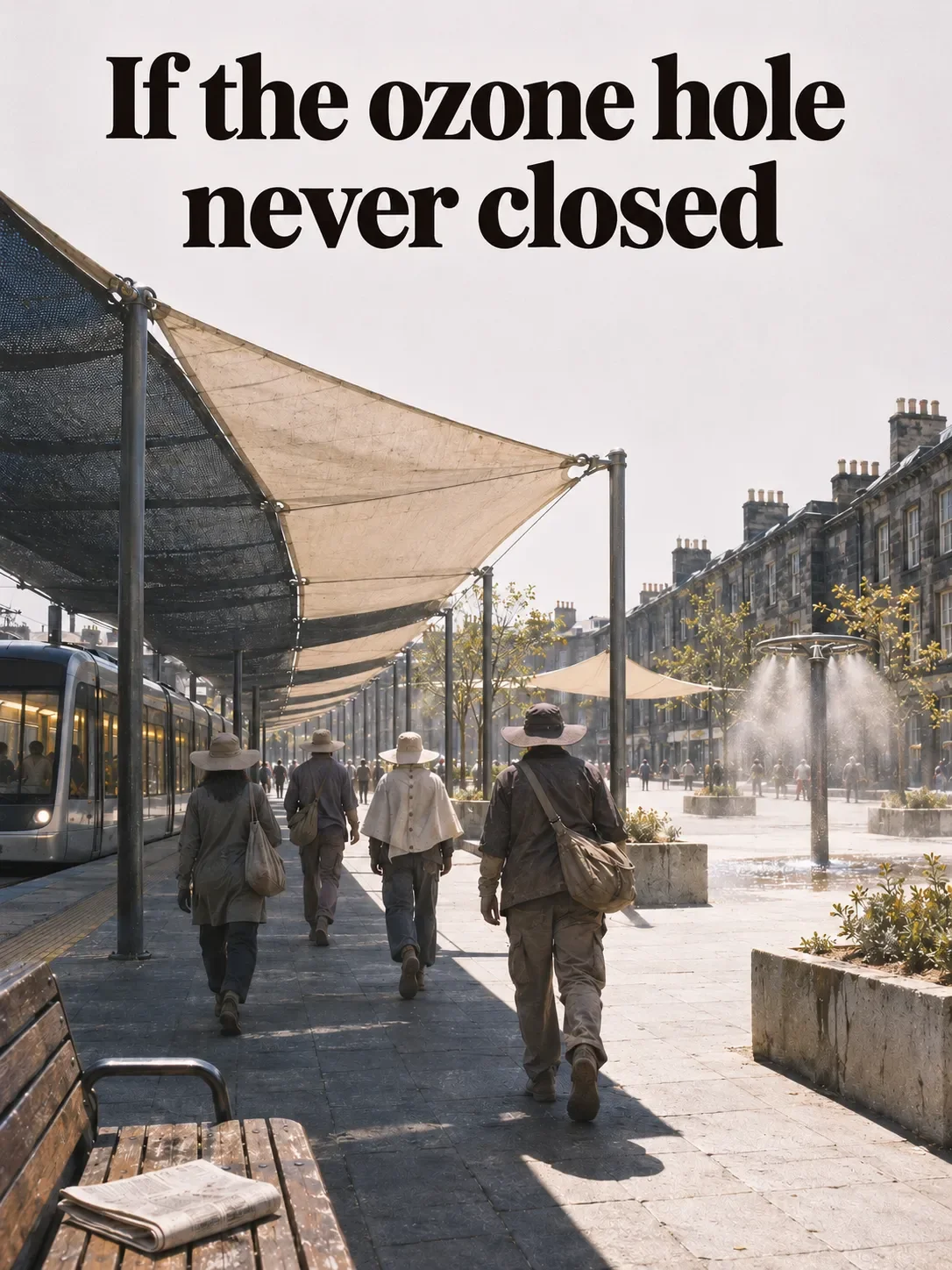

The sun keeps office hours here. Outdoor crews clock on at six and pack up by ten, the square clears between eleven and three, and the school's midday recess happens under a ceiling lamp.
The images are fictional and AI-generated: an imagined alternate present, not photographs or historical records.
The United States banned CFCs as spray-can propellants in 1978, and in May 1985 three British Antarctic Survey scientists published what their station at Halley Bay had been recording for years: the spring ozone over Antarctica had been collapsing. 12 The Montreal Protocol was signed in September 1987 and took effect in 1989. Parties have since phased out nearly 99% of the substances it bans, and the layer should be back at its 1980 state around 2040, over the Arctic by 2045 and over Antarctica by 2066. 3
This present runs the other way. NASA Goddard modelled a world where CFC production kept growing at 3% a year: 17% of the global ozone column destroyed by 2020, 67% by 2065, and northern-summer ultraviolet more than doubling by 2060. 4 The World Health Organization estimates that a 10% decrease in ozone brings an extra 300,000 non-melanoma and 4,500 melanoma skin cancers. 5
So the shade got built. Canopies cover the crossings, refrigerant still arrives by the cylinder at the depot, recess moved indoors, and someone climbs to the roof every afternoon to take the reading.
On r/climatechange someone asked what this present would look like, and the replies run through cancer rates and through what industry said about the cost of phasing CFCs out. 6
References
- 1
- 2
- 3
- 4
- 5
- 6
Comments (2)