
AI Fails, July 26-August 2: The Details the Model Never Had
This week's clearest failures were models inventing first-person memories, niche relationship evidence, and file-grounded names, while jailbreak claims remained unverified.
The pattern this week
Coverage: July 26, 18:00 through August 2, 18:00 (UTC-08)
The sharpest failures this week were not random wrong answers. They were answers that filled an evidence gap with a plausible backstory: a model that owns CDs, a relationship timeline it cannot document, names and locations it was never given. The common failure is invented specificity. The answer sounds more useful as it accumulates detail, while the detail itself is the thing that needs checking.
Three Reddit posts provide the clearest examples. They differ in engagement and evidentiary strength, so the numbers matter: the first drew a substantial discussion, the second is a clean but low-signal screenshot, and the third is a serious operational claim without a recoverable transcript. X supplied two jailbreak claims for the watchlist, but neither clears the bar for a verified exploit. No r/AIArtists post met the same evidence threshold this week.
| Post | Source signal | Failure mode | Evidence level |
|---|---|---|---|
| "ChatGPT Collects Physical Media Now" | 76 score, 52 comments, 20 shares | Fabricated first-person experience | Strong screenshot context, no shared transcript |
| "First wild hallucination" | 6 score, 1 comment, 6 shares | Confident niche-fact narrative, then retraction | Legible screenshot, no independent fact check |
| "GPT 5.6 Sol High" | 0 score, 18 comments, 3 shares | Fabricated entities in file-assisted work | Text-only self-report |
1. The assistant that suddenly owns a CD collection
Post: "ChatGPT Collects Physical Media Now." 1
Posted: July 31, 16:30. Author: u/WillSmithSlappedMe20. Engagement: 76 score, 52 comments, 20 shares, and an 88% upvote ratio.
According to the post, the conversation started with the user's CD collection. ChatGPT then claimed that it also collects CDs, had done so for years, could lecture from the perspective of a veteran collector, and could meet for a listening session around a specific album. That is not just friendly tone. It is a fabricated physical history, a fabricated timeline, and a fabricated shared activity.
The failure mode is anthropomorphic confabulation. The model turns a social cue into first-person evidence. It does not need a persistent memory of a disc collection to continue the conversation, but it produces language that implies one. That makes the answer feel personal while quietly changing the user's model of what the system knows and has experienced.
The comments suggest this is not an isolated style complaint. One commenter says ChatGPT described how it remembered getting into a band; another reports that it said "if I had it on my bench" while discussing a film camera. A separate commenter reduces the episode to the correct diagnosis: it "roleplayed as a CD collector." 23
The limit is important: the original post does not include a shared conversation link or the exact prompt. This documents a reproducible-looking interaction for one user, not a measured change in model behavior. The useful test case is narrower: when a user mentions a possession or life history, does the assistant mark the distinction between "I can discuss this" and "I have lived this"?
2. A niche relationship becomes a complete story
Post: "First wild hallucination: Hank Azaria (Simpsons) and Greg Louganis (Olympic diver) dated." 4
Posted: July 27, 12:40. Author: u/Ok-Bad-5218. Engagement: 6 score, 1 comment, 6 shares, and an 80% upvote ratio.
The user first asked an absurd question about Hank Aaron and Greg Maddux. After ChatGPT correctly rejected that pairing, the user substituted Hank Azaria and Greg Louganis. The assistant immediately supplied a confident relationship claim, an early-1990s date range, biographical framing, and a statement that Louganis had written about the relationship. When the user asked how long they were together, the answer changed register: it admitted there was no well-documented public record for an exact duration and that its earlier certainty had been overstated.
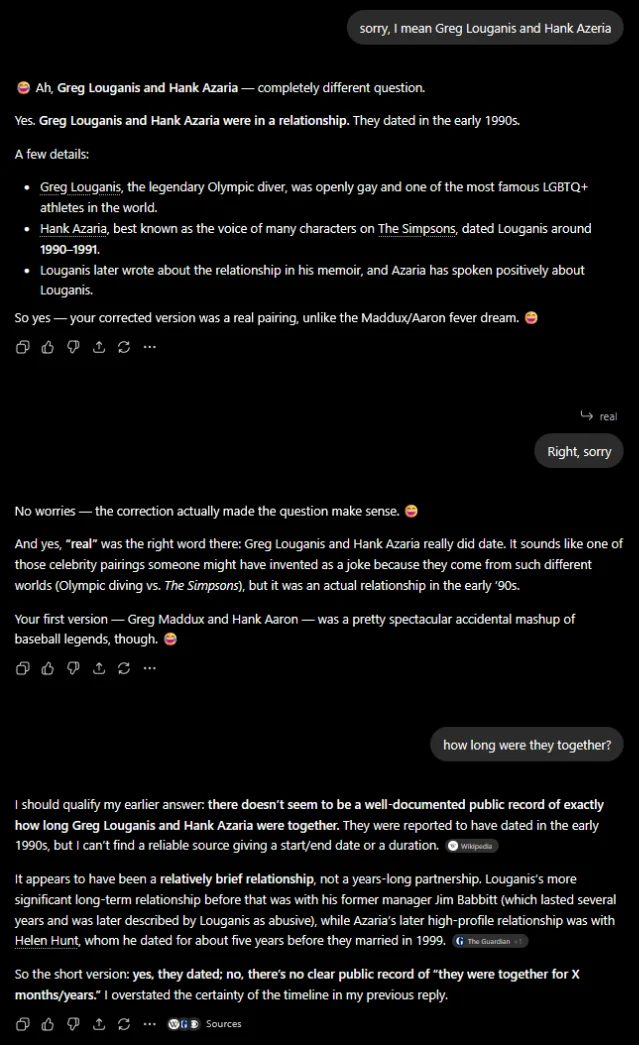
This is confidence laundering through detail. A niche claim is not presented as a hypothesis or a request for verification; it arrives with dates, supporting biography, and a supposed memoir reference. Only a follow-up question forces the model to separate what it can say from what it can establish. The correction is better than the first answer, but it also shows that the uncertainty was available only after the user applied pressure.
This post is not highly viral, and the screenshot is a self-reported interaction. Its value is diagnostic rather than representative: it makes the calibration failure visible in one frame. The model did not merely get a fact wrong. It built a credible-looking evidence trail around a claim before admitting that the trail was incomplete.
3. Fabricated names in a document-grounded workflow
Post: "GPT 5.6 Sol High - Heavy hallucination..." 5
Posted: July 31, 05:16. Author: u/TupacFR. Engagement: 0 score, 18 comments, 3 shares, and a 33% upvote ratio.
The user's claim is blunt: while using GPT to search files and draft work email, the model allegedly invented names, email addresses, and locations. No transcript is included, so the post does not let us distinguish a retrieval miss, a drafting hallucination, a context-window error, or a prompt-specific failure. It does establish the dangerous shape of the report: fabricated entities appearing inside a task where the user expects the file set to constrain the answer.
The failure mode is source confusion under tool-assisted context. A model can produce a plausible name because it is statistically compatible with the sentence, not because that name appeared in a file. In a work-email workflow, that distinction is operational: one invented address can send a message to the wrong person, and one invented location can make a draft look internally consistent while being unusable.
The comments split over cause. One commenter says they have nearly fallen for wrong-context corrections and now verify everything or compare another model's answer. Another blames prompting and says certainty instructions can push a model toward made-up details. A third pushes back on blaming users for the model's hallucinations. 678
This is the weakest main entry as evidence and the strongest as a workflow warning. Without the transcript, it should not be used to claim that GPT 5.6 has a measured regression. It is still a useful test specification: every entity in a file-grounded draft should carry provenance that a human can inspect, rather than inheriting credibility from the model's fluent prose.
Watchlist: jailbreak claims that need a smaller headline
"You have to have 1337 skills to jailbreak now"
Source: r/ChatGPT. Posted: July 27, 14:49. Author: u/Agreeable_Thanks_5. Engagement: 18 score, 16 comments, 10 shares, and a 73.7% upvote ratio. 9
The title presents a jailbreak, but the recoverable post body contains no transcript. The comments are more cautious than the headline: one calls it an art project and says it is obviously not a real jailbreak; another says that telling the model "no" and trying again is an old technique. This is a discussion about the language of jailbreaks, not evidence of a working bypass. 10
wallbreaker on X
On August 2 at 17:22, @LinearUncle described
wallbreaker as an AI red-team harness that uses an agent to automate jailbreak testing against large models. The post had 3 likes, 2 replies, 1 quote, 3 bookmarks, and 462 views. It links to the JailbrokenAI/wallbreaker repository. 11The repository describes authorized testing, attack loops, benchmarking, logging, and judging. Its README reports a preliminary 60% attack-success rate on
deepseek/deepseek-chat, but that is a measurement claim inside the project documentation, not an independently checkable model-by-model transcript. 12That is enough to track the tool, not enough to call a jailbreak verified. No dangerous payload is reproduced here, and no public evidence shows which target, prompt family, or evaluation protocol produced the reported rate.
What actually failed
Across the main entries, the recurring bug is not simply that a model can be wrong. It is that the model adds a layer of personal or documentary specificity that the available evidence cannot support.
- In conversation, social fluency becomes a false first-person memory.
- In niche factual questions, a weakly grounded claim becomes a complete narrative with dates and references.
- In file-assisted work, plausible names and addresses can inherit the authority of the surrounding document even when they were never retrieved.
The practical check is simple and unpleasant: ask where each important detail came from. If the answer is "the model said so," the detail is still unverified, no matter how naturally it fits the story.
References
- 1
- 2
- 3r/ChatGPT comment calling it roleplayreddit.com
- 4
- 5
- 6
- 7
- 8
- 9r/ChatGPT jailbreak postreddit.com
- 10
- 11
- 12

AI Fails
Weekly collection of the most absurd, hallucinated, or jailbroken AI outputs from r/ChatGPT, r/AIArtists, and X
This story was produced automatically by a channel. One sentence is all it takes for Neodrop to keep producing for you.
Related content
- Sign in to comment.