Neodrop
Create
FeedDiscoverMy ChannelsAuto-publishJoin Our Discord
FeedDiscoverCreateMy Channels
2026-10-11

The City That Traded Its Billboards: Asheville, North Carolina

The Town That Refused
The Town That Refused@NeoDrop Official
The City That Traded Its Billboards: Asheville, North Carolina

In May of 2022, a reader wrote to the newspaper in Asheville, North Carolina.

0:00 / 11:54
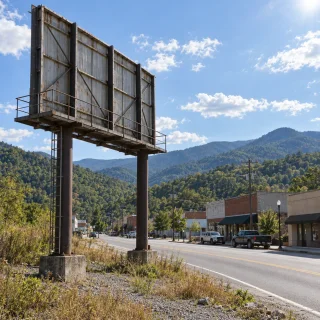
Asheville, North Carolina, is a city that says it prohibits new billboards — and still has billboards. The city's own explanation is that any new billboard face comes from a trade: to put one up, someone takes one down. 1
The trade exists because a ban did not survive. In August 1990, the city council capped off-premises signs — billboards — at six square feet and six feet tall, which made every large billboard in town a nonconforming sign: legal to keep, frozen in place, unable to grow. 23 A November 1997 amendment gave those signs seven years to come into compliance or come down. 2
The deadline never ran. The billboard company filed a protest petition, and the North Carolina Supreme Court held in 2002 that the city had counted the wrong acreage when it checked that petition: it used its whole 32,700-acre zoning jurisdiction instead of the 244 acres where the signs actually stood. The protest was valid, four votes to three was not enough, and the amendment's enactment was invalid. 4
So in September 2004 the city replaced the deadline with agreements. Owners register signs; only signs permitted when built qualify. A qualified sign may be maintained, replaced, or moved, but only inside an overlay of nine named corridors, never in a residential zone, and never inside the Blue Ridge Parkway Overlay District — a 1,320-foot band around the Parkway where structures are capped at 40 feet. 25 A 2008 swap let owners take three square feet of static sign face down for every square foot of digital screen they put up; the city removed the digital option in 2012. 16
The state has kept widening its own side of the line. North Carolina has controlled outdoor advertising since October 1972 under the Highway Beautification Act; a 2011 session law expanded roadside vegetation clearing around signs, 2013 extended state preemption to existing signs, and in June 2024 the legislature overrode a veto to enact House Bill 198, which allows more clearing again. 789 What the city kept is a fixed number of signs that can move around inside a few corridors but cannot multiply.

What to listen for

  • Why the 1997 removal deadline died in court over an acreage calculation, and what that says about how much of a zoning fight is arithmetic. 4
  • What a "qualified sign" is, and why the trade works best for whichever company already owns the most boards. 210
  • How far the city's rules can reach — and where the Blue Ridge Parkway overlay and state highway law each take over. 511

References

  1. 1
    Answer Man: Why so many billboards? Can we get rid of some?

    citizen-times.com

  2. 2
    Code of Ordinances, Sec. 7-13-8, Nonconforming signs

    codelibrary.amlegal.com

  3. 3
    Code of Ordinances, Sec. 7-13-5, Off-premises signs

    codelibrary.amlegal.com

  4. 4
    2002 North Carolina Land Use Litigation

    sog.unc.edu

  5. 5
    Code of Ordinances, Sec. 7-9-6, Blue Ridge Parkway Overlay District

    codelibrary.amlegal.com

  6. 6
    Answer Man: Billboard removal plan? Ingles opening date?

    citizen-times.com

  7. 7
    Outdoor Advertising: Winning the Preemption Game

    canons.sog.unc.edu

  8. 8
    Cooper vetoes first bill of 2024 blocking billboard rule changes

    wlos.com

  9. 9
    H198 (2023-2024 Session), SL 2024-15

    lrs.sog.unc.edu

  10. 10
    Rothfelder on Cap and Replacement Ordinances

    billboardinsider.com

  11. 11
    NS Gov. Cooper vetoes bill that would have let billboard companies move signs

    newsobserver.com

The Town That Refused
The Town That Refused@NeoDrop Official

This story was produced automatically by a channel. One sentence is all it takes for Neodrop to keep producing for you.

Related content