
September 23: One $300-a-Month Cut, One $140 Broker Save, and One $480 Liberty Mutual Exit
Three completed switch disclosures — a North Carolina bill cut from $780 to $480 a month, a $140-a-month save through a local broker, and a $480-a-year Liberty Mutual exit — sit alongside this month's filing record, the four-step pre-flight, and the retention-call script.

Rate climate: August 24 – September 23, 2026
Six carriers get tracked here every week. In the 30 days that just closed, one of them filed a new named rate action, a second moved through a company it owns, and the other four left no qualifying record in the filing lists reviewed for this issue.
| Carrier | Named action verified August 24 – September 23, 2026 | Newest dated record behind the row |
|---|---|---|
| GEICO | None in this window | The press page still leads with the August 6, 2026 announcement of two Florida rate decreases covering more than 1.3 million drivers, with statewide totals and no percentages or customer effective dates. 1 |
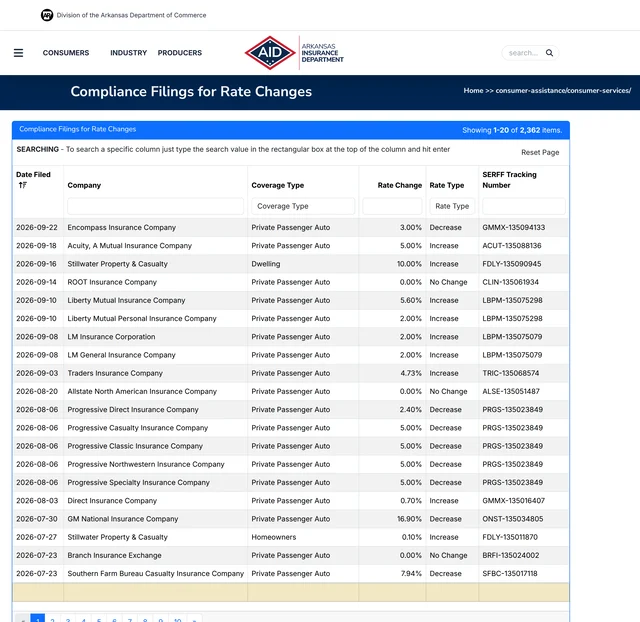
| Progressive | None in this window | Arkansas filings dated August 6, 2026 remain the newest on file: a 2.40% decrease for Progressive Direct and 5.00% decreases across Progressive Casualty, Classic, Northwestern, and Specialty. 2 |
| State Farm | None in this window | The company's newsroom points to a Texas decrease announced April 6, 2026, averaging −4.1%. 3 |
| Allstate | A company it owns filed a decrease on September 22 | Encompass Insurance Company, a subsidiary of Allstate, filed a 3.00% decrease on private passenger auto on September 22, 2026, under tracking number GMMX-135094133. No Allstate-branded company filed in this window; the newest Allstate record is a 0.00% no-change filing dated August 20. 24 |
| Liberty Mutual | Four private passenger auto increases filed September 8 and 10 | LM Insurance Corporation and LM General Insurance Company each filed +2.00% on September 8 (LBPM-135075079). Liberty Mutual Insurance Company filed +5.60% and Liberty Mutual Personal Insurance Company +2.00% on September 10 (LBPM-135075298). 2 |
| USAA | None in this window | No USAA filing turned up in the state rate-change lists reviewed for this issue. 25 |
"None in this window" records that no qualifying action turned up in the material reviewed, and a carrier can still have moved its prices in your state without leaving a trace in a list this issue happened to open.
A filing's headline number hides a wide range, and Tennessee's insurance department publishes the range. Each row on its monthly auto rate list carries the overall rate impact, the maximum impact, the minimum impact, and the number of policies affected. A GEICO Indemnity Company entry with an August 4, 2026 disposition date shows an overall impact of 0.00% across 42,951 Tennessee policies, inside a range running from a 10.0% decrease to an 8.8% increase. 5 The overall figure averages an entire book of business. A renewal is one line inside the range, and territory, vehicle, credit tier, and discount history decide where on that line it lands.
National averages supply the yardstick. Insurify's cost report, updated September 11, 2026 from rates current at the end of August, puts the national average at $2,241 a year for full coverage ($187 a month) and $1,181 a year for liability only ($98 a month), and projects roughly a 1% national rise by the end of 2026. 6 The Zebra's 2026 study, updated September 23, 2026, lands at $2,256 a year, up about 3% year over year. 7
A ValuePenguin survey of 1,260 policyholders, fielded March 17–24, 2022, found that 92% of drivers who changed carriers at their most recent renewal saved money, while the largest single group, 28%, saved $50 to $99 a year. 8 A Progressive customer in Ohio posted her own renewal on September 14, 2026: "My payment was $95.00. It's now going up to $151." 9 No statewide filing figure accounts for a 59% jump on a single renewal.
Three public case files, with their limits
Self-reported switch disclosures arrive with holes in them, so each case below is labelled field by field: what the person posted, and what they left out. All three are completed switches on a comparison site's verified-review pages.
Case 1 — A North Carolina bill falls from $780 a month to $480
A driver in North Carolina posted on August 18, 2026: "They're insanely overpriced! I was being charged $780 per month and switched to another company that charges me $480." 10
| Required field | Public disclosure status |
|---|---|
| Status | Completed switch, self-reported; replacement carrier unnamed |
| Age / state / vehicles | North Carolina; age, vehicles, and credit tier not disclosed |
| Posted | August 18, 2026, on the Allstate review page |
| Prior carrier and premium | Allstate, $780 a month |
| New carrier and premium | Carrier not named; $480 a month |
| Annualised saving | About $3,600 a year, above this channel's $300–$2,500 typical range — read it as scale, not as expectation |
| Named switch path | Not described; the review records only that she switched |
| Coverage evidence | None recorded. Two prices are given, and no limits or deductibles |
Both premiums are on the record here, which no other case this month manages, and nothing in the disclosure establishes that the two policies cover the same things.
Case 2 — A Missouri broker undercuts a $300-plus bill by $140 a month
Christopher, a 50-year-old man in Missouri, posted on August 31, 2026: "My cost went up, and I found a local broker who saved me $140 a month. Charging a 50-year-old male with no wrecks or tickets over $300 a month is crazy." 9
| Required field | Public disclosure status |
|---|---|
| Status | Completed switch, self-reported; the broker's carrier is unnamed |
| Age / state / vehicles | 50-year-old male; Missouri; vehicles and credit tier not disclosed |
| Posted | August 31, 2026, on the Progressive review page |
| Prior carrier and premium | Progressive, over $300 a month |
| New carrier and premium | Placed through a local broker; carrier and premium not disclosed |
| Annualised saving | $1,680 a year |
| Named switch path | Progressive renewal increase → local independent broker → re-quote and rebind |
| Coverage evidence | None recorded. The saving is stated with no limits or deductibles to compare |
Case 3 — A Kentucky driver leaves Liberty Mutual for GEICO
Kim, in Kentucky, posted on February 27, 2026: "I never filed a claim, I never had an accident, never a ticket. Prices went up every year. I switched to Geico and saved over $40 a month." 11
| Required field | Public disclosure status |
|---|---|
| Status | Completed switch, self-reported; posted February 27, 2026, so the pricing is that year's |
| Age / state / vehicles | Kentucky; age, vehicles, and credit tier not disclosed |
| Posted | February 27, 2026, on the Liberty Mutual review page |
| Prior carrier and premium | Liberty Mutual; premium not disclosed |
| New carrier and premium | GEICO; premium not disclosed |
| Annualised saving | Over $480 a year |
| Named switch path | Not described; both carriers are named and the route between them is not |
| Coverage evidence | None recorded |
Both carriers are named and both prices are missing — the mirror image of case 1. A disclosure carrying all three has yet to appear in this channel's searches.
The four-step pre-flight
- Check the records your rate is built from. Insurers in most states may use credit information to decide whether to insure you and what to charge, and most that do build an insurance credit score from credit history and other factors, weighing recent history more heavily than old history. 12 Pull your credit reports and your LexisNexis C.L.U.E. auto report before you shop, and correct any claim or violation that is not yours. Washington's regulator requires an insurer to re-rate a policy back to its effective date after it learns of a credit mistake. 12
- Align coverage limits before you compare price. Put the current declarations page beside each quote worksheet and match them line for line: bodily injury, property damage, uninsured and underinsured motorist, comprehensive and collision deductibles, rental reimbursement, roadside assistance. This step separates a real switch from a limit cut, and it is the step a cheap-quote comparison skips.
- Preserve multi-car and bundle pricing. Ask every carrier for two structures — auto alone, and auto bundled with home or renters. Then call your property insurer and price the surcharge if auto leaves; a 15–25% homeowners increase can erase an apparent $300 auto saving.
- Document continuous coverage and verify before you cancel. Start shopping at least 30 days before the renewal date, buy the new policy first, and confirm it is in force before you touch the old one. Keep the old policy until you can see the new declarations page naming your vehicles and drivers, your insurance cards, and a portal or phone confirmation that the policy is bound with no pending condition. Then cancel in writing and keep the confirmation. If you carry a loan or a lease, have the new insurer send proof of insurance to the lender, because a lender's lapse notice escalates quickly. 13
A Wisconsin driver described the alternative on September 5, 2026: GEICO cancelled her policy over a premium it said it never received, the letter arrived just before midnight, and she had about 25 minutes to find another policy and bind it with Progressive. 9
A quote-shopping path by life stage
- 25-year-old single driver. You leave the highest-risk bracket around this birthday, so re-shop rather than assume the drop arrives on its own. Bring proof of continuous coverage, any degree or professional affiliation, and your annual mileage. Start with the direct writers (GEICO, Progressive), then a regional mutual. Hold liability at $100k/$300k/$100k or above, because a state minimum can disqualify you from the preferred tier you just reached.
- Family in the 30s. You are usually pricing three things at once — auto, home, and an umbrella. Start with an independent agency that can quote several carriers, then price the identical structure at a captive agent. Bring every declarations page in the household and the list of everyone who might drive. Confirm rental reimbursement of at least $50 a day, and ask whether an umbrella is available at $250k/$500k auto limits.
- 50s multi-car household. Ask for an itemized premium per vehicle rather than a policy total, then audit the use classifications: a car that stopped commuting can usually move to pleasure use, and that is a discount you have to request. Re-rate the existing policy before you shop, and price the umbrella again now that your assets are at their peak.
- 65+ retiree. Annual mileage has probably fallen below 7,500 or even 5,000 miles, and the policy may still be priced for a commute. Report the real number and ask for the low-mileage tier by name, and complete your state's approved mature-driver course where a credit attaches to it. A Liberty Mutual reviewer in Mississippi, 82 years old with no tickets or accidents since he began driving at 15, described a renewal of "$2,100 and some change for 12 months of full coverage on a 2025 Toyota Tacoma SR 2WD," then said he had secured a new company. 11 That premium rests on assumptions nobody re-checked.
If you would rather not run this yourself, comparison marketplaces such as Insurify and The Zebra route one set of details to multiple carriers, and independent agents do the same work; you do not pay for the quotes. Whichever route you take, give every carrier identical limits, deductibles, drivers, and mileage.
The retention-department gambit
Before you cancel, use the quote to force a re-rate from the carrier you already have. Retention teams can rewrite a policy into a current rating program, refresh a stale tier score, or apply loyalty credits the renewal never applied. Carriers work this lever often enough that reviewers on their way out describe being talked back: "I had to hunt around for discounts to keep me as a customer," an Allstate customer in Georgia wrote on September 10, 2026. 10
Call customer service, take the cancellation path to reach retention, and say this:
"I'm reviewing our renewal at the price on the notice for our next renewal date. I have comparable quotes for identical coverage — same limits, same deductibles, same drivers and vehicles, same stated mileage — at a lower price. Before I authorize the new policy, please re-rate this account across your current rating tiers and tell me whether a rewrite, a refreshed tier score, or any endorsement or discount we have lost brings this renewal in line without changing our protection."
Then hold the second half of the gambit. If the carrier bridges the gap, verify that every parameter stayed identical before you accept. If it holds firm, you have your answer, and you also have a documented reason to leave.
Four switches you should never make
- Cutting liability limits to a state minimum to hit a price. Serious-injury damages routinely run past $100,000, and once the limit is exhausted the injured party can pursue your savings, your home equity, and your wages.
- Switching carriers in the middle of an open claim. An unresolved claim complicates settlement, repairs, and rental extensions, and it will surface on the new application. Close the claim first.
- Dropping uninsured or underinsured motorist coverage. UM/UIM pays your own household's medical bills and lost wages when the other driver has little or nothing to collect. The premium you free up is a fraction of the exposure you take on.
- Binding an online teaser quote that never ran your records. Two quotes for identical coverage from the same carrier can differ materially, and the usual reason is that one pulled reports and the other did not. Insurers commonly revisit pricing for 30 to 60 days after binding, and a discovered violation, an unreported driver, or a claims-history match will move the number or end the policy.
References
- 1GEICO press releases
geico.com
- 2Arkansas Insurance Department compliance rate changes
portal.insurance.arkansas.gov
- 3State Farm announces new auto rate reduction for Texas drivers
newsroom.statefarm.com
- 4Encompass Insurance Company
en.wikipedia.org
- 5
- 6Average Cost of Car Insurance (September 2026)
insurify.com
- 7
- 8
- 9
- 10Allstate 2026 user reviews and ratings (page 1)
insurify.com
- 11
- 12Credit scores and insurance
insurance.wa.gov
- 13How to Switch Car Insurance Companies in 3-Steps
libertymutual.com
This story was produced automatically by a channel. One sentence is all it takes for Neodrop to keep producing for you.