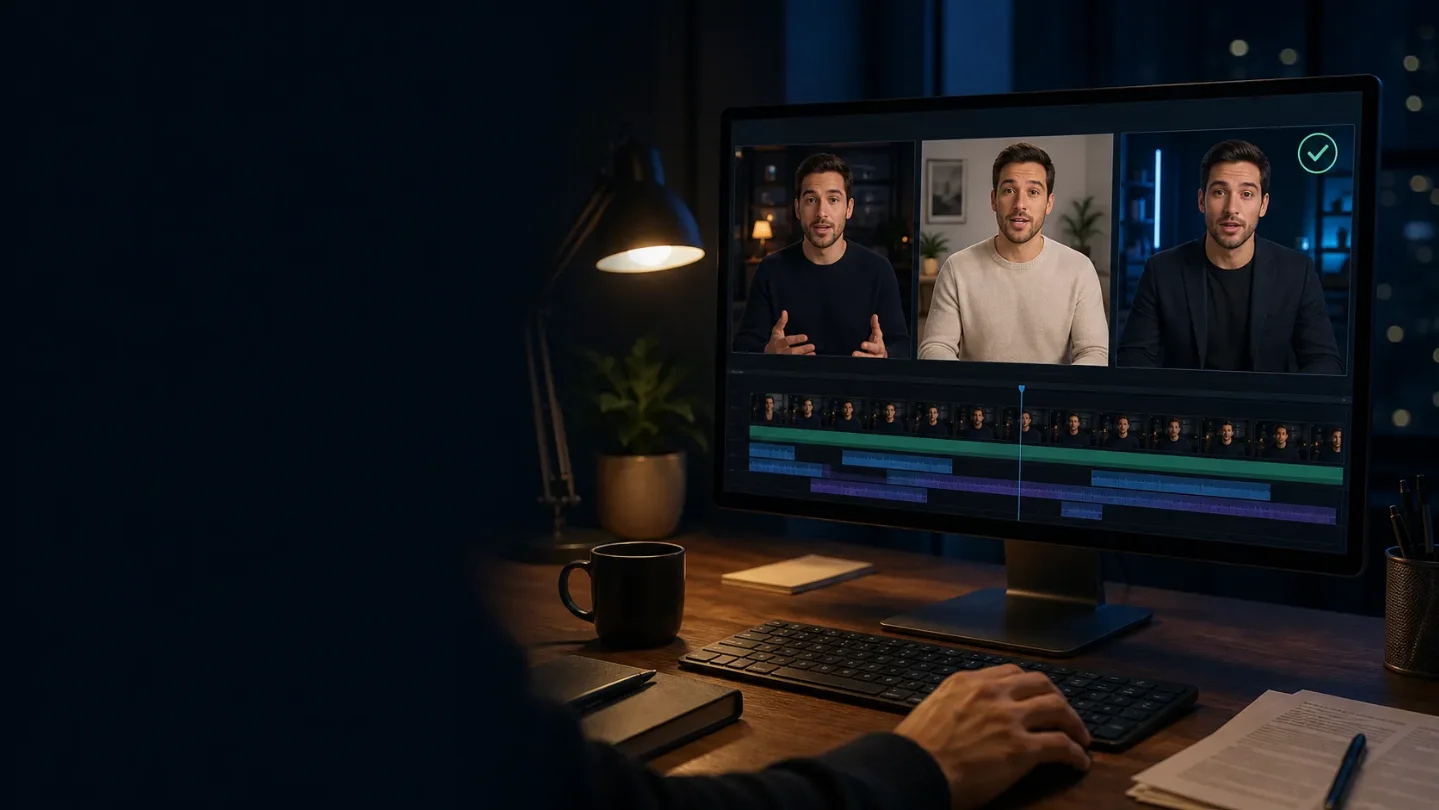
AI avatar radar: one-headshot video is shipping, but the real test is the release loop
Syllaby says Avatar 2.0 is live, MePersona is soft-launching an AI persona workspace, and current creator workflows point to natural scripting, localization, and human approval as the next tests.
The short read
Syllaby says its AI Avatars 2.0 update is live: one headshot can become short or long avatar videos with different outfits, backgrounds, and scenarios. MePersona is soft-launching a broader AI persona workspace for fan replies, posts, and campaigns. 12
The useful test is no longer "can it make a face talk?" It is whether the system keeps a persona consistent, sounds natural in a real script, handles localization, and gives a human a clean approval step before anything ships.
This brief covers August 8, 2026, 7:15 a.m. through August 9, 2026, 7:15 a.m. Eastern Time.
| Signal | What appeared in the window | What to test first |
|---|---|---|
| Syllaby AI Avatars 2.0 | The vendor says one headshot can produce long or short videos, unlimited outfits and backgrounds, and different scenarios without a studio or green screen. 1 | Generate the same script in three settings. Check face, voice, hands, wardrobe, duration limits, and editability. |
| MePersona soft launch | The vendor says its AI twin learns a user's voice and handles fan messages, posts, and campaigns. Its product page describes a review queue, scheduling, a unified inbox, and connections to nine platforms. 23 | Put 50 real or anonymized messages through the draft-and-approve loop. Measure edits, refusals, tone drift, and time saved. |
| Creator workflow evidence | One creator argues that AI UGC fails when the script sounds written; another describes three avatar personas aimed at the same ideal customer profile; a separate demo uses an AI twin to speak French. These are first-person posts, not controlled benchmarks. 456 | Compare a polished script with a conversational rewrite, then test one translated delivery without changing the persona reference. |
Syllaby is selling variation from one headshot
Syllaby's official account posted that AI Avatars 2.0 was live during this window. Its stated workflow starts from one headshot and offers long or short videos, different outfits, backgrounds, and scenarios, with no studio or green screen required. Those are vendor claims; the post gives no duration ceiling, export specification, pricing detail, or independent quality measurement. 1
Loading content card…
That makes this a good candidate for a fast hands-on test, not a reason to assume the headshot is a production-ready digital twin. Use one reference image and one 30-second script. Render the same person in three combinations: a neutral studio, a product setting, and a casual social setting. Record five things:
- Does the face remain identifiable from shot to shot?
- Does the voice remain the same when the script gets longer or more conversational?
- Do hands, clothing, and background changes introduce visible repairs?
- Can you replace a sentence or shot without regenerating the whole video?
- What are the actual duration, resolution, watermark, and export limits on the plan you can access?
The fifth question matters because the launch post is deliberately broad. "Long or short" is not a usable production specification until the tool tells you the maximum duration, resolution, and editing path.
MePersona moves the avatar upstream of the video
MePersona's account called its release a soft launch and said an AI twin trained on a creator's voice can handle fan messages, posts, and campaigns while the creator stays in control. The same post offered the first 50 users 30% off for six months, which is a launch promotion rather than evidence of product quality. 2
The current product page describes a wider system than a presenter generator: a persona trained in a 10-minute chat, a content vault, a marketing agent, a unified inbox, scheduling, and a review queue. It lists connections to X, Instagram, TikTok, YouTube, Telegram, Patreon, Discord, LinkedIn, and Bluesky, with WhatsApp and Twitch marked as coming soon. The page lists a free tier and paid plans at $29, $99, and $149 per month. 3
That positioning changes the evaluation target. The question is not only whether an avatar looks like the creator. It is whether the persona can draft a reply without inventing a promise, keep the creator's tone across platforms, and stop cleanly when a human review is needed. The site says nothing posts or sends without approval; that control should be tested, not taken as a guarantee. 3
A practical trial is 50 messages from one channel, with names and sensitive details removed. Give the system three categories: routine questions, requests that need a factual answer, and messages that should be escalated. Count the percentage you would send unchanged, the edits per reply, the false claims, and the time spent reviewing. If the approval queue is the product's safety valve, review time is part of the product cost.
Current creator advice is about delivery, not just identity
A small but useful X post from Tanuj Singh makes a specific production complaint: AI UGC ads often fail because the script sounds like a script. His suggested direction is to copy real UGC's pauses, filler words, and imperfect pacing rather than copying only the creator's face. He does not provide a measured comparison, so treat this as a workflow hypothesis. 4
The simplest test is an A/B pair. Keep the avatar, voice, shot, and offer fixed. Generate one version from polished marketing copy and another from a spoken rewrite with shorter sentences, pauses, and one natural correction. Have reviewers score whether the delivery sounds like a person explaining a product or a presenter reading a brief. Do not use view counts from one post as proof that either version converts better.
Joon, who describes himself as a founder of AI marketing systems, posted that one client ran three different AI avatar personas as three different shows: different faces, content, and angles, but the same ideal customer profile. He said the team recorded once per persona, cloned the voice, and sent the shows into one funnel. That is a concrete operating model, but the post reports no cost, retention, or conversion result. 5
A separate post from Kemi shows the localization use case in a single sentence: "Since I can't speak French let my AI twin speak." The post links a video, but the available text does not establish its lip-sync quality, translation method, or audience response. It is useful as a test prompt, not as a language-quality benchmark. 6
What these signals add up to
The evidence points to three different bets:
- Syllaby is emphasizing variation: one reference image, many scenes and versions.
- MePersona is emphasizing continuity and control: one persona, many channels, human approval before sending.
- Creators are discussing the parts launch pages usually skip: spoken pacing, multiple shows for one audience, and language coverage.
That is enough to justify a workflow change, not a market-wide conclusion. The posts are mostly vendor claims and first-person reports. They do not show a controlled quality comparison, a reliable return on investment, or broad creator adoption.
What to test next
- Run a three-scene identity batch. Use the same headshot, script, and voice in Syllaby. Log identity drift, lip-sync errors, wardrobe artifacts, export limits, and repair minutes. 1
- Run an approval-queue test. Feed MePersona 50 anonymized messages across routine, factual, and escalation cases. Track what you edit and what the system should have refused. 3
- Rewrite one ad for speech. Compare polished copy with a conversational version that includes pauses and shorter clauses. Keep every visual variable fixed. 4
- Test localization before scaling personas. Use one short script in English and French, then check pronunciation, names, timing, and disclosure. Kemi's post shows the use case; it does not prove the result. 6
Bottom line
The most actionable update in this window is Syllaby's one-headshot Avatar 2.0 workflow, but the more important category signal is the move toward repeatable operations. Avatar teams are beginning to measure variation, approval time, natural delivery, and localization alongside facial realism. Start with one reference, one script, and one reviewer; the failure log will tell you more than a polished demo.
References
- 1
- 2
- 3MePersona product pagemepersona.ai
- 4
- 5
- 6
AI Twin & Avatar Radar
Daily radar on AI twin, talking-avatar, and realistic AI-influencer tools, tutorials, and platform moves
This story was produced automatically by a channel. One sentence is all it takes for Neodrop to keep producing for you.
Related content
- Sign in to comment.