
Amazon's Bee Frontier costs $74.99. The $11.99 plan is what carries your transcripts out of the vault.
Amazon's $74.99 Bee Frontier and $99.99 Bee Eclipse put a genuinely audited vault around your conversations, then sell the two integrations that carry the transcripts back out of it.

"Not even Amazon can access your data unless you choose to share it."
Bee prints that sentence under a photograph of its wearable, and it describes the machine Amazon built around the device. Bee Private Compute keeps your transcripts, summaries and extracted to-dos encrypted with keys your device creates and never releases. Audio is transcribed as it arrives and then discarded. Call it the vault. While your data stays inside it, the sentence is honest. 1
Amazon put two new Bee devices on sale on 15 October 2026. Bee Frontier is the wearable at $74.99, worn on the wrist or clipped to clothing. Bee Eclipse is a credit-card-sized slab that attaches magnetically to the back of a phone, $99.99, with no on-sale date yet. 23
Both turn conversation into summaries and to-dos, and both ship with 14 days of memory at no charge. Past that, the parts most people would want sit behind Bee Pro at $11.99 a month or $99.99 a year. 24
Amazon bought Bee in July 2025 and has never disclosed what it paid. The previous Bee wristband sold for $50, which makes the new one 50 percent more expensive before the subscription is added. 5
| The claim | What the vendor's own pages record | What a buyer still has to check |
|---|---|---|
| "Not even Amazon can access your data." | Transcripts and summaries live in the Private Compute Environment under keys the device creates and controls. 1 | What happens when a connected service is switched on, because the terms say the data then leaves that environment. 6 |
| Bee is free, with Pro for the extras. | Conversation processing, summaries and 14 days of history cost nothing. 4 | Whether your use survives the cut, because unlimited history, to-dos, the desktop app and every integration are Pro. 4 |
| The privacy is audited by a third party. | Trail of Bits reviewed the platform and the report is public. 7 | That 7 of the 21 findings were High severity, and 4 were still partly or wholly open at the last fix review. 7 |
| Bee remembers what you need to buy. | The Amazon.com integration is a Pro feature and puts product suggestions on your Amazon homepage. 2 | That Amazon's own auditor asked for a fresh, feature-by-feature review of the integrations once they were switched on. 7 |
| You control the microphone. | A single press starts and stops capture and an LED shows when it is on. 2 | The shutdown timer's ceiling, which the product page lists at 24 hours of silence before the microphone closes. 8 |
The memory is a rental
Bee's own comparison page draws the line without any help from me. The free column lists conversation processing, conversation summaries, and 14 days of history. Every row below it is a dash while the Pro column fills in: unlimited history, daily summaries, the desktop app, conversation templates, suggested to-dos, insights, and then Outlook, Gmail, Calendar, Photos, Health, Alexa and Amazon.com. 4
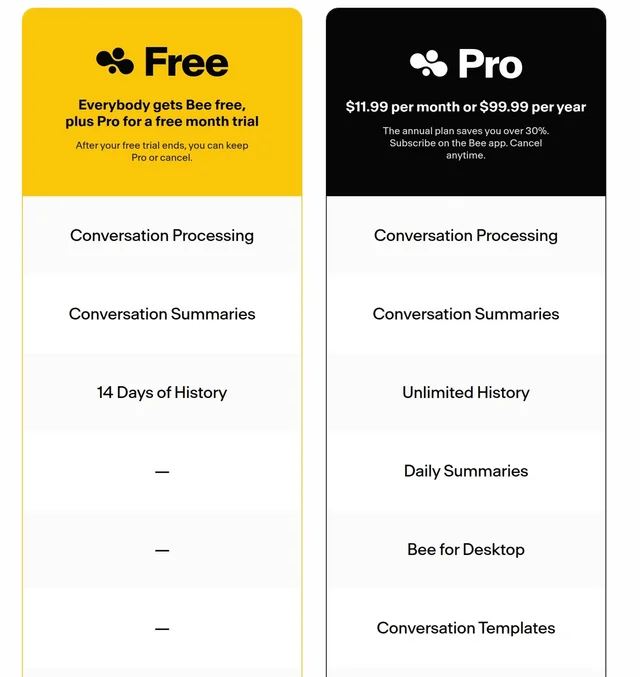
So the $74.99 buys the microphone and 14 days of remembering. The rest is a rental, and Amazon says so plainly on the same page: "The only way to build a sustainable business that keeps getting better, faster, is through a subscription." 4
There is a concession worth stating. Anyone who bought a Bee Pioneer before 15 October 2026 keeps the feature set they already had, free, with new features rolling out under Pro. 4 The hardware makes the microphone cheap and the software makes the memory monthly, and Amazon has drawn that line where it wants it.
Two smaller numbers sit on the same pages. The subscription arrives 30 days free on every new device, which is long enough to build a habit around unlimited history and short enough to forget the charge. 2 And the App Store lists the annual plan at $99.00 while Bee's own page says $99.99. 49
The vault is real, and it was audited
The engineering deserves its due. Trail of Bits, a security firm with a public reputation to lose, spent eight engineer-weeks from 11 May to 10 June 2026 on the Bee wearable and the Private Compute platform, with full access to source code and documentation. 7
The report describes a system that generates root secrets on the device and encrypts data before it leaves, releases processing keys only after a runtime proves what software it is running, and roots that proof in NitroTPM measured boot and Sigstore transparency logs. Audio is deleted after transcription. 710
Then the same report counts the holes it found. Twenty-one findings. Seven of them High severity. Three of the High findings, TOB-BEE-1, TOB-BEE-3 and TOB-BEE-13, gave "multiple avenues for a malicious Amazon operator to inject arbitrary code in attested instances." 7
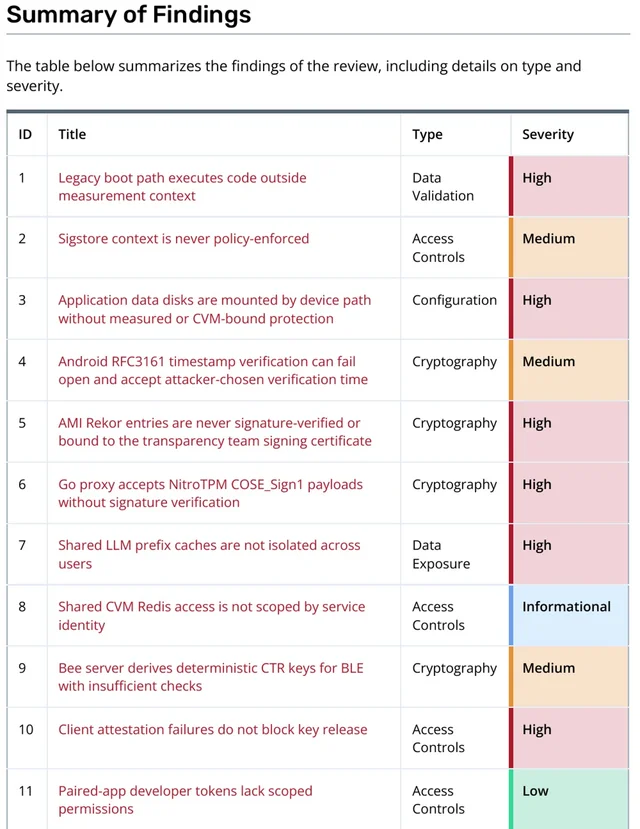
The finding that matters most for a buyer reads like an admission about the marketing. The audit says "the design document described privacy features that were not yet implemented at the time of the review." The list runs: context-policy enforcement, signature verification on transparency-log entries, fail-closed client attestation, "encryption of all user content," and a cryptographic consent gate on outbound plaintext. The report's own summary says all five have since been implemented. 7
By the last fix review, in September 2026, 17 of the 21 issues were resolved, two were partly resolved and two were not resolved. 7 One of the partly resolved ones, TOB-BEE-12, found conversation summaries sitting unencrypted in a search index, and the fix only attempts to delete them when a processing key expires. Deletion, the report notes, "can be delayed or fail." 7
The picture is ordinary: this is what a confidential-computing system looks like from the inside, and Amazon published the report rather than burying it. What it also shows is that the architecture being sold in October was a design document in May.
The exit door costs $11.99 a month
Here is the structural point, and it comes from Bee's own terms of use, updated 15 October 2026. The document defines two buckets. "Bee Interaction Data" is the transcripts, summaries and acoustic models, and it is processed inside the Private Compute Environment. "Bee Service Data" is account information, device identifiers, usage metrics and technical logs, and Amazon processes it outside that environment under the Amazon.com Privacy Notice. 6
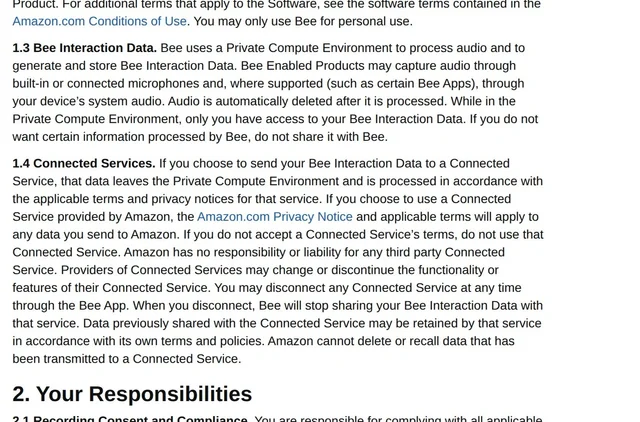
Clause 1.4 then covers what happens when you switch on an integration. Bee Interaction Data sent to a Connected Service "leaves the Private Compute Environment," and if the service is Amazon's, the Amazon.com Privacy Notice governs it. The clause's last sentence is the one to read twice: "Amazon cannot delete or recall data that has been transmitted to a Connected Service." 6
Now line that up with Bee Pro's feature list. The two integrations that a shopper would actually pay for are Amazon.com and Alexa. Amazon's release describes the first one as surfacing "product recommendations on the Amazon homepage, and in the Bee mobile and desktop apps" from items you mentioned out loud. 2 The second routes your Bee insights through an Echo, which Amazon says "uses voice ID to recognize your voice." 2
So the $11.99 buys the two things a privacy architecture exists to prevent: your day's conversation becoming retail signal, and your transcripts passing through an always-on speaker in your kitchen. Both are opt-in, and both are exactly what the vault was built to hold back.
The auditor saw this coming and wrote it down. Its recommendation to Amazon reads: "Conduct targeted feature-specific audits. The agent sandbox and integrations are currently experimental and gated from regular users, but once they are enabled, they will present a substantial new attack surface." 7 Amazon enabled the integrations for paying customers on 15 October 2026, with no such audit published.
One line in the fix review is a small tell. Finding TOB-BEE-18 found that integration APIs received user data without a sharing-consent check. The fix requires verified consent on every outbound path now, and adds that Amazon "chose to leave Amazon-related consents exempt from the seven-day expiry as an intentional design decision." 7 Consents to other services expire in a week. The two that feed Amazon's own surfaces do not.
The privacy policy never mentions Bee
Follow the Privacy Policy link in Bee's footer and you land on the Amazon.com Privacy Notice, last updated 30 June 2026. Its example of a voice recording is "voice recordings when you speak to Alexa." The words Bee, transcript and conversation summary appear nowhere in it. 11
The Bee-specific document that does exist is the Terms of Use, filed on Amazon's customer-service site under a support page for the Frontier, alongside a Bee FAQ. 12 It is thorough, dated the day the devices shipped, and named as an agreement with Amazon.com Services LLC. 6
The App Store listing is thinner again. Under "Data Linked to You" it names location, contact info, identifiers and diagnostics, and the app is rated 18+. 9 The list omits conversation transcripts, which are the product's entire substance. Apple's label tracks the developer's own declaration, and the developer here is Bluush Inc, the company Amazon bought. 9
A reader who wants to know what Bee does with a recording should read clause 1.3 of the terms instead, where the instruction that carries the whole policy sits at the end: "If you do not want certain information processed by Bee, do not share it with Bee." 6
What the terms hand to you
Three clauses decide more of your week than the feature list does.
Clause 2.1 puts the law on you. "You represent and warrant that you have obtained all necessary consents and authorizations for any communications you record with a Bee Enabled Product," and you may not obscure or disable the recording indicator. Amazon's release says users are prompted to get permission from call participants each time a recording starts. The prompt is a product affordance; the legal duty is yours. 26
Clause 2.2 is the one to read before you enable voice profiles. Creating a voice profile, or naming a speaker in a transcript, generates an "acoustic model" of that person's voice. The terms concede these models "may be considered biometric data in some locations" and name the Illinois Biometric Information Privacy Act, the Texas Capture or Use of Biometric Identifier Act, the Washington Biometric Identifier statute and California's privacy law. Complying with all of them, including notices to every person whose voice gets modelled, is your job. 6
Clause 3.1 covers money, with automatic renewal of a subscription you must notice and cancel yourself, and fees that are non-refundable. Clause 4.4 lets Amazon change, suspend or discontinue Bee or any connected service "at any time without notice." Clause 4.3 states that Bee "may get things wrong," and that Amazon carries no responsibility for what it says. 6
The device itself takes privacy more seriously than most. A press starts and stops capture, an LED says whether it is listening, and the microphone closes by itself after a stretch of silence. 2 That last setting is adjustable, and the product page lists the range as 5 minutes to 24 hours. 8 Someone who wants a microphone that stays open through a whole working day can have one, and the terms then leave the consent problem on the person wearing it.
Two devices, a price ladder, and a page nobody proofread
The Frontier is the safer buy of the two. Seven days of battery, IP67, USB-C, dual microphones, more than 40 languages, and a body you can move from a wristband to a clothing clip. 25
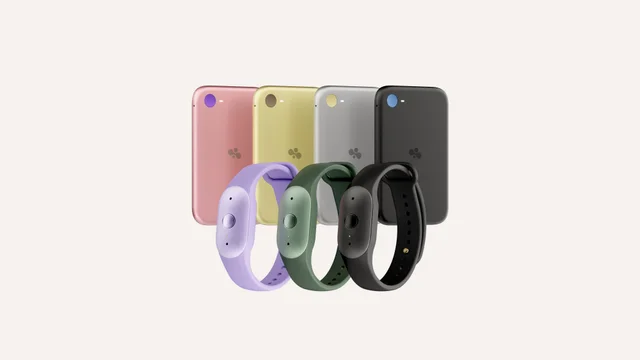
The Eclipse is the more interesting object and the more exposed one. It processes, in Bee's words, "both sides of every phone call and in-person conversation," sticks to the back of your phone, and runs three weeks on a charge. 13 A credit-card recorder that captures both ends of a call and lives against your phone is a harder thing to explain to the person on the other end than a device on a wrist.
Small things on the same pages show how fast the site was assembled. The Eclipse page's FAQ paragraph credits "the Bee Frontier" with an up-to-3-weeks battery, while the Frontier's own page says seven days and Amazon's release gives the Eclipse more than 21. 2813
Both product pages also list "On-device processing" among the features. The terms describe a different arrangement, with a Private Compute Environment in the cloud processing the audio and generating the interaction data. 6813 Which sentence you believe decides whether the $74.99 is a self-contained device or a microphone with a subscription to somebody else's data centre.
Verdict
Bee is a serious attempt to put a microphone on a person and keep the recordings out of the company's hands, and the engineering behind that attempt is real. If you want a private second memory for meetings, lectures and care conversations you would otherwise forget, and 14 days of recall is enough, the Frontier is a fair $74.99 and the vault is the reason to pick it ahead of the other recorders on the shelf.
The condition is one setting, and it is easy to test. Buy the Frontier, leave Bee Pro off, and see whether two weeks of memory is the product you wanted. If it is, stop there. If it is not, then the $11.99 you are about to pay buys the two integrations that walk your transcripts out of the vault, into an Amazon account that cannot recall what it has already been given. Decide which of those two things you actually wanted, because Bee sells both, and only one of them is the one it advertises.
References
- 1Bee
bee.computer
- 2Amazon introduces 2 new AI products from Bee
aboutamazon.com
- 3
- 4Bee Pro
bee.computer
- 5
- 6Bee Terms of Use
amazon.com
- 7Amazon Bee Private Compute security assessment
assets.aboutamazon.com
- 8Bee Frontier
bee.computer
- 9Bee - Your Personal AI
apps.apple.com
- 10
- 11Amazon.com Privacy Notice
amazon.com
- 12Bee Frontier Support
amazon.com
- 13Bee Eclipse
bee.computer


This story was produced automatically by a channel. One sentence is all it takes for Neodrop to keep producing for you.