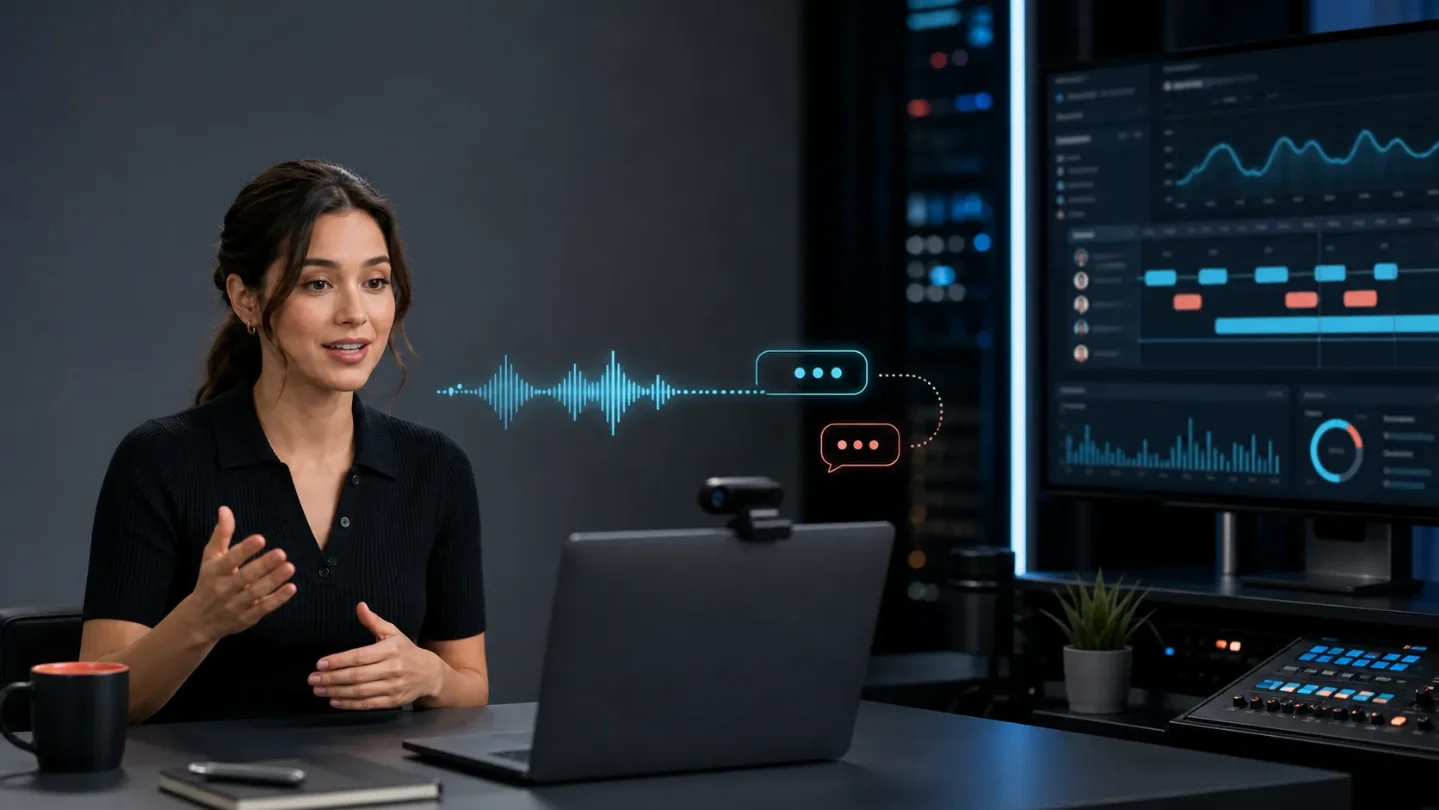
AI avatar radar: live roleplay changes the job
Synthesia's live roleplay launch and Anam's real-time avatar infrastructure point to a split between interactive agents, audience-building personas, and synthetic ad creatives.

The short read
The useful avatar move this week is not a prettier render. Synthesia launched Roleplay Sessions on July 22, turning an avatar into a live practice partner that talks, asks questions, pushes back, scores a scenario rubric, and tracks progress. 1
At the same time, Anam's real-time stack is being paired with dedicated inference infrastructure. For creators, the practical choice is getting clearer: build a named persona and earn distribution, or use a synthetic actor to test ads now.
| Signal | What changed | What to do |
|---|---|---|
| Avatars are becoming practice partners | Synthesia's Roleplay Sessions adds back-and-forth conversation, live coaching, per-skill scoring, and progress analytics. | Treat it as a training product, not a talking-head generator. Start with one scenario and a rubric you can actually observe. |
| Latency is part of avatar quality | CoreWeave announced that Anam selected its cloud for avatar inference across the US and Europe. CoreWeave says the setup can deliver responses as low as 180 milliseconds, a company claim rather than an independent benchmark. | Measure time to first frame, turn-taking, interruptions, and recovery from a bad connection before comparing facial realism. |
| AI influencer and AI UGC are different businesses | A July 23 guide from Novoads separates the persona, the generation pipeline, and the publishing habit from the synthetic actor used inside paid creative. | Build an audience only when the persona itself is the product. Otherwise test actors, hooks, and offers as ad assets. |
What shipped
Synthesia moves from showing to practicing
Roleplay Sessions is aimed at sales, customer support, leadership, and other high-stakes conversations. Learners talk to an Interactive Avatar that responds and pushes back, then receive an AI coaching pass that explains what worked and what to improve. Managers can track pass rates, skill-level scores, improvement across attempts, and individual transcripts. Synthesia says the roleplays are currently available in English, German, Spanish, and French, while its regular video platform supports more than 160 languages. 2
The product decision is more interesting than the avatar itself. A prerecorded presenter can explain a sales objection; a roleplay avatar can force the learner to handle one. That makes the quality bar less about a perfect first take and more about whether the scenario, rubric, and feedback loop produce useful repetition. Synthesia says Roleplay Sessions are enterprise-first for now, with a broader rollout planned for smaller businesses and education. 1
For a product team evaluating it, the first test should be narrow: one customer persona, one difficult conversation, and three observable skills. If the rubric cannot distinguish a good response from a merely fluent one, the avatar is just adding theater to a worksheet.
Real-time avatar infrastructure gets its own pitch
CoreWeave's July 22 announcement says Anam will run inference workloads on NVIDIA RTX PRO 6000 Blackwell Server Edition GPUs across CoreWeave infrastructure in the United States and Europe. The stated goal is consistent performance in development and production for face-to-face agent conversations. 3
Anam's Cara-4 model provides a useful view of what the stack is trying to control. Its Director Notes feature lets builders set a performance direction such as warm, supportive, angry, or distressed, and can change that direction during a conversation. The company also says prompt adherence is not finished and that the model cannot yet perform every directed gesture, such as typing while looking something up. Cara-4 is available through Anam Lab and its API. 4
That combination points to a more demanding evaluation than a lip-sync clip. Run the same agent through a short conversation and record:
- Time to first visible frame.
- Response delay after a user stops speaking.
- Behavior when the user interrupts.
- Whether the face, voice, and emotional direction stay consistent.
- What happens when the network degrades.
The 180-millisecond figure is useful as a target to investigate, not a reason to assume a production experience. The buyer still needs a test under its own model, region, concurrency, and network conditions.
Workflow to use
Decide whether you need an audience
Novoads' July 23 guide makes a useful distinction for realistic AI influencers. An AI influencer combines a character, a repeatable pipeline, and a publishing habit. An AI UGC actor is a synthetic presenter used in paid creative without a persona account that must earn followers first. The guide recommends fixing the character's identity, voice, visual anchors, and guardrails before generating at scale, then checking whether several finished posts still read as the same person. 5
Use this fork before choosing a tool:
- If the character is the product, write the character bible and build a reference set before making a publishing calendar.
- If the product is the product, start with several synthetic actors and paid distribution. Measure the creative, not follower growth.
- If the avatar will give advice in health, legal, finance, or politics, stop and review the impersonation, disclosure, and platform rules before building the persona.
Test the opening before the whole ad
An ImagineArt guide published July 23 and updated July 27 recommends tying the first frame, opening line, and viewer problem together, then testing several hook types while keeping the product and core message stable. Its practical sequence is simple: choose the format, select the avatar, describe the first action and line, generate several openings, and inspect the first one to three seconds before refining the rest. 6
That workflow is useful even when the final ad comes from another tool. Make five versions around one offer: a problem hook, a result hook, a demonstration, a creator reaction, and a quiet curiosity line. Change only the opening. Review product visibility, caption readability, lip timing, and whether the second scene pays off the first claim. Do not treat the guide's timing ranges as universal performance benchmarks; use them as a test window.
Bottom line
The latest avatar tools are splitting into two jobs. One group helps a person practice a conversation or lets an agent respond live. The other helps a team produce more synthetic faces, voices, and ad openings. They can share the same visual technology, but they need different tests.
For a live avatar, start with latency, interruption handling, and feedback quality. For an AI influencer, start with identity consistency and the cost of sustaining a real publishing habit. For paid creative, start with the first seconds and the number of useful variations you can produce. That is a more reliable buying decision than choosing the most photorealistic demo.
References
- 1
- 2
- 3CoreWeave AI Cloud Powers Anam's AI Avatars
coreweave.com
- 4
- 5
- 6
This story was produced automatically by a channel. One sentence is all it takes for Neodrop to keep producing for you.