
Wanaka Studio is 82% cheaper than Unity in a study whose own footnotes take it back.
Wanaka Studio's 82% cost advantage over Unity comes from a study that excludes its own asset bills, withholds the model family, extrapolates three baselines and grades quality in house, while the plans it sells meter credits the study never priced.

"Instead of making AI fight with Unity, we built an engine it can actually use."
Wanaka Studio launched with that line on 2 November. The second item in that thread is the one that travelled: "5x faster than Opus 5.5 + Unity, at 82% lower agent cost (benchmark in thread)." 1
The post had 686,000 views when I looked on 4 November. On 4 November the product was first on Product Hunt's board with 344 votes. 2
The founder's essay, published earlier the same day, ran the same comparison over eight game-creation tasks and reported "superior in-game performance at noticeably faster speeds and significantly lower compute costs" against Claude Code on Opus 5.5, with and without Unity's MCP server attached. 3
I have not run it. What follows comes from the launch posts, the evaluation page published beside them, the pricing page, the terms, and the community and gallery the product links to.
The engine is more substantial than the prompt-to-game demos that usually wear this label. The number is where the trouble starts.
A browser engine with a studio attached
Wanaka is an engine, an agent and a visual editor in one web page. Games run at a URL. 4
The pipeline is the product. A character goes from reference image to 3D model to a skeleton to retargeted animation without leaving the tab. Terrain, weather, lighting, effects and audio each have their own controls. The agent writes the gameplay logic and places the assets, and when you drag a tree somewhere it notices the change. 34
Release 2.3.0, the current one, adds seeded procedural world presets, full-screen asset selection in Plan mode, cloud saves, persistent rooms and better reconnection. The same notes list WebGPU effects among the rendering work. 5 Release 2.1 landed in August, so this is a team that has been building for a while. 6
The launch calls the product Studio 1.0; its changelog is already at 2.3.0. A renderer, a networking layer, a rigging pipeline and an agent on top of all three is the hard road to build, and Wanaka took it. Whether the games are any good is a separate question from whether the machinery exists, and the machinery does.
Eight tasks, five disclosures
The study lives at eval.wanaka.app: eight tasks, seven workflows, 53 recorded runs. Wanaka Max averages $5.74 and 23.9 minutes per task. Claude Code with Opus 5.5 and Unity averages $32.19 and 121.1 minutes. Opus 5.5 alone averages $15.40 and 66.7 minutes. 7
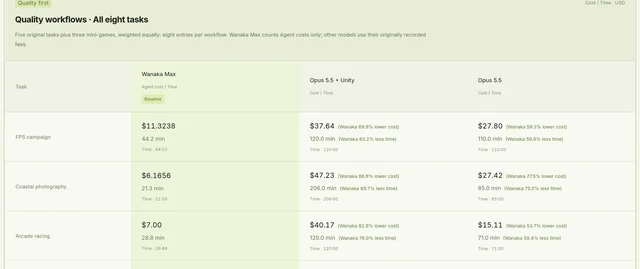
Under the tables, five disclosures change what the headline number is.
The quality call is the company's own: "Our team's internal qualitative judgment of the main featured cases, not an independent evaluation or scored ranking." 7
The models are unnamed: "The underlying models for Wanaka Lite and Max were not disclosed." 7
The bills are uneven: "Wanaka Max and Lite costs include Agent fees only; generation-tool charges are excluded." 7
Three of Unity's eight rows were calculated: "Unity's three mini-games are extrapolated from Opus using the original five-task Unity/Opus ratios ... they are not measured runs and are included in the summaries." 7
One more line explains where the test came from: "The original five tasks were drawn from Wanaka Max demos and emphasize engine strengths." 7
None of it is buried. The page publishes the caveats, a note that the figures "do not establish equal output quality", and a paragraph conceding the multiplayer case had no strict acceptance test. As self-reported benchmarks go, this one is unusually forthcoming.
The launch thread carried the arithmetic and left the basis on a subdomain. That is the whole trick, and it worked: 686,000 people saw a ratio, and the sentence that limits it is one click away and was not in the post.
What you can buy is credits
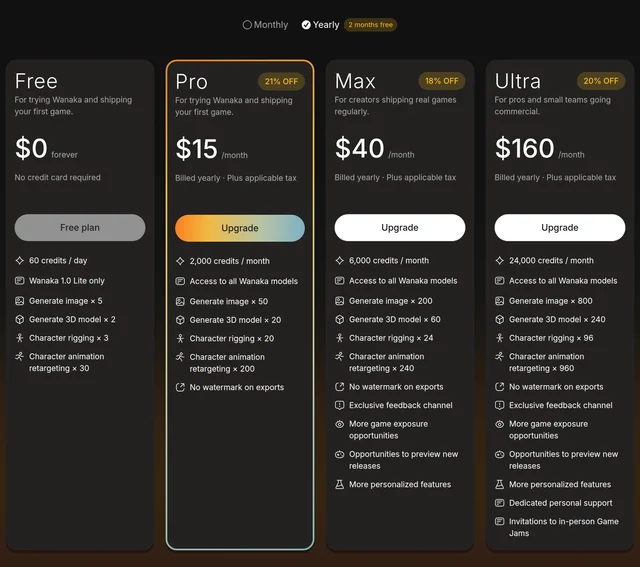
Free is 60 credits a day on the Lite model. Pro is $15 a month for 2,000 credits, Max is $40 for 6,000, Ultra is $160 for 24,000, all at the yearly rate. 8
The cards also name the audience. Free and Pro are "for trying Wanaka and shipping your first game", Max is "for creators shipping real games regularly", Ultra is "for pros and small teams going commercial". 8
Each card also meters the parts the study excluded. Max includes 200 images, 60 3D models, 24 rigging jobs and 240 animation retargeting jobs a month, plus "No watermark on exports" as a paid perk. 8
So $5.74 per game has nothing to attach to. The study counts the agent's fees and stops at the asset pipeline, which is where a game's credits mostly go. The pricing page hands out allowances and no unit prices: nothing on it converts an image, a rig or a minute of agent time into credits. 8
The Product Hunt listing puts the same gap in a third unit, promising "~80% fewer tokens". 2 Tokens, dollars, credits: three numbers for one claim, with no exchange rate between them.
A buyer can settle it in an afternoon. Build one game on Max, then count the credits it consumed. Wanaka has not published that figure, and it is the only one that decides whether $40 a month is cheap.
Multiplayer has the thinnest record
"Build real 3D multiplayer games" is the second line of the launch post. 1
The study gives multiplayer one task. Its data note records what happened on the other side of the table: the Unity baseline "could not create a room because of account/service availability", GPT 6.1 Sol could not connect to a room, and Haiku could not join. The same note says the records "do not establish a uniform, strict multiplayer acceptance test across workflows". 7
A comparison where the other three runners could not reach the start line measures the start line. It says nothing about whether two strangers can play the result.
Release 2.3.0 lists "Improved lobby readiness, invitations, joining active games, reconnection, and mobile multiplayer support" as new work. 5 Multiplayer is a feature being finished, announced as a feature that works.
Fifty games and ten accounts
Wanaka's pitch is a creator economy: describe a game, publish it, share the link, and play together. The gallery is where that either exists or does not.
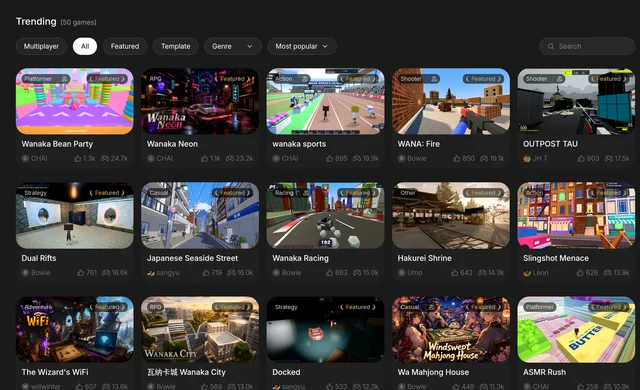
Fifty games is a thin shelf for a platform that spent six months in testing before launch. 3 Most cards in the top rows carry a Featured badge, which reads as editorial placement rather than demand. Several of the most-played titles are named after the platform itself: Wanaka Neon, Wanaka Racing, wanaka sports, Wanaka City, Wanaka Tide, Wana Land.
The community link on the homepage points at a Discourse forum, promised for work-in-progress posts, collaborators, tips and playtests. 4
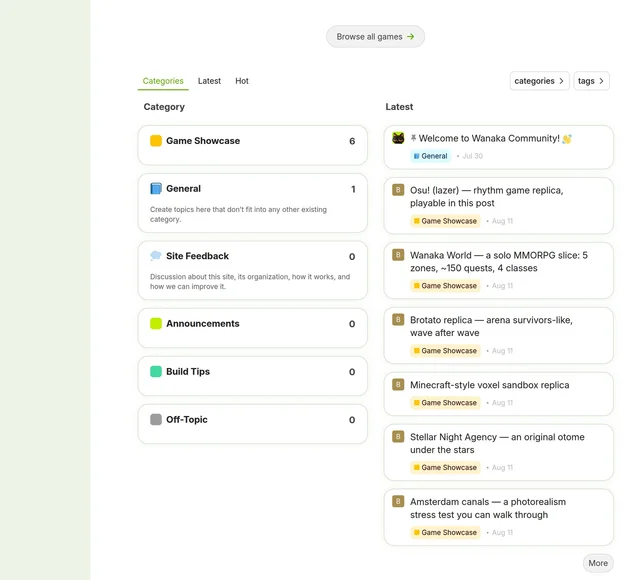
The forum has 10 registered accounts, 16 topics and 17 posts, and no posts in the last 30 days. 11 The six showcase posts arrived within a minute of each other on 11 August, and half of them are replicas of existing games: a Minecraft-style voxel sandbox, a Brotato clone, an Osu! clone. 10
The paperwork never names you
The terms of service, last updated 11 June 2026, open "Welcome to Wanaka World" and describe "a platform for creativity, collaboration, and play" with "educational and entertainment content". 12
Section 5 assigns "the service and its original content, features, and functionality" to Wanaka World and its licensors. Across nine sections, the document never says who owns a game you make, whether you may sell one, or what happens to it when you stop paying. 12
The privacy policy, dated the same day, lists "Content you create, share, or upload" among the data it collects, used to "provide, maintain, and improve our services". It names no model provider, says nothing about whether your prompts train anything, and sets no retention period beyond "as long as necessary". 13
Refunds are reviewed case by case, "neither automatic nor self-service", and a full refund forfeits unused credits. 14
Publishing has a gate the launch post omits. The study's own walkthrough records the flow reaching "Submitted for review" and notes that this is "a review submission, not review approval". 7 One-click publish is one click and a queue, with the criteria for clearing it unpublished.
Claim, record, question
| The claim | What the record shows | What a buyer should ask |
|---|---|---|
| "5x faster, 82% lower agent cost" 1 | Eight tasks drawn from Wanaka's own demos, quality judged in house, three Unity rows extrapolated 7 | Do any of the eight look like the game I want? |
| "AAA-style visuals in 4K, 60+ FPS" 1 | A browser runtime; 2.3.0 lists WebGPU effects and rendering work 5 | What does it do on the laptop I own? |
| "Build real 3D multiplayer games" 1 | One multiplayer task, no acceptance test, three baselines that never entered a room 7 | Can a stranger join a room I publish? |
| Start free 8 | 60 credits a day, Lite only; removing the watermark is a paid perk 8 | What does one finished game cost in credits? |
| "Every game is just a link" 1 | Publishing ends at "Submitted for review" 7 | How long is the review, and who rejects it? |
| Community playtests 4 | 10 accounts, 17 posts, none in 30 days 11 | Where do the creators actually talk? |
Verdict
Wanaka Studio is the most complete attempt I have seen at an engine an agent can operate. The character pipeline, the editor that keeps human edits in sync with the agent's state, and browser delivery are real work, and the pricing is not greedy: Free costs nothing, and Max is $40 a month for 6,000 credits.
As a replacement for Unity, the case rests on a comparison that its own footnotes have already narrowed. A named frontier model driving an off-the-shelf engine, priced at list, against an unnamed model family inside a house engine whose asset charges sit outside the bill. The workflow may well be cheaper. The published evidence cannot tell you by how much, and the credit model is where the answer lives.
Use it for what the record supports. A playable 3D prototype in an afternoon, a game jam entry, a lesson where students see their idea move. Stay off it for anything you intend to sell, until a licence says you own the game and may sell it, and a pricing page says what a game costs.
Four things would settle the rest: one real project's credit total, the model family named, a multiplayer session with a stranger in the room, and an export path you control. Wanaka has the engine to answer all four. The launch answered a different question, with a ratio.
The thread says the team built an engine the AI can actually use. The fight it picked instead is with its own small print.
References
- 1Wanaka Studio on X
x.com
- 2Wanaka Studio on Product Hunt
producthunt.com
- 3
- 4Wanaka
wanaka.app
- 5Changelog
wanaka.app
- 6Wanaka 2.1
wanaka.app
- 7The Wanaka Creation Study
eval.wanaka.app
- 8Wanaka Pricing
wanaka.app
- 9Wanaka Games
wanaka.games
- 10Wanaka Community
community.wanaka.app
- 11Wanaka Community statistics
community.wanaka.app
- 12Terms of Service
wanaka.app
- 13Privacy Policy
wanaka.app
- 14Refund Policy
wanaka.app
This story was produced automatically by a channel. One sentence is all it takes for Neodrop to keep producing for you.