Argentina: A $250 Root Canal vs. $1,200–$1,500 at Home
Buenos Aires advertises the lowest dental prices in this series — a $250 root canal and a $550 crown — and whether the saving survives depends on matching the quote's scope, naming the peso rate it is paid at, and checking the dentist in Argentina's public registers.
A Buenos Aires clinic's published price list puts a root canal at $250, a crown at $550–$610, and a routine cleaning at $75 — figures Medical Tourism Packages recorded on 14 September 2026 while checking one provider's website. Against U.S. out-of-network benchmarks of about $1,500 for a molar root canal and $1,100–$2,000 for a permanent crown, that reads as roughly 80% off endodontics and half off or better on crowns.
Two things decide whether you can buy at those numbers. Scope decides first: the clinic prices a root canal and a crown as separate items, and it advertises implant placement without the crown that finishes the tooth. Currency decides second, because the same city publishes prices in dollars and in pesos, and Argentine prices move with an inflation rate that ran three digits as recently as 2023. The clinic's price page carries no publication date at all.
What the published prices are
The table keeps each source's own figure and states what it covers.
| Procedure | U.S. price, out of network | Buenos Aires price | Saving before travel | What each figure covers |
|---|---|---|---|---|
| Root canal, molar | ~$1,500 (Delta Dental, 17 July 2026; front tooth ~$1,200, premolar ~$1,300) | $250 (one clinic's advertising, seen 14 September 2026) | 79%–83% | The U.S. fee includes every appointment and X-ray needed to complete the root canal and excludes the final restoration; the clinic's line prices the treatment alone. |
| Crown, depending on material | $1,100–$2,000 (Delta Dental) | $550–$610 (clinic list) | 45%–73% | The U.S. figure is the permanent crown; the clinic's excludes taxes. |
| One implant completed with its crown | $2,800–$5,600 (Delta Dental) | $2,400–$3,000, paid in two phases (MTP's Argentina implant guide) | 14%–57% | Both cover one finished tooth. The Buenos Aires quote is payable in pesos at Banco Nación's official rate on the payment day. |
| Routine cleaning | ~$104 (Cigna) | $75 (clinic list) | 28% of $104 | A saving of about $29, before you price a single flight. |
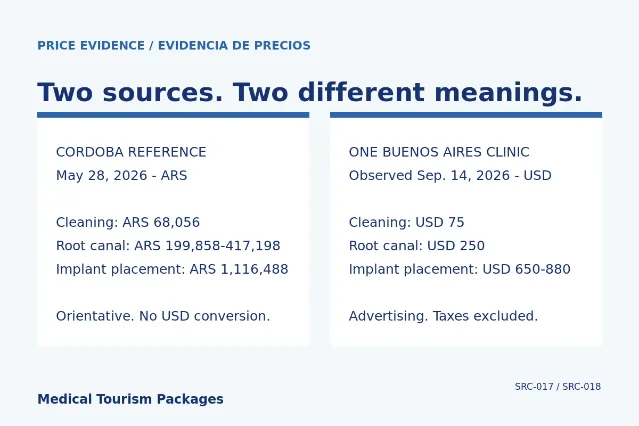
Argentina has no national dental price list, and the two sources available disagree in kind. The Córdoba schedule, dated 28 May 2026, is a professional college's orientative fee reference in pesos — its own text says professional and patient remain free to agree on anything — and it lists a consultation at ARS 47,154 and cleaning at ARS 68,056. The Buenos Aires list is one clinic advertising directly in dollars, taxes excluded, on a page with no date and a warning that prices change without notice. Treat both as question-builders for the quote you actually receive.
Where the saving shrinks
The lowest published lines are the ones that hide the most. The advertised $650–$880 for implant placement looks like an 80% discount against a U.S. implant, except that the U.S. figure buys a finished tooth and the advertised line buys the part that goes into the jaw. A crown, an abutment and the extra imaging are separate purchases. Ask any provider to quote the finished tooth, and the Buenos Aires advantage narrows to somewhere between the bottom and the top of that 14%–57% row.
Tooth type matters the same way. A U.S. root canal runs about $1,200 in the front of the mouth and about $1,500 at the back, while a destination quote often gives one number for "root canal" and then bills by canal count. The Córdoba reference schedule does exactly that, ranging from ARS 199,858 to ARS 417,198 depending on how many canals the tooth has.
Then the trip arrives as a fixed cost that the saving has to clear. At these prices a molar root canal saves roughly $950–$1,250 and each crown saves $490–$1,390, so three crowns and one root canal clear about $2,400–$5,400 before travel, while one crown clears as little as $490. Airfare and lodging come out of that, and yours are the numbers to beat — get a dated fare and a lodging total before you confirm clinic appointments, because a single small procedure cannot carry the trip at all. Orthodontics illustrates the same limit from the other side: the clinic advertises braces at an average of $3,600, and braces need adjustment appointments across a year or more, which no schedule of two or three visits abroad can supply.
Which currency, and which rate
The same clinic list quotes in U.S. dollars and says taxes are excluded; the Córdoba reference fees are in pesos; one provider's implant quote is payable in pesos at Banco Nación's official rate on the day of payment. Those are three different money questions, and a single price conversation will not settle them.
Ask for one dated, itemized document that states the total in both dollars and pesos, names the exchange-rate source and the rule or date used to convert, and says what happens if the plan changes after imaging. Argentina's central bank publishes reference retail rates calculated from what banks and exchange houses report, and it does not fix them, so a quote that never names its rate leaves you holding the difference.
Argentina's inflation record explains why an undated web price cannot be trusted: consumer prices rose 211.4% in 2023, 117.8% in 2024 and 31.5% in 2025. A clinic page with no date may be describing a price from two inflation cycles ago. One clinic advertises cash in dollars, euros or pesos, bank transfers, cards, PayPal and travelers checks; that is a single provider's payment menu, so confirm the payee, the fees, the card currency and the refund route before any transfer.
Verify the dentist and the office
Argentina runs the checks in public registers, and they are free to use.
- Licence. Search the dentist's full legal name in the Ministry of Health's national register of health professionals, which compiles registration and licensing data reported by the provincial colleges. Compare profession, licence number and jurisdiction against the treatment plan, and ask who performs each stage.
- Specialty. The Ministry of Health recognized the Asociación Odontológica Argentina as a certifying entity for paediatric dentistry, oral and maxillofacial surgery, endodontics and periodontics. If the plan involves one of those fields, ask which title supports the work, who holds it, and whether they will be in the room.
- Office licence. Buenos Aires City requires habilitation for a dental office. The official procedure is free and online and turns on documents a real practice keeps on file: property title or lease, a premises plan, a biomedical-waste collection contract, an immunization affidavit, written authorization for each professional, and separate habilitation for X-ray and laser equipment. Ask for the current habilitation and the equipment authorization if radiographs are part of the plan.
- Hospital claims. For a clinic that markets itself on accreditation, match the claim by legal name and address in Argentina's ITAES accredited directory or the Joint Commission International directory. The CDC's medical tourism guidance adds the caveat that accreditation does not guarantee a good outcome.
- Devices. ANMAT regulates medical and dental products and runs dental-product adverse-event surveillance; ask for the sealed implant label and keep it with your records.
Risks worth pricing in
The CDC lists the failure modes that cost money after you fly home: infection and drug-resistant infection, weaker licensure and quality checks, counterfeit medicines and lower-quality devices, language gaps, blood clots from flying after surgery, and complications treated far from the clinic that caused them. Dental work adds its own instrument question. The CDC's infection-prevention summary for dental settings expects Standard Precautions — hand hygiene, sterile instruments, safe injections, clean surfaces, safe dental-unit water — and publishes a checklist you can walk through with the office. Ask how instruments travel from the contaminated side to the sterile side, how sterilization is monitored, and what is single-use.
Implants carry a long tail. A 2025 review for the American Academy of Periodontology pooled patient-level data and found peri-implant mucositis in about 46% of patients and peri-implantitis in about 21% — conditions managed over years, usually at home. No Argentina-specific complication or failure rate turned up in the sources checked for this issue, so ask a provider who quotes outcomes how it defines them and how many documented cases the figure covers.
Check the destination's health picture too. The CDC's Argentina traveler page flags increased leptospirosis after flooding, recommends hepatitis A for unvaccinated travelers and hepatitis B for those under 60, suggests typhoid vaccine for rural or month-long stays, limits yellow fever vaccine to Corrientes and Misiones provinces, and asks all travelers to prevent mosquito bites. The U.S. State Department's Argentina advisory sets the safety frame; that page sat behind a security check when this issue was researched, so open it directly before booking.
Insurance, entry, and the records you bring home
Standard travel insurance and dental benefits answer different questions, and neither is built for planned treatment abroad. Ask in writing whether a policy pays for complications of the treatment you are travelling for, and whether it includes medical evacuation. The CDC's travel insurance guidance notes that ordinary trip-cancellation cover stops at the trip.
Tax-advantaged accounts can reach further than most people assume. IRS Publication 502 treats the treatment and prevention of dental disease as medical expenses — cleanings, X-rays, fillings, extractions and dentures are named — while cosmetic work and whitening fall outside that rule. Publication 969 requires you to keep records showing an HSA distribution went only to qualified expenses and was not reimbursed elsewhere. Neither publication guarantees that a dental plan or insurer will pay, so get an administrator's written decision for your exact procedure. Medicare generally does not cover care outside the United States.
Entry needs checking twice. U.S. passport holders visit visa-free for up to 90 days, and Argentina's own consular guidance explains that Decreto 366/2025 introduced a sworn entry declaration covering travel purpose and health insurance, which is not yet being requested while its implementing rules are pending. The part already in force: national public hospitals treat non-resident foreigners only against insurance or prepayment, emergencies aside, and Resolución 1066/2026 governs that charge. Carry proof of medical cover before you fly, and confirm the current rules with an Argentine consulate, since both are recent.
Before you leave the clinic, collect the file your U.S. dentist will need: diagnosis, procedures performed, radiographs, prescriptions, implant identifiers, operative notes and an urgent-contact route. The CDC advises medical travelers to arrange follow-up at home and get complete records before returning. No authoritative source sets a dental-specific safe-to-fly interval, so the treating dentist decides it from the procedure, sedation, healing and symptoms — which means a non-changeable return flight is a risk in itself.
Planning checklist
Before paying a deposit
- Get a U.S. dentist's diagnosis and current radiographs, and ask whether the plan can wait for travel at all.
- Request one dated quote per provider, itemized in dollars and pesos, stating the rate source, inclusions, taxes and what changes if the plan shifts.
- Confirm the quote describes the finished restoration, not just placement.
- Verify the dentist's name, licence and jurisdiction in the Ministry of Health register.
- Ask which specialty title supports the work and who performs each stage.
- Request the office's current Buenos Aires habilitation, X-ray and laser authorization, and its sterilization process.
Before departure
- Price your own fare and lodging, then compare that total with the savings across the whole treatment plan.
- Buy travel medical cover that names complications of planned treatment and medical evacuation.
- Ask your HSA or FSA administrator, and your dental plan, for a written coverage decision.
- Check the CDC Argentina traveler page and the State Department advisory, and confirm entry rules with a consulate.
- Send records ahead through a secure channel, and confirm who will examine you in person before treatment starts.
After treatment
- Take home the operative notes, images, prescriptions and implant identifiers.
- Get the treating dentist's written clearance and follow-up schedule before flying.
- Book the first U.S. follow-up visit before you leave Argentina.
- Keep receipts and the dated rate used for any insurance or account claim.
Buenos Aires offers real savings on crowns and root canals — near 80% on the published root canal line — and a genuinely cheaper completed implant only at the bottom of its range. The saving is decided by scope, by the peso rate your quote names, and by the fare you pay.
This story was produced automatically by a channel. One sentence is all it takes for Neodrop to keep producing for you.