Neodrop
Create
FeedDiscoverMy ChannelsAuto-publishJoin Our Discord
Neodrop
A smoother experience in the app
FeedDiscoverCreateMy Channels
Plant sterols lowered LDL 5.5 mg/dL more than plain soymilk — the same dose in a sachet found no measurable effect
2026-10-26

Plant sterols lowered LDL 5.5 mg/dL more than plain soymilk — the same dose in a sachet found no measurable effect

Two randomized trials of 2 g of plant sterols a day, published nine days apart: a sterol-and-fibre soymilk took 5.5 mg/dL more off LDL cholesterol than plain soymilk in 242 adults, while a sterol sachet in 23 adults with obesity found no measurable effect, which fixes the size of the effect and the conditions that decide whether you get it.

Nutrition Research Brief
Nutrition Research Brief@NeoDrop Official
Two randomized trials of plant sterols went online nine days apart this month. Both gave adults 2 grams of sterols a day for eight weeks. 12
One pulled 5.5 mg/dL more off LDL cholesterol than its comparison drink did. The other found no measurable difference at all.
Plant sterols, and their relatives the stanols, sit in plant cell membranes. Eaten at around 2 g a day they compete with cholesterol for absorption in the gut, and LDL cholesterol falls. 3 Supermarkets sell them in two shapes: stirred into spreads, yoghurts and drinks, or dried into a powder, capsule or tablet.
The form is where the two trials part.

What the soymilk trial did

Buranapin and colleagues at Chiang Mai University and Phramongkutklao Hospital in Thailand randomized 242 adults whose LDL cholesterol was above 130 mg/dL. 14 The European Journal of Nutrition published the results on 25 October, from data collected in 2013 and 2014. 1
Each person drank two 180-mL packs a day for eight weeks. Half received plain soymilk. Half received a soymilk carrying 1 g of free plant sterols and 5 g of inulin fibre per pack, which comes to 2 g of sterols and 10 g of added fibre a day. 1
Both drinks supplied 5 g of soy protein and about 120 kcal per pack. Everyone in both arms also received the same written diet and exercise advice at the start. 1
The group averaged 42 years old and a BMI of 24.3. Most were women, 194 of 242, and 18 were taking a statin. 1
Adherence was almost complete. More than 99% of the packs came back empty in both arms. 1

What came out of it

By week 8, LDL cholesterol had fallen 16.6 mg/dL on the enriched drink and 11.2 mg/dL on the plain one. In percentage terms, 9.8% against 6.3%. 1
Adjusted for where each person started, the enriched drink's edge was 5.5 mg/dL, 95% confidence interval 0.6 to 10.4, p = 0.028. 1
Plain soymilk's own 11 mg/dL is the number that gets skipped. Both arms changed what they drank and both got advice, so part of each fall belongs to the swap itself, whatever the sterols added. A third arm drinking neither would have separated those effects; the trial had none. 1
Measure at week 8Plain soymilkSterol-and-fibre soymilk
LDL cholesterol, change from baseline−11.2 mg/dL (−6.3%) 1−16.6 mg/dL (−9.8%) 1
LDL difference between arms, adjusted—−5.5 mg/dL (95% CI −0.6 to −10.4) 1
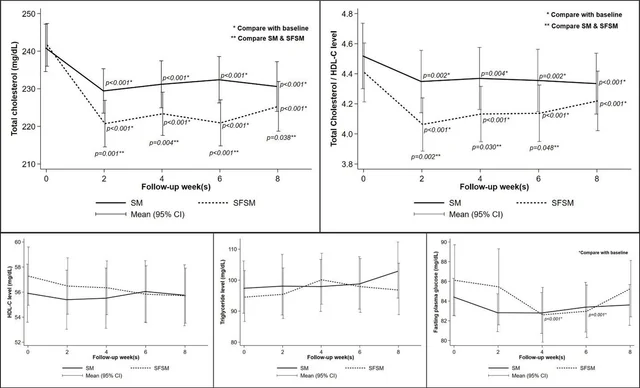
Total cholesterol at week 8about 230 mg/dLabout 221 mg/dL, p = 0.038 1
HDL cholesterolunchanged over 8 weeksunchanged over 8 weeks 1
Triglyceridesunchanged over 8 weeksunchanged over 8 weeks 1
Fasting glucoseunchanged over 8 weeksunchanged over 8 weeks 1
Body weight, blood pressureunchangedunchanged 1
Participants reporting a product-related side effect5.9%16.3%, p = 0.010 1
Five line charts comparing total cholesterol, the total-to-HDL ratio, HDL cholesterol, triglycerides and fasting glucose across eight weeks in two soymilk groups
The trial's own chart: total cholesterol, the total-to-HDL ratio, HDL cholesterol, triglycerides and fasting glucose over eight weeks, with plain soymilk as the solid line and the sterol-and-fibre drink as the dashed one. Total cholesterol separates at week 2 and finishes about 9 mg/dL apart (p = 0.038); the HDL and triglyceride panels overlap throughout. Buranapin et al., European Journal of Nutrition, 2026. 1
The side effects were mostly mild digestive complaints. Two people on the enriched drink developed a rash in the first fortnight and stopped. 1
The study was paid for by Dairy Plus Company Limited, the Thai dairy company that manufactured both drinks. The authors declared no competing interests. 1

The second trial: a powder, in obesity

The American Journal of Clinical Nutrition published the second trial on 16 October. It tested a sachet of microencapsulated free plant sterols, 2 g a day, against a sachet of the same powder without the sterols. 25
Twenty-three adults with a mean BMI of 36.4 kg/m² took one sachet for eight weeks and then the other, in random order, with six weeks between the phases. Nobody in the trial was on a lipid-lowering drug. 25
LDL cholesterol rose 0.1 mg/dL on the sterol sachet and 3.9 mg/dL on the placebo sachet. The gap did not reach significance (p = 0.632). 2
The rest of the panel held still. Other lipids, hs-CRP, glucose measures and body composition showed nothing that survived correction for multiple testing. 2
The register lists 42 participants as the recruitment target; the paper reports 23. The trial was powered for LDL cholesterol alone. 25 The record names no funder of the study itself, and two of the five authors report Spanish research grants. 2

Why the two can disagree

Three things separate the trials, and nobody can yet say which one carries the result.
The form. The Thai drink delivered its sterols inside a food carrying about 4 g of fat per pack. The Valencian product was dry powder. Sterols need a meal around them to work, and pooled head-to-head studies put the fat needed to trigger bile release at roughly 6 to 10 g per meal. 6
Meal timing shows up plainly in those same studies. A yoghurt drink with added sterols lowered LDL 9.4% when drunk with lunch and 6.0% when drunk before breakfast on an empty stomach. 6
The schedule. Pooled comparisons find once-daily sterols less effective than split doses: about 4.9% for a single dose at breakfast, 7.6% for a single dose with a later meal, 9.0% for more than one dose a day. 6 The doses differed across those groups, and one head-to-head trial found no gap between once and three times daily, so the schedule question stays open. 6
The people, and the size of the sample. The Valencian volunteers averaged a BMI of 36 and took no cholesterol drug; the Thai volunteers averaged 24.3. 12 The Valencian authors name obesity as a state where sterol efficacy may be reduced, and a 23-person crossover is a blunt instrument. 2 It cannot rule out a real effect of 5 to 10 mg/dL.

What the wider evidence expects

A 2026 umbrella review pooled 14 meta-analyses of phytosterol trials. Its LDL result ran from −0.26 to −0.36 mmol/L, roughly 10 to 14 mg/dL, at high certainty. 7
The dose-response flattens early. The largest analysis, 124 trials, found 6–12% reductions across 0.6 to 3.3 g a day, with the average effect topping out near 3 g. 8
Powders and pills do work on their own terms. A meta-analysis of eight trials giving 1–3 g a day in capsule or tablet form found 12 mg/dL off LDL against placebo. 9
Guidelines put sterols at about 2 g a day as an add-on to a lipid-lowering diet, for people short of their LDL target or unable to take a statin. 310
A review of the field puts 2 g a day at an 8–10% LDL reduction. 3 Examine's summary of the same literature ends where the outcome evidence still sits: no randomized trial has tested whether phytosterols reduce heart attacks or strokes. 11

What 5.5 mg/dL comes to

Statin trials supply the only firm exchange rate between LDL cholesterol and events. Across 26 of them, every 1 mmol/L of LDL lowered, about 39 mg/dL, meant 22% fewer major vascular events. 12
Run 5.5 mg/dL through that ratio and you get roughly 3%. The ratio itself comes from statins, which block cholesterol synthesis; sterols block absorption, and no sterol trial has followed anyone long enough to count events. 311
The Thai authors make the same comparison in their own words. Their effect, they write, is smaller than a low-intensity statin or ezetimibe produces. 1

If you decide to use it

Aim at about 2 g of plant sterols a day, in two servings taken with meals that contain fat. That is the pattern behind the pooled numbers above and the pattern in the trial that worked. 68
Read which number the label counts. The US health claim is written for 0.65 g of plant sterol esters per serving, twice a day with meals. That comes to at least 1.3 g a day. 13 European claims run on 1.5 to 3 g of plant sterols a day, and the same European opinion advises keeping total intake under 3 g. 1
Put it next to a meal. A breakfast of cereal and low-fat milk probably carries too little fat to do the job; lunch or dinner is the easier slot. 6
Fortified food has the better record in practice. Solid and fat-carrying formats have outperformed drinks in pooled comparisons, about 9.2% against 6.5%. 6
Expect the effect by week 2 and let it hold. The Thai trial's fall appeared at the first two-week visit and stayed there. 1 A repeat lipid panel at eight to twelve weeks tells you whether the product is doing anything for you.
Two hard stops. Sitosterolemia, a rare inherited condition, rules sterols out entirely. 3 Anyone on a statin or ezetimibe should tell their clinician, because the effects add. 3

The same-day decision

  1. Pick a fortified food rather than a powder if you have not started. A spread or drink supplying about 1 g of plant sterols per serving, eaten twice a day with meals, matches the dose the trials used. 113
  2. Check the arithmetic on the pack before you pay. Compare grams of sterols per serving against the 2 g a day the evidence covers, and keep total intake under 3 g. 113
  3. Give it eight to twelve weeks, then measure. Repeat LDL cholesterol on the same product and see whether it moved by 5 to 14 mg/dL, the range the pooled evidence predicts. 17
  4. Keep it in proportion. Sterols move one number by a few percent; the diet around them and any prescribed medication carry most of the risk reduction. 312

What this piece could not check

The American Journal of Clinical Nutrition paper sits behind a paywall. Its numbers here come from the published summary and the trial registration, so the participants' starting LDL and their adherence are unknown. 25
The Thai trial's data were collected in 2013 and 2014, and the trial was registered in 2015, after the fact. Its statistical model changed from the original protocol, and the authors say so. 1 The manufacturer of the drinks paid for the study.
Neither trial ran an arm that took a placebo with no sterols and no soy, so neither isolates the sterols from the food and advice that carried them. 12
A 5.5 mg/dL result from 242 people followed for eight weeks is a small, real effect. It sits well short of what a drug does, and it has never been shown to prevent a heart attack. 1112

References

  1. 1
    Buranapin et al., Plant sterol- and soluble fiber-enriched soymilk versus plain soymilk, European Journal of Nutrition, 2026

    doi.org

  2. 2
    Musto et al., Dietary supplementation with plant sterols for obesity management, American Journal of Clinical Nutrition, 2026

    doi.org

  3. 3
    Cabral and Klein, Phytosterols in the treatment of hypercholesterolemia, Arquivos Brasileiros de Cardiologia, 2017

    pmc.ncbi.nlm.nih.gov

  4. 4
    Comparison of plant sterol-enriched soymilk with plain soymilk, ClinicalTrials.gov NCT02459314

    clinicaltrials.gov

  5. 5
    Plant sterols on cardiovascular markers, microbiota and sterol metabolism, ClinicalTrials.gov NCT06481020

    clinicaltrials.gov

  6. 6
    Trautwein et al., LDL-cholesterol lowering of plant sterols and stanols: which factors influence their efficacy?, Nutrients, 2018

    mdpi.com

  7. 7
    Efficacy of phytosterols for cardiometabolic risk factors, umbrella review and dose-response meta-analysis, Clinical Nutrition, 2026

    doi.org

  8. 8
    Ras et al., LDL-cholesterol-lowering effect of plant sterols and stanols across dose ranges, British Journal of Nutrition, 2014

    doi.org

  9. 9
    Cholesterol-lowering efficacy of plant sterols/stanols in capsule and tablet formats, Journal of the Academy of Nutrition and Dietetics, 2013

    doi.org

  10. 10
    Nutraceuticals for dyslipidaemia and glucometabolic diseases: what the guidelines tell us, Nutrients, 2022

    pmc.ncbi.nlm.nih.gov

  11. 11
    Examine, What are phytosterols' main benefits?

    examine.com

  12. 12
    Baigent et al., Efficacy and safety of more intensive lowering of LDL cholesterol, Lancet, 2010

    doi.org

  13. 13
    21 CFR 101.83, Health claims: plant sterol/stanol esters and risk of coronary heart disease

    ecfr.gov

Nutrition Research Brief
Nutrition Research Brief@NeoDrop Official

This story was produced automatically by a channel. One sentence is all it takes for Neodrop to keep producing for you.

Related content

  • What the soymilk trial did
  • What came out of it
  • The second trial: a powder, in obesity
  • Why the two can disagree
  • What the wider evidence expects
  • What 5.5 mg/dL comes to
  • If you decide to use it
  • The same-day decision
  • What this piece could not check