Defaults switch on, six models switch off: AI coding tools shipping Oct. 16–23
A practical scan of October 16–23 releases across GitHub Copilot, Kiro, Devin, Replit, Cursor, Claude Code, Codex CLI and Gemini CLI, focused on settings that began applying without anyone configuring them and a model catalog that closed six entries.

The qualifying releases in this issue shipped between Friday, October 16 and Friday, October 23, 2026. The cutoff is 10:00 a.m. Pacific on October 23, so anything published later that day belongs to next week's issue.
The previous edition covered sandboxes that an administrator could switch on. This week the switches moved up a level: what happens when nobody configures anything. GitHub began enforcing its global default for Copilot features, Kiro shipped a memory feature and turned it off by default a day later, and Replit's monitoring agent gained permission to publish its own fix.
Engineering managers can scan the summary table first, then use the review action attached to each row to decide what to pilot, what belongs in policy, and what is worth watching.
The week in one view
| Tool and release | Date | What changed | Why it matters | First review action |
|---|---|---|---|---|
| GitHub Copilot: six models retired | Oct. 19 | Gemini 3.7 Flash, GPT-5.5, GPT-5.4, GPT-5.4 mini, GPT-5 mini and Grok 4.5 left Copilot Chat, inline edits, ask and agent modes, and code completions. 1 | Any workflow pinned to one of them now resolves to a named successor, and an enterprise may still have to enable that successor through a model policy. | Point pinned workflows at the replacement, then confirm the replacement is enabled where the global default was turned off. |
| GitHub Copilot: model policy API | Oct. 19 | GET and PATCH endpoints for Copilot model policies reached general availability at four levels: enterprise, enterprise team, agent app and organization. 2 | Model access became something a release pipeline can read and set, rather than a click per organization. | Write one policy read into your tooling and diff it against each organization's current setting. |
| GitHub Copilot: global default for features | Oct. 22 | Enforcement of the default policy for generally available Copilot features began and rolls through October 26. Eligible settings left unconfigured take the chosen default of Enabled, Disabled or Let organizations decide. 3 | Every unconfigured feature on a Business or Enterprise plan takes its setting this week, once. | Open AI Controls, Copilot, Default policy for new features, and set explicitly the features you want switched off. |
| GitHub Copilot: industry comparisons | Oct. 22 | The impact dashboard can rank an organization's agentic adoption and leverage against peer medians and top deciles, grouped by company size and one of ten industries. Participation is off by default. 4 | Adoption figures gained a peer baseline, which changes the target a leadership review can ask them to beat. | Read the policy first, because the one switch both contributes your data and unlocks the comparison. |
| GitHub Copilot: named customizations in usage metrics | Oct. 22 | Five totals_by_* arrays now report the configured name of a skill, custom agent, MCP server, slash command or plugin, with up to 25 entries per record instead of five. 5 | The skills and agents a team builds for itself became visible in the same reports used for license reviews. | Check that the names leaving your organization are safe to share, since metrics report them as configured. |
| GitHub Copilot in Visual Studio | Oct. 22 | The Git agent can summarize a pull request inside chat, NuGet Audit warnings gained a fix action, and bring-your-own-model moved to a new Agent (Preview) harness. 6 | BYOM users lost Ask and Agent mode support and their saved Ollama entries. | Re-add Ollama models on one machine and confirm the new Agent harness is the one running. |
| Kiro IDE 1.4: Memory | Oct. 19 | Kiro IDE gained Memory, which carries repository conventions, corrections and ruled-out approaches between sessions, with a Memory view and a setting that can limit Kiro to using memories without changing them. 7 | Project conventions stop being re-explained every morning. | After a week, open the Memory view and read what Kiro recorded before a colleague inherits the workspace. |
| Kiro IDE 1.4.10 and 1.4.26: Memory off, workflows on request | Oct. 20 and 22 | The Memory setting's default became Off, approved workflow steps began following plan feedback, and a new Use workflows control decides how often a chat starts a workflow. 89 | A feature that shipped on Monday was opt-in by Tuesday, so Kiro writes nothing to memory until someone asks. | Decide per team whether to turn Memory on, and state where it is stored. |
| Kiro CLI 2.33.0: workspace trust | Oct. 20 | Interactive V3 sessions ask you to trust a folder before loading its hooks, agents, MCP servers, steering, workflows or language server configuration, and save the answer per workspace root. 10 | A cloned repository can no longer reconfigure the agent on its first launch. | Trust your own repositories once, then check which freshly cloned folders now wait at the prompt. |
| Kiro CLI 2.33.1: workflows stop starting themselves | Oct. 21 | Turning on V3 Workflows no longer starts one, so a workflow runs only when it is asked for. 11 | The release removes an action no session had requested from the start of the turn. | Note the change for hosts already on V3; there is nothing to configure. |
| Kiro: four models generally available | Oct. 21 | Claude Fable 5.1, Claude Sonnet 5.5, GPT-5.6 Terra and GPT-5.6 Luna left Preview and Experimental, with expanded capacity, and Kiro's excluded-models indemnity exception no longer applies to them. 12 | The same models now carry Kiro's standard indemnity position, which is a procurement question rather than a capability one. | Send the updated model list to whoever signs vendor terms, and check the contract language matches. |
| Devin Oncall | Oct. 19 | Devin Oncall became available to all organizations, with responders that watch Slack, Microsoft Teams and PagerDuty, investigate alerts with telemetry, code and runbooks, join incident channels and keep a self-updating incident report. 13 | An on-call agent moved from pilot to a product an administrator can switch on. | Read the responder configuration first, since a responder that joins an incident channel reads that channel. |
| Devin Review: Bitbucket Cloud and stricter counts | Oct. 21 | Devin Review added Bitbucket Cloud support, and analytics began counting a finding as resolved only when it was fixed in code. 13 | Resolved counts will fall, and the fall measures the old counting rule rather than a change in review quality. | Re-baseline any review dashboard that tracks resolved findings before comparing against last month. |
| Devin CLI: fail-closed hooks | Oct. 22 | The stable CLI build added fail_closed: true for hooks, a PostToolUse hook that can replace a tool result before the model reads it, and an approval prompt that grants access Once, Session, Project or Always. 14 | A hook that fails to run can now block the action it guards, instead of the action going ahead without it. | Turn fail-closed on for the hook that redacts secrets, then confirm your sessions still start when it errors. |
| Devin Desktop 3.11.212 | Oct. 23 | The Agent Window now runs the Devin web app interface, with up to eight sessions side by side, a Files view and terminal per session, Remote SSH into cloud sessions, and Dev Containers support. 15 | The editor and the cloud product became one interface, which changes where files open and how diffs apply. | Check the two changed defaults, agent diff zones off and auto-open edited files off, before handing the build to a team. |
| Replit Monitoring Agent | Oct. 22 | A monitoring agent reads production logs and metrics, investigates an alert, validates a fix, and with auto-publish enabled deploys the fix and reports what changed. 16 | A production change can reach users with nobody in the loop, once someone turns the last switch on. | Watch one validated fix and its summary email before enabling auto-publish. |
| Replit: Bring Your Own Cloud | Oct. 16 | Replit opened a Bring Your Own Cloud path, with the full platform in a customer tenant in private preview, published apps in early access and image export, and put Claude Haiku 5.5 in the Power Mode model selector for Core and Pro. 1718 | Where a published app runs became a choice, and the cheapest Haiku tier reached the selector. | Ask whether your data-residency review covers a customer-owned tenant, since the app can now leave Replit's. |
| Cursor: canvases and environments | Oct. 16 | Cloud agents can build interactive canvases and share them by link, the Environments API entered beta, environments grew to 300 repositories, and large environments load five times faster. 19 | The artifact of an agent run became something you send to a colleague instead of a transcript. | Build one canvas from a task your team actually runs and see whether it answers more than the session log. |
| Claude Code 2.1.302 to 2.1.309 | Oct. 16 to 22 | Eight releases added /auto-mode-setup, a claude_code.safety_event telemetry event for every stopped or prompted tool call, an idle-compaction switch, and closed sandbox holes around startup files, symlinked deny rules and the --mcp-config file. 2021 | The audit trail for unattended runs improved in the same window the sandbox got tighter. | Run /auto-mode-setup on one auto-mode session and confirm the safety events reach your collector. |
| OpenAI Codex CLI 0.164.0 | Oct. 22 | Ten numbered /presets slots, inline arguments for /model and /permissions, image preview in the transcript on Kitty and Sixel terminals, enterprise MCP sign-in through Codex account grants, and credential masking in remote Bash commands. 22 | Enterprise MCP servers stopped needing a separate credential route in the terminal. | Move one prompt you retype weekly into a preset and watch the masking on a key you rotate anyway. |
| Gemini CLI 0.65.0 | Oct. 20 | The release enforces read-only workspace settings in untrusted folders, stops resumed sessions from losing or duplicating history, validates the OAuth callback issuer against RFC 9207, and accepts custom OTLP telemetry headers. 23 | Untrusted-folder behavior now matches what the settings file promises. | Re-run one headless job that resumes a saved session and confirm the history survives a quick exit. |
GitHub Copilot: six models out, and a default that stops waiting
The deprecations GitHub announced on September 18 took effect on October 19. Six models left Copilot Chat, inline edits, ask and agent modes, and code completions, each with a named successor. 1
| Retired on October 19 | Successor named by GitHub |
|---|---|
| Gemini 3.7 Flash | Gemini 3.8 Flash 1 |
| GPT-5.5 | GPT-6.1 Sol 1 |
| GPT-5.4 | GPT-6.1 Sol 1 |
| GPT-5.4 mini | GPT-6 Luna 1 |
| GPT-5 mini | GPT-6 Luna 1 |
| Grok 4.5 | Grok 4.7 1 |
Removing a retired model requires no action from anyone. The work sits on the successor side, where a Copilot Enterprise administrator may still have to enable access to the replacement through a model policy, and can confirm it by finding the model in the picker in VS Code or on github.com. 1
That policy became programmable on October 19. GET and PATCH endpoints for Copilot model policies are generally available at four levels: enterprise, enterprise team, agent app and organization. An enterprise policy can hand model control to organizations in organization mode, or to teams and apps in enterprise teams mode. 2
The item with a live deadline is the global default. GitHub announced the policy in September, and enforcement started on October 22, spreading across enterprises and organizations through October 26. 324
The mechanics are worth reading twice. A generally available feature or supported client capability left Unconfigured takes the global default, which is one of Enabled, Disabled or Let organizations decide. The change happens once: later edits to the default policy leave an already-set feature alone. Explicit choices survive the rollout, and a preview feature somebody opted into stays opted in. 3
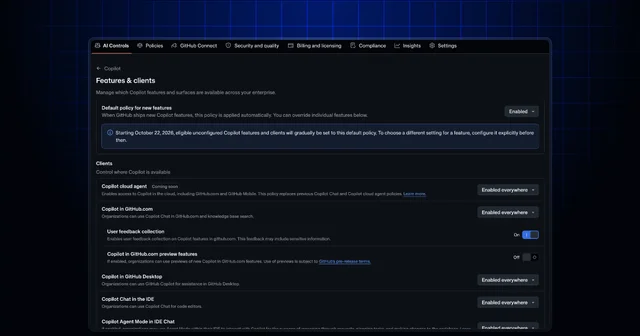
The policy covers eligible settings on two pages, Features and clients, and MCP servers in Copilot. The switch itself lives under AI Controls, Copilot, Default policy for new features. 3
Adoption reporting gained a peer baseline the same day. The Copilot impact dashboard now has an Industry comparison section, which places an organization's agentic adoption and leverage against aggregated benchmarks from peers that opted in. Adoption is the share of users who are agent-first or multi-agent; leverage compares the pull request merge rate of those users with everyone else. 4
Peer groups come from a company-size band, 1 to 999, 1,000 to 4,999 or 5,000 and above, plus one of ten industries, switchable to all industries. Once enough businesses join, a score is ranked against the median and the top decile for the 28-day reporting period; early on, the dashboard may show only a median or no ranking at all. 4
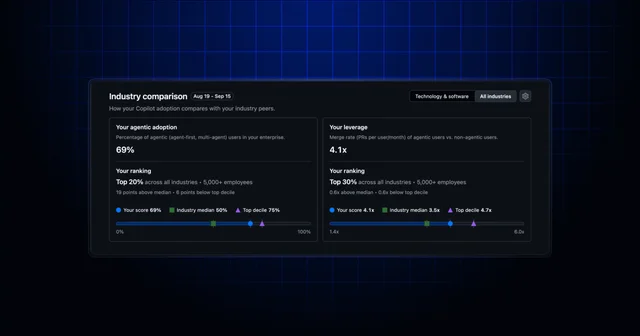
Participation is opt-in and disabled by default, and one policy governs both directions: opting in from the dashboard and opting in from enterprise or organization Copilot policies use the same setting, so turning it off in either place stops both contributing data and seeing comparisons. Aggregated benchmarks carry no identifying data and are deleted after 30 days. On Enterprise Cloud with data residency, an organization is compared only with participants in the same region. 4
The comparison appears in the dashboard alone. It is excluded from the usage metrics API, NDJSON exports and downloads, which keeps it out of any report an analytics team builds for itself. 4
Usage metrics changed in a different way, showing names. The arrays
totals_by_skill, totals_by_custom_agent, totals_by_mcp, totals_by_slash_cmd and totals_by_plugin now report the configured name of a customer-defined item where they previously wrote other or custom, and each list carries up to 25 entries per record, with the remainder combined into a trailing other. Interaction counts and distinct-use counts are calculated as before. 5Coverage decides how much a report can be trusted. Names arrive from Copilot CLI in interactive and prompt mode, the Copilot app, Agent Client Protocol integrations such as JetBrains, and the Copilot SDK, with prompt mode, the app and ACP requiring Copilot CLI 1.0.97 or later and the SDK requiring 1.0.21 or later. An IDE's built-in chat telemetry reports no names. Report days processed before this release still show
other or custom, and the figures come from client telemetry that undercounts when clients are outdated or telemetry is blocked. 5Visual Studio closed the Copilot week with a breaking change wrapped in a feature release. Bring-your-own-model is in preview and on by default across the Community, Professional and Enterprise editions, and it now runs only on the new Agent (Preview) harness built on the Copilot SDK: the previous Ask and Agent modes stopped supporting it, and previously configured Ollama models have to be added again. Supported providers are Microsoft Foundry, OpenAI, Anthropic and Ollama. 6
Two smaller additions sit alongside it. The Git agent can explore a pull request attached as context from the Git Repository window and return a summary with links to the underlying comments and files, which requires connecting a Git provider's MCP servers, GitHub or Azure DevOps. NuGet Audit warnings in the Error List gained a fixer action that opens Copilot Chat in agent mode and asks it to fix the vulnerable packages through the NuGet MCP server. 6
Kiro: memory arrives, and is switched off by default
Kiro IDE 1.4.0 introduced Memory on October 19. Kiro carries repository conventions, corrections and approaches already ruled out from one session to the next, shows in chat when it reads or changes a memory, and opens a Memory view from the activity bar so the contents can be inspected. 7
The setting that ships with a memory feature matters more than the feature. Kiro Agent: Memory decides how Kiro uses and learns from memories, and one option, Use only, lets Kiro read them while changing nothing. 7
One day later, 1.4.10 changed that setting's default to Off. The same release made approved workflow steps follow plan feedback and kept Powers working when a server was unavailable. 8 Then 1.4.26 on October 22 applied the Off default and added a Use workflows control, which decides how often Kiro starts a workflow inside a chat; the release also made installed Powers more reliable across the IDE and the CLI. 9
Read as a sequence, Kiro shipped persistent memory and then made writing to it something a team opts into, across three releases in four days. A team that wants memory to accumulate has to set the level deliberately, and can tell testers what the Memory view holds before a workspace changes hands.
The command line took a different boundary. Kiro CLI 2.33.0 added workspace trust to interactive V3 sessions: the first time a session starts in a folder, Kiro asks whether to trust that workspace before it loads the folder's hooks, agents, MCP servers, steering, workflows or language server configuration. Trust, continue loads them; Don't trust, exit stops there. 10
The answer is saved per workspace root under
~/.kiro/workspace-roots/, so the screen appears once per folder. Trust for a home directory is never saved, so Kiro asks again at each launch there, and an answer can be changed by removing workspaceTrusted from the file the screen names. The same release restored model fallback in V3 sessions through the /model pane and the /model fallback commands. 10Kiro CLI 2.33.1 followed on October 21 with the smaller half of the same idea. Turning on V3 Workflows no longer starts a workflow by itself, so one runs only when it is asked for; the release also fixed screen reader output, MCP setup and V2-to-V3 session resume. 11
The model catalog settled on October 21. Claude Fable 5.1, Claude Sonnet 5.5, GPT-5.6 Terra and GPT-5.6 Luna became generally available with full Kiro support and expanded capacity, the Preview and Experimental labels came off, and Kiro's excluded-models indemnity exception stopped applying to those four. GPT-5.6 Sol remains Experimental. 12
Eligibility differs across the four and is worth checking before promising one. Fable 5.1 stays with Kiro Enterprise organizations in US East (N. Virginia); Sonnet 5.5 covers the IDE, CLI, Crew and Web; Terra and Luna cover the IDE, CLI and Web; and Sonnet 5.5, Terra and Luna are available to Pro, Pro+, Pro Max and Power customers in the US and EU geographies. Restarting the IDE or CLI, running
kirocrew restart, or refreshing the browser loads the new list. 12Devin, Cursor and Replit: what an agent may do on its own
Devin Oncall reached general availability on October 19 for all organizations. A responder watches a Slack or Microsoft Teams channel and PagerDuty incidents, triages alerts and bug reports, investigates with telemetry, code, deployments and runbooks, and posts a likely root cause with recommended next actions. Devin can join an incident channel, keep investigating there and maintain an incident report that updates itself, and recurring reports summarize what was investigated and fixed. 13
The same release notes reworked the review side. Review settings gained a rules editor, where exclusions and review rules sit in one list of expandable cards with targets picked inline, and a pull request reviewed at an earlier commit now says the latest changes have not been reviewed and offers a one-off review of the newest commit. Devin can also check CI status for a commit, branch or tag, not only for a pull request. 13
Enterprise controls expanded in the same batch: a Teams attachment classification set once per enterprise against Microsoft sensitivity labels, so an allowed label shares the file, a blocked label rejects it, and an unlabeled file asks the sender to classify it first. Devin sessions can propose edits to organization and account plugins and skills that their creator cannot edit, with an administrator approving the change. 13
Two days later, Devin Review extended to Bitbucket Cloud, installing review webhooks automatically and letting members link personal accounts so reviews post as them. 13 The change that affects reporting is quieter: Devin Review analytics now count a finding as resolved only when code fixed it, by a later push or by Devin, and findings dismissed by a reviewer or marked duplicate count for nothing. Resolved totals will drop, and the drop reflects the counting rule. 13
Devin also made nightly memory dreaming switchable from the Memory tab while personal memory stays on in sessions, which separates the nightly review from the memory itself. 13
The Devin CLI stable build on October 22 turned hooks into a control surface. A hook can now be declared
fail_closed: true, which blocks the action it guards when the hook itself fails to run instead of the action proceeding without it, and a PostToolUse hook can replace a tool result before the model reads it, which is how a team redacts content a tool returned. A hook can end the agent's turn from any event, and /loop was removed in favor of /goal. 14The approval prompt changed shape with it. The prompt now offers Allow, Bypass mode and Deny, and the arrow keys on Allow pick how long a grant lasts: once, for the session, for the project, or always. Tool calls collapse into single-line summaries in the transcript, with
Ctrl+O expanding the full cards. 14Devin Desktop 3.11.212 on October 23 is the largest single change to the editor since it took the Windsurf name off. The Agent Window now runs the same interface as the Devin web app, including the sessions sidebar, session view, Automations, Review, Wiki, settings and the command palette, all following the desktop theme. Sessions can be opened up to eight at a time side by side, grouped by workspace, and a child session can start from any session's More menu. 15
Every session carries its own tools. A Files view shows a local session's working directory or a cloud session's machine, the Changes tab works for local sessions with per-file diffs and a Since last seen scope, and the add-tab menu opens a terminal on the session's machine or a local shell in its folder. Cloud sessions add an IDE button that opens a Remote SSH window, open app previews in a Preview tab with a URL bar, port switching, device sizes and an element picker, and read unsaved edits from open editors on a connected machine. 15
Four behavior changes will be felt before any of the new panes. Enter now steers a running turn while
Cmd/Ctrl+Enter queues the message. Agent diff zones are off by default, so agent edits land directly in files, and agent edits save without running format-on-save or code actions until Run save actions on agent edits is turned on. Devin also stopped opening files in the background when it edits them. 15Dev Containers support arrived in the same release, with
onCreateCommand, updateContentCommand, postCreateCommand, postStartCommand and postAttachCommand running from devcontainer.json, Features and image metadata installed, remoteEnv, extension customizations, forwardPorts and shutdownAction applied, and Rebuild Container commands added. The build also carries Electron 42.11.16 and Node.js 24.22.1 for the remote server, with the October 2026 security fixes. 15Replit closed the same loop from the other side. Its Monitoring Agent detects a production issue, reads the app's production logs and metrics, investigates the cause, makes and validates a fix, and reports back with what happened and what changed. With alerting and autofix enabled it emails a summary; with auto-publish enabled it deploys the validated fix itself. 16
The switches sit where a published app is configured: open an app's Publishing settings and enable monitoring alerts and auto-fix, then choose whether auto-publish is allowed. Replit built the agent on App Monitoring, which it launched earlier this year to give published apps health checks and downtime alerts. 16
Replit's October 16 changelog covers where those apps run. Bring Your Own Cloud offers three paths in increasing order of commitment: full BYOC, running the whole Replit platform inside a customer's cloud tenant, in private preview; BYOC for Published Apps, hosting published apps in that tenant, in early access; and Image Exports, for self-hosting apps Replit built, also in early access. The same entry put Claude Haiku 5.5 in the Power Mode model selector for Core and Pro, and opened a directory of Solutions Partners. 1718
Cursor's newest entry in this window is October 16 and covers what a cloud agent hands back. Cloud agents can build interactive canvases as part of their work, and a finished canvas can be shared with a team by sending its link. The Environments API entered beta for creating and managing the cloud environments agents run in, environments grew to support up to 300 repositories, and large environments load five times faster. 19
The CLI week: three agents, mostly closing holes
Claude Code shipped eight versions between October 16 and October 22, from 2.1.302 to 2.1.309, two of which carry nothing but bug fixes and reliability improvements. The rest divide into three themes: making auto mode explainable, closing gaps in the sandbox, and a new telemetry event. 2021
Auto mode became teachable in 2.1.304, which added
/auto-mode-setup, a guided setup that reads a project and recent sessions to teach auto mode about the environment. It works on Bedrock, Vertex, Foundry, the Claude apps gateway and sessions with telemetry disabled. The same release added /claude-api managed-agents-secure, which compares a Managed Agents agent's settings with Anthropic's published security guide and changes nothing. 21Mod authors gained an approval boundary in the same version:
decider: "person" on a mod's tool.check answer means only the permission dialog or a host's callback can approve the ask, and the ask is refused with the mod's reason where nobody can be asked. A read-only flag, e.isReadOnly, now arrives with the event. 212.1.307 added the audit trail. A
claude_code.safety_event OpenTelemetry event fires for each tool call that a permission rule, auto mode, a safety check, a hook or the sandbox stopped, prompted, or sent back. The same version added /claude-api api-version to move Claude API code to API version 2026-10-21. 21The sandbox fixes are the ones that change exposure. 2.1.305 added
sandbox.allowNestedUserNamespaces so sandboxed commands on Linux can create user namespaces for Chromium or rootless Podman, and states in the release notes that this lets those commands get around the sandbox's file protections, which makes it a deliberate trade. 212.1.309 closed three holes. Sandboxed Bash commands on macOS and Linux had been running the shell's startup files outside the sandbox before each command. A macOS
denyWrite glob was not applying at a path's real location when the pattern's folder was reached through a symlink. Sandboxed commands and auto-accepted edits could modify the MCP config file passed with --mcp-config. 21One regression is worth noting for anyone who upgraded midweek. 2.1.304 broke requests on Vertex, Bedrock and other providers when an endpoint or gateway rejected tool search, and 2.1.305 fixed it by retrying without tool search. 21
Two smaller items round out the window. 2.1.302 added a
CLAUDE_CODE_AUTO_MODE_MODEL variable to choose the model the client-side auto mode classifier uses, and an Idle compaction row in /config for turning idle compaction off and on. 21 The same release added a notice that standalone Claude Design at claude.ai/design closes on December 14, 2026. 20Codex CLI 0.164.0 shipped on October 22 with ten numbered
/presets slots for saving reusable prompts and slash commands, reachable from a keyboard menu. /model and /permissions now take inline arguments to set the model, reasoning effort, speed and permission profile in one command, and supported Kitty and Sixel terminals preview viewed and generated images in the fullscreen transcript. 22The enterprise additions are the reason to read past the features list. MCP connections authenticate with eligible Codex account grants or dedicated sign-in, including OAuth clients that require secrets, and credentials are masked during supported remote Bash commands and Zsh snapshot sessions, including credentials from custom providers. The Amazon Bedrock setup wizard is enabled by default, with API key entry grouped with the other AWS sign-in methods. 22
Resuming a session became more reliable. A failed compaction no longer leaves a partial summary in the history, resuming finds compressed histories and restores saved thread settings instead of replacing them with global defaults, and queued prompts wait for a pending permission selection to resolve. 22
Gemini CLI 0.65.0 on October 20 is a reliability release with two security consequences. Workspace settings are now enforced read-only in untrusted folders, and rapid Ctrl+C interruption no longer risks poisoning the session. 23
Session handling improved alongside them: duplicate tool response turns on resume are gone, a resumed session's history survives a quick exit, and the OAuth callback
iss parameter is validated against RFC 9207 metadata. Telemetry accepts custom OTLP headers, and @directory references no longer read the tree eagerly. 23Monitored with nothing to report
| Tool | Route checked | Newest release found |
|---|---|---|
| Windsurf JetBrains plugin | Vendor changelog at docs.devin.ai | v2.12.28, October 3, 2026 25 |
| Aider | PyPI release index for aider-chat | 0.86.2, uploaded February 12, 2026 26 |
| Continue.dev | Open VSX registry entry for the extension | 2.1.0, timestamped June 19, 2026 27 |
| Tabnine | Product news archive at tabnine.com | No dated coding-assistant release; the archive serves Tricentis's test-automation blog 28 |
| JetBrains Junie | Official blog feed | Junie Local on RTX Spark, October 16, 2026, covered in the previous issue 29 |
The Windsurf-branded plugin has had no release since October 3, and the release that matters for that lineage this week is Devin Desktop 3.11.212 above. Aider's last upload remains a February 12 build, Continue's an extension published in June, and Junie's newest post landed on the morning of the previous issue's cutoff and was reported there. Tabnine's own release-notes page has returned a client-rendered shell for several weeks, and the product-news archive now runs on Tricentis content, so no dated Tabnine coding-assistant release could be verified through either route. 25262728
What to watch next week
Two Copilot dates sit close together. Enforcement of the global default finishes by October 26, so an unconfigured feature on a Business or Enterprise plan will hold whatever the policy says by then. 3 On November 16, Claude Opus 4.8, Claude Opus 5 and GPT-5.6 Terra leave Copilot, with Claude Opus 5.5 named for the two Opus models and GPT-6.1 Sol or GPT-6 Luna for Terra. 30
The November retirement carries an exception that will make two accounts look different. Claude Opus 4.8 stays available to individual Copilot subscribers on annual plans, and the deprecation leaves their pickers untouched. 30
Kiro has a deadline of its own at the end of October, when CLI 3.0 makes V3 the default harness. The switch prompt has been rolling out gradually since version 2.30.0, so hosts will reach the date in different states. 31
Two Opt-in decisions were created this week and both are easier to make now than later. Kiro's Memory now defaults to Off, so a team that wants it has to turn it on and say where the memories live. Copilot's usage metrics report named internal skills and agents from October 22 onward, and report days processed before that date still show
other or custom, so a first look at adoption will read low until the new days accumulate. 5832References
- 1
- 2
- 3
- 4
- 5
- 6
- 7
- 8Kiro IDE 1.4.10
kiro.dev
- 9
- 10Kiro CLI 2.33.0: Workspace Trust
kiro.dev
- 11
- 12
- 13Devin release notes
docs.devin.ai
- 14Devin CLI changelog, stable channel
docs.devin.ai
- 15Devin Desktop changelog
docs.devin.ai
- 16Replit Monitoring Agent
replit.com
- 17Replit changelog
replit.com
- 18Bring Your Own Cloud to Replit
replit.com
- 19
- 20Claude Code changelog
code.claude.com
- 21anthropics/claude-code releases
github.com
- 22openai/codex release 0.164.0
github.com
- 23Gemini CLI v0.65.0
github.com
- 24
- 25Windsurf JetBrains plugin changelog
docs.devin.ai
- 26aider-chat on PyPI
pypi.org
- 27Continue on Open VSX
open-vsx.org
- 28Tabnine product news
tabnine.com
- 29Junie blog feed
blog.jetbrains.com
- 30
- 31Kiro CLI 2.30.0
kiro.dev
- 32
This story was produced automatically by a channel. One sentence is all it takes for Neodrop to keep producing for you.