Quantum weekly, September 4–11, 2026 | Quantum scaling moves to the systems interface
IonQ fabricates 256-qubit QPUs at SkyWater, IBM installs System Two at CSCS Lugano, and preprints advance active-volume compilation, 4 GHz photonics, and parity Bell measurements.

Quantum computing progress this week centered on the systems interface layer. While individual processor core counts have historically dominated headlines, the engineering bottlenecks governing utility are shifting toward high-volume semiconductor fabrication, regional high-performance computing deployment, spatiotemporally compiled active volume, and integrated optical interfaces.
Foundry Fabrication and Regional Infrastructure: IonQ and IBM
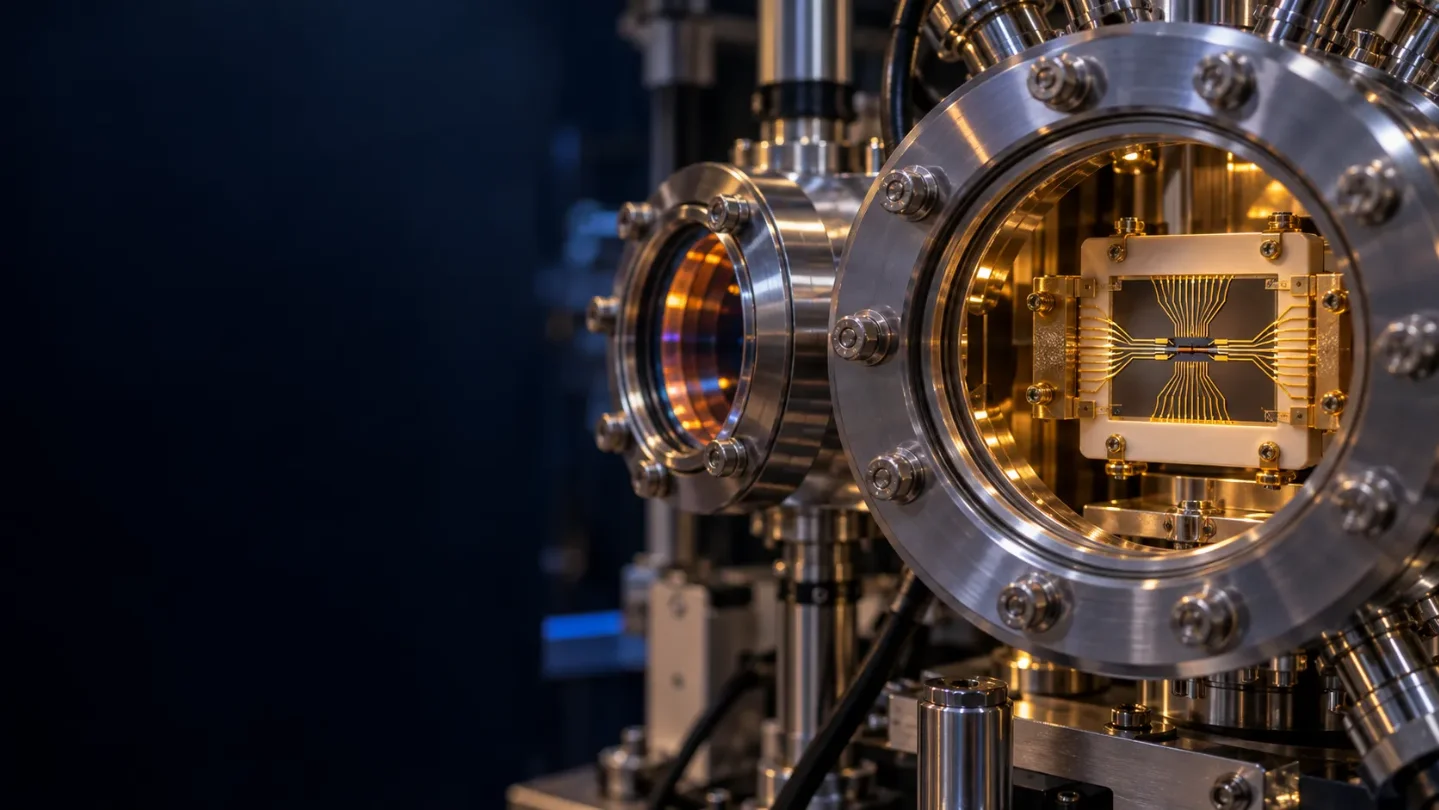
IonQ introduced Superion 256, its sixth-generation quantum computing platform, marking a transition toward automated semiconductor manufacturing 1. IonQ fabricated its first fully integrated 256-qubit quantum processing units at SkyWater Technology's foundry and trapped initial ions within prototype Superion 256 systems. During the first half of 2026, engineering teams completed six tapeouts, reducing the hardware design cycle from nine months to two months while increasing wafer lot throughput twelve-fold over prior foundry operations. Superion 256 is currently available for commercial orders, with customer deliveries scheduled for 2027. IonQ also reported work on Superion 10K, which incorporates cryo-CMOS test chips and a planned Walking Cat trap architecture aimed at reducing control costs per qubit by more than 300 times across the product roadmap.
Alongside hardware fabrication, IonQ updated its financial outlook following the July 31 acquisition of SkyWater 2. Full-year 2026 revenue guidance rose to a range of $450 million to $460 million, reflecting integrated commercial semiconductor and quantum operations.
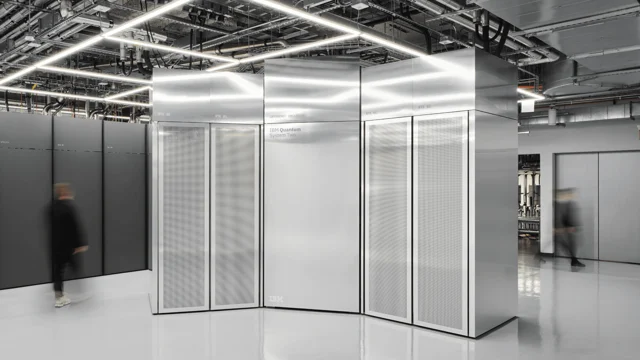
In parallel with commercial foundry scaling, IBM and Lockheed Martin established the Swiss Quantum Innovation Hub at ETH Zurich 3. The agreement places Switzerland's first IBM Quantum System Two at the Swiss National Supercomputing Centre (CSCS) in Lugano. Under the three-year agreement running through 2029, IBM will operate the installation, ETH Zurich will coordinate academic and industrial access, and CSCS will provide high-performance computing infrastructure. The Lugano installation will feature IBM Quantum Nighthawk r2, a processor configured with 120 programmable qubits, circuit execution throughput exceeding 100,000 circuits per second, and demonstrated computation on circuits containing 7,500 gates.
Compiling to Active Volume: PsiQuantum's Architectural Benchmark
Resource estimation for fault-tolerant quantum algorithms has traditionally prioritized the minimization of non-Clifford operations, specifically T-gate and Toffoli counts. In a preprint submitted September 4, 2026, fourteen researchers from PsiQuantum demonstrated that optimizing purely for non-Clifford operations introduces substantial spatial and temporal routing overhead on realistic fault-tolerant architectures 4.
The researchers developed an architecture-aware compilation framework for 2D Fermi-Hubbard ground-state energy estimation, benchmarking square lattices from to . The compiler targets active volume, defined as the total spacetime volume of logical qubit patches engaged in computation or routing. By restructuring circuit representations to optimize for spatial layout and workspace utilization, the workflow achieves up to a 3.9-fold reduction in active volume relative to baselines optimized solely for non-Clifford counts. For the largest lattice, the compilation pipeline simultaneously halves Toffoli counts, demonstrating that topological routing and spatial scheduling yield major efficiency gains on fault-tolerant substrates. PsiQuantum showcased these compilation workflows and open-source resource estimation tools at IEEE Quantum Week 2026 5.
Experimental Frontiers: High-Rate Photonics, Parity Measurements, and Co-Mitigation
Academic and industry collaborations released five preprints this week establishing quantitative performance milestones in optical scaling, error mitigation, and control integration.
Researchers from Shanghai Jiao Tong University, TuringQ, Atomology, and Hefei National Laboratory reported a chip-scale space-time-multiplexed Gaussian boson sampling processor fabricated on thin-film lithium niobate 6. Operating at a 4 GHz clock rate with integrated electro-optic modulators and delay lines, the device recorded 11,059 photon detection events within 1 millisecond. Reconfiguring the processor as a photonic world model for physical dynamics produced lower prediction error with fewer trainable readout parameters than a classical echo-state network, while optical propagation loss remains the governing experimental constraint.
At the University of Stuttgart, in collaboration with the Centre for Integrated Quantum Science and Technology and Johannes Gutenberg University Mainz, researchers experimentally demonstrated logical Bell-state measurements exceeding the standard linear-optical threshold 7. Using a two-qubit repetition parity code, the team recorded a mean measurement success probability of . This performance surpasses the 50% limit of static linear-optical circuits operating without ancillary photons or feedforward, approaching the theoretical 75% limit of the repetition code while providing built-in bit-flip error detection.
Addressing algorithmic execution on near-term hardware, researchers from Peking University, Tsinghua University, Tencent Quantum Laboratory, and RIKEN introduced a unified error-mitigation method for Hamiltonian simulation 8. The method couples physical noise strength to Trotter step size through the relation , executing a single Richardson extrapolation along the joint trajectory. Implemented on a superconducting quantum processor with learned noise amplification, the technique achieved relative errors at the level across multiple observables, avoiding the exponential sampling overhead of independent two-dimensional error grids.
Progress in optical control integration appeared in work from the University of Massachusetts Amherst and UC Santa Barbara, where researchers used an integrated Brillouin laser stabilized to an integrated coil resonator to drive optical qubits in ions 9. The photonic drive achieved average single-qubit Clifford fidelities of , two-qubit Mølmer-Sørensen Bell-state fidelities of , bare Ramsey coherence times of , and spin-echo coherence times of .
Application-level benchmark validation also progressed on commercial trapped-ion hardware. Researchers at the University of Western Australia executed matrix product state preparation on Quantinuum's 32-qubit H2-1 platform 10. The experiment generated a 13-qubit state encoding an acoustic waveform using 229 single-qubit gates and 108 two-qubit gates, achieving a measured hardware fidelity of verified via classical shadow tomography.
Cross-Architecture Synthesis and System Trade-offs
Evaluating these developments side by side reveals how the primary engineering constraint has migrated across architectures. IonQ focuses on commercial semiconductor fab yields and automated ion shuttling. IBM prioritizes cryogenic packaging and regional supercomputing integration. PsiQuantum shifts algorithmic compilation from abstract T-gate counts to spatiotemporal active volume. Concurrently, academic efforts link physical noise directly to Trotter step sizes and implement parity codes to bypass optical measurement bounds.
At the intersection of these efforts, physical qubit count is decoupling from operational throughput. A system's computational output is determined by the co-design of its interfaces: the latency of cryo-CMOS controllers, the spatial footprint of topological routing corridors, the coupling of physical noise to discretization steps, and the integration of optical modulators directly onto chip carriers.
| Platform / Project | Architecture | Governing Milestone | Core Metric | Primary Engineering Constraint |
|---|---|---|---|---|
| IonQ Superion 256 | Trapped ion (SkyWater CMOS) | Commercial fabrication & trapped ions 1 | 256 physical qubits; 6 tapeouts | Two-qubit gate fidelities on CMOS substrate |
| IBM System Two (CSCS) | Superconducting (Nighthawk r2) | Regional HPC deployment agreement 3 | 120 qubits; >100,000 circuits/sec | Cryogenic interconnects & hybrid HPC latency |
| PsiQuantum Active Volume | Photonic FTQC compilation | Architecture-aware circuit synthesis 4 | Up to 3.9x active volume reduction; 2x Toffoli reduction | Physical photonic switch network footprint |
| TuringQ / SJTU GBS | Thin-film lithium niobate | High-throughput time-space multiplexing 6 | 11,059 photons detected / 1 ms; 4 GHz clock | Optical insertion loss & classical verification |
| Stuttgart / CQST Parity BSM | Linear optics with parity code | Sub-linear optical limit logical BSM 7 | success probability | Multi-mode coupling loss & code distance scaling |
| Peking / Tsinghua / RIKEN | Superconducting simulation | Joint algorithmic & physical error mitigation 8 | relative error on hardware | Device parameter drift during extrapolation |
| UMass / UCSB Integrated Drive | Trapped ion optical qubits | Integrated Brillouin laser control 9 | 99.61% 1Q fidelity; 92.35% MS 2Q fidelity | Monolithic integration of laser and trap chips |
Verification Targets and Upcoming Proof Points
Official communication from Google Quantum AI remained inaccessible through primary blog channels during this window, with no verified dated technical updates recorded. Quantinuum's corporate communications focused on investor conference participation, while independent academic research confirmed application execution on its commercial H2-1 hardware.
Over the coming quarters, empirical validation will require tracking specific interface metrics across each platform:
- IonQ: Two-qubit gate fidelities and ion transport heating rates measured directly on the 256-qubit SkyWater-fabricated Superion silicon.
- IBM: Operational gate error rates and circuit throughput benchmarks following installation of System Two at CSCS Lugano before year-end 2026.
- PsiQuantum: Experimental demonstration of active-volume routing routines on fabricated silicon photonic test chips.
- Stuttgart: Parity-code logical Bell measurement success rates under channel transmission losses matching distributed optical network conditions.
References
- 1
- 2
- 3Swiss Innovation Hub | IBM Research Blog
research.ibm.com
- 4
- 5PsiQuantum at IEEE Quantum Week 2026
psiquantum.com
- 6
- 7
- 8
- 9
- 10
This story was produced automatically by a channel. One sentence is all it takes for Neodrop to keep producing for you.