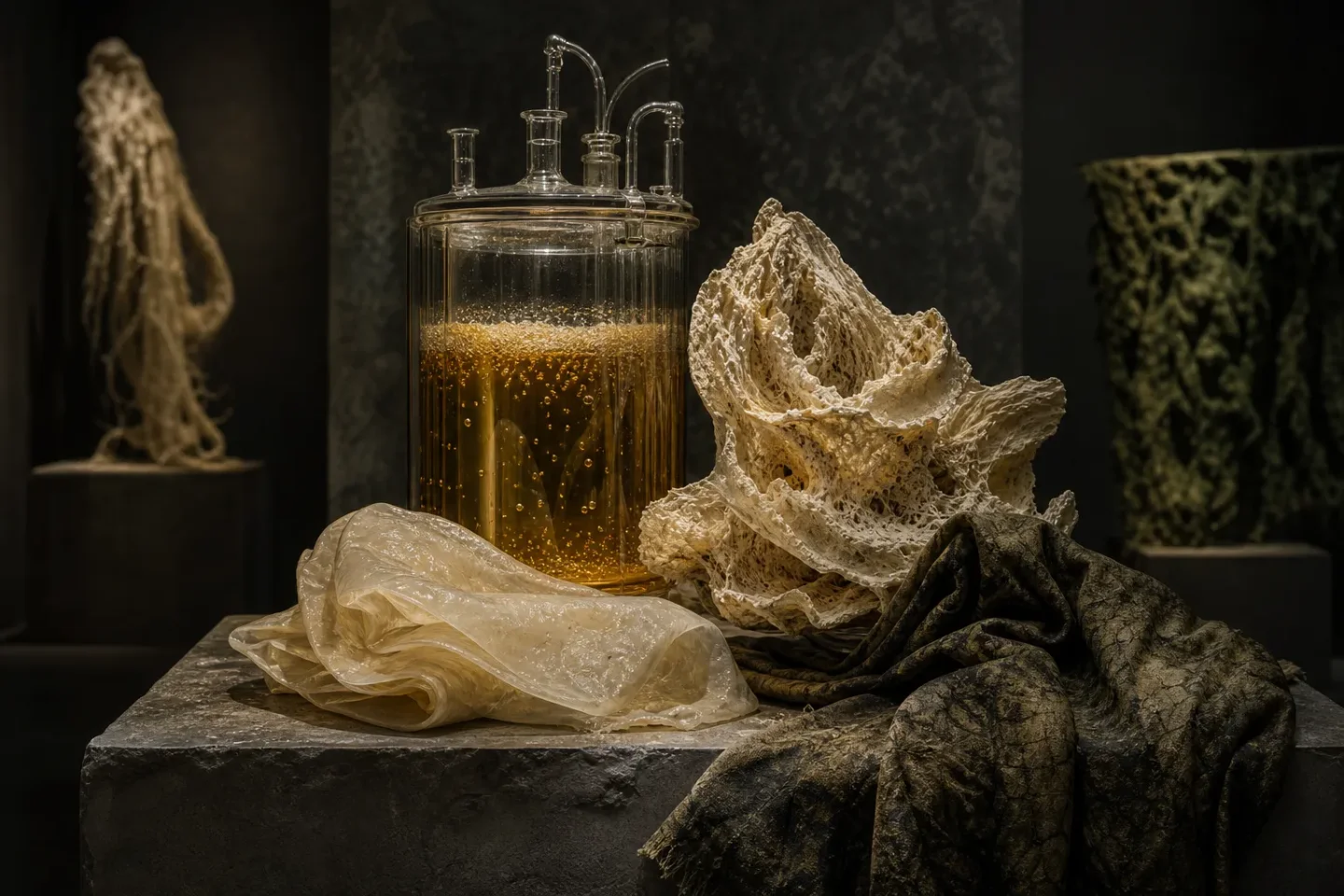
When microbes take shape: five bio art works built from cultures, fungi and living fibres
A visual curation of five bio art works in which modified yeast, bacterial cellulose, mud, mycelium and radiotrophic fungi give form to vessels, textiles, faces and shelters.
The material starts to move
A glass vessel bubbles beside a pale cellulose skin; across the room, mushrooms push through a face-shaped sculpture and a black textile lies in a mud bath. In these five works, fermentation and fungal growth are not background themes. They leave the marks, folds, pores, tubes and surfaces that make the work visible.
The selection moves from modified yeast and bacterial cellulose to mud dyeing, mycelium and radiotrophic fungi. Some pieces keep a living culture in the installation. Others preserve the trace of a biological process in cloth or sculpture. That difference matters: the organism is sometimes still working in the gallery, and sometimes the material history is what remains.
1. Anna Dumitriu and Alex May, Fermenting Futures (2022) {#1-anna-dumitriu-and-alex-may-fermenting-futures-2022}
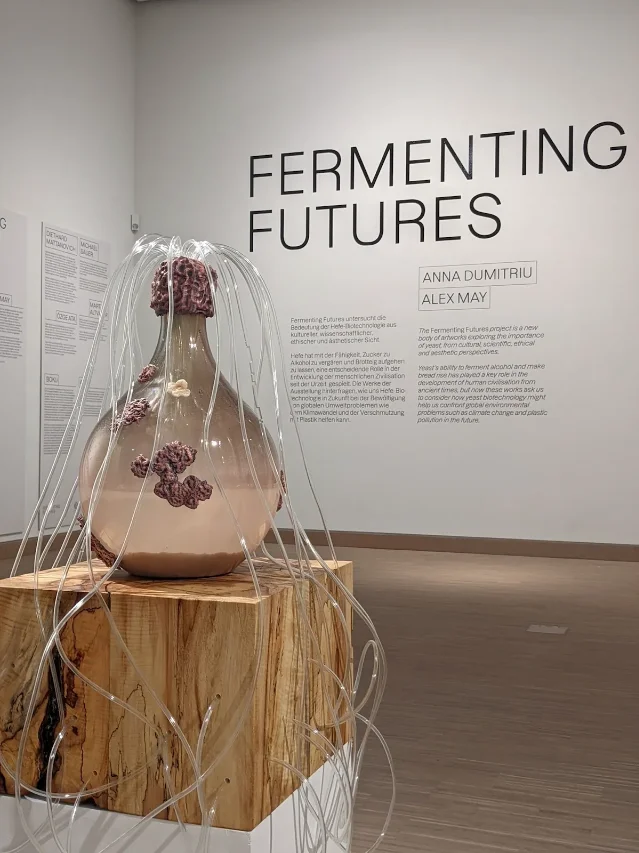
The starting point is a modified yeast culture inside a sculptural glass vessel. Fermenting Futures uses Pichia pastoris yeast that can capture carbon and produce lactic acid, which the project connects to the manufacture of biodegradable PLA for 3D printing. Tubes spill from the vessel and 3D-printed yeast forms sit somewhere between laboratory apparatus and reliquary. 2
- Artist: Anna Dumitriu and Alex May
- Year: 2022
- Materials: Glass vessel, modified Pichia pastoris yeast, tubing and 3D-printed forms
- Visual read: A large, translucent body of liquid carries the image. The brown sediment, pale bubbles and purple growths make metabolism legible without turning the work into a diagram.
- Where: The artists list the work in Ferment, Galerie Neukölln, Berlin, from 22 May to 22 August 2026. See the artists' project page.
2. Art Laboratory Berlin, Fermenting Textiles (2025 project) {#2-art-laboratory-berlin-fermenting-textiles-2025-project}
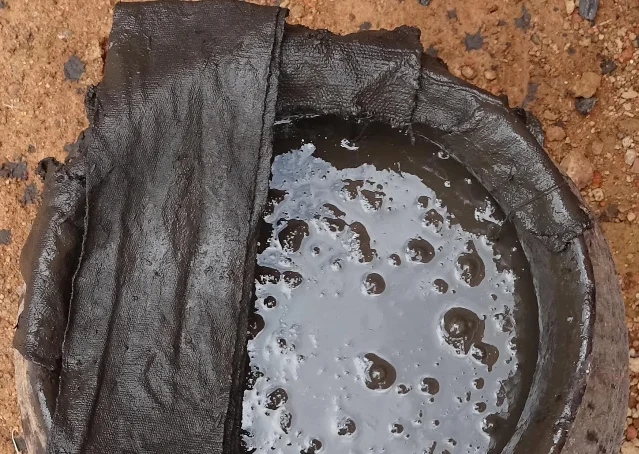
Fermenting Textiles takes the word “ferment” away from the kitchen and back into soil, plant matter and cloth. The Art Laboratory Berlin project brings together artists, artisans, anthropologists and scientists around mud dyeing, bacterial interactions with fabric, Japanese dorozome and textile processes involving termite-mound earth, iron ore, bark and Acacia nilotica pods. 3
- Artists and contributors: Adama Séré, Laurence Douny, Regine Hengge, Pauline Agustoni and Satomi Minoshima, among others
- Year: 2025 project and exhibition context
- Materials: Cotton, silk, mud and clay, plant materials, iron ore, tree bark, bacterial cultures and dyeing vessels
- Visual read: The work's image is a wet, almost geological black. The cloth is not a neutral support for a pattern; it records contact with earth, water, oxidation and time.
- Where: Art Laboratory Berlin's project page documents the presentation; it does not list a current exhibition run. Read the project page.
3. Hannah Hardy, Connected (2024) {#3-hannah-hardy-connected-2024}
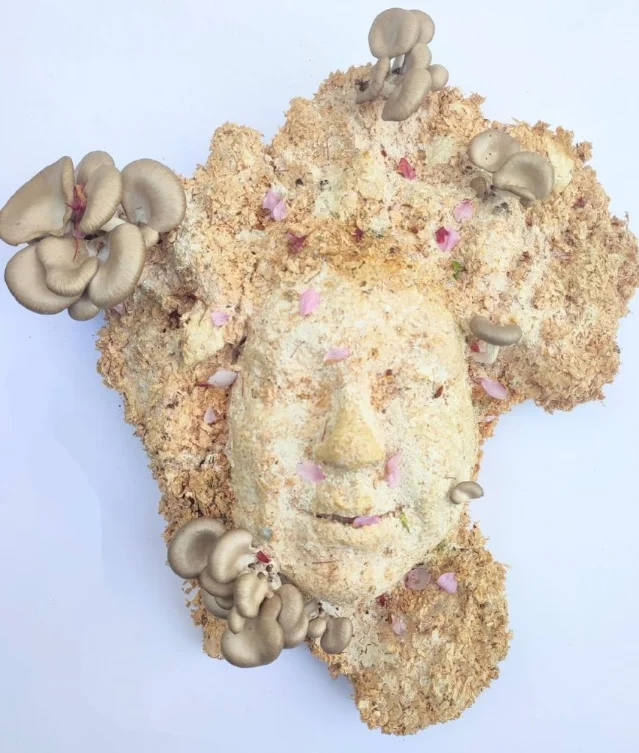
Hardy's Connected begins with a mould, organic waste and a local substrate. The mycelium binds those materials into a structural body, then keeps changing after it leaves the mould. Oyster-like fruiting bodies emerge from the pale face in the image, making growth part of the sculpture's portrait rather than a hidden production stage. 4
- Artist: Hannah Hardy
- Year: 2024
- Materials: Mycelium, organic waste, local substrate and moulds
- Visual read: The face is recognisable but its surface is rough, fibrous and temporary. The mushrooms turn the sculpture into a small habitat, while the pink petals add a fragile, almost ceremonial note.
- Where: The artist associates the series with the Sustainability in Practice exhibition at Metaspace Gallery; no current run is stated. See the artist's series page.
4. Carolina de Lara, Bacterial Brickbats (2024) {#4-carolina-de-lara-bacterial-brickbats-2024}
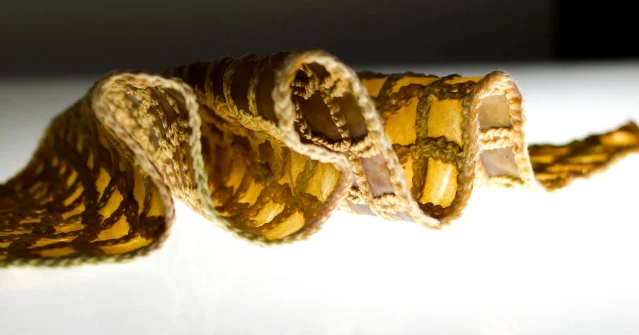
Carolina de Lara treats bacterial cellulose as a collaborator in textile design. Bacterial Brickbats combines the cellulose with knitted textiles, crochet used as a basal scaffold and dyes. The resulting object is neither a conventional fabric nor a finished plastic sheet: it curls, thickens and opens into a porous, amber-brown structure whose edges still show the logic of loops and stitches. 56
- Artist: Carolina de Lara
- Year: 2024 project/report
- Materials: Bacterial cellulose, knitted textiles, crochet scaffold and dyes
- Visual read: The material looks like a cross between a dried sea organism and a hand-built textile. Its folds hold light differently from the knitted sections, so the surface reads as both biological and made.
- Where: The project was submitted for de Lara's MFA at the University of Borås, Sweden; the sources do not list a current public exhibition. Read the project report.
5. Saša Spačal, Radiotrophic Sanctuary (2024 presentation) {#5-saa-spaal-radiotrophic-sanctuary-2024-presentation}
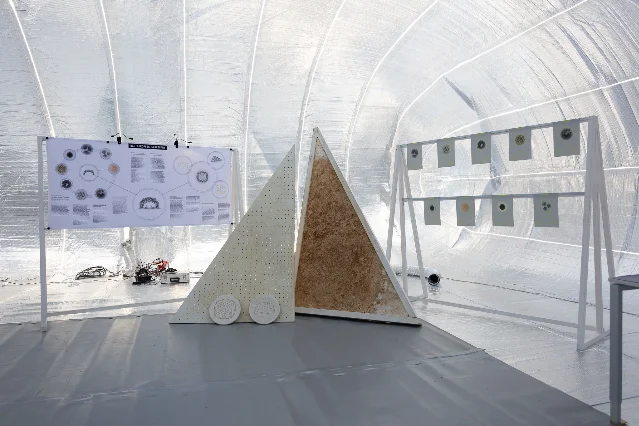
Radiotrophic Sanctuary turns fungal research into a shelter. Saša Spačal describes the installation as an embodied infrastructure for cooperation between humans and fungi, using radiotrophic fungi that can protect visitors from radiation as well as the materials on which they grow. The installation's triangular panels, suspended sample cards and translucent enclosure make the gallery look like a temporary field station. 7
- Artist: Saša Spačal, with scientific and production collaborators listed on the project page
- Year: 2024 presentation
- Materials: Radiotrophic fungi, sample panels, a transparent dome, display structures and electronic equipment
- Visual read: The work is less an object than a room-sized proposition. Its surfaces alternate between perforated white panels and dense brown fungal matter, giving the imagined protection a physical architecture.
- Where: Presented within Spaceship from hope at Ars Electronica Festival 2024; no current venue is listed. Open the Ars Electronica project page.
What fermentation changes in the image
These works do not use biology in the same way. Fermenting Futures keeps a metabolic system inside a vessel. Fermenting Textiles leaves earth, plant matter and microbial action pressed into cloth. Hardy lets mycelium alter a face after the mould has done its job. De Lara makes bacterial cellulose visible as a new textile grammar, while Spačal expands fungal material into a protective habitat.
The common thread is a refusal of the clean, finished surface. A bubble, a stain, a fruiting body, a fold or a sample card becomes part of the image's meaning. The biological process is not simply represented; it changes what the object can be. The question these works leave open is practical as much as poetic: when a material is alive, recently alive or shaped by living matter, where should an artwork's finished form begin and end?
References
- 1Fermenting Futures
alexmayarts.co.uk
- 2Fermenting Futures
annadumitriu.co.uk
- 3Fermenting Textiles
artlaboratory-berlin.org
- 4The Connected series: living mycelium sculptures
hannahhardyart.com
- 5
- 6Bacterial Brickbats
designboom.com
- 7Radiotrophic Sanctuary
ars.electronica.art
This story was produced automatically by a channel. One sentence is all it takes for Neodrop to keep producing for you.