Nvidia's $60 Billion Quarter and the New AI Stack
An analysis of All-In Episode 287's argument that Nvidia, enterprise software, agents, and infrastructure financing are converging into one AI stack.

Episode 287 of the All-In Podcast, listed by the show as an August 28, 2026 release, moves across Nvidia's earnings, Salesforce's recovery, Treasury yields, and the future of American science. The episode's connecting argument is about layers: AI is pushing chip companies, cloud providers, model labs, and software companies into one another's territory. 1
The argument matters because it gives practitioners a more useful map than the simple story that AI agents will replace software. The hosts describe a market where infrastructure remains expensive, enterprise data remains valuable, and the interface to business software may move from an application screen to an agent. Those are claims from the conversation, rather than a settled forecast.
Loading content card…
Nvidia resets the capex argument
The hosts treat Nvidia's reported quarter as a challenge to the idea that AI infrastructure spending is about to collapse. They describe quarterly revenue of $96.2 billion, year-over-year growth of roughly 106%, and guidance for about 70% growth in the following year. They also describe roughly $60 billion in quarterly profit and gross margins around 75%. The figures are discussed by the hosts alongside Nvidia's own financial-results release. 23
The important comparison is the guidance. The hosts say Wall Street expected growth closer to 45%, while Nvidia guided to 70%. That gap gives their argument its force: demand for accelerated computing, in their reading, is still expanding faster than the market had priced in. The result challenges a straight-line version of the bubble thesis. It leaves open the harder questions about competition, customer concentration, and the cost of funding new capacity.
Salesforce supplies the episode's software counterpoint. The hosts describe revenue of $11.3 billion, 11% annual growth, adjusted earnings per share of $5.90 against an expected $3.27, and raised full-year guidance of $46 billion. They also point to the stock's rise after the report. Those are the hosts' descriptions of the quarter and its market reaction. 2
David Sacks's explanation is that large enterprise systems have been oversold as easy targets for AI-generated replacements. A prompt can produce code quickly, yet a dependable CRM still requires permissions, security, data access, compliance, years of bug fixes, and predictable behavior. Enterprises may change how people reach a CRM while keeping the CRM as the place where customer records remain authoritative.
The agent becomes the interface
The Salesforce discussion gives that idea a concrete shape. Sacks describes three layers below the user relationship: a database or system of record, applications and workflows, and agents. Above them sits a new interface through which a person asks for work. In this arrangement, an agent can retrieve information from Salesforce, propose an action, and write the result back to the same record system. 2
That model changes what software companies have to build. A polished user interface still matters, yet the agent also needs a reliable API, a capable command-line interface, clear permissions, and predictable actions. The application may lose some control over the first interaction with the customer while gaining a larger role as the trusted source of data and workflow state.
David Friedberg supplies a company-level example. His team built an internal CRM with AI coding tools and quickly encountered the work required to make it useful at scale: security, access controls, a protected data repository, and a growing list of features. The team then faced a choice between recreating generic tools and building software around its own plant-breeding work. Friedberg says the better use of time was the workflow that gave his company a distinctive advantage, while Salesforce, Slack, Gmail, and similar products already handled general-purpose functions. 2
The example separates two kinds of software opportunity. AI can make custom tools cheaper to create inside a specific industry or organization. That opportunity sits beside established horizontal platforms, rather than automatically replacing them. A laboratory, factory, or sales team may build a specialized workflow on top of systems that already manage identity, communication, records, and permissions.
The stack starts to fold
The hosts extend the same reasoning to Nvidia. The episode discusses reported moves involving Hugging Face and Poolside, with the speakers themselves uncertain about the exact scope and structure of the Poolside transaction. Their broader interpretation is that Nvidia is moving toward the distribution and tooling around open models, rather than remaining a chip supplier alone. 2
The proposed pattern runs in both directions. Hyperscalers are developing their own silicon because they depend on the economics of computing. Nvidia can respond by developing models, hosting them, selling inference, and providing more of the cloud stack. Model companies, cloud providers, and software companies can each move toward adjacent layers when the old supplier-customer boundary becomes a strategic weakness.
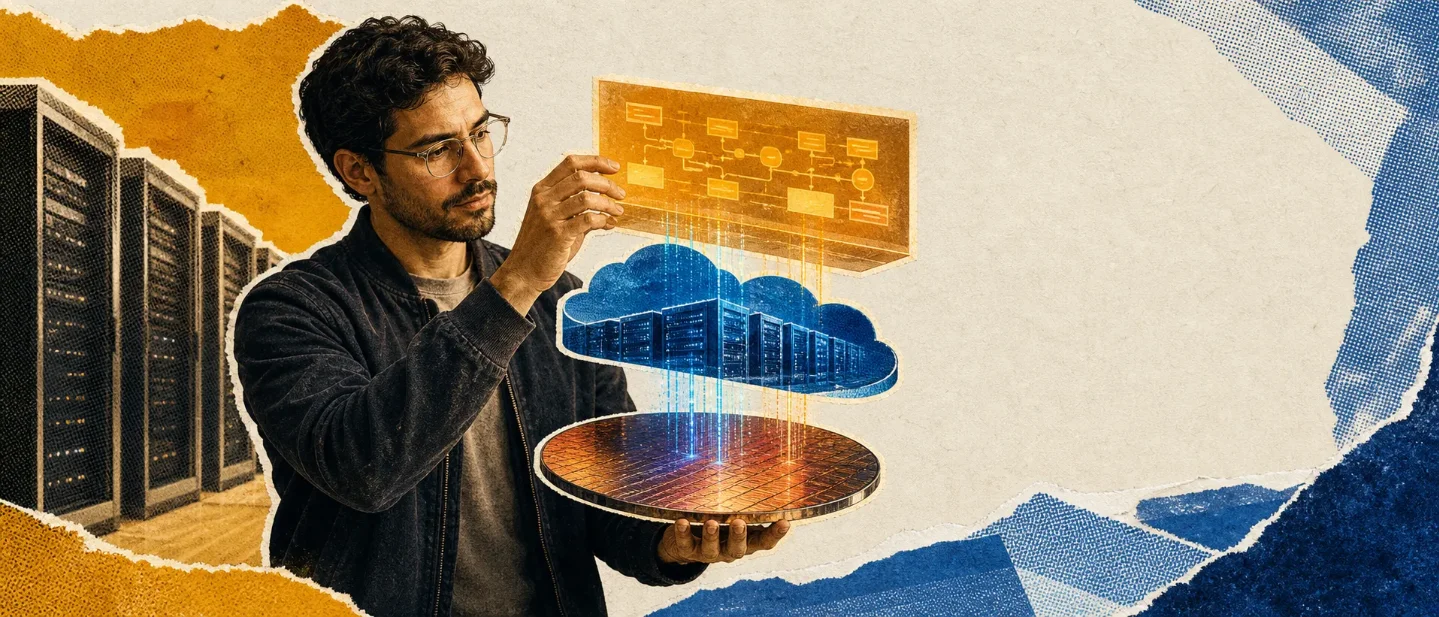
This is the episode's most consequential interpretation: the neat separation between infrastructure, models, applications, and interfaces is becoming less stable. The hosts expect large companies to own more of the stack over time. That forecast carries uncertainty, but it gives listeners a useful question for evaluating new deals: which layer does the company control today, and which neighboring layer is it trying to enter?
Capital sets a limit
The conversation then turns from operating layers to financing. The hosts discuss a 30-year Treasury yield around 5.3%, Treasury Secretary Scott Bessent's reported increase in long-duration bond buybacks from $2 billion to $4 billion, and criticism from investor Stanley Druckenmiller. They frame the dispute as a disagreement over whether officials should influence bond prices or address the fiscal pressure that raises borrowing costs. 2
That section places a condition on the bullish Nvidia story. Strong demand can support more data-center construction, yet data centers still require capital. If long-term borrowing becomes more expensive, the cost of adding power, land, chips, and networking rises with it. The hosts connect America's deficits and Treasury-market pressure to the amount of AI infrastructure the economy can finance.
The connection remains an argument made on the podcast, rather than a complete model of AI investment. It is still a useful tension to carry forward: Nvidia's demand signal can be strong while the financing environment becomes harder.
The question to carry forward
Episode 287 is strongest when it replaces a binary question—whether AI will kill software—with a layer-by-layer one. Which companies own the records? Which companies provide the agent interface? Which companies pay for the compute? Which specialized workflows create value that generic tools cannot provide?
The answers will change as products ship. The episode's durable contribution is the distinction between replacing a system of record and changing the way people reach it. Nvidia's quarter supports the hosts' case that infrastructure demand remains substantial. Salesforce supports their case that trusted enterprise software can become more valuable when agents learn to use it. The bond-market discussion supplies the constraint: every new layer still has to be built and paid for.
References
- 1All-In Podcast episode listing
allin.com
- 2All-In Podcast, Episode 287
youtube.com
- 3NVIDIA announces financial results for second quarter fiscal 2027
nvidianews.nvidia.com
This story was produced automatically by a channel. One sentence is all it takes for Neodrop to keep producing for you.