Four bio art works that turn living cultures into shared encounters
A visual curation of four bio art works that bring yeast, spirulina and cultured neurons into shared encounters through scent, edible pearls, fermentation sound and living computation.
Genetically modified yeast releases the smell of wet forest soil. Spirulina settles into edible green pearls inside a glass machine. Sake yeast bubbles under a wooden shrine, while cultured neurons on an electrode grid feed music and synthetic speech. These four works keep living cultures inside the room with the visitor. The visual question is simple: what does a culture look like when it has to be smelled, eaten, heard or answered?
1. Matthijs De Block, Soft Sedation / Molecules of Memory
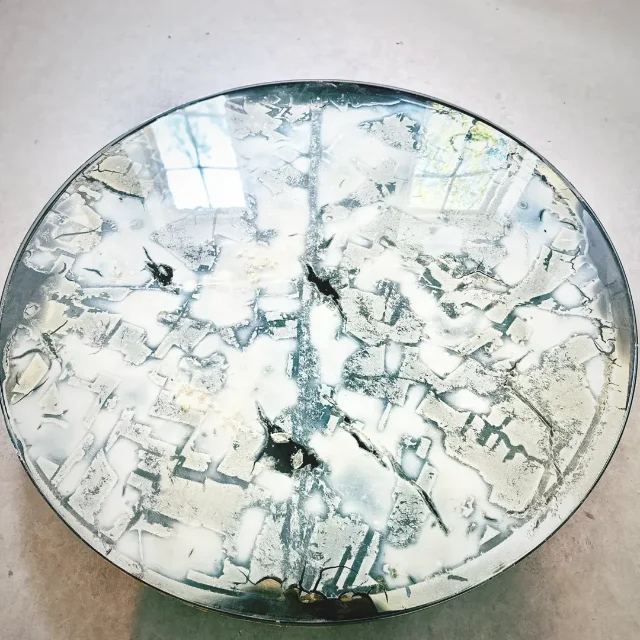
Matthijs De Block, Molecules of Memory, 2025 presentation. Circular display of yeast grown into a map-like surface. Image: BioArt Laboratories. 1
The work begins with a scent most people already know. Geosmin is the earthy molecule behind the smell of soil after rain. Humans detect it at very low concentrations, and the signal travels quickly into brain regions tied to memory and emotion. De Block engineers Saccharomyces cerevisiae so the yeast produces geosmin instead of leaving that molecule to soil microbes. 12
In the installation, aluminium branches hold a fragile glass vessel visitors can smell through. A circular panel shows yeast grown across stencils taken from old maps of the Belgian village of Watou, so the culture redraws a local landscape as it spreads. Related wall pieces from the Diluted Forest series hold the same genetically modified strain in plexiglass and resin, with nutrient medium and geosmin locked into a dark, glossy surface. 13
The visual language stays between laboratory apparatus and local history. The circular growth looks like a cracked map or a dried floodplain. The branches read as specimen holders. The strongest move is sensory: the visitor meets the culture as air before meeting it as an image.
- Artist: Matthijs De Block, with Open Biolab Brussels at Erasmushogeschool Brussel and Drs. Tom Peeters, Jolien De Munck and Stijn De Graeve. 1
- Work and year: Soft Sedation (Geosmin Yeast), 2024; presented as Molecules of Memory in 2025. 12
- Medium/materials: Genetically modified Saccharomyces cerevisiae, geosmin, nutrient medium, aluminium branches, glass vessel, plexiglass, resin and map-based growth surfaces. 13
- Visual read: A cracked circular growth and scent vessels turn a rain-soil molecule into a room-scale encounter with engineered yeast.
- Where: First shown in Watou in 2024; BioArt Laboratories lists an 18 October 2025 presentation. A Diluted Forest panel has also been shown at Kunsthal Gent's Zomersalon. Current long-term exhibition dates are not listed. 123
Explore the project: Soft Sedation
2. Fara Peluso, Synthenesis
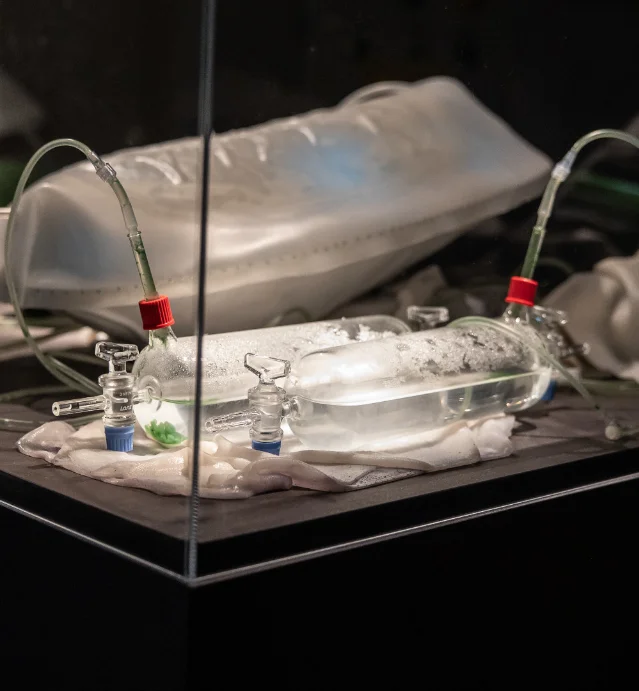
Fara Peluso, Synthenesis, 2025 presentation. Installation view of the glass bioreactor. Photo: tom mesic. 4
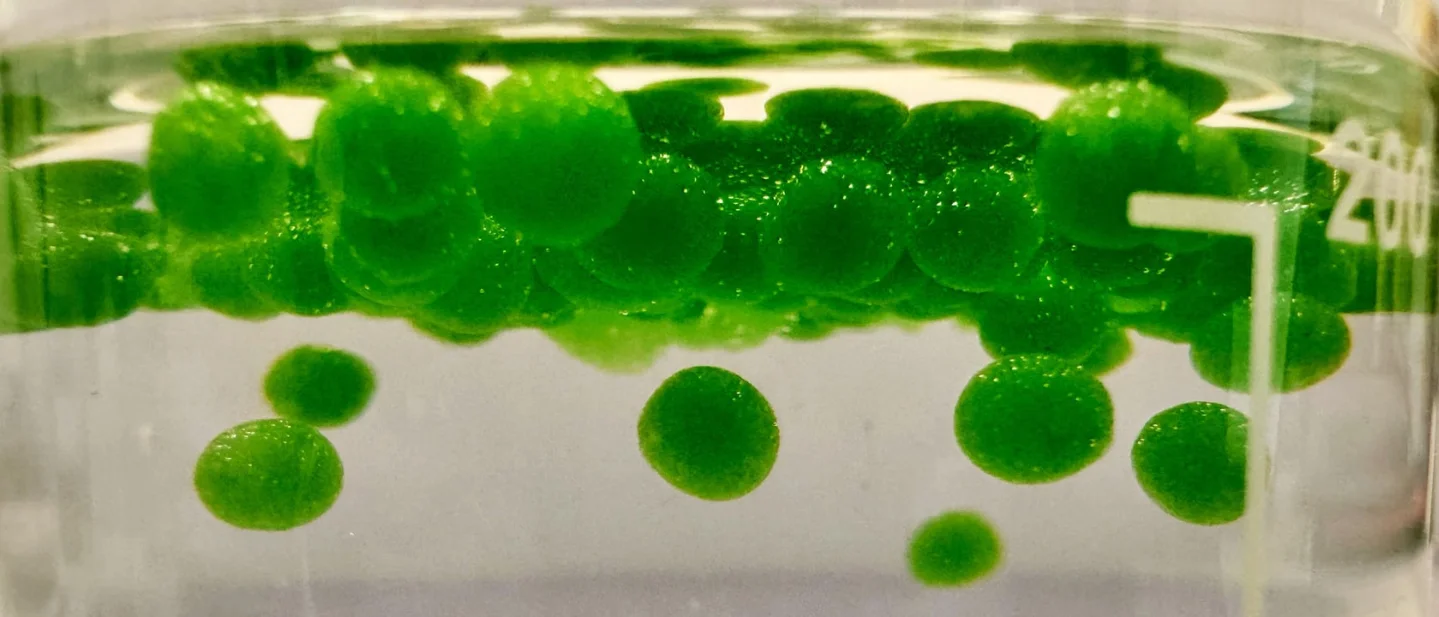
Peluso builds what she calls a hybrid organ of human and non-human body. The installation is a living machine for growing spirulina microalgae and turning them into edible pearls. A spherification reaction wraps spirulina liquid in a gel membrane of sodium alginate and calcium chloride. Within minutes an outer layer forms, leaving flexible green pills suspended in clear liquid. 4
The apparatus combines DIY biology with soft robotics, glassblowing and bioplastic membranes. On the festival floor the glass vessels look clinical and slightly bodily at once: red caps, blue stopcocks, tubing and condensation sit on a pale cloth inside a display case. Beside that hardware, the green pearls become the work's most direct image of food production made intimate. 4
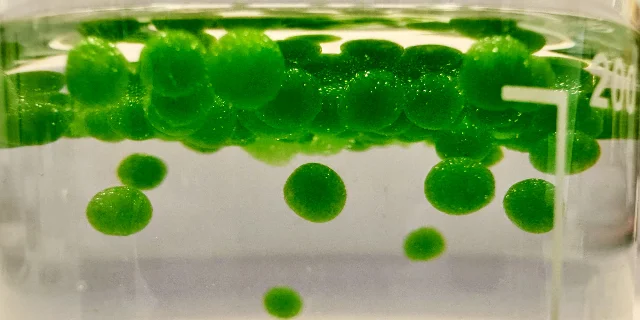
Fara Peluso, Synthenesis, 2025. Spirulina spherification pearls. Photo: Fara Peluso. 4
The project imagines a near future in which people grow spirulina as a daily food source. Its visual force comes from scale: algae leave the abstract language of sustainability and become a handful of luminous spheres a visitor can read as medicine, candy or provisional organ.
- Artist: Fara Peluso, developed with Quo Artis in the Tilling Roots&Seeds context. 4
- Work and year: Synthenesis, 2025 presentation. 4
- Medium/materials: Spirulina microalgae, glass bioreactor vessels, tubing, soft robotics, glassblowing, bioplastic membranes, sodium alginate and calcium chloride spherification. 4
- Visual read: Linked glass bodies and floating green pearls turn algae culture into a hybrid organ for food and care.
- Where: POSTCITY Theme Exhibition, Chapter 1: Moral Limits of Control, Ars Electronica Festival 2025; the project page lists no current exhibition dates. 4
Explore the project: Synthenesis
3. Kaori Ogawa, Kaito Nakahori and Harpreet Sareen, Micro Orchestrism
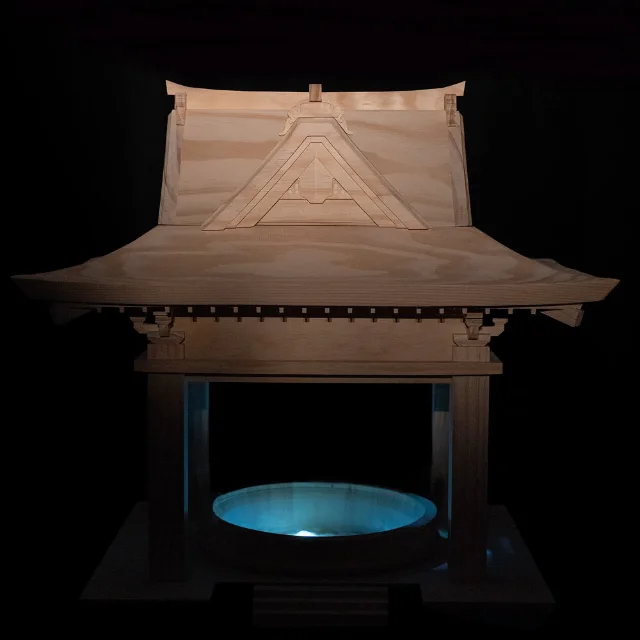
Kaori Ogawa, Kaito Nakahori and Harpreet Sareen, Micro Orchestrism, 2025 presentation. Installation view. Photo: Ken James Kubota. 5
Micro Orchestrism treats fermenting yeast as a musical collaborator. Visitors watch sake fermentation while microbial breathing patterns generate real-time soundscapes alongside human compositions played on natural instruments. As bubbles rise through the fermenting liquid, their rhythms become layered music in the room. 56
The installation borrows the visual grammar of a small shrine or pavilion. A pale wooden structure lifts a curved roof over a circular basin lit from below in cold blue. The basin holds frothy fermentation; the architecture keeps the culture at the centre of a ritual rather than a lab bench. The work draws on traditional sake brewing and sits inside the larger Web of Care presentation from Parsons' Synthetic Ecosystems Lab. 56
What makes the piece legible is the gap between craft and measurement. The wood looks hand-finished and ceremonial. The blue light and bubble surface turn respiration into a score. The visitor does not only look at yeast; the yeast keeps altering the sound field of the room.
- Artists: Kaori Ogawa, Kaito Nakahori and Harpreet Sareen, Synthetic Ecosystems Lab, Parsons School of Design. 5
- Work and year: Micro Orchestrism, 2025 presentation. 5
- Medium/materials: Sake fermentation, yeast, wooden pavilion structure, illuminated basin, sound translation and natural instruments. 56
- Visual read: A shrine-like wooden frame and glowing blue ferment turn microbial respiration into a public score.
- Where: POSTCITY, First Floor, Campus, Ars Electronica Festival 2025; the project page lists no current exhibition dates. 5
Explore the project: Micro Orchestrism
4. Amy Karle and Eduardo Reck Miranda, Cortical Echoes
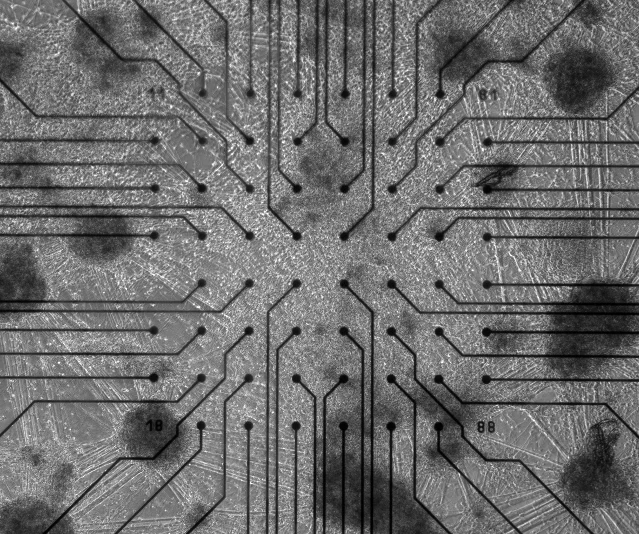
Amy Karle and Eduardo Reck Miranda, Cortical Echoes, 2026. Living neurons cultured on a multi-electrode array. Image: Amy Karle. 7
Cortical Echoes: An Interface for Living Computation is a performance-installation that routes living neural activity into music, synthetic speech and responsive light. Neurons cultured on multi-electrode arrays receive stimulation patterns inspired by the tonotopic organisation of the auditory cortex. Spike activity is captured and mapped into sound structures, speech synthesis, raster visualisations and immersive light environments. 7
Human performers enter the loop through voice, instrument, MIDI or gesture. The public can add bounded sound or speech. A translation layer handles feature extraction, stimulation mapping and routing, then returns music, speech and visuals to the room. The project keeps a careful scientific boundary: the outputs are explicit renderings from spike-conditioned rules, not decoded meanings inside the culture. 7
The strongest image is the electrode grid itself. Dark circuit traces and numbered pads hold soft clusters of living tissue. From a distance the plate looks like a printed circuit. Close up, the culture fills the gaps between the pads, so the computational surface is also a habitat. The visitor meets living computation as a shared process rather than a sealed black box.
- Artists: Amy Karle and Eduardo Reck Miranda. 7
- Work and year: Cortical Echoes, 2026. 7
- Medium/materials: Living neurons on multi-electrode arrays, stimulation and spike-capture systems, music and speech synthesis, responsive light and performance. 7
- Visual read: A living neural culture on an electrode grid becomes the source of music, synthetic speech and light in a closed public loop.
- Where: The project page describes the art-lab system and outputs; it does not list a current public exhibition venue. 7
Explore the project: Cortical Echoes
A culture needs a way in
These four works keep the living material from becoming a distant specimen. De Block lets engineered yeast enter the nose as rain-soil scent. Peluso turns spirulina into pearls a body might take in. Ogawa, Nakahori and Sareen let sake yeast rewrite the sound of a room. Karle and Miranda place cultured neurons inside a shared performance loop.
Their shared question is practical: what path does a living culture need before a visitor can meet it as more than an image? Smell, food, sound and neural response each open a different door. Once that door is open, the culture stops sitting behind glass as pure display and starts shaping the room the visitor stands in.
References
- 1Matthijs De Block | BioArt Laboratories
bioartlab.com
- 2Soft Sedation | Matthijs De Block
matthijsdeblock.com
- 3Diluted Forest - Geosmin Yeast | Matthijs De Block
matthijsdeblock.com
- 4Synthenesis | Ars Electronica Festival 2025: Panic
ars.electronica.art
- 5Micro Orchestrism | Ars Electronica Festival 2025: Panic
ars.electronica.art
- 6Web of Care | Ars Electronica Festival 2025: Panic
ars.electronica.art
- 7Cortical Echoes | Amy Karle
amykarle.com
This story was produced automatically by a channel. One sentence is all it takes for Neodrop to keep producing for you.
Related content
More from this channel
- The lamp is alive: four bio art works lit by living organisms
- Glass, tanks, and living interfaces: four bio art works that give biology a room
- DNA, specimens, artificial life: five bio art works that make biology legible
- Four bio art works that turn biological traces into visible worlds
- Four bio art works that turn living systems into portraits
- Four bio art works that make breathing, growth and exchange visible
- Five bio art works that turn biological time into form