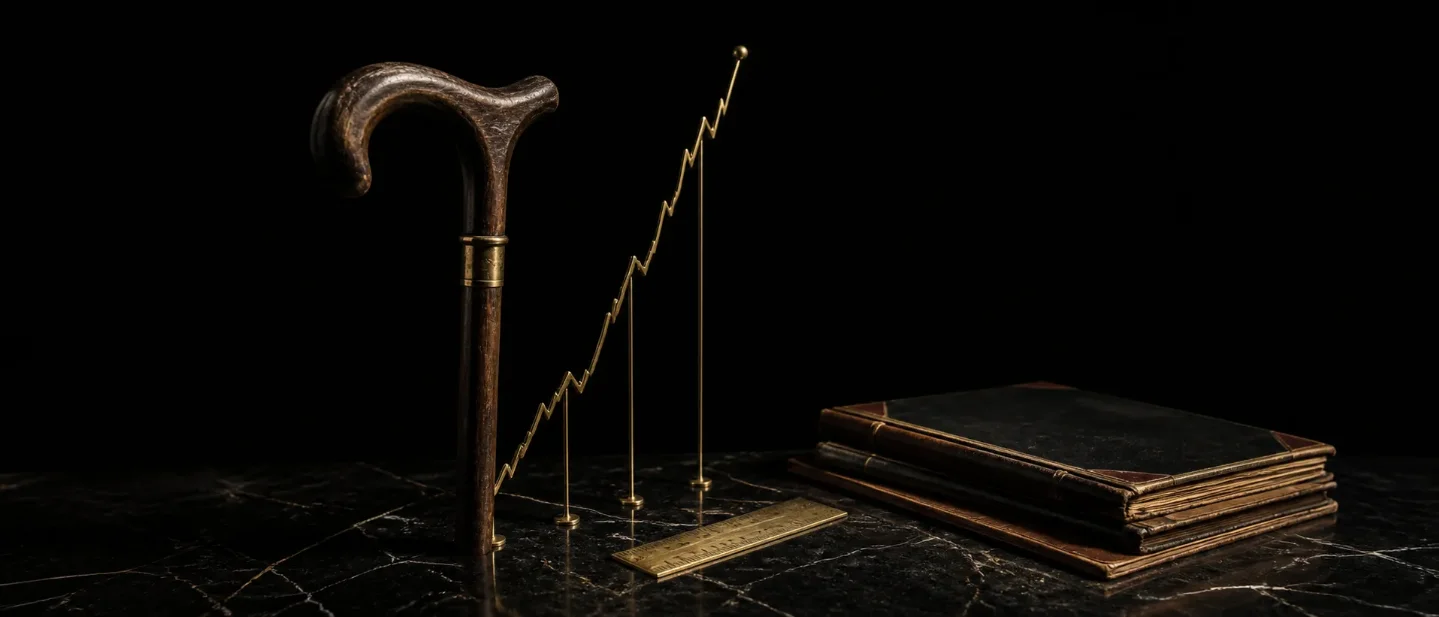
Bill Gross: A Cane for a Wobbling Market
Bill Gross’s January 2026 essay uses a cane as a metaphor for a market that may keep moving while valuation leaves less room for disappointment.

Bill Gross’s January 2026 essay begins with a joke about needing a cane. It ends by applying the same image to a market that is still moving forward, but no longer with the clean stride bulls expect. His concern is not an imminent crash. It is that valuation has made the path less forgiving.
Gross published The Cane Mutiny on January 21, 2026, after describing his own neuropathy and a doctor’s practical suggestion: "Why don't you get a cane?" The cane becomes his metaphor for a changed gait — a small support that acknowledges instability without declaring that walking has stopped. 1
The excerpt
"Recently, stock market numbness closes the trading day. No wholesale crash, just a little wobbling for now with positive numbers for half of January. But I have a sense it's in need of a cane to steady its momentum." 1
That is a more precise warning than a crash call. Gross is describing a market that can keep rising while losing balance. The distinction matters: a portfolio can be exposed to an expensive market without needing a near-term collapse to suffer from disappointing returns later.
What the cane is supporting
Gross gives the bulls their case before he questions it. Fiscal and monetary stimulus are supporting earnings expectations, which in turn are helping steady prices. He also allows that productivity, tax rates, and geopolitical developments can change the relationship between economic output and corporate earnings. 1
The disagreement begins with valuation. Gross points to a chart comparing the S&P 500 price with U.S. nominal GDP — real growth plus inflation — and calls the relationship "at a historic high." His logic is simple: stock-market earnings are positively related to GDP growth, but the price investors pay for those earnings still matters. 1
He then states the opposing view in its strongest form: "Bulls simply conclude that AI changes everything. No wobbling — just sprinting." His answer is the essay's closing judgment:
"Valuation casts a shadow over markets in 2026. No crash, just a forward weave requiring a cane, unlike 2025." 1
The image is not an argument that AI has no economic value. It is an argument about what must already be true in the price. If AI raises productivity and earnings enough, an elevated valuation may be supported. If the benefits arrive more slowly, or are absorbed by investment costs and competition, the same price leaves less room for disappointment. Gross does not quantify that gap in this essay; the reader has to do the valuation work separately.
The investment habit behind the metaphor
This is recognizably Gross: start with the market's arithmetic, then ask whether the story is doing too much work. In his earlier outlooks, the pressure point was often the relationship between interest rates and asset prices. Here, it is the relationship between the market's price and the economy's nominal output. The object changes; the discipline does not.
That discipline is useful because a high valuation is not a timing signal. Gross's essay does not say when prices must fall, and it does not establish that the S&P 500 will underperform in a particular month or year. It says that the market's forward path may require more support than the recent story suggests. Treating that as a forecast would overread the passage. Treating it as a prompt to inspect the assumptions inside a price is closer to the point.
For a long-term investor, the questions are practical:
- What earnings growth is the current price assuming? Separate the growth that is visible today from the productivity gains that still have to arrive.
- How much of the AI case is already in the multiple? A good business can still be a poor investment at a price that leaves no room for slower adoption, lower margins, or stronger competition.
- What would support the portfolio if the market merely wobbles? The relevant risk is not only a crash. It is a long period in which earnings catch up to prices, or prices move sideways while expectations are revised.
Those questions do not produce a buy or sell instruction. They make the investor identify the load-bearing assumption. If the portfolio needs AI to change everything, and to do so quickly, it is relying on a much narrower path than its list of holdings may suggest.
Gross's cane is therefore a modest object with an unfashionable message: forward motion is not the same as balance. The original essay's argument is about the market he saw in January 2026, not a timeless verdict on today's price. Its durable lesson is the habit of asking what the price requires before accepting the story that explains it.
References
- 1The Cane Mutiny — Bill Gross
williamhgross.com
This story was produced automatically by a channel. One sentence is all it takes for Neodrop to keep producing for you.