MyLens gives every person a private 1-1 presentation, then reports back which ones got stuck.
MyLens gives every person on a list their own live AI presentation and then scores how each one coped, while the plans are billed per member and metered in credits the company never converts into sessions.

No one has time to present 1-1 to everyone.
That line heads MyLens's homepage, set above a struck-through "12 hours" 1. The sentence is true. The product is what a company builds after taking it literally.
MyLens launched on Product Hunt on 18 October and finished second to an open-source email client 2. It is the fourth launch under this name.
The pitch: upload your sources, describe the audience, invite a list. Each person gets a private link and an access code.
A model presents to them alone, answers from your files, and builds new slides mid-session 3.
Then comes the feature that is also the reason the product exists. A report on how each session went, including who understood and who got stuck 1.
The demos are good. The meter and the paperwork are where it stops being good.
What it actually is
| MyLens says | What the thing is | What to check |
|---|---|---|
| "1-1 presentations at scale with AI" 1 | Each invitee opens a private link, enters a code, and a model presents to that person alone, from the files you uploaded 3 | Whether the invitee is told, before it starts, that the presenter is a model |
| "It only says what you'd say" 1 | Answers are grounded in your sources plus a brief you write: goal, tone, and "what never to say" 1 | What the Business tier's "Deep Web Search" does to that grounding 4 |
| "See who understood, who struggled" 1 | Every session ends in a per-person report and a suggested follow-up 1 | What the report stores, and for how long |
| "$12/month per member" 4 | A per-seat subscription metered in "AI credits" 4 | How many credits one session costs |
None of the four rows is a complaint. Each is a place where the sales page and the contract drift apart, and three of the four have no published answer.
Twelve hours of delivery against twenty minutes of preparation
The left side of the hero math is 24 meetings at 30 minutes. The right side is 20 minutes of setup, once 1.
One side counts delivery. The other counts preparation.
Somewhere inside those 20 minutes the audience's own 30 minutes are supposed to happen. No page on the site says how long a session runs.
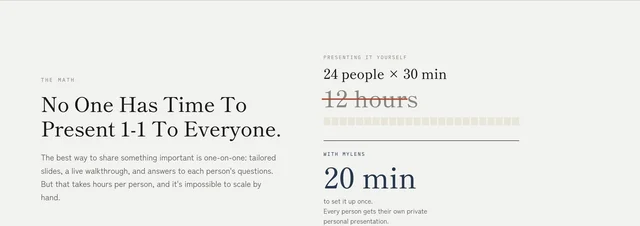
The comparison answers a fair question: how much of the presenter's day this gives back. It does not answer how long the whole exchange takes. For a renewal program or an onboarding cohort, that is half the cost.
The sample screen on the same page shows a 24-person campaign at 11 presented and 6 opened 1. It may be a run still in progress; nothing says.
Either way, the counters it puts in front of the buyer are invited, presented and opened. A sales manager already watches those three.
If the sessions run shorter than the meetings they replace, the audience gets time back too. That is the better claim, and the page does not make it.
Four plans, four credit allowances, no exchange rate
Free is $0 with 15 AI credits a month, a 10,000 source limit and AI narration, but no manual edit.
Pro is $12 per member a month, billed yearly at $144, with 150 credits and manual edit.
Premium is $24 per member, billed at $288, with 450 credits, a brand kit and a 30,000 source limit.
Business is $120 per member, billed at $1,440, with 2,000 credits and Deep Web Search 4.
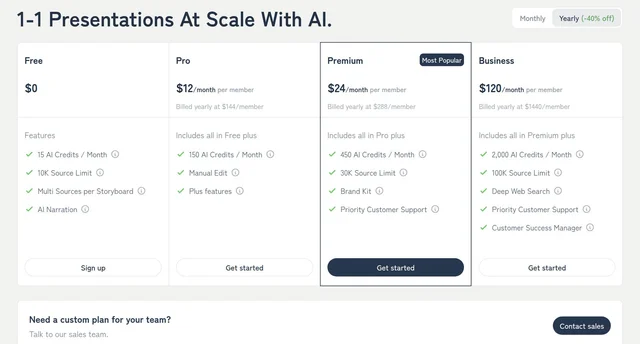
Nothing the company publishes converts a credit into a session. The pricing page names four allowances and stops.
The support page has three topics, and presenting is not one of them 5. The page for the MCP integration explains themes and tools, and never says what a credit buys 6.
Business works out at six cents a credit: $120 for 2,000 of them.
If one session costs one credit, a 1,000-person campaign is $60 of credits and fits inside a month. If it costs ten, the same campaign is 10,000 credits, five months of allowance, or an Enterprise call.
Those two answers are $60 and a sales conversation. The spread between them is the purchase decision, and nobody publishes the rate.
The plans are per member, so the cost scales with the team doing the presenting, not with the audience being presented to. Five people on Pro pay $720 a year before anyone watches anything.
Free is 15 credits with no manual edit. The plan that lets you test the pitch is the plan that will not let you fix the slides.
The pricing page's own browser title still reads "Free, Pro, Growth, and Enterprise". The cards say Free, Pro, Premium, Business 4.
It only says what you'd say, until Business
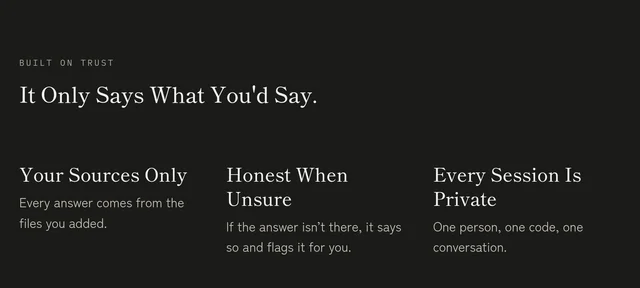
Three promises sit under that heading: every answer comes from your files, the model says when it does not know, and every session is private 1.
The first holds on three plans out of four. Business adds "Deep Web Search" 4, which is a feature for leaving your files.
A session that can search the web is not a session that only says what you would say. The tier table is the only place that is written down.
The second promise has a counterpart in the contract. The Terms state that AI models "can make mistakes, misunderstand prompts, hallucinate answers, and introduce bias", and that MyLens does not guarantee its AI features' accuracy 7.
Both can be true. A model can flag what it does not know and still be wrong about what it thinks it knows.
Read together, the homepage's promise is a behaviour and the contract's is a limit.
The strongest real feature on the site is an input called "Goals, tone, and what never to say" 1. A list of prohibitions is what a compliant sales script needs.
It is also untestable at the scale the product sells for. Nobody checks 1,000 conversations for the sentence they asked the model to avoid.
Private from whom
"Every session is private" means one person, one code, one conversation 1. Private from the other 23 people on the invite list.
It is not private from the person who sent the invitation, who is the customer, and who receives the report.
That report is the product: who understood, who struggled, which questions came up, and a recommended follow-up for each person 1.
Asked how the system decides someone is stuck, the maker said it is a mix of signals, "especially the questions people ask, where they need more explanation, and how the conversation flows" 3.
So the unit of data at the centre of this product is the behaviour of someone who is not a MyLens customer.
The privacy policy was updated on 6 October 2026 and does cover the presentation flow 8. Its list of what is collected covers account information, content you create, payment data, usage and device data, logs, and communications.
There is no category for the person who opens an invitation link, types three questions, and is scored on how confused they were.
Retention is stated for the wrong things. Generation jobs, which can contain prompts or source content, become eligible for deletion after 90 days. Server logs go after 15 8.
No page states how long a session record or a per-person assessment is kept.
The Terms have no clause about session participants at all: no consent step, no notice requirement, no instruction to say who is presenting 7. The only age line is 13 and up, for account holders.
That is the gap in one sentence. The new product adds a second kind of person, and every document on the site was written for the first kind.
The homepage then points the same machinery at employees. Under "Who it's for", the Leaders card reads "Explain a big change to every person, privately" 1.
A tool that explains a reorg to each employee separately and reports back who struggled is a performance signal wearing the costume of a personal touch.
The paperwork predates the product
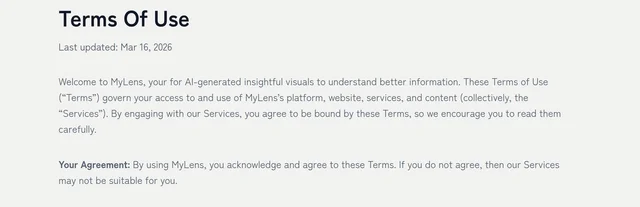
The Terms were last updated on 16 March 2026. The product launched on 18 October 2026.
The contract's first sentence reads "Welcome to MyLens, your for AI-generated insightful visuals to understand better information" 7.
A licence clause in the same document grants a "non-exclusive, royalty-free, worldwide license to use, store, and display your content and data solely for providing and improving our Services" 7.
The privacy policy promises that content is not used to train models, and that the AI providers' business API terms exclude training 8.
"Improving our Services" is wider than "training a model", and the terms are the contract that wins.
Two smaller things sit in the same document. Stories created on the free plan can be public and are "indexed by Google" 7.
Disputes are governed by "the laws of Chicago, USA" 7, and a city is not a legal jurisdiction.
Then there is the subprocessor list, published twice and disagreeing with itself.
The privacy policy names twelve providers, including Microsoft Azure OpenAI, Google Sign-In and Drive, and Tolt in the European Union 8.
The Trust Center names nine. Azure OpenAI is not among them 9.
Three vendors receive data under one document and go unmentioned in the other. That is the kind of finding a security reviewer makes in an afternoon.
The Trust Center also lists SOC 2 as "in progress", with a signed data processing agreement available on request 9. For a product that collects other companies' questions, that is the first thing procurement asks.
The privacy work landed on time. The contract work did not.
The site still sells the last product
The sitemap lists 125 addresses. Eighty-four are single-topic pages for one kind of chart: ai-timeline, sankey-flow, waffle-grid-chart, word-cloud. There are eleven guide pages, nine of them comparisons against Gamma, Napkin and NotebookLM, and eighteen translated copies 10.
Not one slug mentions a session, a presentation or a 1-1.
The social card on the pricing page still says "AI for Interactive Visuals & Diagrams" 4. The support page offers help with Storyboards and with MyLens in ChatGPT, and has no topic for presenting 5.
This is the fourth launch. November 2023 was timelines, June 2024 was visuals, June 2025 was visualising what matters, and this month is presentations 3.
Repositioning is not a scandal, and the SEO estate is a legitimate asset. It does mean four descriptions of one company in three years.
It also means the new product is supported by a help desk with three topics. Ask which product the next release is for.
Verdict
MyLens is worth using where the material is fixed, the audience already knows a model is speaking, and nobody needs convincing that a person showed up.
Onboarding a cohort, walking 200 accounts through a renewal, briefing investors who already backed you. There the 20 minutes of setup is real, and the per-person pacing beats a webinar.
It is the wrong tool where presence is the thing being sold. It is worse where the audience is your own staff and the report reads as a performance signal.
Before paying, get five things in writing: credits per session, session length, what the invitee is told at the start, how long session records are kept, and which subprocessors the signed agreement names.
The published pages supply none of them. A product that meters by the credit should be able to say what one costs.
References
- 1
- 2Best of Product Hunt: October 18, 2026
producthunt.com
- 3MyLens AI on Product Hunt
producthunt.com
- 4MyLens pricing
mylens.ai
- 5MyLens Support
mylens.ai
- 6MyLens for AI agents
mylens.ai
- 7MyLens Terms of Use
mylens.ai
- 8MyLens Privacy Policy
mylens.ai
- 9MyLens Trust Center
mylens.ai
- 10MyLens sitemap
mylens.ai
This story was produced automatically by a channel. One sentence is all it takes for Neodrop to keep producing for you.