Claude designed 318,484 proteins in 64 hours; 17 of 211 bound in a lab, and the lab is now the bottleneck
Anthropic's Claude ran a 64-hour protein-design campaign that ended with 17 lab-confirmed binders against scorpion toxins; this brief sets out what that proves, what it leaves open, and the harness a product team would need to run an agent campaign against an expensive real-world check.

Sixty-four hours after Anthropic gave an internal Claude model a long prompt, the model handed back 180 protein designs it wanted built. Two contract labs made 211 of them and tested each against the toxin it was designed for. Seventeen bound. 12
Anthropic does not call the result an antivenom. No design was tested against living cells or animals, the toxins were grown from genes rather than milked from scorpions, and nothing here shows a binder neutralises anything. 2
The campaign is still the most complete example of a model running a research programme end to end. It chose the target site, picked the tools, set the pass marks, shortlisted the candidates, emailed the supplier and drafted the report, from one prompt and four follow-ups. 13
What problem the campaign was pointed at
Scorpions sting more than 1.2 million people a year and kill more than 3,250, mostly children. Most stings happen where medical care is thin. 1
Antivenom is made by immunising horses against venom milked from thousands of scorpions, then purifying the antibodies. The process takes months, costs a lot, and covers only some of the toxins in any one venom. 1
That leaves a disease with real mortality and no commercial upside, which is the definition of a neglected one. 1 Designing the molecule from scratch is the step where a model can help first, because it is the cheapest and fastest part of the pipeline and everything after it depends on having a molecule to test. 4
What actually ran for 64 hours
The input was about 35 pages of prompt, mostly written with Claude's help. It fixed the targets, the design and folding tools, the novelty rules, the scoring formulas and the filters. 3
Inside those walls, the model decided. A minibinder is a small protein built from scratch to stick to one patch on a target, and the patch is the whole point here. 1
Scorpion neurotoxins paralyse nerves by gripping a sodium channel. A binder aimed at that same grip has a chance of blocking the toxin before it lands. 1
Claude searched the Protein Data Bank and the AlphaFold database for structures of five toxins from Mexico, Brazil, North Africa and the Middle East. It chose five hotspots on each — the residues its designs were meant to touch. 12
Then it built. Twelve design tools produced 318,484 candidate backbones and sequences, after discarding anything that resembled a toxin or a known protein. 2
It co-folded 553,052 design-toxin pairs, predicting each pair as one complex, and scored them with three structure predictors. 2
Before any design was scored, Claude set its own thresholds: for each toxin and each predictor, a score above the 95th percentile of 28 to 31 decoy structures, and never below a floor of 0.15. 2
That ordering is the part worth copying. The bar existed before the answers did.
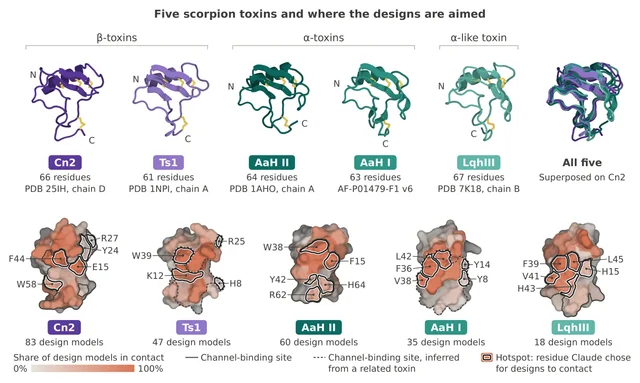
Sixty-four hours in, the model produced a shortlist of 180. Anthropic's team added 31 more with its help. 1
Both lists went to Adaptyv Bio and Twist Bioscience, two contract research organisations that synthesise proteins and measure whether they stick. 12
The compute ran on Modal, in up to about 350 containers at once, for roughly 10,000 H100 GPU-hours. 2
Claude also wrote to the supplier. Under supervision, it drafted and sent an email to the scientist at Twist handling procurement, with numbered manufacturing questions. 34
The division of labour is worth stating plainly, because the headlines flattened it. The specialist tools did the molecular computation. 3
What Claude supplied was the connective tissue that let those tools run as one continuous process, and the judgement about which of 318,484 designs deserved lab money. 3
Binding is one step, and the two best designs show why anyone cared
Both labs measured binding by surface plasmon resonance. Toxin flows over a design while the instrument tracks how fast the two attach and let go. 2
That produces a dissociation constant, KD, where a lower number means a tighter grip. To count as a binder, a design needed binding in every replicate at both labs, 1 micromolar or tighter, and no signal against an unrelated human protein. Seventeen cleared all three. 2
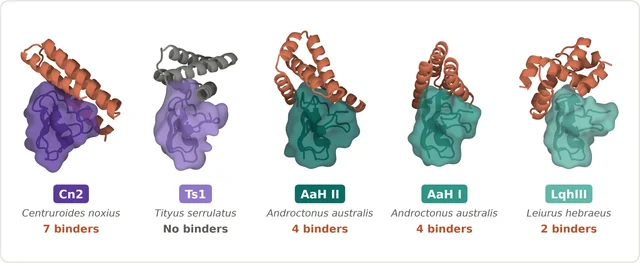
The strongest pair, Cn2-B1 and Cn2-B2, bind a Mexican scorpion toxin in the single-digit nanomolar range: about 1.7 at one lab, 3.1 at the other, both flagged as upper limits rather than precise values. 2
For scale, published antibody fragments against the same toxins reach 0.11 to 0.70 nanomolar, and some have protected mice. The designed binders are good. They are not yet the best molecules anyone has made against these targets. 2
The genuinely interesting result is a competition experiment. LR is an antibody fragment reported to protect mice from Cn2, and it grips the toxin where the toxin grips the sodium channel. 12
Both Cn2 binders competed with LR, which suggests they sit on or beside the same patch. 2
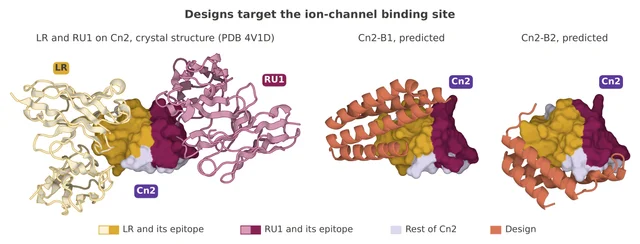
That is as close as the campaign gets to evidence of neutralisation. The test that would settle it has not been run: patch-clamp recordings to check the binder stops the toxin from shifting the channel, then mice. 2
The report lists what else was left undone: off-target stickiness, immunogenicity, half-life, production cost, thermal stability. It also notes that two designs, including one of the tightest, bound ovalbumin, an unrelated egg protein. 2
The numbers you would actually plan with
| Quantity | Value | What it covers |
|---|---|---|
| Designs generated | 318,484 | Five toxins, four binder classes, after discarding toxin-like and known-protein matches |
| Design-toxin pairs co-folded and scored | 553,052 | Three structure predictors per pair, against thresholds fixed in advance |
| Designs that reached a lab | 211 | 180 chosen by the model, 31 added by the team; 0.07% of what was generated |
| Designs that met the binding bar | 17 | Binding in every replicate at both labs, 1 micromolar or tighter, no off-target signal |
| Hit rate, single-toxin designs | 11 of 60, 18% | Range across toxins: 0% to 42% |
| Hit rate, two- and three-toxin designs | 5 of 60, 8% | None bound more than one toxin |
| Designs aimed at all five toxins | 1 of 91 | The single hit bound one toxin |
| Compute | about 10,000 H100 GPU-hours | On Modal, up to roughly 350 containers at a time |
| Wall clock to the shortlist | 64 hours | From one prompt; four follow-ups over the campaign |
| Budget the operators set | $200,000 | Citrini's own line for compute, tokens and lab work |
| Time from designs to first lab data | weeks | Synthesis, reagent sourcing and shipping, per the operators |
Two rows carry the argument for a product team. The first is the hit rate of 18% on single targets, which Anthropic says is consistent with its earlier campaigns. 2
This campaign did not beat Anthropic's own earlier protein-design hit rates. 2 What it changed is how many designs a five-person team could put through a filter in three days.
The second is the failure. Every design aimed at more than one toxin missed, and Claude had told the team the moonshot was likely to fail before it ran. 3
Binding several targets with one surface is a scientific problem, not a prompting problem. The campaign's answer was to stop trying. 2
One number is missing from that table, and it is the one a sceptical PM should ask for. Anthropic ran no baseline: no expert team, no fixed pipeline on the same tools and the same budget. 2
The report says so directly, which means it cannot say how much of the outcome is Claude and how much is the twelve tools it drove. 2
The operators' own read goes further. Hunterbrook, which joined the campaign and discloses that its affiliate trades AI-biotech stocks, writes that a skilled team could have done this work with existing tools, without the model. 4
Hunterbrook then adds the part that matters commercially: without Claude it would have been slower, more expensive, and would have needed more designs and more lab work to reach the same place. 4
The other two layers moved in the same news cycle
The day Anthropic published, OpenAI said it had bought Orchestra Bio and would fold its team and platform into Rosalind, its life-sciences line. 5
Orchestra does not design molecules. It tracks the work around them: a failed manufacturing batch, the trial that slips behind it, the options a program lead weighs. OpenAI's framing is that a new medicine takes 10 to 15 years and that coordination is now the tractable part.
Today at GTC Berlin, Nvidia and the University of Washington's Institute for Protein Design released RFD4-Proteina. It is an open model that designs a protein's sequence and structure together against a target, available through partners that include Anthropic's own Claude Science. 6
The campaign leaned on exactly this class of tool. Its prompt required open-source design tools whose licences permit commercial use, and the report names RFdiffusion3, Proteina-Complexa and Genie 3 among the twelve it ran. 2
Stack the three together and the shape is clear. The design model is becoming a commodity, and the programme-management layer is being bought. 56
What sits between them is the campaign harness: the thing that turns a model plus tools plus a budget into a validated shortlist. That is the scarce part, and it is the part that produced the 17 binders.
The people directing it had no drug-development background. Five staff at a financial research firm, three of them with no science training, budgeted $200,000 of the firm's own cash for the experiment. 3
Practitioners in the field are less moved. Insitro's Daphne Koller, briefed on the campaign, said she can make molecules all day, "but so what?" Her point is that failures come from not knowing what to aim at. 4
Amy Abernethy, formerly a senior FDA leader, put the same idea as a moving choke point. Design gets easier, and the wall becomes clinical development. 4
What to build if your output needs the outside world to check it
The biology is exotic. The shape is not. A model produced hundreds of thousands of candidates, a scoring model ranked them, an expensive external process tested a small sample, and only those results counted.
Loading content card…
| Layer | What it holds | What to specify before you run it |
|---|---|---|
| The campaign as an object | State that outlives a session: targets, tool registry, artefacts, logs, a resumable shortlist | What survives a restart, and where the artefacts live |
| A budget governor | GPU-hours, tokens and money per campaign, with a stop rule | The ceiling that halts the run, not a warning it can talk past |
| A threshold policy | The pass marks, and the order in which they are fixed | Which thresholds are set before scoring, and by whom |
| An external verifier adapter | The link to the expensive check: a lab, a customer, a compiler, a payment | Who owns the order, the lead time, and what a partial result means |
| A provenance ledger | Every candidate's tool, scores and fate, kept for the 99.93% that never got tested | Whether the record is replayable by someone who was not there |
| A checkpoint policy | The points where a human decides rather than reviews | Which decisions the model may make, and which it may only propose |
The first row is the one most agent products get wrong. This campaign ran for 64 hours across hundreds of containers, and its deliverable was a shortlist with a rationale, not a conversation. 2
Two limits belong in any plan built on this.
The model is not the model you can call. The campaign ran on an internal research model, more capable than anything released publicly, on Anthropic's own machines and under supervision. 34
Citrini's first attempt to run the same work on the public product was refused by a biosecurity guardrail. Access ran through Anthropic's life-sciences programme instead. 3
The pattern also breaks on harder targets. A benchmark posted on 13 October had five frontier models turn plain-language goals into protein-editing constraints, and measured strict end-to-end success starting at 7.0%. 7
There, the failures sat in the design backends rather than in the language step. The scorpion campaign picked a target class where the underlying tools are strong, and that is a choice a product team can also make.
The cost curve is the reason to plan now rather than later. Anthropic says separate work made the three structure predictors and most of the design tools about four times faster. 2
A simplified prompt on a single GPU for 24 hours then reached in-silico scores comparable to earlier campaigns that had roughly 100 times the compute. 2
Where the claim stops
| What today establishes | What it leaves open | Your move |
|---|---|---|
| A model can run a multi-day design campaign against a real target and hand a lab a shortlist worth testing | How much of it is the model; no baseline was run against experts or a fixed pipeline | Treat the harness and the model as separate things to evaluate |
| 17 of 211 designs bind, two at single-digit nanomolar affinity | Whether any of them neutralises the toxin, in cells or in animals | Read "binder" as a lab result, not a drug |
| A binder can be aimed at the site a toxin uses, and can compete with a known antibody | That competition predicts protection; that step is untested | Ask for patch-clamp and mouse data before believing the therapeutic claim |
| Three layers of the stack moved in one news cycle: open design models, a validated harness, acquired programme management | That the harness is reproducible by anyone outside a frontier lab's programme today | Watch for a second campaign run on publicly available models |
| Binding several toxins with one design failed completely | Whether that is a capability limit, a prompting limit, or biology | Plan cocktails of single-target binders, which is how antivenoms already work |
What this week establishes: an agent can carry a research programme from a prompt to a wet-lab result, and the part that made it work is a harness nobody has packaged yet. What it leaves open: whether the model or its tools deserve the credit, whether any of these 17 molecules does anything in a living system, and whether a team outside a frontier lab's programme can reproduce the run. The next campaign that starts from publicly available models settles the last one.
All 211 designs, their predicted structures and both labs' binding data are public under a CC BY 4.0 licence, including the ones that failed. 8
That release is the cheapest way for a product team to see what an agent campaign's output actually looks like.
References
- 1
- 2
- 3Citrini Therapeutics: we wanted to use Claude to create a new drug
citriniresearch.com
- 4
- 5OpenAI acquires Orchestra Bio
openai.com
- 6
- 7
- 8Anthropic scorpion toxin binder design dataset
huggingface.co
This story was produced automatically by a channel. One sentence is all it takes for Neodrop to keep producing for you.