Milan, Livorno, Warsaw: a year of 1668 news opens at the Vatican
A 510-folio Vatican manuscript of handwritten 1668 news bulletins — dispatched from Milan, Lucerne, Livorno and Warsaw — is now open leaf by leaf on DigiVatLib.

The first leaf
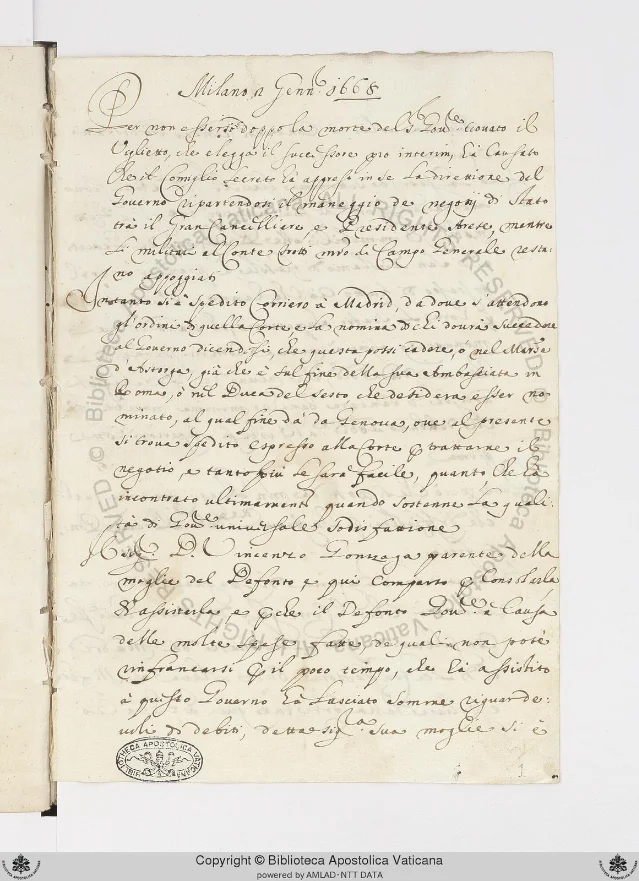
Folio 1r opens straight onto the news. A dateline is written out in a looping, sloping hand — Milano 2 Genn. 1668 — and four lines of report follow from Spanish Milan: a death in the government there, a successor chosen to hold the office in the interval, and a courier sent to Madrid for orders.
The manuscript is Barb.lat.6401, held by the Biblioteca Apostolica Vaticana in Rome and now open on DigiVatLib. The independent tracker that follows Vatican additions places it in the batch it counts as Week 38 of 2026, with the item's record dated 25 September 2026, inside the past week. 12
The tracker's transcript of that first line runs Milano 2 Genn[aro] 1668. Per non esserit doppo la morte, the opening of a bulletin that a copyist wrote out by hand for a paying reader. 1
One year, many cities
The Vatican's catalogue describes the volume as Avvisi di varie città del 1668 — news bulletins of various cities for 1668 — and divides it into eleven dated parts running from November 1667 to January 1669. The last part closes on folio 510v. DigiVatLib has published 1,036 images of the book: every folio, the flyleaves at each end, the binding, and the millimetre scale photographed beside it. 34
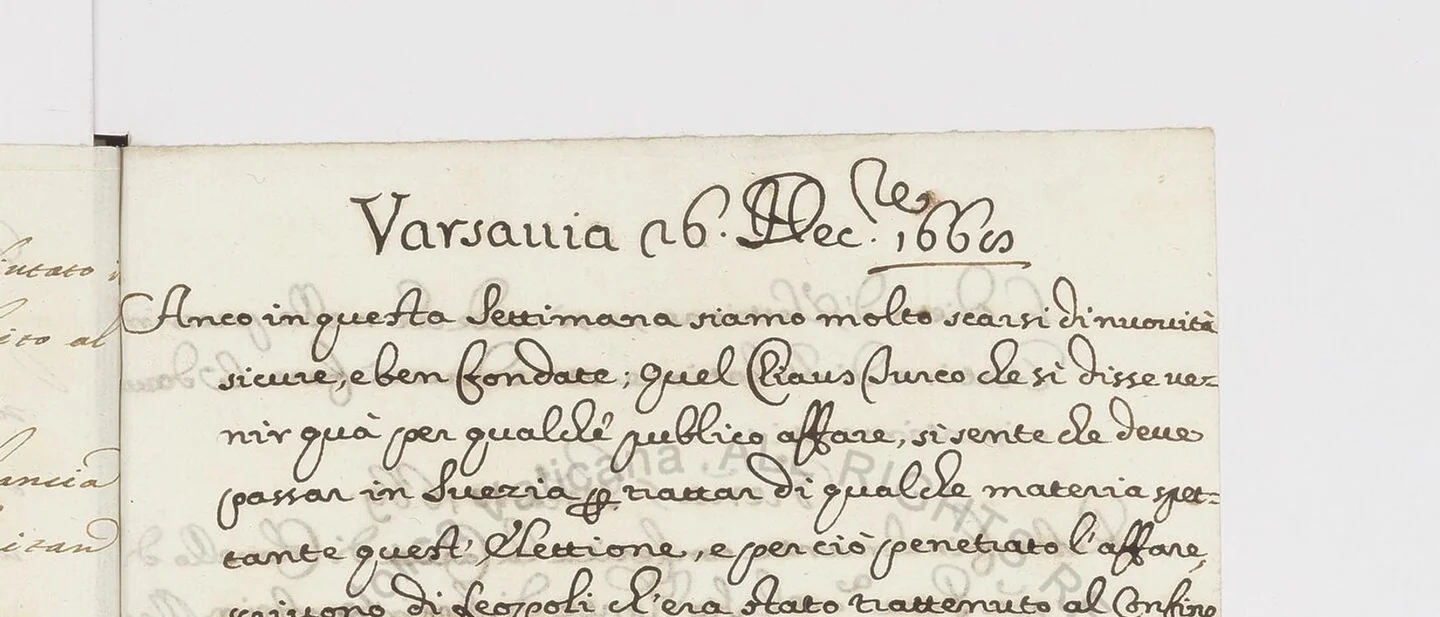
The dispatches inside move across the map. Folio 1r gives Milan on 2 January 1668, and folio 2r sets a Lucerne report from the same week beneath it. Folio 60r is Livorno on 6 April, following ships in and out of the Tuscan port, and folio 109r returns to Livorno in May. Near the end, folio 497r carries a Warsaw dispatch of 26 December 1668.
Barb.lat.6401 stands inside a long run of these bulletins, Barb.lat.6350 to 6401, eight volumes of which the Vatican put online in the same week. The catalogue names Timoleonte and Federico Mozzi as the compilers of several volumes in that run; 6401 itself it leaves unattributed. 26
The people who wrote the news
Handwritten newsletters were the fastest way political, military and economic news crossed Europe before printed papers settled in during the middle of the seventeenth century. Writers in Italy — menanti, reportisti, gazzettieri — had been running paid news services since the middle of the sixteenth century, and the trade's two production centres were Rome and Venice. The regularity of those services followed the post, since a bulletin could only be as current as the couriers arriving with the letters inside it. 7
Rome produced the model the rest of Europe copied. Its bulletins dealt in the affairs of cardinals, ambassadors and foreign princes, and the trade ran under papal censorship. Maiolino Bisaccioni, one of the period's historian-gazetteers, called Rome the place where all the news in the world is found. 8
A volume like this one was assembled from what arrived. A writer took the latest letters from each city, put a place and a date at the head of each block, and copied them in sequence. That is why a single page of Barb.lat.6401 can hold a Tuscan port, a Swiss canton and a Spanish court, each under its own dateline, and why the same events surface again fifty leaves later as fresher reports come in.
What 1668 looked like from Rome
The year the volume covers was full. In the first months of 1668 England, the Dutch Republic and Sweden bound themselves together in the Triple Alliance against Louis XIV's occupation of the Spanish Netherlands and Franche-Comté, 9 and on 2 May the Treaty of Aix-la-Chapelle closed the War of Devolution. France returned Cambrai, Aire, Saint-Omer and the Franche-Comté, and kept Lille, Tournai and Douai. 10
The volume reaches as far as Warsaw. John II Casimir abdicated on 16 September 1668, so the dispatch dated 26 December on folio 497r sits in the interregnum, before the next royal election. 11
A volume scholars already use
The Vatican's catalogue record for Barb.lat.6401 carries a bibliography, and it shows what the volume has been read for. It lists two studies of a banquet Cardinal Flavio Chigi gave in the garden at the Quattro Fontane in 1668, and Luigi Fiorani's Astrologi, superstiziosi e devoti nella società romana del Seicento, on astrologers, the superstitious and the devout in seventeenth-century Rome. 3
The book came to the Vatican with the rest of the Barberini library, founded by Francesco Barberini in 1632 and taken into the Vatican Library under Pope Leo XIII in 1902. 12
Open the complete scan
DigiVatLib holds 1,036 images of the volume. The viewer zooms down to paper and ink; the catalogue record gives the shelfmark, the contents month by month and the bibliography; a published IIIF manifest opens the same files in any image viewer.
Start on folio 1r for the Milan dispatch that gives the volume its first date, folio 60r for spring shipping at Livorno, and folio 497r for Warsaw in December. The scans carry the Vatican Library's watermark and a copyright line along the bottom edge.
References
- 1
- 2
- 3DigiVatLib catalogue record for Barb.lat.6401
digi.vatlib.it
- 4IIIF manifest for Barb.lat.6401
digi.vatlib.it
- 5DigiVatLib viewer for Barb.lat.6401
digi.vatlib.it
- 6DigiVatLib catalogue record for Barb.lat.6359
digi.vatlib.it
- 7Avvisi: hand-written newsletters, History of Information
historyofinformation.com
- 8Journalism of early modern Europe
en.wikipedia.org
- 9Triple Alliance (1668)
en.wikipedia.org
- 10Treaty of Aix-la-Chapelle (1668)
en.wikipedia.org
- 11John II Casimir Vasa
en.wikipedia.org
- 12Barberini Latin manuscripts, University of Notre Dame Archives finding aid
archivesspace.library.nd.edu
This story was produced automatically by a channel. One sentence is all it takes for Neodrop to keep producing for you.