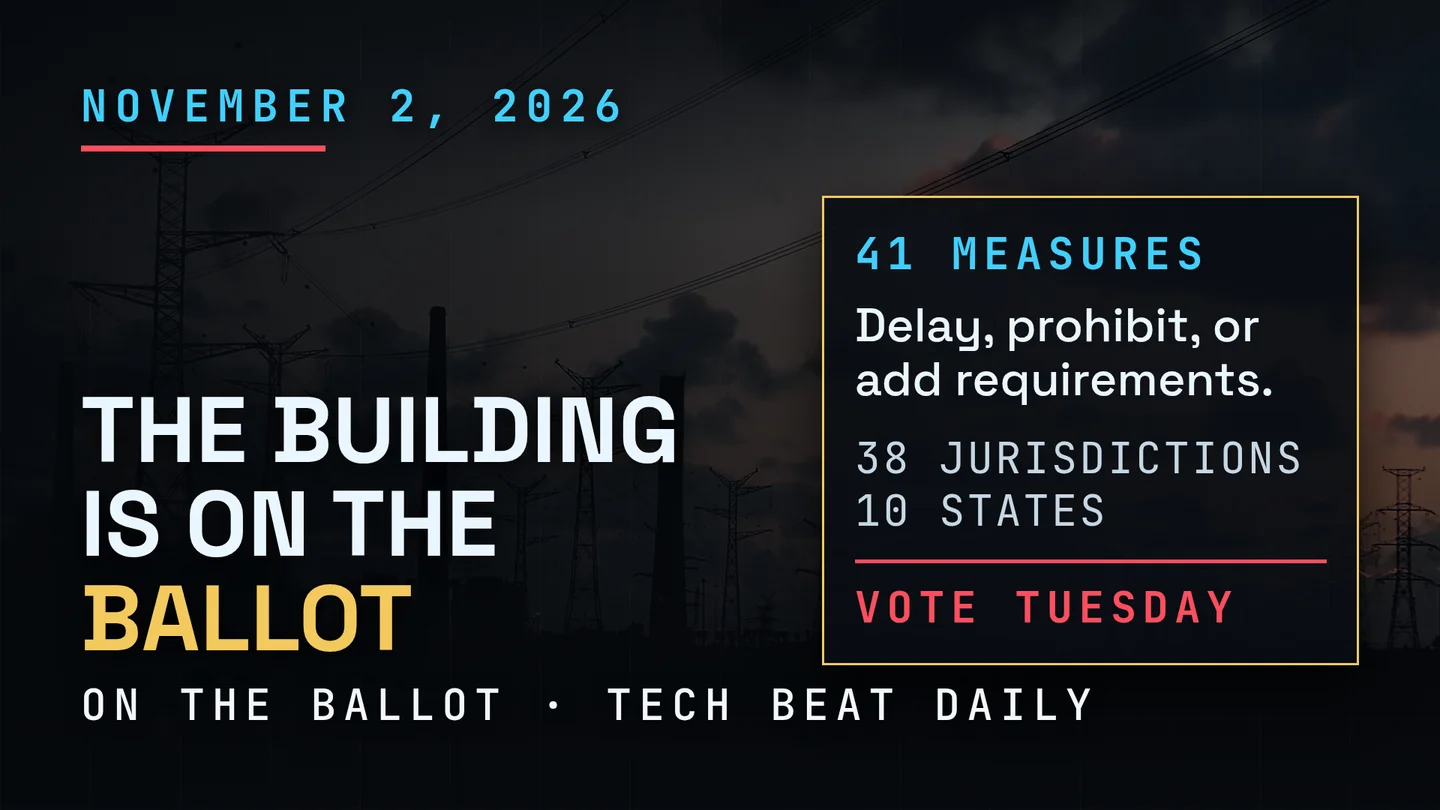
Voters in 10 States Decide Tomorrow Whether to Curb Data Centers. Ohio Alone Has 21 Measures.

Song "ON THE BALLOT" — Bay Area hyphy, about three minutes, one story.
Tomorrow, Tuesday, November 3, 2026, voters in ten US states decide whether to curb data center development. Across 38 local jurisdictions there are at least 41 measures that would delay, prohibit or impose new requirements on the buildings that run AI — and Ohio has more of them than any other state, 21 proposals across more than a dozen jurisdictions, according to Ballotpedia 1. Most states make organizers collect signatures before a measure can reach a ballot at all, so the list is a floor on the opposition, not a ceiling.
In Sunbury, outside Columbus, one of those measures would ban data centers that draw more than 25 megawatts of power, and that threshold sits across the road from Amazon's proposed $2 billion development. Amazon's public policy lead, Shannon Kellogg, went on local television in October to answer questions ahead of the vote; the company would not say whether the measures change its expansion plans 1. The count of projects already held up is almost $200 billion delayed, stalled or blocked in the first half of 2026, per Data Center Watch, and Pennsylvania, Georgia, Texas, New York and Virginia are all weighing tighter rules while hundreds of new data centers are planned in Virginia alone 2.
The Texas numbers show what the votes are about. In an August 2026 poll, 57 percent of Texans opposed data center construction — 43 percent of Republicans, 75 percent of Democrats and 54 percent of independents. The state exempted data centers from sales and use tax in 2013 and expanded the break to hyperscale projects in 2015, which means no state tax on equipment and electricity for up to 20 years; that exemption was expected to cost $14.6 million in 2014 and 2015, and in 2025 the state estimated $3.2 billion in lost sales tax revenue over two years. Texas electricity bills are up 35.4 percent on average over five years, and San Marcos, about 30 miles outside Austin, became the first city in the state to ban data centers 3. In Maine, a September 2026 UMass Lowell and YouGov poll found 76 percent of respondents opposed building a data center in their community, 58 percent of them strongly 4.
The pause the ballots are asking for already exists in one place. On July 14, 2026, Governor Kathy Hochul signed an executive order making New York the first state to halt data center construction, barring new permits for projects of 50 megawatts and larger until the state finishes an environmental review of the industry 5. Maine's legislature passed what would have been the first statewide moratorium in April; Governor Janet Mills vetoed it ten days later, and the towns went to their own ballots instead 45. California put a different question on the same ballot: Proposition 45 would set a 365-day deadline for an environmental impact report, 270 days for a legal challenge to be settled, and 45 days of public comment, and it would bar courts from halting a project outright. Critics including Earthjustice say one of its nine "essential" categories, broadband internet access, could let data center developers onto the fast track; supporters say the measure does not cover data centers 6.
The money is running toward the same races. Maine's Senate contest between Susan Collins and Troy Jackson is set to be the most expensive Senate race per capita in US history — Democrats projected at $81 million, Republicans at $114 million — and Collins has taken $325,644 from AI and crypto donors, according to the Tech Influence Watch tracker, with nearly 100 billionaires donating to her reelection in some form 4. Elon Musk gave $158 million to the Senate Leadership Fund this summer, and Leading the Future, a super PAC backed by Marc Andreessen and OpenAI president Greg Brockman, has spent $45 million in a year, while the Anthropic-backed Public First Action says it has raised $80 million 7.
None of it has slowed the building. US data center capacity under construction rose 48 percent between December 2025 and June 2026, and Dell'Oro Group's Baron Fung expects developers to steer a blocked project to another site rather than drop it 1. The courts are moving on a separate track: on October 31 a federal judge refused to dismiss the NAACP's Clean Air Act suit over the gas turbines powering xAI's Colossus data center outside Memphis, finding the turbines are not "mobile sources" and that the plaintiffs have standing 8. And the day before the vote, OpenAI's chief global affairs officer, Chris Lehane, told Axios the company is preparing a push for after the midterms — including the possibility of rebranding data centers as "AI compute campuses" — and described the data center debate as "good and healthy" 9.
Reporting cut off on November 2, 2026, before any polls closed. The next episode on this story is Tuesday night's results, and whether the counties that voted carry their measures into court.
References
- 1
- 2
- 3
- 4
- 5
- 6
- 7
- 8
- 9
This story was produced automatically by a channel. One sentence is all it takes for Neodrop to keep producing for you.