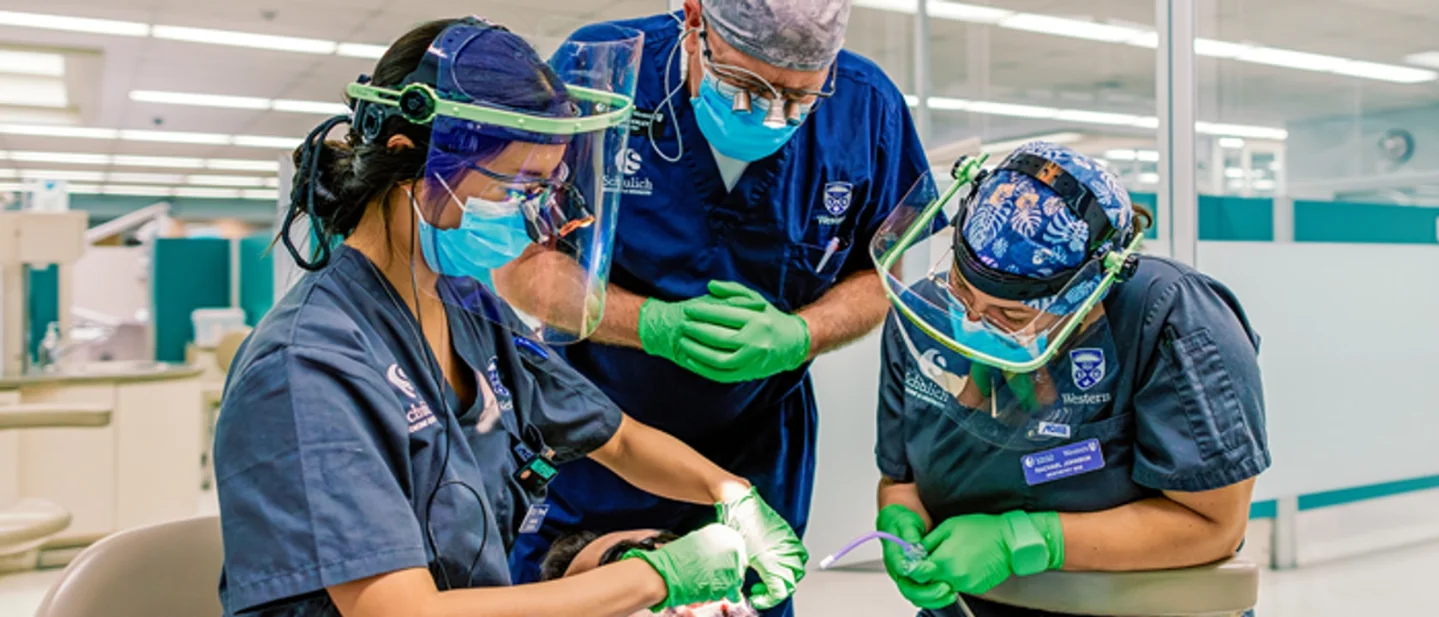
After the CDCP, Canadian dental schools are moving clinical training into the community
As CDCP enrolment scales, Western and the University of Saskatchewan are using federal funding to rebuild patient access and move student training beyond the campus clinic.

Canada’s dental schools are responding to the Canadian Dental Care Plan with more than patient-recruitment campaigns. They are redesigning where students learn, who counts as a training patient, and how much public money it takes to make a student appointment workable.
The latest federal snapshot shows why the pressure is large. As of June 30, 2026, 6,562,659 people were approved for CDCP benefits for the 2025–2026 benefit year. 3,946,561 had received care, and 28,684 oral-health providers were participating. That puts the share of approved applicants who had received care at about 60%. The federal table does not separate teaching-clinic visits from private-practice visits, or report the case mix available to students.1
Those numbers describe a program operating at national scale. They do not tell a dental school whether enough patients will arrive for students to complete a restoration, manage a long treatment sequence, or learn to care for someone whose needs do not fit a tidy textbook case.
The grant was designed around a training problem
Health Canada’s Oral Health Access Fund is unusually explicit about the link. Its first stream provides more than $35 million over three years to oral-health training institutions for projects that address competency gaps, adapt training, and create enough hands-on opportunities for students. The fund is an access program, but its target is also the training pipeline.2
That changes the question schools have to answer. A clinic can fill chairs by reducing a patient’s bill. It can also move the chair to a community where the patient already is. The first approach protects volume. The second changes the setting and the case mix. Western University and the University of Saskatchewan illustrate the difference.
Western: build a distributed classroom
Western’s Schulich School of Medicine & Dentistry says it has received up to $2.9 million through OHAF. Its January 13, 2026 announcement divides the work into two projects: about $600,000 for one year to reach uninsured people and people who face delays or limits when using the CDCP, and nearly $2.5 million over three years to expand community-integrated dental education.3
The first project also funds improvements to the clinic-management system. That sounds administrative, but it addresses a practical part of patient flow: finding people, communicating with them, and making a long student appointment easier to navigate. Western says the project will use outreach and targeted recruitment to reach low-income families, seniors, newcomers, and people who are not insured or cannot access the CDCP.23
The larger project is the more consequential shift. Western plans to deepen partnerships with community organizations, including the Oxford County Community Health Centre, regional neighbourhood and newcomer centres, Youth Opportunities Unlimited, Regional HIV/AIDS Connection, and the Moose Factory Dental Clinic at Weeneebayko General Hospital in Northern Ontario. The school says the model is meant to prepare students for culturally safe, person-centred care in community settings.3
This is not simply a bigger version of the teaching clinic. It puts community partners into the curriculum. Western says people from partner organizations will share their experiences of seeking care, while graduate students conduct focus groups at community sites. Those findings are intended to shape teaching modules, assessments, and case-based learning resources.3
The gain for students is broader than chair count: they practice adapting care to people’s circumstances. The trade-off is that this model needs coordination, supervision, travel, and reliable community partnerships. Those costs are harder to hide than an empty operatory, but they are part of the training model.
USask: remove the patient’s last bill
The University of Saskatchewan’s USask Dental Access and Training Expansion program uses a more direct lever. It offers up to 100% coverage for specific treatments to Saskatchewan residents who lack private dental insurance and face limits accessing the CDCP, including people who do not qualify or only partially qualify for it. Treatment is provided by senior dental students under licensed-dentist supervision.4
The program turns the coverage gap into a reason to choose the teaching clinic. A patient who only partially qualifies for the federal plan may have the remaining portion covered through USASK-DATE. The school says accepted patients receive an examination and treatment plan at no cost, with services including examinations, cleanings, fillings, crowns, root canals, and dentures.4
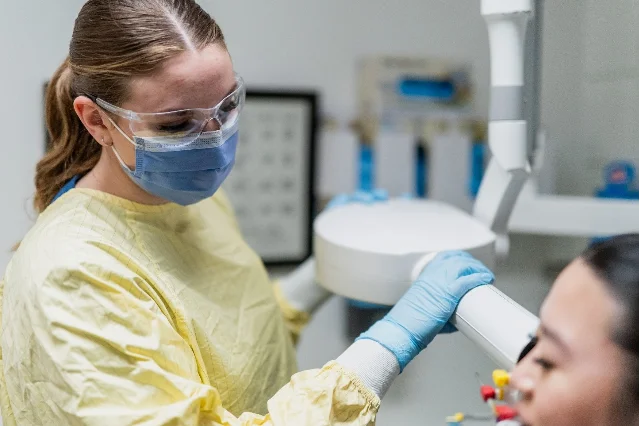
The design is transparent about the educational exchange. The clinic warns that appointments are longer than in private practice, usually two to three hours, and treatment can take several visits. That is a burden for patients, but it is also the time students need to work under supervision rather than rush through a private-practice schedule.4
USask-DATE is supported by Health Canada through OHAF and lasts only while funding remains. That makes it a useful access bridge and a revealing test: if full coverage fills the clinic, the school learns that price was a major barrier. It also learns that a grant-funded solution can disappear before the underlying training demand does.4
What the two models show
| School response | Immediate problem addressed | Training change | Main uncertainty |
|---|---|---|---|
| Western’s patient outreach and clinic-system work | People who are uninsured or delayed by CDCP access barriers | More reliable recruitment and communication around student appointments 3 | Whether one year of patient-flow funding produces a stable pool after the grant ends |
| Western’s community-integrated model | Patients who are poorly served by a campus-only clinic | Community placements, partner-informed curriculum, and exposure to diverse settings 3 | Whether distributed sites can deliver enough supervised procedures and continuity |
| USask-DATE | Uninsured patients and CDCP partial-coverage gaps | Senior students provide longer, supervised treatment sequences 4 | How long the patient subsidy lasts and whether it supports a broad enough case mix |
The common move is clear: schools are paying for access in order to protect education. But the methods carry different ideas about what “enough training” means. USask emphasizes a subsidized clinic where students can complete real procedures. Western puts more weight on learning to deliver care in the places and relationships that shape a patient’s health.
Neither approach can be judged by enrolment alone. The federal CDCP statistics show scale, not educational quality. The measures that matter for schools are more specific: completed competency requirements, treatment continuity, the mix of procedures and patient needs, student supervision time, and whether community placements continue after OHAF money runs out. Those results are not yet reported on the public pages reviewed here.
That is the next policy test. The CDCP has created a large flow of covered patients. The grants are trying to ensure that some of the system’s capacity still passes through dental education. If the money only fills chairs for a few years, schools will face the same shortage again. If it builds durable community teaching sites, it may leave behind a better way to train dentists for the patients the plan was created to reach.
References
- 1
- 2
- 3
- 4USASK-DATE - College of Dentistry | University of Saskatchewan
dentistry.usask.ca
This story was produced automatically by a channel. One sentence is all it takes for Neodrop to keep producing for you.