
Neodrop
Create
FeedDiscoverMy ChannelsAuto-publishJoin Our Discord
Neodrop
A smoother experience in the app
FeedDiscoverCreateMy Channels
DB Weekly: eleven psqlodbc CVEs, and three ways to move analytics off the primary
2026-11-09

DB Weekly: eleven psqlodbc CVEs, and three ways to move analytics off the primary

Eleven CVEs in the ODBC driver under every BI tool, Weaviate's authorization fixes, Milvus 3.0.5's release notes at last, and measured latency for moving Postgres analytics into ClickHouse or a DuckDB replica.

Database Selection Brief for Backend Engineers
Database Selection Brief for Backend Engineers@NeoDrop Official
The week from November 2, 2026 at 10:00 a.m. through November 9, 2026 at 10:00 a.m. (UTC-08:00) had one security release that reaches further than its version number suggests, and three separate designs for taking analytical read work off the transactional primary.
psqlodbc, the driver between PostgreSQL and every BI tool, spreadsheet and ETL job written against it, published eleven CVEs on November 2, six of them at CVSS 7.0 or higher. The bugs live on the client machine, in the process that holds the reporting credentials. 1
The three designs arrived from a conference talk, a vendor test and a storage platform. A ClickHouse engineer described a replication path that reads PostgreSQL's physical write-ahead log and lands rows in ClickHouse in under a second, plus an extension that pushes analytical queries the other way. Percona ran a store's reports against a MySQL replica whose tables are stored in DuckDB. Separately, PlanetScale and Neon each published numbers on which tier of storage their Postgres reads from.
Oracle shipped no MySQL release this week. MongoDB shipped no server release. PostgreSQL shipped no core or supported-branch release, and PostgreSQL 14's final release is scheduled for November 12.

Decision table

Date (UTC-08:00)ComponentVerified changeTrade-off or gateImmediate check
Oct 30Milvus 3.0.5Release notes for the October 30 tag published this week: an unencrypted delete part written to the WAL on CMEK collections during upsert, ST_DWITHIN under-returning on RTREE segments, a Storage V3 write stall after a coordinator restart 2A metric label change restarts an existing series at zero; a QueryCoord timeout key was renamedIf CMEK is enabled, schedule the upgrade; then update the internal_storage_op_count dashboard
Nov 2psqlodbc 18.00.0006Eleven CVEs, six at 7.0 or above, among them buffer overflows in large-object reads, row caches, the ODBC escape parser and binding functions, plus SQL injection through SQLSpecialColumns 3The injection affects 17.00.0006 through 18.00.0005; the rest affect every earlier releaseFind every host and desktop running the PostgreSQL ODBC driver, including Excel, Access and BI gateways
Nov 2CMU talk: WalShadow and pg_clickhouseA replication path that reads PostgreSQL's physical WAL and reaches sub-second latency in ClickHouse, plus an extension that pushes analytical queries back 4Source and shadow must share a PostgreSQL major version; sequence state and unplanned promotion are outside the contractRead the limitations list before comparing this against a logical-decoding CDC tool
Nov 3Percona Search for MongoDB 1.70.5-3Fork of MongoDB's mongot reaches general availability, with local and hosted embedding providers 5At 90% disk usage mongot stops applying change events and serves stale results while mongod reports healthyAlert on mongot disk usage today, whatever engine you run
Nov 3Weaviate 1.38.24Vector search distances kept aligned when an object is missing from the store; backported to 1.37 and 1.38 6The misalignment predates 1.40, so earlier results may have been wrongRe-run one known-answer nearest-neighbour query against a collection with deletions
Nov 3PlanetScale: local NVMe against EBSDefault EBS volumes cap at 3,000 IOPS; local NVMe on the same platform reaches about 300,000 7Local disks buy latency and IOPS at the cost of a cross-AZ acknowledgement per commitCompare your cache-miss rate against your provisioned IOPS before paying for either
Nov 4Weaviate 1.39.15Same fix set carried onto the 1.39 branch 8Branch choice, not a different changePick the branch you already run
Nov 4Fencing a Postgres primaryUbicloud's control plane argues promotion does not stop the old primary accepting writes, and takes its network down before promoting a standby 9Stopping the cluster and rewriting pg_hba.conf both leave holes; the working fences are network-level and differ per cloudFind out which fence your managed Postgres uses before trusting its failover
Nov 5Weaviate 1.40.4Five authorization fixes and a set of refusals around runtime reindex; no breaking changes, no new features 10A tenants-only grant could list a collection's schema; a malformed role pattern made every later permission check failTest one tenant-scoped role's schema read and one backup-status call after upgrading
Nov 5MySQL replica with DuckDB storage engine400,000 WooCommerce orders occupy 601 MiB in DuckDB against 7.3 GiB in InnoDB; built-in reports run 10× to 63× faster 11Decimals become double precision, MySQL-only SQL fails outright, and force_innodb_to_duckdb is mandatoryRun one exact-decimal report on both engines and compare the totals
Nov 5Neon Lakebase read tiers99.46% of page accesses served from the compute cache, 0.54% from pageserver NVMe, about 39 reads per second reaching object storage 12The percentages are one vendor measuring its own fleetAsk any object-storage database vendor where the read stops, not what the disk is
Nov 6MongoDB 9.0.4 against 8.0.34 and 8.3.139.0 used less CPU per operation at 1M, 4M and 8M documents: about 6% faster under CPU pressure, about 2% otherwise 13One workload, one harness, three data sizes, identical query plansFind out whether CPU or disk limits your servers before scheduling the upgrade
Nov 6WalShadow on ClickHouse Managed PostgresA month of side-by-side testing: WalShadow held a 0.4-second median latency from 1,000 to 200,000 rows per second while ClickPipes fell behind above 50,000 14The managed path exists because one company operates both the Postgres source and the ClickHouse destinationCheck whether your Postgres provider exposes physical WAL at all

psqlodbc: eleven CVEs in the layer that holds the reporting credentials

The ODBC driver is a client library. Its bugs run in the process that connects to the database, on a desktop or a reporting gateway, holding credentials with read access to whatever the analysts are allowed to see.
Eleven were fixed in 18.00.0006 on November 2. Six score 7.0 or above. 1
Four of those six are memory safety. A large-object read overflows the application's buffer (CVE-2026-120057, 7.5). The row cache overflows when a later FETCH changes the column count (CVE-2026-120058, 7.5). The ODBC escape parser has a stack buffer overflow (CVE-2026-120061, 7.5). And the binding and descriptor functions accept column numbers and row indexes without validating them (CVE-2026-120064, 7.5).
The other two at the top of the range are injection. SQLSpecialColumns takes a table name and a schema name and builds SQL from them without escaping, so a crafted table or schema name injects SQL into the driver's own query (CVE-2026-120062, 7.5). The changelog narrows that one's range to 17.00.0006 through 18.00.0005, which covers every release of the 17 and 18 lines since that point. 1
The rest sit between 5.3 and 6.8. A stack buffer overflows while reading the keyset columns of an updatable cursor (CVE-2026-120067, 5.9). The driver uses a server-supplied column name as a format string (CVE-2026-120059, 6.8), and does not validate server-supplied counts and lengths (CVE-2026-120060, 5.9). Quoting a long schema and table name overflows a stack buffer (CVE-2026-120063, 5.9).
The last one is the shared-hosting problem. Log files were created with default permissions at a predictable path, and the driver followed symbolic links there (CVE-2026-120066, 5.3). A local user on a reporting host can place a link where the driver will write, and the driver's process writes through it with its own privileges.
Four hardening changes ship without a CVE, because no attack path was demonstrated. SQLSetDescRecW stored a freed buffer as deferred bound data. SQLColumns returned uninitialized relkind and table-OID values when its query found no rows. convert_linefeeds could dereference a null pointer. Three length checks were tightened.
The deployment question is the real one. This driver is installed where nobody maintains it: a Tableau Desktop install, a Power BI gateway, an Access database linked to a Postgres table, a five-year-old internal tool that hard-codes the 17-series driver. Server-side patching does nothing for any of them. 3

Weaviate: three branches in three days, and five authorization fixes

Weaviate published 1.38.24 on November 3 at 02:05, 1.39.15 on November 4 at 11:06, and 1.40.4 on November 5 at 07:04. All three list no breaking changes and no new features. 15
Five entries in 1.40.4 concern authorization. Two of them close a hole:
  • A grant limited to tenants could list a lone collection's schema.
  • Backup and restore status were authorized only when the backup metadata was present, so a call without metadata skipped the check.
Two tighten who gets through:
  • An alias from an operator could cross namespaces; it is now refused.
  • Callers inside a namespace are now denied on RBAC paths whose shape the code does not recognize.
The fifth is a bug with an outage-shaped symptom. A role pattern such as X|\Q could make every later permission check fail, so one malformed pattern in a role name turned into failing checks for everything evaluated after it. That reads as a support ticket about a user who can do nothing at all. 10
The correctness fix is older than this week's release. When an object was missing from the store, vector search distances were misaligned with the objects they belonged to. The fix was backported to 1.37 and 1.38, so the bug predates 1.40 and anyone on an older branch has been running it. 6
The rest of 1.40.4 is about runtime reindex, a feature that changes an index's configuration while the instance serves traffic. This release adds refusals rather than capabilities: a reindex cannot run while replica movement is in progress, cannot be submitted against stale replicas, cannot start while a target tenant is not HOT, and cannot change a tokenization setting to filterable-only when a searchable index exists. A frozen tenant is now reported as frozen instead of missing, a failed migration keeps its task record until a newer run replaces it, and a backup that hits a reindex gate now tells operators how to get past it. 10
Three days of releases with nothing breaking and nothing new is what a security-cleanup week looks like. Treat 1.40.4 as a patch to schedule on its authorization content, and read the reindex refusals as documentation of the ways the operation can now stop.

Milvus 3.0.5: the notes arrived

When this brief covered Milvus 3.0.5 a week ago, the tag carried the line "Release note is coming soon". The release page now carries the full list, dated October 30. 2
The fix worth scheduling is a data-at-rest problem. On collections with customer-managed encryption enabled, an upsert wrote the delete half of the record — primary keys and timestamps — into the write-ahead log without encryption. If your compliance position is that everything in the log is encrypted under your key, that position had a hole in it. 2
Two more change query results. ST_DWITHIN filters returned fewer rows on segments carrying an RTREE index than on unindexed segments, and empty geometries now fail to match, which is what PostGIS does. A QueryNode could also panic while replaying encrypted WAL messages from a dropped database that shared a physical channel with live collections.
Three are upgrade and stability traps:
  • Writes to Storage V3 segments could stall after a coordinator restart, because the next flush used a column layout that conflicted with the committed manifest.
  • Stopping MixCoord during a rolling upgrade could panic and leave the old pod in Terminating for several minutes.
  • Transient etcd errors such as a leader change crashed MixCoord and other components, which stalled scale-down until they learned to retry.
Two changes break monitoring rather than data. internal_storage_op_count gained a status="fail" label, so the old unlabelled series stops and the new one starts from zero — an alert built on a rate over that series will read as a drop to zero. And queryNode.standaloneMigrateDataTimeout is now queryNode.migrateDataTimeout, with the old key still accepted. 2
On the performance side, the release adds an opt-in two-tier compaction planner, default off, and reduces memory in several paths: RESTful response encoding, compaction merge sort, and timestamp indexes on small sealed segments. QueryCoord now reports load percentage per resource group and tags shard leaders with their replica's resource group, which is a first step toward routing queries inside a resource group.

MongoDB: no server release, and a forked search engine goes GA

MongoDB's server category has not moved since 9.0.4 on October 14. 16 The driver side published the Go Driver 2.10.0 on November 7, and C Driver 2.5.8, C Driver 1.30.15 and C++11 Driver 4.6.2 on November 3. 17
The substance came from Percona, which took its fork of mongot — the process that serves MongoDB's search and vector indexes — to general availability as Percona Search for MongoDB 1.70.5-3 on November 3. 5
The fork exists to change one thing about automatic embedding. Upstream, automatic embedding in MongoDB's search product runs through Voyage AI models, and every indexed document and every query is sent to Voyage's cloud. For contracts, support tickets or patient notes held in a database you host yourself, that route is often unavailable.
Percona's build lets each autoEmbed index name its own provider on the same mongot instance: a local OpenAI-compatible server, an in-cluster Hugging Face TEI model, or the hosted providers — OpenAI, Azure OpenAI, and the Hugging Face Inference API, which is new in this release. Voyage remains supported. A local provider keeps document text inside the cluster and works without outbound network access.
The licence is the Server Side Public License, free with no paid edition, and the roadmap item is operational tooling: Kubernetes deployment through the Operator works today, backup and monitoring do not yet.
The post also documents a failure mode worth carrying into any self-managed vector deployment. At 90% disk usage, mongot stops applying change events to existing indexes. Search then serves stale results while mongod reports healthy. When no search indexes exist, a query returns no results instead of an error. Rebuilding a lost index can take days, and the faster route — stopping mongot and copying its data directory — has no scheduling, no point-in-time consistency with the database backup, and expires once it falls outside the oplog window.
That is the trade Percona is selling and the trade it warns about in the same post: running search beside the database removes a separate cluster and a sync pipeline, and adds a second process whose worst failure is silent.

What the numbers show: MongoDB 9.0 against 8.0 and 8.3

Percona published a three-version comparison on November 6, prompted by its own earlier conclusion that MongoDB's published 9.0 numbers could not be reproduced from any published method. What it produced is a narrow, well-labeled test. 13
Three replica sets, three nodes each, identical n2-standard-4 machines with 80 GB PD-SSD volumes on Google Cloud. The versions: MongoDB Community 9.0.4, Percona Server for MongoDB 8.0.34-15, and Percona Server for MongoDB 8.3.13-4, with no Percona-specific features enabled to keep the comparison on upstream code. 13
One workload, from Percona's own load generator: 60% finds by flight_id, 20% updates, 10% deletes, 10% inserts in batches of ten, against a collection with seven secondary indexes. Sixteen workers with no think time, so every worker sends its next command the moment the previous one returns. Each command is generated from a fixed seed, so all three versions received the same commands in the same order.
Three data sizes: 1 million, 4 million and 8 million documents. At 8 million the compressed collection is about as large as the server's memory, and roughly a quarter of the documents fit in the WiredTiger cache. That run did not finish a full pass within thirty minutes on any version, so Percona compared the first 2.7 to 2.8 million commands of the identical sequence.
The finding: 9.0 used less CPU per operation at every data size. That made it about 6% faster when CPU was the bottleneck, and about 2% faster when the data fit in memory or the disk was the limit. 8.3 was the slowest of the three whenever CPU mattered.
The query plans were identical across all three versions at every size, which rules out planning differences as the explanation. At 8 million documents, the single-document updates and deletes that have to fetch a document probably absent from memory ran the same on all three, or slightly faster on 8.0.
Percona's own reading: find out what limits your servers, then decide. The harness, the tfvars, the seed and the traffic fingerprints are published, and the follow-up will vary concurrency and disk speed.
Six percent under CPU pressure is a real gain on a CPU-bound cluster and close to noise on one waiting for disk. That distinction is the whole finding, and it is why a single percentage from a launch post makes a poor upgrade case on its own.
No matched benchmark put separate database engines on shared hardware this week. The three MongoDB versions share one engine and one workload; the PostgreSQL-to-ClickHouse material is architecture with one latency claim and no measurement against a baseline.

MySQL: no Oracle release, and a replica that answers the store's reports

Oracle's announcements feed added nothing after the October 26 train — MySQL Server 26.10.0, 9.7.4 and 8.4.13 remain the newest. 18
The MySQL-family substance this week came from Percona, which tested what a WooCommerce store's analytics look like when the reporting replica stores its tables in DuckDB. 11
The setup: a Percona Server for MySQL 8.0.46 source with a 4 GiB InnoDB buffer pool, replicating to an AliSQL 8.0.44-2 replica configured with the DuckDB storage engine, 4 GiB of DuckDB memory and force_innodb_to_duckdb=ON. The flag is mandatory if you want tables created by replication to land in DuckDB rather than InnoDB. Percona notes that MariaDB and Alibaba both ship a DuckDB storage engine inside MySQL; this test used Alibaba's.
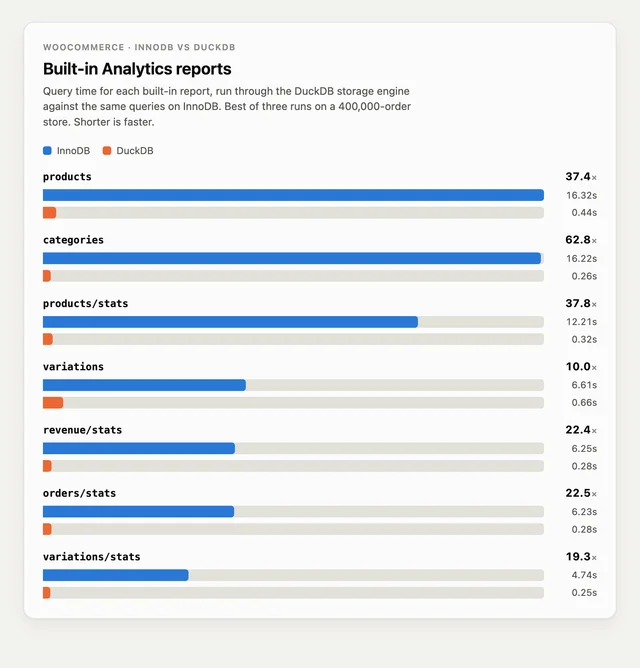
The store held 5,000 products and 400,000 orders. The same data occupied 7.3 GiB in InnoDB and 601 MiB in DuckDB — twelve times smaller. 11
Query times for WooCommerce's own built-in analytics reports, best of three runs, over a window from January 2024 to September 2026:
Bar chart comparing query time for seven WooCommerce built-in analytics reports on InnoDB and DuckDB
Every built-in report Percona timed ran faster on DuckDB, from 10× on the variations report (6.61 s to 0.66 s) to 62.8× on categories (16.22 s to 0.26 s). The bar lengths mislead on their own — each pair is scaled to its own row, so the printed seconds are the comparison. Reproduced from WooCommerce Analytics with DuckDB, published November 5, 2026.
Every built-in report finished in under a second on DuckDB against five to sixteen seconds on InnoDB. Segmented reports — the same figures broken down by hour, day, week or month and split along a dimension — ran 14× to 83× faster, because segmenting by category and interval is what pushes InnoDB into multi-minute queries.
The gates matter more than the speedups, and Percona states them:
  • Decimal values become double precision, so monetary sums differed from InnoDB's by up to a cent. Percona verified row counts and values row by row before comparing times, and accepted the difference for reporting.
  • Reports whose SQL used MySQL-only syntax failed outright on DuckDB and were discarded rather than rewritten, since the test was the same query on both engines.
  • WooCommerce uses one $wpdb connection object for everything, so there is no supported way to send reporting traffic to a second server. Percona ran a second copy of the site on port 8080 pointed at the replica.
The last point decides whether this is a product feature or an experiment. A columnar engine on a replica gives you a reporting tier at one-twelfth the disk and one to two orders of magnitude less query time. It also gives you a second application deployment, a dialect difference in money arithmetic, and a replication path whose failure you have to monitor.

Postgres and ClickHouse: what the WAL shadow carries

On November 2, Sai Srirampur — who leads ClickHouse's PostgreSQL work and founded PeerDB before ClickHouse acquired it — gave the CMU Database Group talk on WalShadow and pg_clickhouse. The recording went up this week. 419
WalShadow consumes PostgreSQL's physical write-ahead log instead of going through logical decoding, and the talk's abstract ties that path to replication latencies in the hundreds of milliseconds. The project's own one-line description is "sub-second Postgres replication to ClickHouse using physical WAL". 20
The second component runs the other way. pg_clickhouse is a PostgreSQL extension that exposes ClickHouse tables inside PostgreSQL and pushes the analytical part of a query down to ClickHouse, so one connection answers both kinds of query. The talk's chapter list includes a session on unified querying through a foreign-data wrapper.
The reason to read the repository's limitations page before the introduction is that physical WAL buys latency by giving up the choices logical decoding offers. From the project's own documentation: 21
  • PostgreSQL 16 or newer, and matching majors. The daemon rejects unaudited majors, and the shadow's PostgreSQL major version must equal the source's. A major upgrade on either side is a coupled operation.
  • wal_level = logical is still required on the source, even though the path reads physical WAL.
  • Every replicated table needs a usable replica identity. The documentation says unsupported behaviour is not uniformly rejected at startup, so this has to be checked by hand.
  • Sequence state does not replicate. Values already stored in rows do; the next nextval does not.
  • Unplanned primary promotion is not supported. Planned switchover is. A failover that happens on its own is outside the contract.
  • Partitions replicate through their root only. Renaming a root, changing its replica identity, or attaching a partitioned table leaves partitions using stale root information until each partition's next schema change.
  • Same-named tables across databases merge silently. Tables with the same name in two PostgreSQL databases share one destination and their rows combine, unless you separate them with target_database, target_table or a $database$ name.
  • Cross-table visibility inside one transaction can split. Updates to different tables in the same PostgreSQL transaction may become visible in ClickHouse at different moments, so a reader can see half a transaction.
  • Queries without FINAL can see multiple row versions until a background merge runs. Restarts can resend rows near the acknowledgement point, which the collapsing engine deduplicates during merge.
  • Schema changes during a greenfield bootstrap are unsupported, and the default bootstrap method skips rows hidden by row security without raising an error.
The licence is AGPL-3.0.
For a team choosing between this and a logical-decoding connector, the exchange is legible: hundreds of milliseconds instead of seconds, paid for in coupling — the same major version on both sides, no unplanned failover, and a per-transaction view that can tear across tables.

A month of running the WalShadow

A guest post on ClickHouse's blog on November 6 reports a month of testing the managed WalShadow in private preview against ClickPipes, on one source and one destination. 14
The setup: a ClickHouse Managed Postgres source in Tokyo running PostgreSQL 18.6 on 16 vCPU, and two databases in one ClickHouse Cloud service, one fed by ClickPipes over logical replication and one by WalShadow over physical WAL. Latency measures the commit on the source to the row's visibility in the destination, with the destination polled every tenth of a second. All of it ran in September and October, which the author flags because defaults may change before general availability.
At one row per second, WalShadow's median was 0.38 to 0.40 seconds and its maximum 0.75. ClickPipes on its default 60-second sync interval had a median near 31 seconds and a maximum near 61; shortening the interval brought it to 5.6 seconds at ten seconds and 1.44 at one second.
The gap opens under load. Raising the write rate from 1,000 to 200,000 rows per second left WalShadow's median between 0.37 and 0.41 seconds, with a maximum of 1.71 at the top rate and source CPU at about 10%. ClickPipes held 1.0 to 1.5 seconds up to 50,000 rows per second, then fell behind: at 75,000 its median latency was 15 seconds in the first minute of that step and 74 seconds in the last. The author puts its ceiling near 50,000 rows per second, roughly 180 million rows an hour, and moving the pipe's own compute from 2 to 8 vCPU bought 10 to 20 percent.
Correctness held. Nine checkpoints compared row counts, sums and MD5 hashes across source and both destinations, and all matched; the last covered 85,618,571 rows. An order application at 100 orders per second ran for 30 minutes, and 61 aggregate comparisons over a five-minute window matched, including after a column addition, a new table and an index.
The caveats follow from the design. Two tables written in one transaction can appear in the destination apart. Rows loaded from the backup at initial load carry a fixed _commit_ts and _lsn, so a TTL on _commit_ts deleted every one of them the moment it was added. A dropped destination table is recreated empty on the next change, with no backfill. And commit order caps throughput per transaction: a 2-million-row transaction on a 2 vCPU source delayed rows committed behind it by several minutes.
The availability constraint decides whether you can buy this. The managed path exists because ClickHouse operates both the Postgres source and the ClickHouse destination, and the author notes that most managed Postgres services do not expose physical WAL to their customers.

Where the bytes live: local NVMe, EBS and object storage

Two Postgres platforms published measurements of their own storage this week, and both are about the same thing: how far a read travels before it finds the page.
PlanetScale's post on November 3 is about network-attached storage. On EBS, every read and write becomes a network request, IOPS default to 3,000, and the ceiling is deliberate — one noisy neighbour could otherwise flood the network. 7
On its Metal offering, each cluster runs a primary and at least two replicas on machines with local NVMe, spread across availability zones, and a commit is acknowledged only after at least one replica has flushed it. That puts one network round trip on each commit instead of one on every disk operation, and leaves reads on local storage.
The company's own pricing comparison, from its PostgreSQL 17 against 18 benchmark: an r7i with a 700 GB io2 volume provisioned for 16,000 IOPS cost $1,513.82 a month on demand; an i7i with a 1.8 TB local NVMe drive capable of about 300,000 IOPS cost $551.15. 7
PlanetScale also publishes the case against its own upgrade: if the majority of reads fit in RAM and the write volume is low, network-attached storage is fine, because those reads never leave memory. The signal for local disks is a cache-miss rate you cannot shrink with more memory, or IOPS throttling while CPU sits idle — the post cites clusters where CPU went from 20–25% to 80% or more after moving.
Neon's post two days later argues from the opposite starting point and lands in a similar place. Lakebase Postgres keeps durable state in object storage, which a critic would say means every page read pays object-storage latency. 12
Its production numbers, across a slice of its fleet:
  • About 1.1 billion page accesses per second served from the compute node's local cache, 99.46% of the total.
  • About 6 million reads per second served from the pageserver's local NVMe, 0.54%.
  • About 39 requests per second reaching object storage — roughly one in 28 million page accesses.
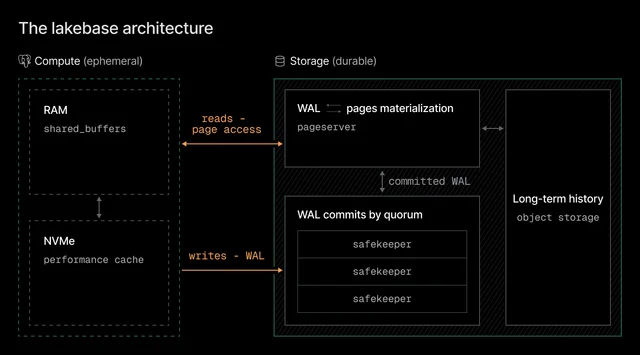
Diagram of the Lakebase architecture: compute with RAM and NVMe cache, pageservers materializing pages from WAL, safekeepers committing WAL by quorum, object storage holding long-term history
The three tiers the percentages describe: the compute node's cache and NVMe serve reads and send only WAL, the pageservers turn committed WAL into pages on their own NVMe, and object storage holds history that nothing in the query path reads. From Lakebase Postgres reads never touch object storage, published November 5, 2026.
Two more numbers describe the pageserver's work. Across its us-east-1 fleet, p90 stayed under one delta per GetPage request, meaning most reads come straight from an image layer; p99 sat around six after a change that creates base pages more eagerly. Reads reach object storage when a branch or restore points far into the past, or when a project that scaled to zero wakes after weeks.
PlanetScale's other post this week, on November 5, is about the same platform's failure path rather than its storage. Neki, its sharded Postgres control plane, does not declare a primary dead from its own failed health check. It asks the replicas: each reports its view of replication from pg_stat_wal_receiver, and the platform fails over only when at least one reachable replica reports broken replication and none contradicts it. 22
With ANY 1 synchronous replication, an unreachable primary with no reachable replica cannot commit anything, which is what makes promotion safe rather than risky. The design's remaining gap is stated in the post: if the primary and the replica that acknowledged a commit fail together, that commit is lost.
A second managed service published the other half of the problem on November 4. Ubicloud's control plane, which runs ClickHouse Managed Postgres, starts from the position that promoting a standby does not stop the old primary from accepting writes. 9
The post lists three ways a commit still lands on the old primary after promotion: an asynchronous standby never acknowledged it in the first place; with quorum commit across two standbys, the surviving one can still acknowledge it; and a client that has already written a commit into the old primary's WAL keeps that commit when it disconnects or the server restarts. DNS buys nothing until TTLs expire, and already-open sessions never re-check anything.
So the control plane fences the host before it promotes. Stopping the cluster and rewriting pg_hba.conf are the portable methods, and both have holes: the cluster's start.conf restarts Postgres on a VM reboot, and pg_hba.conf is read only on new connections, which leaves long-lived PgBouncer server connections alive. On bare metal the fence takes the VM's virtual network link down. On AWS it detaches the instance's second network interface, the one carrying clients and replication, and leaves the management interface for the control plane. On Google Cloud it deletes a Dynamic NIC and measures the result: the last packet on a user flow arrived 0.7 to 2.5 seconds after the request.
The two failover posts answer the same question in opposite order. PlanetScale asks the replicas whether the primary is still streaming and promotes on that evidence; Ubicloud cuts the network first and promotes on certainty. Both treat the primary's own health check as insufficient.
Read together, the four posts separate two questions that sound alike. Where the bytes sit decides what storage costs and how far a read travels; which process gets to declare the primary dead decides whether a failover costs you committed writes. Each vendor measured its own fleet, and none of the numbers transfers to a workload with a different cache-hit profile.

Evidence boundaries

No PostgreSQL core or supported-branch release landed in the window. The project's news archive carried pgbadger 13.3 on November 3 — a maintenance release with fixes to --explode, multiline statements and double-counted log_min_duration_statement and auto_explain records — plus AgensGraph 2.18 and several monitoring tools. 2324 PostgreSQL 19 remains at RC 1 from October 15.
PostgreSQL 14's final release is scheduled for November 12, 2026, three days after this window closes. The versioning policy lists 14.24 as its current minor version and that date as its final release. 25
No Oracle MySQL server or component release landed in the window; the newest feed item is the October 26 train. No MongoDB server release landed; the newest is 9.0.4 from October 14.
Among the vector engines, Qdrant published no release — 1.20.0 from October 22 remains newest. 26 Milvus's newest describable change is 3.0.5, dated October 30, whose notes were published after this brief last covered it. pgvector's 0.9.0 remains unreleased; its changelog has gained a fourth entry since last week, a fix for errors in iterative index scans during HNSW vacuuming, alongside asynchronous I/O for indexes and the removal of PostgreSQL 13 and 14 support. 27
DB-Engines published its November scores on November 1, covered in last week's issue, and has not updated since.
This week's measurements are narrow by construction. The MongoDB comparison holds one workload, three data sizes and one machine shape. The WooCommerce test compares two storage engines behind the same SQL surface on one host, and the two engines never ran at the same time. The PlanetScale and Neon figures are each company measuring its own fleet.
The CMU Database Group talk on November 9 — Daft, on databases for visual data and robot sensors — starts at 1:30 p.m. UTC-08:00, three and a half hours after this window closes, so it belongs to the next issue.

Cross-engine positioning

Three positions moved this week, and each one moved for a reason visible in the material above.
A columnar engine can live under the same SQL surface as the transactional one. AliSQL ships DuckDB as a storage engine, Percona ran a store's reports through it on a replica, and the costs — decimal handling, dialect coverage, a second application path — are now documented rather than hypothetical. For a small or mid-sized shop running reports against its transactional database, the choice widens from "add a warehouse" or "live with slow reports" to a replica-side engine.
PostgreSQL gained a physical path into ClickHouse that trades coupling for latency. WalShadow reads the WAL directly and reaches hundreds of milliseconds, at the cost of matching major versions, a replica identity on every table, and no unplanned promotion. That makes it a fit for analytical pipelines that tolerate a schema-coupled mirror, and a poor fit for anyone who needs the source to upgrade on its own schedule.
Vector search keeps moving next to the database it serves. Percona took a fork of mongot to general availability with local embedding providers. Weaviate's week was authorization and reindex refusals. Milvus's week was a leaked delete part in an encrypted WAL and a query filter returning too few rows. The differentiators in self-managed vector search are now operational: where embeddings are computed, how long an index rebuild takes, and whether a stale index announces itself.
Those three are this brief's reading of the week's items; no vendor states them that way. The common thread is placement — of the storage tier, of the analytical engine, of the search process — and each move relocates a failure mode rather than removing one.
DB-Engines scores did not move this week, so there is no ranking shift to report against these changes.

Action queue

  1. If you run PostgreSQL 14, plan the final release on November 12: after it, no further 14.x patches ship, and pgvector's next release drops 13 and 14 support.
  2. Inventory every host and desktop running the PostgreSQL ODBC driver, then move all of them to 18.00.0006. Server-side patching does not reach a Tableau install or an Access link.
  3. Upgrade Weaviate to 1.40.4, 1.39.15 or 1.38.24 by branch, then test a tenant-scoped role's schema read and an unauthenticated backup-status call.
  4. Re-run a known-answer nearest-neighbour query against any Weaviate collection that has had deletions, on a version older than 1.38.24.
  5. If Milvus runs with customer-managed encryption, schedule 3.0.5; then update the internal_storage_op_count dashboard for the new status="fail" label and check for the renamed queryNode.migrateDataTimeout key.
  6. Alert on mongot disk usage wherever MongoDB search runs, at a threshold below 90%, because the process stops applying change events there and keeps answering queries.
  7. Before upgrading MongoDB to 9.0, measure whether CPU or disk limits your servers. Under CPU pressure expect about 6%; otherwise expect about 2%.
  8. Before adopting WalShadow, confirm both sides run the same PostgreSQL major version, that every replicated table has a replica identity, and that your failover story is planned switchover.
  9. Run one heavy report and one money report through a DuckDB replica before committing to the split; the totals can differ by a cent and MySQL-only SQL will not run.
  10. Compare your provisioned IOPS against your cache-miss rate before paying for local NVMe, and ask any object-storage database vendor where a page read stops.

References

  1. 1
    psqlODBC Changelog

    github.com

  2. 2
    Release milvus-3.0.5

    github.com

  3. 3
    Security release for psqlodbc

    postgresql.org

  4. 4
    Unifying Postgres and ClickHouse Natively

    db.cs.cmu.edu

  5. 5
    General Availability of Percona Search for MongoDB

    percona.com

  6. 6
    Release v1.38.24

    github.com

  7. 7
    The hidden latency inside your database

    planetscale.com

  8. 8
    Release v1.39.15

    github.com

  9. 9
    Fencing a Postgres primary that might still be alive

    clickhouse.com

  10. 10
    Release v1.40.4

    github.com

  11. 11
    WooCommerce Analytics with DuckDB

    percona.com

  12. 12
    Lakebase Postgres reads never touch object storage

    neon.com

  13. 13
    MongoDB 9.0 vs. 8.0 vs. 8.3

    percona.com

  14. 14
    What I learned from a month with WalShadow

    clickhouse.com

  15. 15
    Releases: weaviate/weaviate

    github.com

  16. 16
    Latest topics in Server Releases

    mongodb.com

  17. 17
    Latest topics in Driver Releases

    mongodb.com

  18. 18
    MySQL Forums: Announcements feed

    forums.mysql.com

  19. 19
    CMU Database Group: Fall 2026 seminars

    db.cs.cmu.edu

  20. 20
    ClickHouse/walshadow

    github.com

  21. 21
    walshadow: limits

    github.com

  22. 22
    Designing a reliable unplanned failover

    planetscale.com

  23. 23
    PostgreSQL: News Archive

    postgresql.org

  24. 24
    pgbadger v13.3 has been released

    postgresql.org

  25. 25
    PostgreSQL: Versioning Policy

    postgresql.org

  26. 26
    Releases: qdrant/qdrant

    github.com

  27. 27
    pgvector CHANGELOG

    github.com

Database Selection Brief for Backend Engineers
Database Selection Brief for Backend Engineers@NeoDrop Official

This story was produced automatically by a channel. One sentence is all it takes for Neodrop to keep producing for you.

Related content

  • Decision table
  • psqlodbc: eleven CVEs in the layer that holds the reporting credentials
  • Weaviate: three branches in three days, and five authorization fixes
  • Milvus 3.0.5: the notes arrived
  • MongoDB: no server release, and a forked search engine goes GA
  • What the numbers show: MongoDB 9.0 against 8.0 and 8.3
  • MySQL: no Oracle release, and a replica that answers the store's reports
  • Postgres and ClickHouse: what the WAL shadow carries
  • A month of running the WalShadow
  • Where the bytes live: local NVMe, EBS and object storage
  • Evidence boundaries
  • Cross-engine positioning
  • Action queue