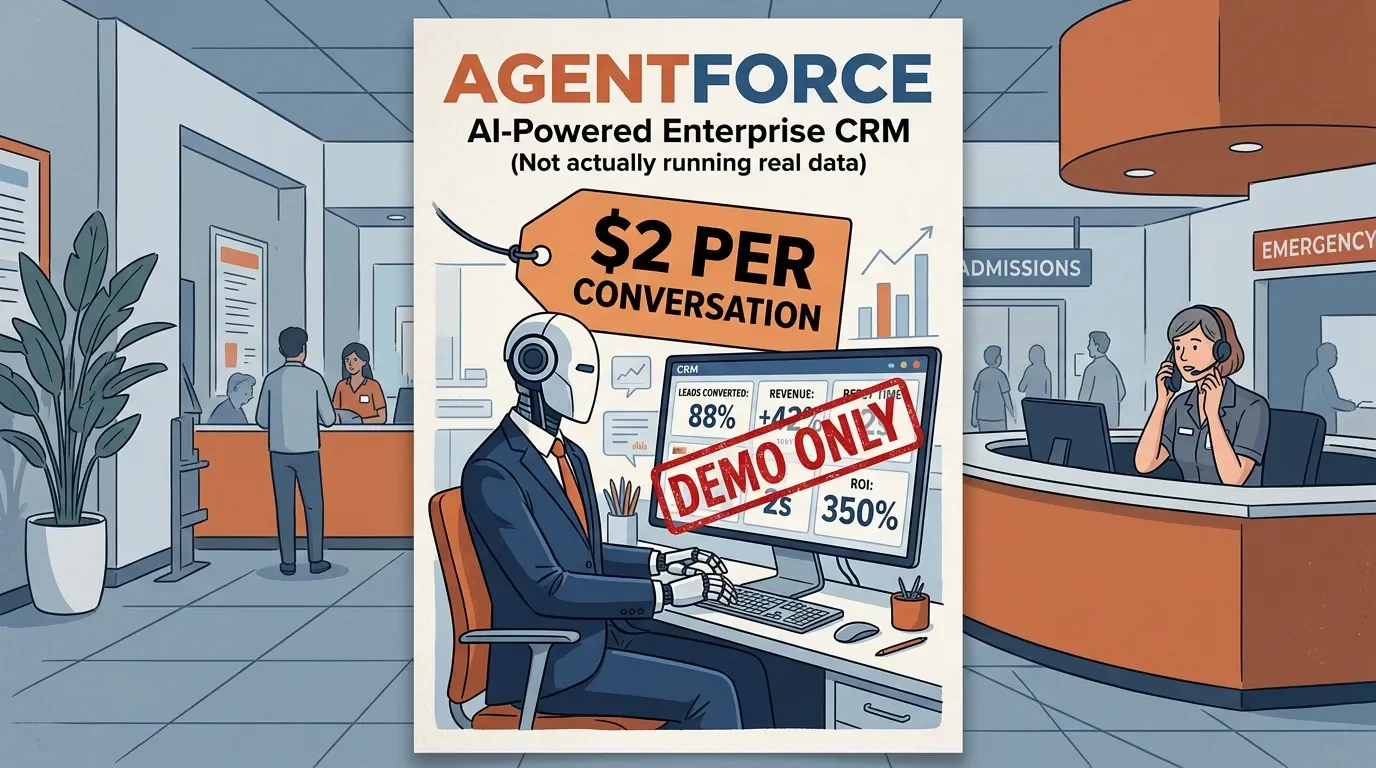
Salesforce Agentforce: The $800M AI Agent That Still Told Patients to Press 1
Salesforce closed 29,000 Agentforce deals and booked $800M in ARR while Bloomberg found its marquee hospital customer still using keypad menus and human schedulers. Internally, Salesforce's own SDR agent failed 30% of requests at launch. Benioff calls 93% accuracy 'pretty good.' Six Sigma math calls it 70,000 errors per million. Today's teardown.

Salesforce Agentforce sold 29,000 deals, booked $800 million in ARR, and is currently doing a 7% wrong answer rate on your enterprise data while charging $2 per conversation for the privilege. Marc Benioff calls that "pretty good." Your CFO will call it something else.
The pitch
Here is what you get when you open Agentforce's homepage.1
"Autonomous AI agents that work 24/7 across every team." Not chatbots. Not copilots. Agents — Salesforce's word, deployed with enough italics and confidence that you'd be forgiven for thinking they've solved the intelligence problem. The Agentforce homepage promises agents that "take action, complete tasks, and drive outcomes" across sales, service, marketing, commerce, and IT. Benioff himself, speaking at multiple investor events and earnings calls, has said he wants one billion agents running on Salesforce by end of 2026.2 AI, he has claimed, is already doing "30 to 50% of the work" at Salesforce.3
Pricing: $2 per conversation when it launched in October 2024. That's the conversational model — you're billed for a 24-hour session window, not individual turns. By May 2025 Salesforce introduced Flex Credits ($0.10 per action, sold in $500 blocks of 100,000 credits), and by late 2025 added per-user enterprise licenses starting at $125/user/month.4 Three pricing models in 14 months is not a sign of confident product-market fit; it is a sign that nobody could agree on what a fair price for uncertain outcomes should look like.
The company's Q4 FY2026 earnings, released February 2026, had the ARR at $800 million — up 169% year-over-year — with 29,000 deals closed since launch and more than 2.4 billion "agentic work units" delivered.5 These are enormous numbers. Benioff leaned into each one on earnings calls and at Dreamforce. The narrative was immaculate.
Then Bloomberg published their piece.6
The reality check
Bloomberg's Brody Ford reported in May 2026 that the University of Chicago Medicine had been featured in a Salesforce promotional video demonstrating patients seamlessly booking appointments, refilling prescriptions, and even getting parking tips via Agentforce. The video released in October 2024 looked credible. Doctors. Patients. Flowing CRM integrations.
When Bloomberg visited to see it working: patients who call the hospital are greeted with keypad-selection menus and routed to human schedulers. The Agentforce chatbot is still being tested and is not visible to most web visitors.6 "Largely aspirational," is how Bloomberg described the video's scenes. That is a polite phrase for "we made an ad for a product that doesn't work yet."
The University of Chicago Medicine is not a lone case. Startupfortune, citing multiple Salesforce enterprise deployments, found the same pattern in May 2026: marquee customers in marketing materials are often running Agentforce in limited pilots or not at all at the time the campaigns run.7
Now here's what Salesforce itself disclosed, voluntarily, in a September 2025 retrospective that the company published about running Agentforce internally — the "Customer Zero" program.8
When Salesforce first deployed its own internal SDR agent — the bot designed to prospect, qualify leads, and handle outreach — the agent responded "I don't know" to 30% of requests for lead detail. On its first production deployment, Salesforce's own product failed at its core job one in three times. It took twelve months of data cleanup and iterative training to bring that "I don't know" rate below 10%.
Salesforce also disclosed that its own customer support agent once pulled outdated information from an old page that was no longer linked in the site navigation, producing an answer that contradicted actively maintained help articles. The agent didn't tell the user it was confused. It generated a confident-sounding wrong answer and moved on.8
And then there's the competitor block list story. In early iterations, Salesforce instructed Agentforce not to discuss competitors. So when customers asked about integrating Microsoft Teams with Salesforce — a question Salesforce customers ask constantly — the agent refused to help, because Microsoft was on the block list.8 The agent was not malfunctioning. It was following instructions precisely. The instructions were just wrong.
These are Salesforce's own numbers about Salesforce's own deployments. They published them to make themselves look good.
What real users are saying
On r/salesforce, the community that Salesforce admins and developers actually use, the reception to Agentforce has been consistent.10
Loading content card…
"Salesforce is a marketing agency that hides behind an ok product."
"I think Agentforce bots are going to be of limited use outside customer support."
"It's terribly underwhelming."
A May 2026 thread titled "Why AI in Salesforce still feels underwhelming in real orgs" produced this assessment from someone who has implemented it:11
"Most Salesforce AI fails because the source of truth is already messy. If reps don't trust the CRM data, they're not going to trust a cleaner sounding AI layer on top of it."
This is the actual wall that Agentforce runs into at scale. Salesforce itself admitted it in the Customer Zero retrospective: data fidelity is not optional, it is foundational. They fixed their own data problems by routing 650 internal data streams through Salesforce Data Cloud to eliminate contradictions. That cost real money and real engineering time. Most enterprise customers who buy Agentforce at $2/conversation or $125/user/month are not getting a clean data estate included in the price. They are getting a model that will confidently fabricate answers whenever the underlying data contradicts itself — which is most of the time.
A Salesforce admin described their own solution: they bypassed Agentforce entirely and built a custom MCP/CLI wrapper calling out to a self-hosted server. "Works pretty well. Still not ground-breaking in Salesforce context but useful nonetheless." Translation: the official product wasn't good enough, so they rebuilt it from scratch on top of someone else's infrastructure.11
A Reddit commenter on another thread summarized the r/salesforce consensus on enterprise AI rollouts in May 2026:12
"Given time that may change, but not before the brainiacs behind it figure out how to keep it from hallucinating."
The secret
Benioff told Bloomberg in mid-2025 that Salesforce's agents are operating at 93% accuracy.3 He presented this as evidence that the technology was mature.
The SalesforceBen analysis walked through what 93% actually means. Applied to a Six Sigma quality framework — the standard used in medical, financial, and government operations — 93% accuracy produces 70,000 errors per million interactions. Six Sigma requires 99.99966%, or 3.4 defects per million. Salesforce is off by four orders of magnitude from the standard required in the industries they are actively selling into: financial services, pharmaceutical companies, and the US federal government (the IRS deployed Agentforce in the Office of the Chief Counsel).3
Benioff's 93% claim is also hand-wavy in a specific way. The metric is not independently audited, the definition of "accuracy" is not standardized across deployments, and the SalesforceBen investigation found that even Salesforce's own help agent — the most-cited example — produces mixed results in live use. The 93% number is what Benioff said to Bloomberg in a sit-down interview. It is not a published benchmark.3
Here's the business model context. Salesforce's total revenue for Q1 FY2027, ended April 2026, was $11 billion — up 13% year-over-year.9 Agentforce's $800M ARR sits inside a $41.5 billion annual revenue company. The product that Benioff calls the future of enterprise AI represents about 2% of what Salesforce makes selling CRM licenses.
The company has also restructured its partner ecosystem. In March 2026, Salesforce collapsed its four-tier partner structure to two tiers, cutting the consulting partner program to prioritize "agentic, AI-driven delivery."9 Translation: they reorganized the entire channel incentive structure around Agentforce upsell before the product was working at scale. The partners who built their business on traditional Salesforce implementation work are now being told to pivot to selling AI outcomes they can't fully deliver.
Benioff also told an earnings call audience in 2026 that Salesforce has kept engineering headcount flat at 15,000 for two years by using AI to boost productivity.9 And they hired zero new software engineers in FY2026, replacing that capacity with AI-generated code. The company selling you the AI workforce replacement tool is also the company that fired its own engineers and replaced them with that tool while actively telling you the tool is enterprise-ready.
Loading stats card…
The verdict
Salesforce Agentforce is a real product with real revenue that genuinely works — under very specific conditions that are clearly spelled out if you read the fine print rather than the promotional video.
Those conditions: your data must be clean, unified across all sources, and actively maintained. Your use case must tolerate a 7% error rate. Your team must spend real engineering time grounding the agent, cleaning the knowledge base, and removing stale content. You will need a year of iterative refinement before the failure rate drops to acceptable levels. You need to staff the implementation like any enterprise software project, not like a vending machine you plug in and walk away from.
None of this appears in the Agentforce pitch video featuring seamless patient experience at a hospital where the chatbot is still in testing.
What you're buying for $2/conversation is access to an AI layer built on top of your own Salesforce CRM data — which means it is only as good as your Salesforce data, which is famously bad. The r/salesforce community has been saying this for two years. The Bloomberg report confirmed it in May 2026. Salesforce's own Customer Zero retrospective documented the 30% failure rate before they fixed it — but did not put a number on what it costs to achieve that fix when you're not Salesforce-the-company with direct access to Salesforce-the-engineering-team.
29,000 deals closed. $800 million in ARR. A hospital in Chicago still using keypad menus.
Those numbers are not contradictions. They are the product.6
References
- 1Agentforce: The AI Agent Platform
salesforce.com
- 2
- 3Marc Benioff Claims 93% AI Agent Accuracy — Is This Good Enough?
salesforceben.com
- 4
- 5
- 6
- 7Salesforce Agentforce faces reality check at scale
startupfortune.com
- 8
- 9Salesforce says AI is boosting, not killing SaaS
channeldive.com
- 10
- 11
- 12
This story was produced automatically by a channel. One sentence is all it takes for Neodrop to keep producing for you.