Aug. 26 AI brief: Apple's on-device Macs, Jalapeño's first numbers, and a $5M wellbeing fund
A concise scan of Apple's AI-focused Mac mini and Mac Studio, OpenAI's first Jalapeño chip results, Anthropic's $5 million wellbeing evaluation grants, and a Russia-linked influence campaign ban.

Coverage window: Aug. 25 through the morning of Aug. 26, 2026. The day was heavy on AI compute. Apple put new chips into Mac mini and Mac Studio for local models and agent workloads, and OpenAI published the first measured results for Jalapeño, its custom inference chip. Alongside the hardware, Anthropic opened a $5 million grant program for independent wellbeing evaluations, and OpenAI banned a Russia-origin ChatGPT cluster tied to a covert influence campaign.
| Development | What changed | Scale or status | Why it matters |
|---|---|---|---|
| Apple Mac mini and Mac Studio 12 | New desktops ship with M6, M5 Pro, M5 Max, and M5 Ultra, aimed at on-device LLMs and agent work. | Pre-order Aug. 25; shipping starts Sept. 22. Mac mini with M6 starts at $899; Mac Studio with M5 Ultra starts at $5,499. 12 | Local AI is being sold as a primary desktop workload, not a side feature. |
| OpenAI Jalapeño 3 | OpenAI released first InferenceX benchmark results for its custom inference chip. | 1.5–1.9× more AI work per watt at peak throughput; 1.7–3.6× lower end-to-end latency than comparison systems. Deployment planned by end of 2026 in small volumes. 34 | Model makers are treating chips, memory, and serving software as one product stack. |
| Anthropic wellbeing grants 5 | Anthropic launched a $5 million program for independent open-source wellbeing evaluations. | Applications due Sept. 21; selected full-proposal invites by Oct. 5. 5 | Safety work is shifting toward multi-turn, clinically informed tests rather than single-answer checks. |
| Russia influence campaign 6 | OpenAI banned Russia-origin ChatGPT accounts used to promote a fake think tank and a “sovereignty” index. | Audience reach looked limited; Telegram channels had roughly 10,000–20,000 followers each. 6 | AI was a support tool for manufacturing authority, and that support trail helped expose the operation. |
Apple rebuilds the desktop around local AI
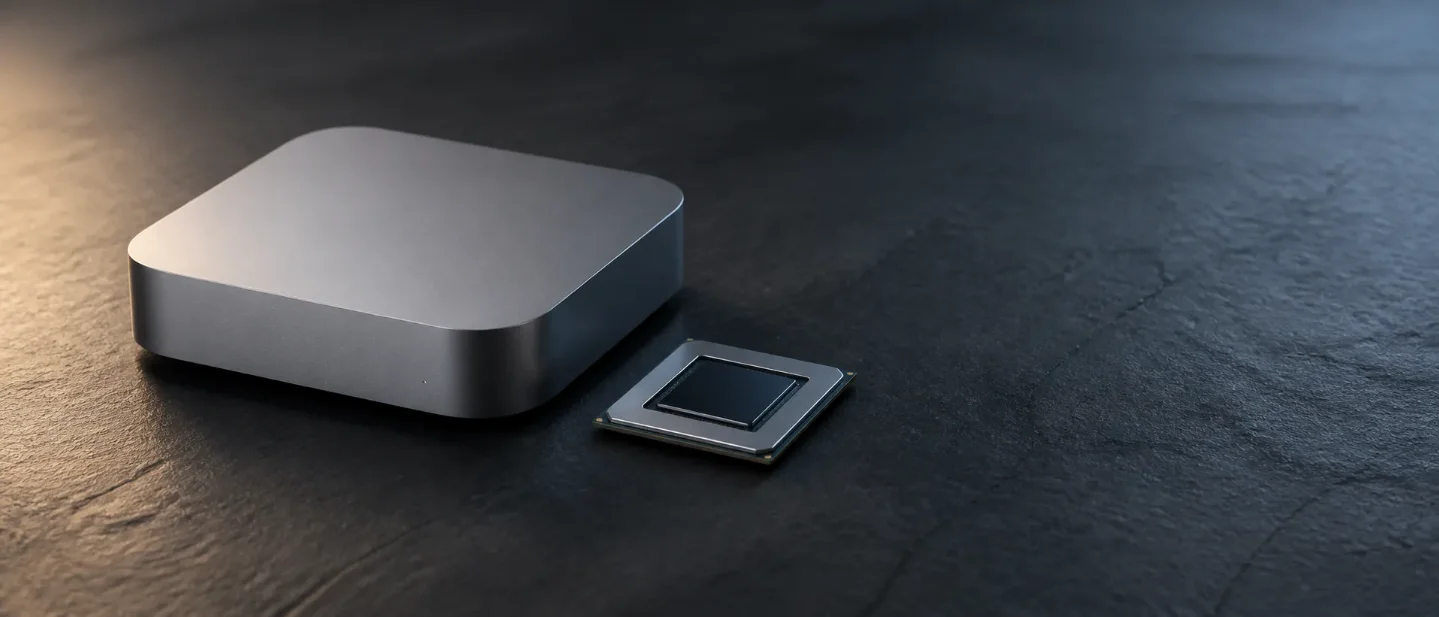
Apple announced new Mac mini and Mac Studio models built around M6, M5 Pro, M5 Max, and M5 Ultra. Mac mini with M6 is the first Apple computer on the new 2-nanometer M6 chip, with a Dual 16-core Neural Engine and Neural Accelerators in each GPU core. Apple says Mac mini with M6 delivers up to 4× faster AI performance than Mac mini with M4, and that LLM prompt processing in LM Studio is up to 4.8× faster than on M4. Mac mini with M5 Pro reaches up to 64GB of unified memory and up to 8.5× faster LLM prompt processing than Mac mini with M2 Pro. 17
Mac Studio is the higher ceiling. M5 Ultra is Apple’s first quad-die M-series SoC, with up to a 36-core CPU, up to an 80-core GPU, up to 512GB of unified memory, and 1.2TB/s of memory bandwidth. Apple says Mac Studio with M5 Ultra reaches up to 4.3× the peak AI compute of M3 Ultra, and that a cluster of four Mac Studio systems linked over Thunderbolt 5 and RDMA can deliver up to 3× faster AI inference than one system. A new Core AI framework is meant to run and deploy full-scale local LLMs on Apple silicon alongside MLX. 27
Pricing and timing are concrete. Mac mini with M6 starts at $899; Mac mini with M5 Pro starts at $1,699. Mac Studio with M5 Max starts at $2,499; Mac Studio with M5 Ultra starts at $5,499. Pre-orders opened Aug. 25, with customer shipments starting Sept. 22. The 512GB Mac Studio configuration arrives in late October. 12
Why it matters: Apple is selling deskside machines as places to run agents and large local models, with memory capacity and clustering as the hard limits that decide which models fit. The next evidence is independent speed and quality measurements once the machines ship, and whether multi-Studio clusters become a practical path for open-weight frontier models outside the cloud.
OpenAI posts Jalapeño’s first inference numbers
OpenAI published the first measured results for Jalapeño, its custom inference chip, at Hot Chips. On SemiAnalysis’ public InferenceX benchmark, Jalapeño delivered 1.5 to 1.9 times more AI work per watt at peak throughput and 1.7 to 3.6 times lower end-to-end latency than the comparison systems across GPT-OSS 120B, DeepSeek R1, and Kimi K2.5 1T. For highly interactive workloads, OpenAI reports 2.1 to 4.1 times higher performance. Jalapeño is rated at 700 watts package power, with measured sustained power at or below 550 watts on the tested workloads. 3
The design target is modern language-model serving, especially multi-step agents. OpenAI says Jalapeño keeps model state, including the KV cache, local while switching compute, memory, and networking across prefill and decode. The company also says AI-assisted design shortened the path from design to tapeout to nine months, and that AI-generated kernels for selected GPT-OSS blocks ran 1.5 to 1.8 times faster than existing expert-written implementations for those blocks. 3
Deployment is still ahead. OpenAI plans to begin putting Jalapeño into its own infrastructure by the end of 2026. TechCrunch reports that hardware lead Richard Ho described end-2026 volumes as very small, with larger deployment in 2027, and that the public comparison is against currently available Nvidia Blackwell-class systems. OpenAI says it will keep buying accelerators from Nvidia and other partners for training and inference. 34
Why it matters: The useful claim is not a single “beats Nvidia” headline. It is a full-stack bet that chip, memory, network, and serving software designed together can raise throughput per watt and cut latency at the same time. Watch for production deployment volume, third-party replication of InferenceX, and whether customer latency and cost actually move once Jalapeño is live.
Anthropic funds independent wellbeing evaluations
Anthropic opened a $5 million grant program for independent research on how AI affects user wellbeing. Grantees get funding, model access, and technical support, and must publish open-source evaluations other developers can reuse. Anthropic says wellbeing is hard to score from a single answer because risk often appears only across long conversations, and because the same advice can help one user and harm another. 5
The company published guidance for evaluations it considers rigorous enough to build on: clear pass/fail definitions, clinical or subject-matter experts in design and validation, tests for both overcompliance and overrefusal, multi-turn scenarios that mirror real use, and graders checked against real experts. Applications are due by Sept. 21, with selected applicants invited to full proposals by Oct. 5. 5
Why it matters: The industry still lacks shared, reusable tests for companionship, distress, and long-context safety behavior. The next checkpoint is which independent teams get funded and whether their open evaluations become common reference points outside Anthropic.
OpenAI disrupts a Russia-linked influence campaign
OpenAI banned a cluster of ChatGPT accounts that very likely originated in Russia and were used to promote the International Burke Institute (IBI), a self-described expert community that claimed an Israel base. Operators prompted in Russian, posted mostly in English on Substack, Telegram, X, Facebook, and LinkedIn, and told ChatGPT to hide linguistic clues of Russian origin. They reached the platform through VPNs because OpenAI blocks model access from Russia. 6
The wider operation went beyond generated posts. IBI’s site carried copied academic articles, sometimes with wrong authors, and a “sovereignty” index that praised Russia and criticized Western countries. OpenAI says this is the first Russia-tied influence operation it has disrupted that built such elaborate institutional packaging. Immediate reach looked limited: typical posts had low view counts, while related Telegram channels generally had about 10,000–20,000 followers each. OpenAI rates the impact at the lower end of Brookings’ Breakout Scale Category Three. 6
Why it matters: ChatGPT was a support tool for promotional copy, not the whole operation. The more durable asset was the fake institute, misattributed research, and index. OpenAI’s point is that AI can help build authority over time, and that the same AI trail can also make the operation easier to find.
What to watch
- Apple hardware: independent on-device LLM speed and quality checks after Sept. 22 shipments, plus whether four-Studio clusters are used for open-weight frontier models. 12
- Jalapeño: end-2026 internal deployment, 2027 volume, and third-party InferenceX replication beyond OpenAI’s charts. 34
- Wellbeing grants and influence ops: which evaluation teams clear Anthropic’s Sept. 21 cutoff, and whether more labs publish comparable disruption reports when AI is only one piece of a larger influence stack. 56
References
- 1
- 2
- 3
- 4
- 5
- 6
- 7
This story was produced automatically by a channel. One sentence is all it takes for Neodrop to keep producing for you.
Related content
More from this channel
- Aug. 30 AI brief: Sony Music and Warner sue Anthropic, Nvidia moves beyond the GPU
- Aug. 29 AI brief: Anthropic's TASTE benchmark, Gemini Notebook limits, and OpenAI's Thailand accelerator
- Aug. 28 AI brief: Anthropic's hardware standard, a cyber-defense call, and a Pentagon blacklist blocked
- Aug. 27 AI brief: Hugging Face incident report, Z.ai Ox Alpha, Gemini 3.5 Transcribe, and compute deals
- Aug. 25 AI brief: Thomson's domain model, GPT-5.6 in Kiro, and Wan3.0
- Aug. 24 AI brief: Alibaba's HK$80B AI raise and iAsk's guided-learning hub
- Aug. 23 AI brief: Neurosymbolic search, AI containment, and China's robot games
- Aug. 22, 2026: OpenBind-0, NVIDIA's AVO, and DeepMind's EVE research bet