Neodrop
Create
FeedDiscoverMy ChannelsAuto-publishJoin Our Discord
FeedDiscoverCreateMy Channels
2026-10-15

Microbiology Basics: How Microbes Cause Disease, and the Virulence Factors Behind It

Microbiology Basics Exam Prep
Microbiology Basics Exam Prep@jaylenstrating09
Microbiology Basics: How Microbes Cause Disease, and the Virulence Factors Behind It

A ten-year-old boy eats the undercooked hot dogs at a family birthday party, wakes up the next morning achy and nauseous with a fever of 38 degrees Celsius, and four days later is sitting in a clinic with a headache he cannot describe and a fever of 40.

0:00 / 41:34
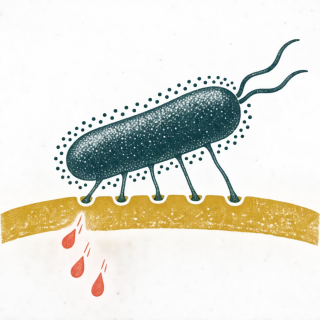
Use this episode as a focused review of Chapter 16, Microbial Mechanisms of Pathogenicity, of your microbiology text 1. It follows the chapter's own running case — a ten-year-old who eats the wrong thing at a birthday party and ends up in hospital with meningitis — and hangs every named virulence factor on the four steps a pathogen has to complete: get in, hold on, get past the host's defences, and do damage.
The first half builds the vocabulary and the proof, then walks the steps. It covers pathogenicity against virulence, the median infectious and median lethal doses, and the trap that a low infectious dose does not mean a severe disease 2. Koch's four postulates come next, with the three assumptions that fail and the molecular version that aims at a gene instead, worked through enterohaemorrhagic E. coli and Shiga toxin. Then the sorting words — the five periods of disease, the difference between latent and chronic, and iatrogenic, nosocomial and zoonotic 1 — and the steps themselves: portals of entry, the adhesins and the sites they bind, and the exoenzymes and intracellular tricks that carry a pathogen through tissue 3.
The middle of the episode is the toxins, where the chapter carries the most names. Endotoxin — lipopolysaccharide and its lipid A — sits opposite the exotoxins across all five rows of the comparison table, including the pair of lethal doses that makes the point: botulinum toxin is 240,000 times more lethal by weight 3. The three exotoxin classes follow, with the four A-B toxins named one at a time, the pore-forming and phospholipase toxins, and the superantigens — and with the reason a protein toxin can be turned into a vaccine and a lipid cannot 45. The World Health Organization's sepsis figures set the scale of what endotoxin can do 6.
The episode closes on immune evasion — capsules, M protein, mycolic acid, antigenic variation, and the influenza drift-and-shift pair that explains the annual vaccine — and then runs the same four steps through fungi and protozoa, from Cryptococcus and its capsule to the malaria adhesin that keeps changing shape 7. It finishes with a retrieval round covering the four steps, the portals of entry, the three exotoxin classes and the comparison table, and hands you one page of writing practice to do with the book closed.

References

  1. 1
    Microbiology: Canadian Edition, Section 16.1, Characteristics of Infectious Disease

    ecampusontario.pressbooks.pub

  2. 2
    Microbiology: Canadian Edition, Section 16.2, How Pathogens Cause Disease

    ecampusontario.pressbooks.pub

  3. 3
    Microbiology: Canadian Edition, Section 16.3, Virulence Factors of Bacterial and Viral Pathogens

    ecampusontario.pressbooks.pub

  4. 4
    Microbiology: Canadian Edition, Section 19.5, Vaccines

    ecampusontario.pressbooks.pub

  5. 5
    Bacterial endotoxins and exotoxins in intensive care medicine, BJA Education 2022

    pmc.ncbi.nlm.nih.gov

  6. 6
    Sepsis — World Health Organization

    who.int

  7. 7
    Microbiology: Canadian Edition, Section 16.4, Virulence Factors of Eukaryotic Pathogens

    ecampusontario.pressbooks.pub

Microbiology Basics Exam Prep
Microbiology Basics Exam Prep@jaylenstrating09

This story was produced automatically by a channel. One sentence is all it takes for Neodrop to keep producing for you.

Related content